Multifamily operations depend on a shared understanding of the metrics, terminology, and strategies that drive property performance. Leasing teams track demand and conversion. Revenue managers evaluate pricing, trade-outs, and exposure. Asset managers focus on net operating income, occupancy goals, and investment performance. Ownership groups rely on consistent reporting to understand whether properties are meeting their business plans.
When teams define and measure these concepts consistently, they can identify emerging risks, recognize opportunities, and make better-informed decisions across the entire portfolio.
This glossary covers 55 essential multifamily terms, organized into five operational categories. Each definition explains what the term means and why it matters for leasing, pricing, revenue management, retention, or long-term asset performance.
Related:
55 Key Multifamily Terms
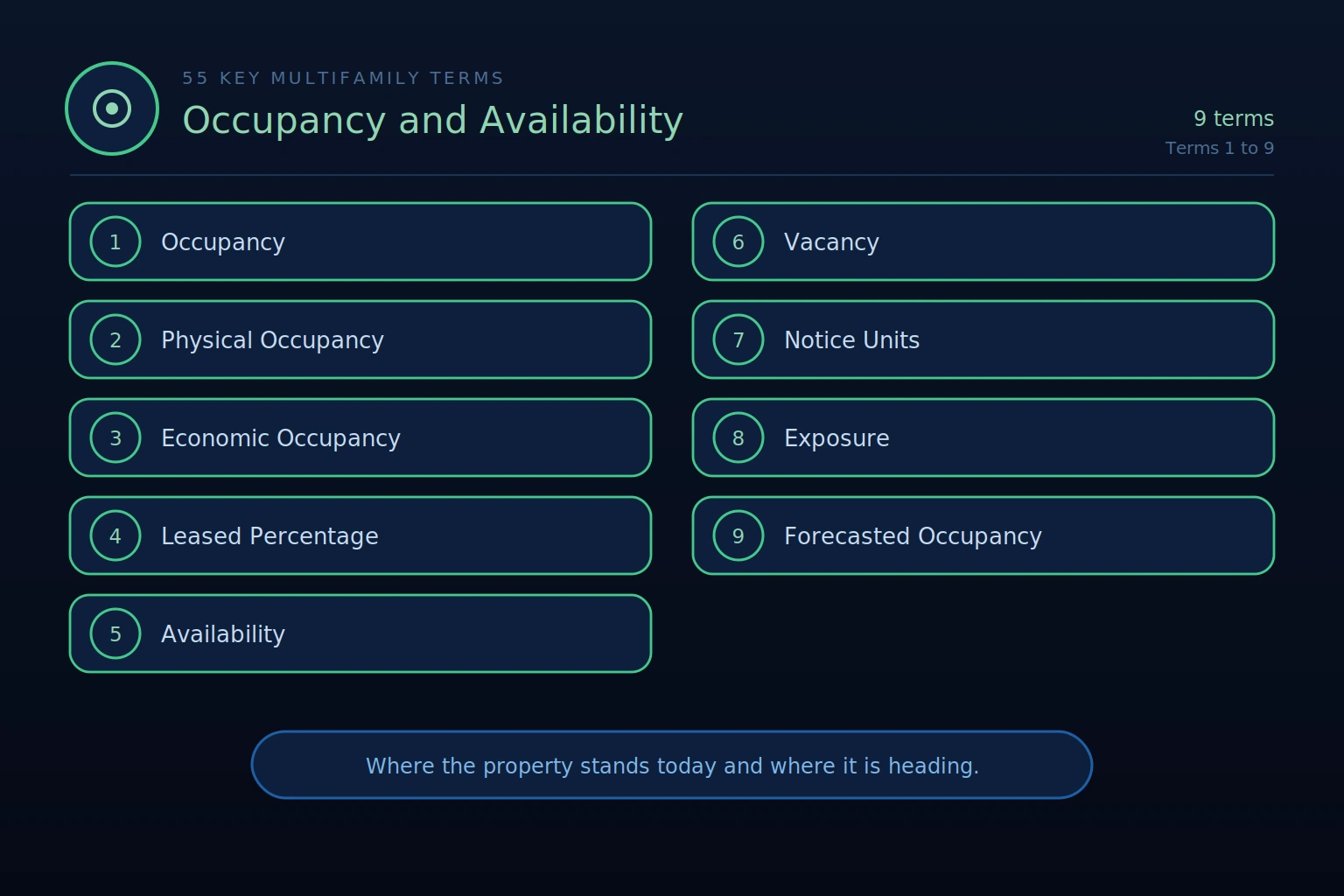
Occupancy and Availability
- Occupancy
- Physical Occupancy
- Economic Occupancy
- Leased Percentage
- Availability
- Vacancy
- Notice Units
- Exposure
- Forecasted Occupancy
Key Multifamily Terms: Occupancy and Availability Terms
Occupancy and vacancy are fundamental indicators of multifamily market conditions. The National Multifamily Housing Council highlights how changes in apartment supply, vacancy rates, and rental demand influence rent growth across markets.
At the property level, understanding occupancy requires looking beyond how many apartments are occupied today. Forward availability, leasing activity, and expiration exposure help operators evaluate where occupancy is heading and whether current performance supports the property's goals.
1. Occupancy
The proportion of a property's apartment units that are occupied during a given period. Occupancy is a fundamental indicator of property performance, but current occupancy alone does not reveal future leasing or vacancy risk.
2. Physical Occupancy
The percentage of total rentable units that are physically occupied, regardless of whether resident’s rent payments are current or have an active lease agreement. Physical occupancy measures unit utilization rather than revenue collection.
3. Economic Occupancy
The percentage of gross potential rental revenue realized after accounting for vacancy loss, concessions, and other applicable rental revenue adjustments. Economic occupancy helps operators understand how effectively a property's rental potential is translating into actual rental revenue.
A property may have strong physical occupancy but lower economic occupancy because of concessions, delinquency, or below-market rents.
4. Leased Percentage
The percentage of rentable units that are covered by signed leases, including units where residents have not yet moved in.
Leased percentage provides an earlier indication of occupancy direction than physical occupancy alone and is particularly valuable during lease-up.
5. Availability
The inventory of apartment units available to lease during a defined period, including currently available apartments and units expected to become available.
Availability helps leasing teams prioritize inventory and revenue managers evaluate future supply relative to expected demand.
6. Vacancy
Units that are physically unoccupied, often expressed as a percentage of total rentable units.
Physical vacancy is the inverse of physical occupancy when both metrics use the same unit inventory and reporting date. Vacancy is different from availability because an occupied apartment may already be marketed for a future lease.
7. Notice Units
Apartments where residents have formally notified management of their intention to vacate.
Notice units represent anticipated future availability and provide important context for leasing priorities and occupancy forecasting.
8. Exposure
The volume or proportion of inventory that is currently available or expected to become available within a future period.
Exposure analysis considers the timing and concentration of potential availability, helping teams recognize when future inventory may exceed expected leasing demand.
The specific calculation may vary by operator or platform.
9. Forecasted Occupancy
An estimate of future occupancy based on current occupancy, leasing activity, anticipated move-ins and move-outs, renewal expectations, and other relevant operating conditions.
Forecasted occupancy helps operators evaluate whether their current leasing and retention strategies are likely to support future occupancy goals.
Unlike current occupancy, it provides a forward-looking view, although actual results may differ as conditions change.
Related:
Key Multifamily Terms: Leasing and Demand
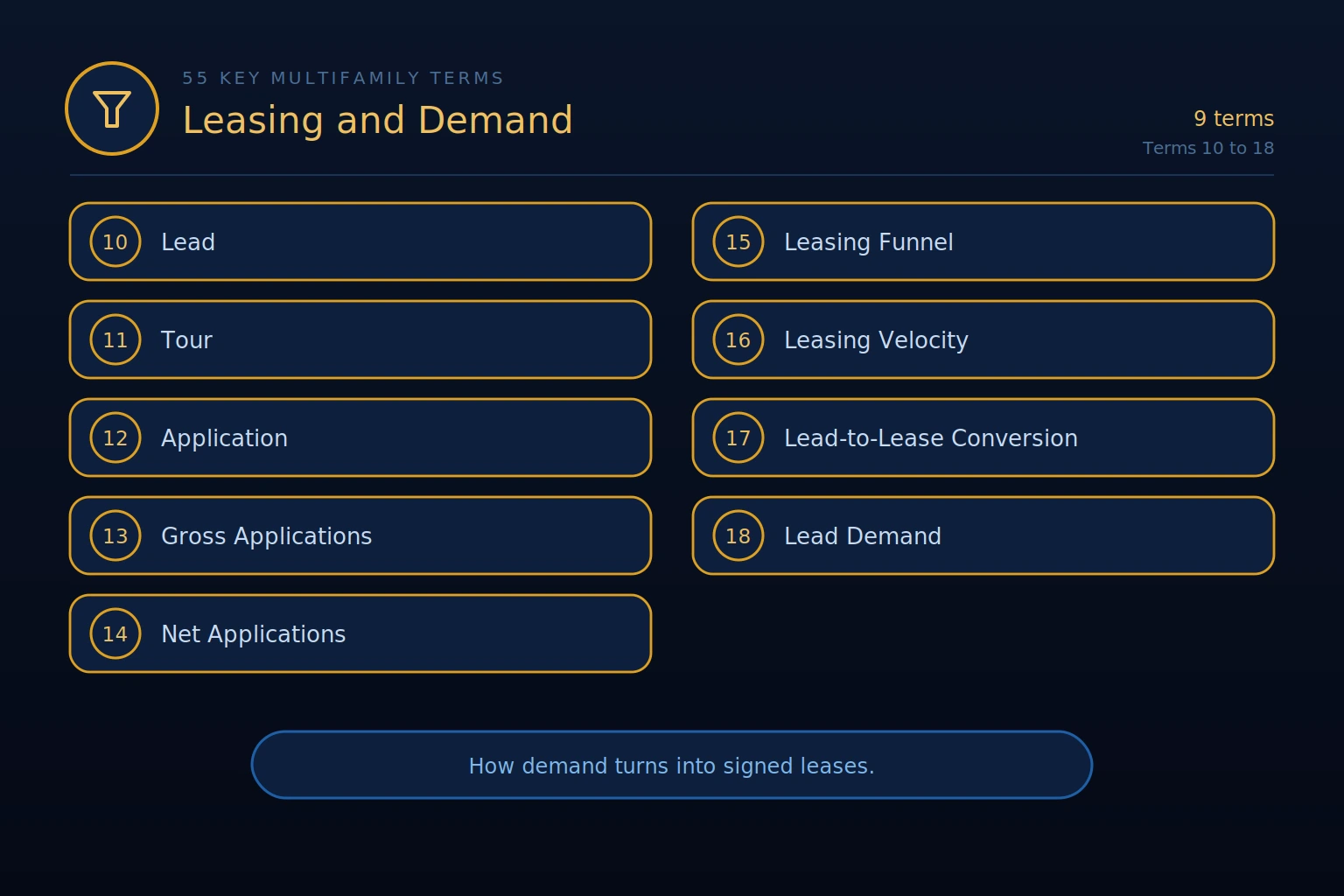
- Lead
- Tour
- Application
- Gross Applications
- Net Applications
- Leasing Funnel
- Leasing Velocity
- Lead-to-Lease Conversion
- Lead Demand
Leasing and Demand Multifamily Terms
The leasing funnel connects prospect interest to executed leases. Understanding performance at each stage helps teams distinguish insufficient demand from conversion challenges and evaluate whether leasing activity is sufficient to support occupancy goals.
10. Lead
A prospective resident who has expressed interest in an apartment community through a listing platform, property website, phone inquiry, email, or another communication channel.
Lead volume is an important measure of initial prospect interest, although not every lead represents a unique or qualified prospect.
11. Tour
An in-person, virtual, or self-guided property visit that allows a prospective resident to evaluate an apartment or community.
Tour activity helps operators understand how effectively initial interest converts into meaningful engagement with the property.
12. Application
A formal request from a prospective resident to lease an apartment, typically including information required for the property's application and screening process.
Applications represent a later stage of the leasing funnel and help teams evaluate how effectively tours and inquiries are converting into leasing commitments.
13. Gross Applications
The total applications received during a defined period before adjustments for cancellations, withdrawals, denials, or other outcomes.
Gross applications measure overall application activity rather than completed leasing transactions.
14. Net Applications
Applications remaining after defined adjustments, such as cancellations, withdrawals, or denials, depending on the operator's reporting methodology.
Operators should use consistent definitions when comparing this metric across properties or reporting systems.
15. Leasing Funnel
The progression of prospective residents through the leasing process, commonly including inquiries, tours, applications, approvals, and executed leases.
Analyzing the leasing funnel helps operators identify where prospective residents disengage and whether challenges are related to lead generation, the prospect experience, pricing, or conversion.
16. Leasing Velocity
The pace at which apartments are leased during a defined period, usually a week or month, and are often measured at the property or bedroom configuration grouping.
Leasing velocity is typically based on historical leasing activity. When evaluated alongside forward availability and occupancy goals, it helps operators determine whether recent absorption is sufficient to support future performance.
17. Lead-to-Lease Conversion
The percentage of leads that result in executed leases during a defined measurement period.
This metric reflects the combined effectiveness of inquiry management, prospect engagement, tours, applications, and leasing execution.
Conversion methodology should account for the timing difference between when leads enter the funnel and when leases are signed.
18. Lead Demand
The volume and quality of prospective resident inquiries generated for a property during a defined period.
Evaluating lead demand alongside historical conversion performance helps teams determine whether the current inquiry pipeline is sufficient to support leasing and occupancy goals.
Read Also:
- 25 Interesting Multifamily Housing Statistics You Didn't Know
- What is Multifamily Syndication in Real Estate?
Key Multifamily Terms: Pricing and Revenue Management
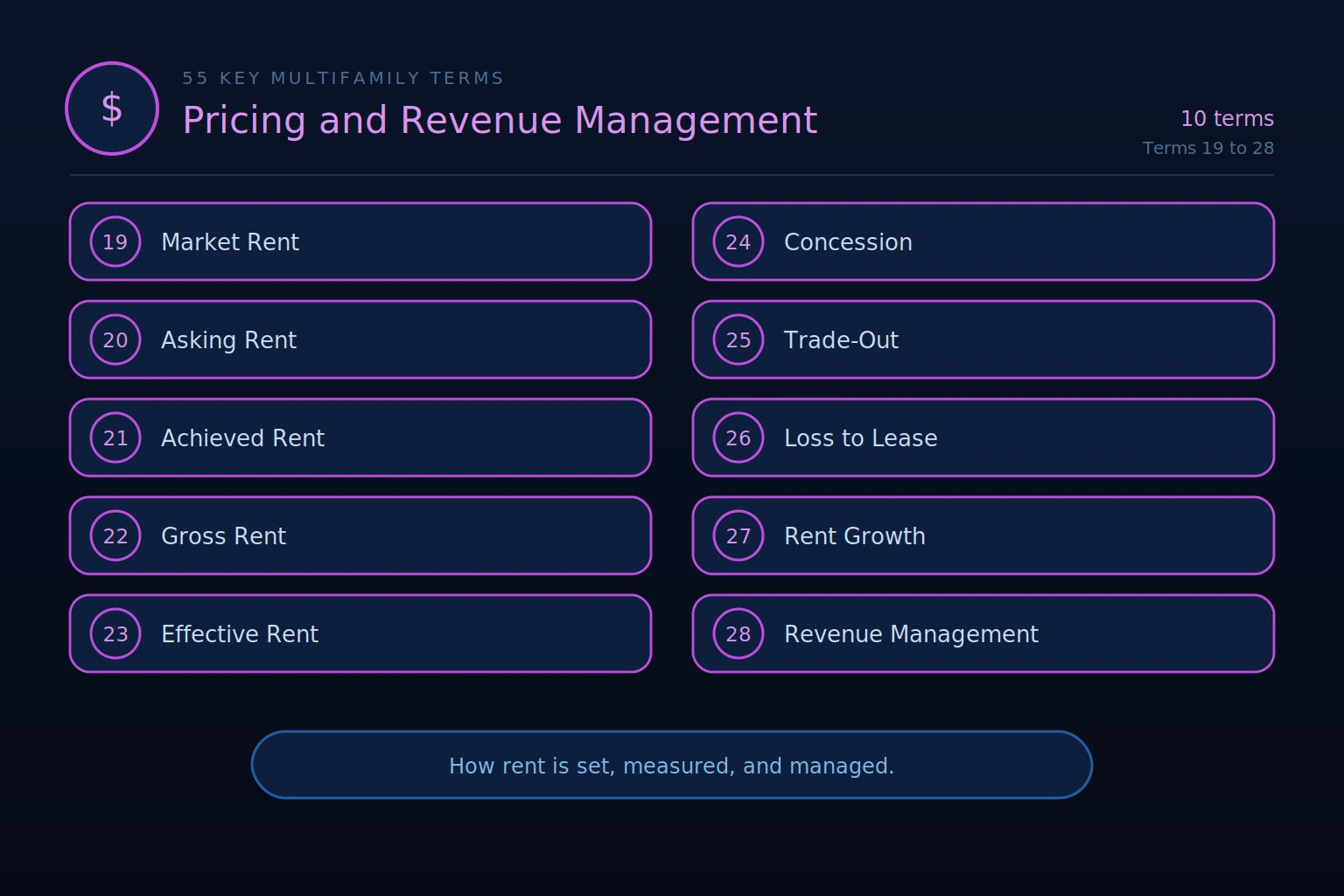
- Market Rent
- Asking Rent
- Achieved Rent
- Gross Rent
- Effective Rent
- Concession
- Trade-Out
- Loss to Lease
- Rent Growth
- Revenue Management
Pricing and Revenue Management Multifamily Terms
The National Multifamily Housing Council defines revenue management systems as technology that uses data to forecast supply and demand and inform pricing decisions.
Effective apartment pricing, however, requires understanding more than supply, demand, or advertised rents alone. Revenue managers evaluate achieved rents, concessions, leasing performance, renewal trends, forward availability, and asset strategy to determine how pricing decisions support both immediate leasing needs and long-term financial performance.
These preserve the industry references without attributing broader strategic claims to sources that don't directly support them.
19. Market Rent
The rental rate a property or unit could reasonably command under prevailing market conditions.
Market rent may be estimated using comparable properties, recent leasing activity, property characteristics, and relevant market conditions.
It is important to distinguish estimated market rent from publicly advertised asking rents and actual achieved rents.
20. Asking Rent
The rental amount advertised for an available apartment before applicable concessions or promotional adjustments.
Asking rent represents what prospective residents initially see when evaluating housing alternatives but may differ from the effective rent associated with a signed lease.
21. Achieved Rent
The rent agreed upon for a completed leasing transaction.
Achieved rent reflects the actual leasing outcome rather than the initial advertised price. Depending on the reporting methodology, it may be expressed as the contractual rent or as an effective rent that incorporates concessions.
22. Gross Rent
The rental amount specified in a lease before concessions, abatements, or other applicable adjustments.
Gross rent provides a contractual reference point for evaluating lease pricing and calculating effective rent.
23. Effective Rent
The rental value of a lease after accounting for applicable concessions or incentives, generally expressed as an average monthly amount over the lease term.
For example, a lease with an advertised monthly rent and a free-rent concession will generally have a lower effective monthly rent than its contractual rate.
Effective rent helps operators compare leasing transactions with different promotional structures more consistently.
24. Concession
A financial incentive offered to encourage a prospective or existing resident to lease or renew an apartment.
Common examples include free-rent periods, waived fees, or other promotional incentives.
Concessions should be evaluated for their impact on effective rent, leasing demand, retention, and the property's broader revenue strategy.
25. Trade-Out
The change in rental rate between an existing or previous lease and the new or renewed lease that replaces it.
Trade-out may be positive or negative and is typically measured in dollars or as a percentage.
Operators commonly distinguish between new-lease trade-out and renewal trade-out to understand how each contributes to rent roll performance.
26. Loss to Lease
The difference between the market rental value of occupied units and the contractual rent associated with those units.
Loss to lease generally reflects below-market rental agreements within the existing rent roll. It is distinct from vacancy loss and concession loss, although these may be analyzed together when evaluating gross potential rental revenue.
Understanding loss to lease helps operators evaluate future revenue opportunities and potential renewal pricing challenges.
27. Rent Growth
The increase or decrease in rental rates over a defined period, commonly expressed as a percentage.
Rent growth may be measured using asking rents, achieved rents, effective rents, or renewal rents.
The measurement basis matters because different rent metrics can show different performance trends during the same period.
28. Revenue Management
The discipline of evaluating pricing, availability, demand, lease terms, and revenue opportunities to support an asset's financial and operating goals.
In housing, multifamily revenue management connects current leasing conditions with future occupancy, renewals, and exposure to inform pricing decisions.
Effective strategy balances rent growth, leasing velocity, occupancy, retention, and long-term asset performance.
Related:
- Multifamily vs Single Family: Which is a Better Investment?
- How to Analyze Multifamily Investment Opportunities
Key Multifamily Terms: Renewal and Retention
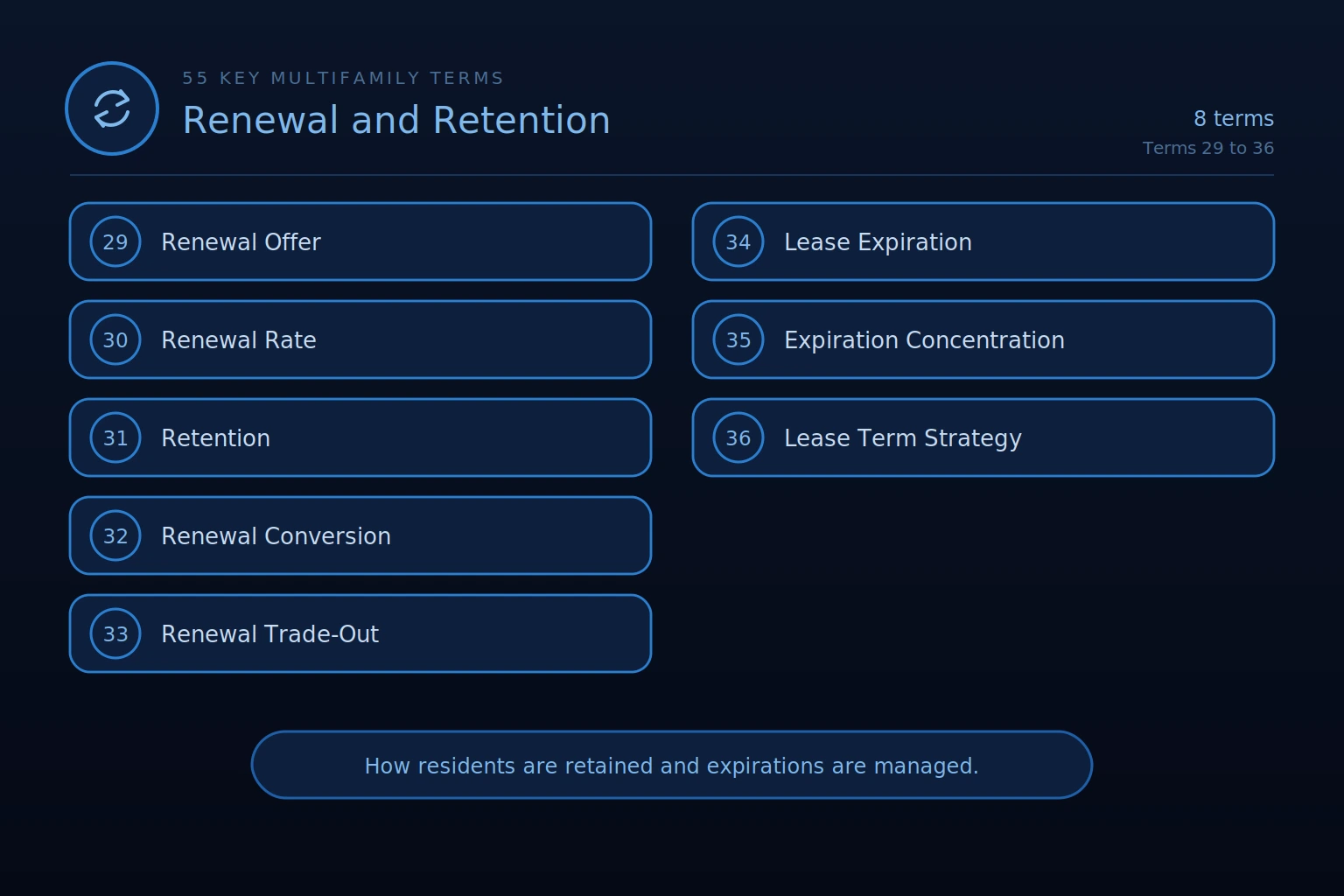
- Renewal Offer
- Renewal Rate
- Retention
- Renewal Conversion
- Renewal Trade-Out
- Lease Expiration
- Expiration Concentration
- Lease Term Strategy
Renewal and Retention Multifamily Terms
Renewal strategy plays a critical role in protecting occupancy, managing turnover costs, and supporting rent growth. By connecting resident retention, renewal pricing, and future availability, operators can evaluate renewal decisions before lease expirations create unnecessary occupancy pressure.
29. Renewal Offer
A proposal presented to an existing resident to extend their tenancy under a new lease agreement, including the proposed rental rate, lease term, and applicable conditions.
Renewal offer strategy should consider current rent, market conditions, loss to lease, resident retention goals, and future availability rather than relying solely on uniform rent increases.
30. Renewal Rate
The percentage of eligible residents or expiring leases that renew during a defined period.
Renewal rate is a key retention metric that helps operators understand how successfully they are retaining existing residents and limiting turnover.
Calculation methods may vary, particularly in how operators account for month-to-month residents, early renewals, and other lease outcomes.
31. Retention
The ability of a property to maintain its existing resident population over time.
Retention is influenced by factors including resident experience, maintenance responsiveness, communication, renewal pricing, and market alternatives.
Strong retention can reduce turnover expenses, support occupancy stability, and help preserve rental revenue.
32. Renewal Conversion
The percentage of eligible renewal opportunities that result in executed renewal leases.
Renewal conversion helps teams evaluate the effectiveness of renewal outreach, offer pricing, and resident engagement.
While renewal rate and renewal conversion are sometimes used interchangeably, renewal conversion can be evaluated more specifically against offers issued or residents engaged in the renewal process. Operators should define the denominator consistently.
33. Renewal Trade-Out
The change in rental rate between a resident's expiring lease and their executed renewal lease.
Renewal trade-out helps revenue managers understand how renewal pricing contributes to rent growth and overall rent roll performance.
Evaluating renewal trade-out alongside retention rates, loss to lease, and new-lease pricing provides a more complete view of renewal strategy effectiveness.
34. Lease Expiration
The scheduled end date of a lease agreement.
Lease expirations provide visibility into potential future availability and establish the timing of renewal decisions.
However, a lease expiration does not necessarily result in vacancy because residents may renew, extend their tenancy, or transition to month-to-month arrangements.
35. Expiration Concentration
The clustering of lease expirations within a particular future period.
High expiration concentration can create occupancy risk when potential move-outs exceed expected leasing demand or operational capacity.
Expiration analysis helps operators identify periods where lease-term pricing, renewal strategy, or leasing priorities may need evaluation.
36. Lease Term Strategy
The approach to offering and pricing different lease durations to balance prospect preferences, rent growth, occupancy goals, and future expiration distribution.
Dynamic lease-term pricing allows operators to evaluate how different lease lengths support immediate leasing objectives and longer-term asset strategy.
Lease-term pricing is not necessarily a simple short-term premium or long-term discount. The appropriate pricing relationship depends on current demand, future exposure, revenue objectives, and property-specific conditions.
Don’t Miss:
- Best Multifamily Newsletters for Operators
- Best Asset Management Reporting Software for Multifamily
Key Multifamily Terms: Asset Management and Investment

- Net Operating Income (NOI)
- Capitalization Rate (Cap Rate)
- Asset Strategy
- Target Occupancy
- Target Tracking
- Stabilized Asset
- Lease-Up
- Value-Add
- Portfolio Performance
Asset Management and Investment Multifamily Terms
Asset management connects daily property operations with long-term financial and investment objectives. These terms help operators evaluate whether leasing, pricing, retention, and capital decisions are supporting the property's business plan.
37. Net Operating Income (NOI)
The income generated by a property after subtracting operating expenses from operating revenue, before debt service, income taxes, depreciation, amortization, and capital expenditures.
NOI is a fundamental measure of property financial performance and an important input into real estate valuation.
According to the National Apartment Association, repairs and maintenance costs have increased substantially faster than NOI since 2021, highlighting the importance of operating efficiency and revenue performance.
38. Capitalization Rate (Cap Rate)
The ratio of a property's net operating income to its market value or purchase price, expressed as a percentage.
Cap rates are commonly used to evaluate real estate investments and estimate property values based on income performance.
For example, at a 5% capitalization rate, an additional $100,000 in annual NOI would represent approximately $2 million in additional property value, assuming the capitalization rate remains unchanged.
39. Asset Strategy
The investment and operating plan that defines what a property is intended to achieve during a particular stage of ownership.
Asset strategy may include occupancy goals, pricing and revenue objectives, renewal priorities, capital investment plans, and anticipated hold periods.
A property's asset strategy provides the context for evaluating operating decisions rather than applying the same performance expectations to every property.
40. Target Occupancy
The occupancy level a property is working toward based on its operating conditions and asset strategy.
Target occupancy may vary based on the property's market, leasing seasonality, development stage, and financial objectives.
Evaluating leasing activity against target occupancy helps teams determine whether demand generation, pricing, and retention strategies are supporting the property's goals.
41. Target Tracking
The process of comparing actual property performance against established operating or financial goals.
Target tracking may include occupancy, revenue, rent performance, renewal conversion, or other property-specific objectives.
Consistent tracking helps operators recognize when performance is diverging from plan and evaluate whether strategic adjustments may be needed.
42. Stabilized Asset
A property that has completed its initial lease-up or major repositioning period and reached a sustainable level of occupancy and operating performance.
Stabilization is generally evaluated against property-specific underwriting assumptions, operating goals, and market conditions rather than one universal occupancy threshold.
Stabilized properties typically focus on maintaining occupancy, supporting retention, managing expenses, and improving long-term revenue performance.
43. Lease-Up
The period during which a newly constructed or substantially repositioned apartment property is actively leasing toward stabilization.
Lease-up strategy involves balancing absorption pace, pricing, concessions, occupancy goals, and the development timeline.
Decisions made during lease-up also influence future revenue performance because lease lengths and expiration dates establish the property's initial rent roll and future expiration distribution.
44. Value-Add
An investment strategy focused on improving property performance through renovations, amenity enhancements, operational improvements, or repositioning.
Value-add strategies typically aim to increase rental revenue, improve NOI, and support long-term asset value.
Successful execution requires evaluating whether improvements are producing sufficient leasing demand, rent premiums, and financial returns to justify the investment.
45. Portfolio Performance
The evaluation of financial and operational results across a collection of properties.
Portfolio performance analysis connects individual asset results with broader investment objectives, helping operators compare performance, identify emerging risks, and prioritize resources.
Effective portfolio analysis considers differences in property strategies, markets, and operating stages rather than applying identical performance expectations across every asset.
Key Multifamily Terms on Reporting and Analytics
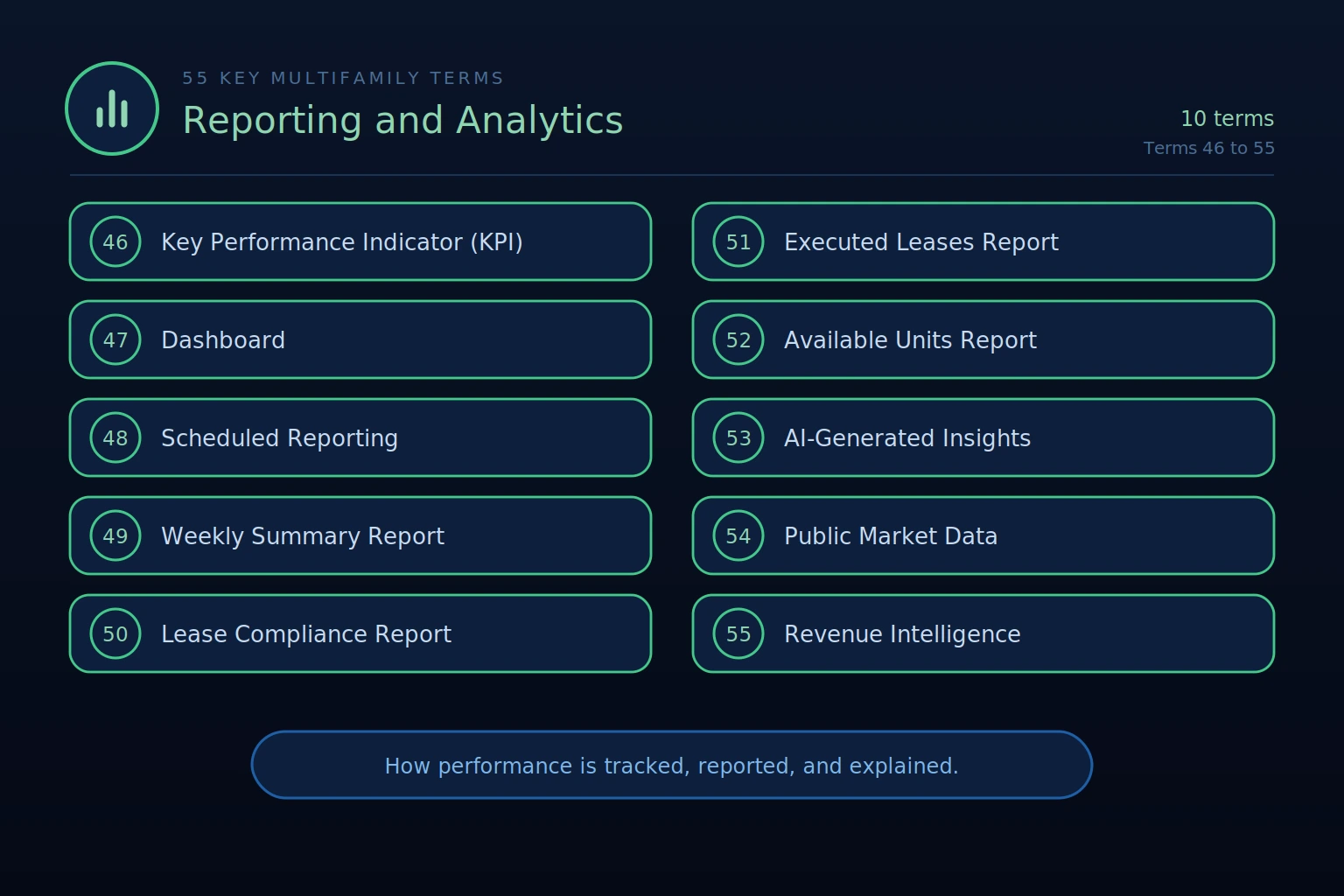
- Key Performance Indicator (KPI)
- Dashboard
- Scheduled Reporting
- Weekly Summary Report
- Lease Compliance Report
- Executed Leases Report
- Available Units Report
- AI-Generated Insights
- Public Market Data
- Revenue Intelligence
You Might Like:
- How to Create A Lifetime Cashflow Through Multifamily Properties
- What Does a Multifamily Asset Manager Do?
Reporting and Analytics Multifamily Terms
Reporting and analytics connect operational information with the decisions required to manage property performance.
While reporting provides consistent visibility into key metrics, analytics and revenue intelligence help operators interpret those metrics, recognize emerging trends, and evaluate opportunities before they become larger operational or financial challenges.
46. Key Performance Indicator (KPI)
A measurable indicator used to evaluate progress toward a specific operational or financial objective.
In multifamily operations, KPIs vary by function.
Leasing teams may track lead volume, conversion, and leasing velocity. Revenue managers evaluate pricing performance, trade-out, and effective rent. Asset managers monitor occupancy, NOI, and performance against investment goals.
The most useful KPIs are connected to decisions and evaluated in the context of the property's asset strategy.
47. Dashboard
A visual interface that brings together important performance metrics and insights in one place.
Dashboards may support property-level operations, revenue management, asset management, or portfolio-wide performance reviews.
Effective dashboards do more than display metrics. They help users recognize changing conditions, identify areas requiring closer investigation, and understand how performance relates to established goals.
48. Scheduled Reporting
The automated generation and distribution of recurring reports according to a defined schedule.
Scheduled reporting reduces manual report preparation while ensuring that leasing teams, revenue managers, asset managers, and ownership groups receive relevant information consistently.
Different reporting cadences support different needs, from daily leasing priorities to weekly performance evaluations and monthly revenue reviews.
49. Weekly Summary Report
A recurring report that consolidates important property performance information into a consistent weekly review.
Depending on the reporting platform, a weekly summary may include occupancy conditions, leasing activity, renewal performance, upcoming expirations, pricing movement, market context, and operational insights.
Weekly reporting helps teams recognize changes, investigate performance gaps, and coordinate decisions before issues become more significant.
50. Lease Compliance Report
A report used to identify lease records or leasing activity that may not align with established policies, approved pricing, lease terms, or data requirements.
Lease compliance reporting can support operational consistency, data accuracy, and timely correction of discrepancies.
Regular review helps teams identify potential problems earlier rather than discovering them during month-end reporting or financial reconciliation.
51. Executed Leases Report
A report summarizing leases that were signed during a defined period.
Executed lease reporting may include lease terms, contractual or effective rents, concessions, new-lease and renewal activity, and trade-out performance.
It helps operators evaluate actual leasing outcomes and determine whether pricing and leasing strategies are producing the intended results for overall revenue objectives.
52. Available Units Report
A report showing apartment inventory that is currently available or expected to become available.
Available units reporting may include unit type, availability date, asking rent, and other information relevant to leasing priorities.
Regular review supports inventory management and helps leasing teams focus on units requiring additional attention.
53. AI-Generated Insights
Analytical findings produced with artificial intelligence to help operators recognize patterns, relationships, and changes across property performance data.
AI-generated insights can connect leasing demand, conversion, occupancy, renewal trends, pricing, resident feedback, and other signals to provide context around emerging conditions.
Their value is not simply identifying which metrics changed, but helping teams understand why those changes may matter and where further evaluation could uncover risks or opportunities.
AI supports human judgment rather than replacing strategic decision-making or accountability.
54. Public Market Data
Information available from public sources that provides context about the rental market.
Examples include advertised rents, concessions, apartment availability, amenities, online reviews, and published market research.
Internet listing services such as Apartments.com, Zillow Rentals, and Apartment List provide visibility into the housing alternatives prospective residents can evaluate.
Public data helps operators understand market positioning from the prospect's perspective. However, advertised conditions do not necessarily reflect competitors' achieved rents or internal operating performance.
55. Revenue Intelligence
The practice of connecting property performance data, forward-looking analytics, and operational insights to support revenue and asset strategy decisions.
Revenue intelligence extends beyond pricing recommendations by evaluating how leasing demand, conversion, occupancy, renewals, exposure, market context, and financial goals interact.
Unlike traditional reporting that primarily documents historical results, revenue intelligence helps operators recognize emerging risks, understand performance drivers, and identify opportunities for strategic adjustments.
For large multifamily portfolios, revenue intelligence platforms provide a more connected framework for balancing immediate operating conditions with long-term revenue and investment objectives.
How Rentana Connects Multifamily Data and Revenue Intelligence
Understanding multifamily terminology is only the starting point. The operational value comes from connecting these metrics to understand how performance is changing, what is driving those changes, and which decisions may require evaluation.
Rentana is a revenue intelligence platform that connects PMS-sourced operational data, public market context, and forward-looking analytics to support multifamily pricing, occupancy, renewal, and asset management decisions.
- Pricing and revenue intelligence connects leasing velocity, availability, occupancy goals, publicly available market context, and asset strategy into pricing recommendations at the bedroom or custom unit group level, with transparent reasoning that revenue managers can evaluate before making decisions.
- Predicted Occupancy and Targeted Lead Rate help teams evaluate where occupancy appears to be heading and whether current lead demand is sufficient to support occupancy goals based on recent conversion performance.
- Exposure and renewal insights provide visibility into future availability, expiration concentration, retention trends, and renewal pricing considerations, helping teams evaluate potential occupancy risk before it affects performance.
- Lease Up Mode supports lease-up properties with data-backed planning, forecasting, AI insights, and pricing recommendations aligned with the property's path to stabilization. It also helps teams maintain visibility into future occupancy risk as the initial rent roll is established.
- AI-generated Property Insights connect operational and market signals to highlight changing conditions, explain why they may matter, and identify opportunities to better align performance with asset strategy.
- Portfolio dashboards and Target Tracking provide shared visibility into property performance, including how assets are progressing against occupancy and revenue goals. Color-coded portfolio views help teams recognize where closer investigation may be valuable.
- Scheduled reporting automatically delivers recurring reports to the appropriate audiences, creating a consistent operating rhythm across leasing, revenue management, asset management, and ownership teams.
- Together, these capabilities help operators translate property data into actionable revenue intelligence without relying on constant manual analysis or disconnected reporting processes.
Don’t Miss:
Conclusion on Key Multifamily Terms
A shared understanding of multifamily terminology creates the foundation for more consistent reporting, stronger collaboration, and better-informed decisions across an apartment portfolio.
However, understanding individual metrics is only part of effective property management. The greatest value comes from recognizing how leasing demand, conversion, pricing, occupancy, renewals, exposure, and financial performance influence one another throughout the resident and asset lifecycle.
By connecting these signals through consistent analytics and revenue intelligence, operators can recognize emerging risks, identify opportunities, and evaluate strategic adjustments before smaller performance changes become larger challenges.
Use Rentana to connect the metrics that matter most and turn multifamily data into forward-looking insights that support pricing, occupancy, revenue growth, and long-term asset performance.