Managing lease pricing across a large apartment portfolio requires balancing competing priorities across properties with different markets, demand conditions, and asset strategies.
A pricing decision that supports occupancy goals at one property may undermine revenue performance at another. Without consistent visibility into leasing activity, forward availability, renewal trends, and market conditions, operators risk making pricing decisions that address immediate challenges while creating longer-term exposure or revenue pressure.
Effective portfolio-level pricing strategy requires more than standardized pricing rules. It requires a scalable framework that connects property-level performance with asset strategy, supports proactive decision-making, and provides the flexibility to respond to changing conditions without sacrificing portfolio-wide consistency.
This article explores seven lease pricing strategies large apartment operators can use to balance rent growth, occupancy, and long-term asset performance, and how Rentana supports informed pricing decisions across the portfolio.
Related:
- What Is Lease Analysis in Multifamily?
- 7 Lease Renewal Strategies That Reduce Turnover Costs
Why Large Operators Need a Scalable Pricing Strategy
For large apartment operators, the challenge is not simply evaluating supply and demand. It is applying a consistent pricing methodology across properties with different markets, operating conditions, and asset strategies. A scalable approach must balance portfolio-wide pricing discipline with the flexibility to make property-level decisions that support occupancy, revenue, and long-term investment goals.
Revenue management and revenue intelligence platforms play a critical role in making that strategy scalable. By connecting leasing performance, forward availability, demand signals, renewal trends, and asset-level goals, these systems help operators evaluate pricing decisions within a broader performance context. Revenue intelligence extends beyond pricing recommendations to provide visibility into emerging risks, opportunities, and whether current strategy is producing the intended results.
For large operators, this connected approach reduces reliance on isolated property-level reviews and manual analysis. Consistent pricing methodologies, clear guardrails, and portfolio-wide visibility help teams maintain strategic alignment while responding to the unique conditions of each asset.
Core Inputs for Lease Pricing Decisions
Effective lease pricing requires a view of the entire leasing and resident lifecycle, from initial demand and prospect conversion through lease execution, renewal, and future availability. Each stage influences both immediate pricing decisions and long-term revenue performance.
The key inputs should be evaluated together, with pricing decisions aligned to the property's asset strategy and operating goals:
- Asset strategy and performance goals: Revenue growth objectives, occupancy targets, retention goals, and the property's broader investment strategy
- Market conditions and competitive positioning: Publicly advertised rents, concessions, availability, and how the property compares to alternatives from the prospect's perspective
- Lead demand: Inquiry volume and whether current demand is sufficient to support leasing and occupancy goals
- Leasing funnel conversion: Prospect progression from inquiry through executed lease, identifying where demand or conversion challenges may affect leasing performance
- Leasing velocity and absorption: Leasing pace by bedroom or custom unit group relative to available inventory and occupancy targets
- Achieved rents and pricing performance: Recent executed lease rates, effective rents after concessions, and pricing performance relative to leasing activity
- Current and future availability: Available inventory, upcoming vacancies, and lease expiration concentration by layout and time window
- Lease-term strategy: How lease lengths and pricing influence future expiration distribution, revenue growth, and exposure management
- Renewal and retention performance: Renewal conversion, loss to lease, retention trends, and the relationship between renewal pricing and current market conditions
- Forecasted occupancy and revenue performance: Where occupancy and revenue appear to be trending based on current leasing activity, renewal expectations, and forward availability
Together, these inputs connect the prospect journey, lease lifecycle, and long-term asset strategy, helping operators evaluate pricing decisions based on both immediate leasing conditions and their potential impact on future occupancy and revenue.
7 Lease Pricing Strategies for Large Apartment Operators
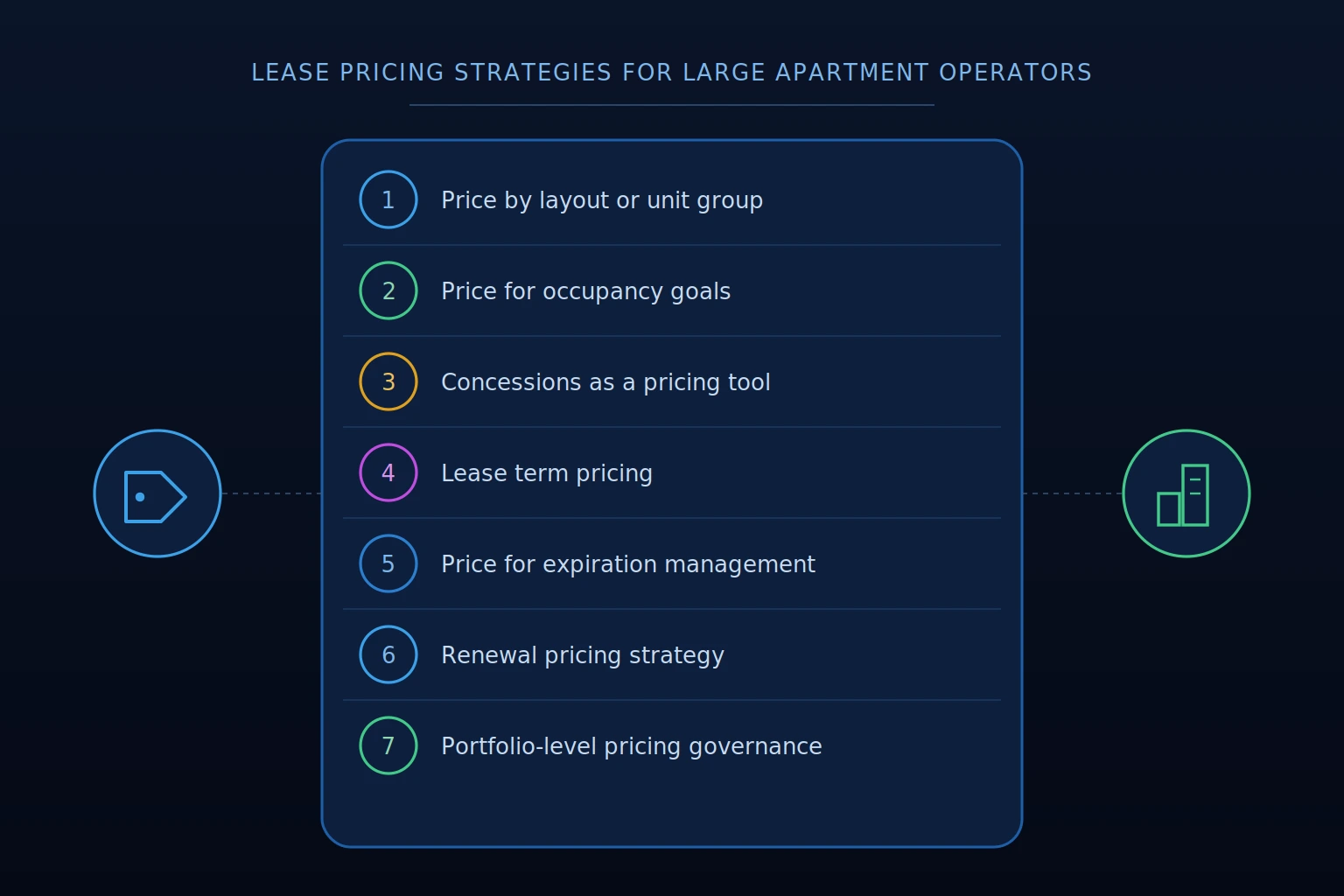
- Pricing by Layout or Custom Unit Group
- Pricing Strategy for Occupancy Goals
- Concession Strategy as a Pricing Tool
- Lease Term Pricing Strategy
- Pricing Strategy for Expiration Management
- Renewal Pricing Strategy
- Portfolio-Level Pricing Governance
1. Pricing by Layout or Custom Unit Group
Demand, leasing velocity, available inventory, and conversion performance can vary materially across layouts within the same property. A two-bedroom absorbing in five days and a two-bedroom absorbing in 28 days at the same price point are telling different stories about where pricing sits relative to demand in each configuration.
Large operators need pricing strategy at the bedroom or custom unit group level, not only at the property level where averages obscure the differences that drive real pricing decisions. Rentana generates pricing recommendations at the bedroom or custom unit group level with the full reasoning attached, so revenue managers can evaluate what conditions are being considered before deciding whether to act. The specificity is what makes the recommendation actionable.
2. Pricing Strategy for Occupancy Goals
Pricing should be evaluated against configured occupancy targets, Predicted Occupancy, targeted lead rate, and current conversion performance rather than against asking rent benchmarks alone. When demand is sufficient and leasing pace is on track relative to forward availability, the pricing evaluation is about whether the current rate is capturing the value the demand signal supports. When demand is insufficient to meet occupancy goals at current pricing, the evaluation shifts.
According to Multifamily Dive, operators entering 2026 saw that leasing velocity improved in several markets as supply pressure eased, with those who maintained pricing discipline during the supply surge positioned to convert improving demand into actual rent recovery rather than giving the recovery back through continued aggressive concessions. Pricing strategy connected to occupancy goals rather than to market momentum is what makes that conversion possible.
Rentana’s predicted occupancy and targeted lead rate help revenue managers evaluate whether current pricing and leasing activity are tracking toward occupancy targets or diverging from them, before the divergence has already reached the reported occupancy number.
3. Concession Strategy as a Pricing Tool
Concessions are a pricing tool, not a leasing strategy on their own. A concession applied to a specific layout absorbing below pace, sized to close the competitive gap and with a defined end date, addresses the actual problem. A concession applied broadly to hit an occupancy number suppresses effective rent across layouts that did not need the help and creates renewal conversations that are harder to navigate when the concession burns off.
For large operators, concession discipline at scale requires visibility into which layouts are genuinely underperforming relative to demand conditions and which are absorbing normally. Without that layout-level specificity, concession decisions default to broad programs that solve localized problems at portfolio-wide cost.
Read Also:
- AI for Lease Management: 5 Core Use Cases
- The Best Lease Renewal Software for Multifamily Real Estate
4. Lease Term Pricing Strategy
Lease term pricing uses price differentials across available lease lengths to balance rent growth, prospect flexibility, and future expiration management. Dynamic lease-term pricing can help operators align available lease terms with near-term leasing goals and longer-term exposure strategy, without treating every term length the same across every asset or season.
The most operationally valuable application of lease term pricing is shaping the forward expiration calendar before concentration has built. When teams can evaluate expiration risk earlier, lease-term pricing can help influence the distribution of future availability before the window becomes difficult to manage.
5. Pricing Strategy for Expiration Management
Pricing and lease-term strategy can help reduce the likelihood that future expiration concentration builds beyond what leasing demand can absorb. When exposure forecasting surfaces a window where concentration is building, lease-term pricing and renewal strategy can help teams evaluate how to manage future availability before it creates occupancy pressure.
According to Multifamily Dive’s rent outlook, concessions were at their highest point since the financial crisis as of late 2025, with nearly one in four apartments offering rent breaks, a condition driven in part by concentrated lease-up expiration patterns in high-supply markets. Operators that manage expiration distribution during lease-up are better positioned to avoid the concentrated availability pressure that reactive concession programs often address after the fact.
Rentana’s exposure forecasting surfaces where expiration concentration is building by layout and time window, helping teams evaluate forward availability before overexposure creates occupancy pressure.
6. Renewal Pricing Strategy
Renewal pricing should consider loss to lease, retention goals, renewal acceptance rates, publicly available market context, and forward availability for the specific layout and expiration window. The goal is to balance the revenue opportunity of a renewal increase against the occupancy and turnover cost risk of pushing a resident to leave.
Rentana’s configurable renewal recommendations connect renewal offer pricing to current leasing conditions, loss-to-lease visibility, and forward availability so renewal pricing reflects actual conditions rather than a fixed escalation cadence applied uniformly across all expiring leases.
7. Portfolio-Level Pricing Governance
At scale, pricing strategy requires more than individual property-level decisions. It requires consistent logic, clear guardrails, reporting cadences, and shared portfolio visibility that keep pricing decisions aligned across regions and properties without requiring central review of every adjustment.
According to the National Apartment Association, the multifamily market has fully entered a cost-efficiency phase where financial performance is shaped less by rent growth and more by how efficiently properties are being run. Pricing governance is one of the most direct expressions of that efficiency: consistent logic, defined parameters, and clear accountability for the decisions that determine how revenue lands across the portfolio.
Effective portfolio-level pricing governance covers occupancy goals and pricing guardrails set at the asset level, reporting cadences that give leadership consistent visibility into pricing performance, and shared workflows that help teams identify where pricing decisions may need closer review.
Rentana supports pricing governance by connecting pricing recommendations to each property’s asset strategy, occupancy goals, and current operating conditions. Portfolio dashboards and scheduled reporting give leadership shared visibility into pricing performance across assets.
How Rentana Supports Lease Pricing Strategies
Rentana connects the pricing disciplines described in this article into a single operational view, organized around the inputs and decisions that determine how pricing performs across a large apartment portfolio.
- Lease Up Mode supports lease-up properties with data-backed planning, forecasting, AI insights, and pricing recommendations aligned to the property’s path to stabilization, while helping teams keep future occupancy risk in view as leases are signed
- Pricing and revenue intelligence connects leasing velocity, forward availability, publicly available market context, asset strategy, loss-to-lease, and renewal conditions into supported pricing evaluations with reasoning attached
- Predicted Occupancy and targeted lead rate help teams evaluate whether current pricing, leasing activity, and demand volume are tracking toward occupancy goals
- Exposure forecasting surfaces where expiration concentration is building by layout and time window, informing lease-term pricing strategy and renewal strategy before overexposure creates occupancy pressure
- AI-generated Insights surface what is changing at specific assets and explain why it may matter given current pricing and leasing conditions
- Target Tracking, portfolio dashboards, and scheduled reporting give revenue managers, asset managers, and leadership shared visibility into pricing performance, property goals, and portfolio-level conditions on a consistent cadence
Don’t Miss:
Conclusion on Lease Pricing Strategies for Large Apartment Operators
Effective lease pricing across a large apartment portfolio requires more than responding to current market conditions. It requires a connected strategy that considers the full leasing lifecycle, from prospect demand and conversion through lease execution, renewal, and future availability. By aligning pricing decisions with property-level performance, occupancy goals, and long-term asset strategy, operators can balance immediate leasing needs with sustainable revenue growth.
Revenue intelligence platforms like Rentana help make this approach scalable by connecting leasing performance, pricing recommendations, forecasted occupancy, renewal trends, and exposure management within a consistent portfolio-wide framework.
Use Rentana to support more informed, proactive lease pricing decisions that align with asset strategy and drive long-term portfolio performance.