When a prospective resident searches for an apartment, they evaluate more than advertised rent. Available inventory, concessions, floor plans, amenities, location, online reviews, and the overall resident experience all contribute to how a property is perceived relative to competing communities.
That evaluation is inherently subjective. A prospect prioritizing affordability may compare properties differently than someone focused on amenities, location, or convenience. Understanding the alternatives prospects are considering, and the value they may place on different features, helps operators evaluate their competitive positioning beyond price alone.
Public apartment data provides visibility into those alternatives, but it does not reveal how a property is performing internally. Combining public market context with leasing activity, conversion performance, renewals, and forward occupancy trends helps operators understand not only how their property is positioned, but how prospects are responding to that positioning.
This article explores what public apartment insights reveal about the competitive market, where their limitations lie, and how operators can connect external market context with internal performance data to make more informed leasing, pricing, and asset strategy decisions.
Related:
- The Best AI Property Insights Platforms
- Real Estate Market Insights For Property Managers
What Are Apartment Insights?
Apartment insights are the market, property, pricing, demand, and resident-experience signals that help multifamily operators understand their competitive positioning, evaluate property performance, and make more informed operational and revenue management decisions.
These insights come from two primary sources:
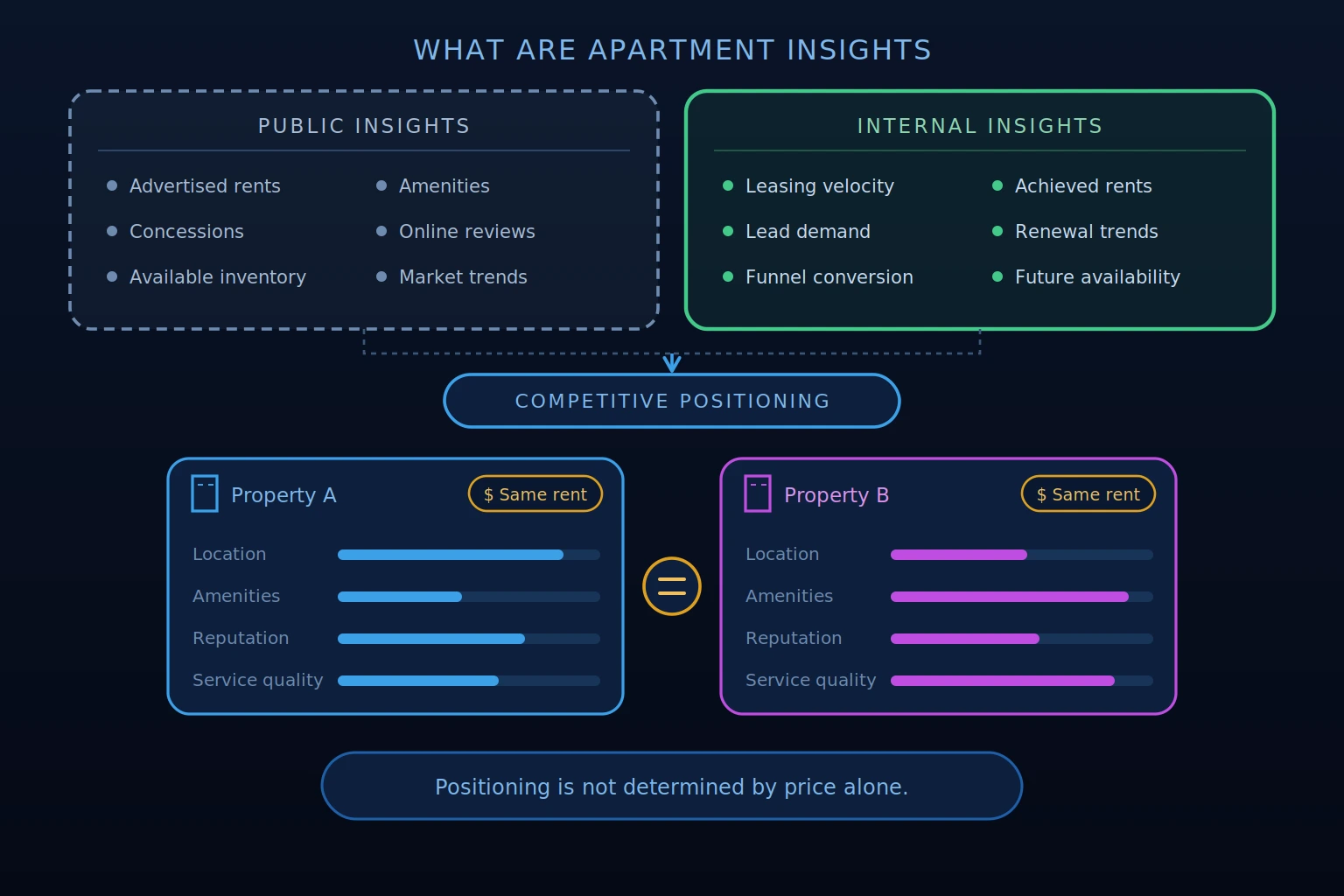
Public apartment insights provide visibility into the information prospective residents use to compare properties, including advertised rents, concessions, available inventory, amenities, online reviews, and broader market trends.
Internal property insights reflect actual operating performance, including leasing velocity, lead demand, funnel conversion, achieved rents, renewal trends, future availability, and forecasted occupancy.
For operators, understanding both perspectives is essential because competitive positioning is not determined by price alone. Two properties with similar asking rents may offer substantially different value propositions based on location, amenities, reputation, service quality, and individual prospect preferences.
Evaluating these differences helps operators understand how their property may be perceived in the competitive market and whether its offering aligns with the prospects they are trying to attract.
Public insights help operators understand the alternatives available to prospects and how their property compares. Internal insights reveal how prospects are actually responding through leasing demand, conversion, and overall performance.
By connecting both perspectives, operators can identify emerging risks, evaluate competitive opportunities, and make more informed decisions about pricing, property positioning, resident experience, and long-term asset strategy.
What Public Data Can Tell You About Your Market
Public market data helps operators evaluate their properties from the perspective of prospective residents comparing available alternatives. Several categories provide particularly useful context.
Advertised rents. Publicly listed asking rents show how communities position their pricing by bedroom count, floor plan, and unit type. These figures establish visible market reference points, but they do not necessarily reflect the effective rents properties achieve after concessions.
Public concessions and specials. Promotional offers influence how prospects compare the relative cost of different apartments. According to Multi-Housing News, nearly 40% of apartment listings on Zillow offered concessions in June 2026, up from 35.2% a year earlier, with concession prevalence exceeding 65% in markets including Charlotte, Denver, and Dallas. This highlights why advertised asking rents alone may not reflect the full market conditions.
Advertised availability and visible supply. Public listings show the inventory prospective residents can currently evaluate across properties. Changes in advertised availability can help operators understand visible supply conditions, although publicly listed inventory does not necessarily represent a property's total current or future availability.
Floor plan positioning. Comparing similar layouts, bedroom counts, square footage, and unit features helps operators evaluate market positioning beyond property-level averages. Rent per square foot can provide additional context, but differences in layout efficiency, finishes, and functionality also influence perceived value.
Amenity and product positioning. Amenities, unit features, community services, and location influence how prospects evaluate properties. Their relative importance varies by individual preferences, making it important to consider the complete value proposition rather than assuming every prospect values the same features equally.
Online reputation and resident sentiment. Public reviews provide visibility into resident experiences and recurring themes involving maintenance, communication, amenities, service quality, and overall satisfaction. These perceptions can shape a prospect's expectations before they contact the leasing team.
Local market trends. Changes in publicly advertised rents, concessions, available inventory, and development activity provide context for how the surrounding rental market is evolving.
Together, these signals help operators evaluate not simply whether their property is priced competitively, but how its overall offering compares with the alternatives available to prospective residents.
Top Picks:
- Real-Time Public Market Data Insights for Multifamily Pricing
- Market Rent Analysis Tool for Apartment Pricing Decisions
Where Public Data Helps Revenue Managers
Public apartment insights are most valuable when they help operators understand market positioning, evaluate the prospect experience, and identify potential opportunities to improve performance.
Evaluating the property's value proposition. Pricing should be considered alongside amenities, location, unit features, reputation, and the broader resident experience. A property with higher advertised rents may still be competitively positioned if prospects perceive sufficient additional value. Conversely, lower pricing may not overcome concerns about service quality, location, or product fit.
Identifying the market’s concession activity. Understanding advertised concessions across the broader market and specific submarkets helps revenue managers evaluate how promotional offers influence the effective rent comparisons prospects are making. This provides valuable context for assessing property positioning, leasing performance, and concession strategy without treating publicly advertised offers as the basis for pricing decisions.
Understanding prospect preferences. Different prospects prioritize different characteristics. Some may place greater value on location and convenience, while others emphasize affordability, amenities, or apartment features. Evaluating the market environment through these different perspectives can help operators identify strengths, weaknesses, and opportunities to improve positioning.
Identifying amenity and product opportunities. Comparing publicly advertised amenities and unit features across the surrounding rental market helps teams assess how their offering is positioned. When connected with internal leasing activity and resident feedback, these insights may reveal opportunities to improve marketing, leasing conversations, or asset-level investment priorities.
Spotting reputation trends that may affect demand. Recurring public review themes involving maintenance responsiveness, communication, amenity reliability, or resident satisfaction may influence how prospects perceive a community. Evaluating these themes alongside internal operating data helps teams determine whether further investigation is warranted.
The goal is not to identify one universally superior offering. It is to understand how different prospects may perceive the property's value and whether that positioning is producing the leasing and retention outcomes needed to support asset strategy.
What Public Data Does Not Show
Public apartment data describes the market environment visible to prospective residents. It does not reveal the internal operating conditions that determine how a specific property is performing.
Important information that public data cannot reliably provide includes:
- Achieved rents: Actual lease rates and effective rents after concessions on executed leases
- Leasing demand and conversion: Internal lead volume, prospect progression, and conversion rates from inquiry through signed lease
- Renewal and retention performance: Renewal acceptance rates, pricing outcomes, and retention trends
- Future availability: Upcoming vacancies, lease expirations, and forward exposure beyond publicly advertised inventory
- Lease-term performance: Actual lease lengths, expiration distribution, and how term strategy influences future availability
- Occupancy and revenue goals: The property's operating targets and broader asset strategy
- Forecasted performance: Where occupancy and revenue appear to be heading based on current leasing activity, renewal expectations, and future availability
Public data also cannot fully explain why an individual prospect chooses one property over another. Advertised pricing, amenities, and online reviews provide insight into available choices, but they do not capture every personal preference or purchasing consideration.
A property may appear appropriately positioned based on its advertised offering while experiencing declining conversion, softening leasing velocity, or growing future occupancy risk.
Understanding those conditions requires internal performance data.
Read Also:
- Property Management Public Data Analytics
- Rental Market Intelligence: What Public Data Can and Cannot Tell You
Turning Apartment Insights Into Better Questions
The most practical application of public apartment insights is using market context to guide more informed property-level evaluations.
According to CBRE's 2026 U.S. Real Estate Market Outlook, asking rent growth does not capture the full picture of multifamily rent performance, particularly when renewal activity is considered. This reinforces the importance of distinguishing publicly advertised market conditions from actual property-level outcomes.
Rather than treating public market data as a direct pricing instruction, operators should use it to investigate how their property's market positioning relates to actual leasing and resident behavior.
Questions worth asking include:
- Pricing and perceived value: How does our pricing compare with publicly advertised alternatives, and does our leasing performance suggest prospects recognize the value of our offering?
- Concessions and competitive positioning: Are publicly advertised concessions changing the effective rent comparison, and could that be influencing prospect conversion?
- Amenity positioning: Are competing properties highlighting features or experiences that may be influencing prospect preferences, and are we effectively communicating our own property's differentiators?
- Online reputation: Do recurring review themes suggest opportunities to improve service quality, prospect expectations, or resident retention?
- Leasing performance: Are particular layouts experiencing weaker conversion or slower absorption despite appearing competitively positioned?
- Market versus property conditions: Are leasing challenges consistent with broader market trends, or does internal performance suggest a property-specific issue?
These questions recognize that market positioning is not the same as pricing position.
Public data helps operators understand the alternatives prospects are evaluating. Internal data helps determine whether the property's offering is generating the demand, conversion, and retention needed to support its goals.
How to Pair Public Data With Internal Performance Data
The strongest apartment insights connect the market environment with actual property performance. Public market context helps explain what prospects are seeing, while internal operational data reveals how they are responding and whether current conditions support the property's business plan.
Internal performance signals worth evaluating alongside public market context include:
- Lead demand: Inquiry volume and whether current traffic is sufficient to support leasing and occupancy goals
- Funnel conversion: Prospect progression from inquiry through executed lease, identifying where conversion challenges may exist
- Leasing velocity: Absorption pace by bedroom or unit group relative to available inventory and occupancy targets
- Pricing and achieved rents: Current pricing, recent executed lease rates, effective rents, and concession performance
- Current and future availability: Available inventory, upcoming vacancies, and exposure concentration by layout and time window
- Renewal and retention trends: Renewal conversion, retention performance, and how renewal pricing compares with current leasing conditions
- Forecasted occupancy: Where occupancy appears to be heading based on current leasing activity, renewal expectations, and future availability
- Asset strategy and performance goals: How current leasing, occupancy, and revenue conditions compare with the property's broader objectives
Connecting these signals helps teams move beyond identifying individual performance changes to understanding the relationships between them.
For example, an increase in publicly advertised concessions may coincide with softening internal leasing velocity and declining prospect conversion or an influx of supply. That combination provides more useful context than any single metric alone. It may indicate a need to evaluate competitive positioning, pricing, marketing effectiveness, or the prospect experience.
Similarly, negative public feedback around an amenity may warrant closer investigation when paired with internal resident sentiment or leasing performance. The value comes from recognizing where external perceptions and internal outcomes may be connected, rather than assuming one signal directly causes another.
AI-powered analytics can make these relationships easier to identify by evaluating connected signals and surfacing emerging patterns that might otherwise require extensive manual analysis.
These insights support earlier investigation and more informed decisions while leaving strategic judgment and accountability with the property management and asset management teams.
How Rentana Supports Apartment Insights
Rentana connects public market context with internal property performance data to help multifamily operators understand changing conditions, evaluate competitive positioning, and identify opportunities to improve performance in alignment with asset strategy.
Public market context and pricing intelligence bring publicly advertised rents, concessions, and specials into the pricing evaluation alongside leasing performance, forward availability, occupancy goals, and asset strategy. Pricing recommendations are provided at the bedroom or custom unit group level with supporting reasoning so revenue managers can evaluate the context before making decisions.
AI-generated Property Insights connect operational performance signals to highlight what is changing, why it may matter, and where further evaluation may uncover opportunities. Insights can help teams investigate leasing challenges, competitive positioning, resident experience, amenity performance, and other conditions affecting property outcomes.
Leasing demand and conversion insights help teams understand whether current lead volume and prospect conversion are sufficient to support leasing goals, providing context for evaluating whether performance challenges relate to demand, conversion, pricing, or property positioning.
Predicted Occupancy and exposure management connect current leasing activity, renewal trends, and future availability to provide a forward-looking view of occupancy conditions. This helps teams identify potential occupancy pressure and evaluate whether current strategy is aligned with property goals.
Renewal and retention visibility helps teams evaluate renewal performance, pricing considerations, and emerging retention trends alongside current leasing conditions and future availability.
Lease Up Mode supports lease-up properties with data-backed planning, forecasting, AI insights, and pricing recommendations aligned with the property's path to stabilization. Public market context and internal leasing performance help teams evaluate absorption progress and maintain visibility into future occupancy risk as leases are signed.
Portfolio dashboards provide asset managers and revenue managers with shared visibility into performance across properties, helping teams recognize changing conditions and identify where closer investigation may be valuable.
Together, these capabilities help operators move beyond isolated market comparisons and evaluate how competitive positioning, leasing activity, resident experience, and asset strategy influence property performance.
Don’t Miss:
- Public Market Intelligence Platform for Multifamily
- Multifamily Rent Growth: Public Market Trends
Conclusion on Apartment Insights
Apartment insights help multifamily operators understand how their properties are positioned in a market market and how prospective residents may evaluate the alternatives available to them. Advertised rents, concessions, amenities, availability, and online reputation all contribute to perceived value, but their importance varies based on individual prospect preferences.
Public market data provides that market perspective. Internal performance data reveals how prospects and residents are actually responding through leasing demand, conversion, achieved rents, renewals, and occupancy trends.
Connecting both perspectives helps operators identify emerging risks, evaluate competitive opportunities, and make more informed decisions about pricing, positioning, resident experience, and long-term asset performance.
Use Rentana to connect public market context with AI-generated property insights, leasing performance, pricing recommendations, and forward-looking occupancy analytics to support decisions aligned with asset strategy.