Real estate asset managers and operators work with data from multiple sources simultaneously: PMS exports, leasing reports, renewal summaries, market surveys, financial statements, and ownership presentations. The challenge is rarely a shortage of data. It is having the right data organized in a way that supports decisions rather than just documenting outcomes.
A real estate analytics platform is software that connects property, portfolio, leasing, pricing, renewal, and operational data into a single analytical view, giving asset managers and operators the visibility they need to understand what is changing, where performance is heading, and where there may be areas of opportunity to better align performance with asset strategy.
According to Multi-Housing News, the multifamily sector’s forward momentum depends on operational agility, informed decision-making, and the ability to adapt to changing market conditions, with data and technology playing an increasingly central role in how leading operators manage performance across their portfolios.
The gap between operators with connected analytics infrastructure and those relying on static reports is widening as the operating environment becomes less forgiving of delayed visibility.
Related:
What Is a Real Estate Analytics Platform?
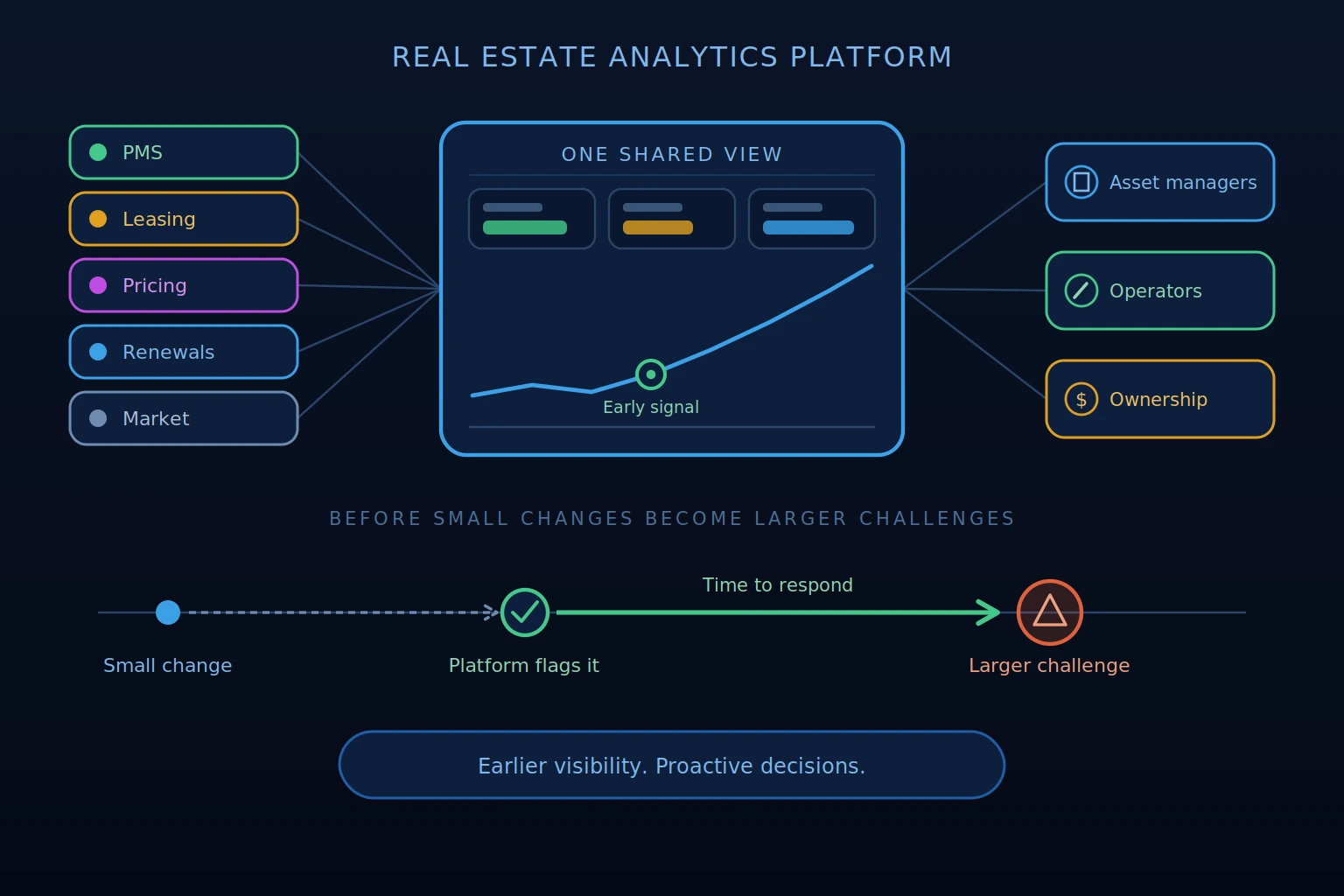
A real estate analytics platform is software that helps asset managers, operators, and ownership teams analyze property, portfolio, market, leasing, pricing, renewal, and operational data in one place. It connects data from the PMS and other operational systems into a shared view that supports decisions across multiple functions and multiple assets simultaneously.
The defining characteristic of a strong analytics platform is its ability to support proactive decisions, not just report data. By connecting performance signals across an asset, it helps teams recognize emerging trends, understand why they matter, and identify which decisions may need consideration before smaller changes become larger operational or financial challenges. Rather than relying on constant manual analysis to uncover developing conditions, operators gain earlier visibility into risks and opportunities to better align performance with asset strategy.
Core Data a Real Estate Analytics Platform Should Connect
The data categories that matter most for multifamily real estate analytics:
- Occupancy and availability: What is occupied, available, and expected to become available by property and layout
- Leasing performance: Leasing velocity, lead demand, and funnel conversion by layout
- Pricing and rent performance: Asking rent, effective rent, pricing movement, concessions, and loss-to-lease context
- Renewals and retention: Renewal conversion, renewal pricing, trade-out, and upcoming expiration activity
- Exposure and expirations: Forward availability concentration by layout and time window
- Performance targets: Occupancy, retention, and revenue goals by property
- Public market context: Publicly advertised asking rents, concessions, specials, and competitor availability as external calibration
- Portfolio performance: Cross-property comparison to support prioritization and strategy conversations
Portfolio-Level Visibility
Asset managers overseeing multiple properties need a portfolio-wide view that surfaces where conditions are shifting without requiring sequential manual review of every asset. The operational value of portfolio-level visibility is in prioritization: knowing which assets need attention this week based on what the data is showing rather than based on which property happened to be reviewed most recently.
A strong portfolio-level view surfaces where multiple conditions are shifting simultaneously at the same asset, because that combination is more significant than any individual signal reviewed alone. Leasing velocity softening alongside a renewal conversion decline and a forward exposure concentration building in the same layout is a different operational situation than any of those three conditions appearing independently. The analytics platform should surface that combination rather than requiring the asset manager to identify it manually across separate reports.
Portfolio-level analytics should also support cross-property comparison using consistent metrics and methodology, so performance differences between assets reflect actual operational conditions rather than reporting inconsistencies.
Property-Level Drilldowns
Portfolio-level visibility tells asset managers where to look. Property-level drilldowns tell them what they are looking at.
A strong analytics platform allows teams to move from a portfolio-wide signal to property-level detail and from there to layout-level specifics within the same analytical view.
When a property surfaces as needing attention at the portfolio level, the path to understanding what is driving the signal, which layouts are contributing, what the forward exposure picture shows, how renewal conversion is trending in the affected segments, should be a few clicks rather than a separate report request.
Property-level drilldowns are most operationally useful when they maintain the same current data source as the portfolio view rather than pulling from separate exports that may reflect different points in time.
Public Market Context
Public market data provides the external frame for evaluating how a property’s internal performance compares to what the surrounding competitive set is showing. Publicly advertised asking rents, concession specials, market availability, and published market research from organizations like CBRE, NAA, and Cushman & Wakefield all contribute to this external picture.
Public data should support analysis rather than replace internal property performance data. Advertised asking rents are not necessarily achieved rents. Public availability is not the same as internal exposure. The external picture provides calibration context. The internal performance data determines how the specific property is actually performing within that external environment.
Public market context also helps operators evaluate their property through the lens of a prospective resident. Prospects compare advertised rents, concessions, availability, amenities, reviews, and the overall value proposition across competing communities. Understanding that experience helps teams assess whether their property is competitively positioned, identify potential barriers to leasing, and evaluate opportunities to improve pricing, product positioning, or the prospect experience.
Forward-Looking Analytics
According to Multifamily Dive’s 2026 multifamily outlook, true operational transformation hinges on the centralization of technology and operations, with operators who unify data across systems gaining clearer visibility into revenue performance and new opportunities while giving leadership the strategic foresight needed for long-term portfolio growth. Strategic foresight requires forward-looking analytics, not only backward-looking reports.
A strong real estate analytics platform shows where occupancy appears to be heading under current leasing and renewal conditions, where upcoming lease expiration concentration is building before it creates availability pressure, how expected future availability compares to what the leasing pipeline can realistically absorb, and how performance at each asset is tracking against property goals rather than only against prior period actuals.
Forward-looking analytics creates the response window that proactive management requires. When a platform shows only historical performance, teams have less time to evaluate conditions before outcomes are already visible. When it surfaces where conditions are heading, teams can evaluate earlier whether current strategy is aligned with the asset’s goals.
Read Also:
AI Insights and Context
AI in a real estate analytics platform adds value primarily by summarizing what is changing across multiple signals simultaneously and explaining why it may matter given current operational conditions. Rather than requiring an asset manager to review leasing velocity, renewal conversion, exposure concentration, and pricing performance separately and identify where the combination is significant, AI can surface what the combination is pointing toward and where further evaluation may be needed.
According to Multi-Housing News, AI-powered tools handle analysis with precision, allowing teams to focus on complex tasks, while predictive analytics help property managers understand occupancy patterns and enable proactive strategies to maintain high occupancy. The analytical value comes from connecting signals in context rather than presenting each metric independently.
AI Insights should answer three questions consistently: what changed, why it may matter given current operational conditions, and where there may be areas of opportunity to better align performance with asset strategy. They are a starting point for evaluation and judgment, not a substitute for it. Human judgment, strategy, compliance review, and decision accountability remain the responsibility of the asset management team.
Reporting and Scheduled Reports
A real estate analytics platform should support automated reporting that keeps teams consistently informed without requiring manual report assembly. By delivering relevant performance data to leasing teams, revenue managers, asset managers, and ownership groups on a predictable cadence, scheduled reporting creates a shared operating rhythm. Teams can identify emerging trends, evaluate performance against goals, and coordinate decisions using consistent information, allowing potential issues to be addressed before they escalate.
Different reports serve different operational needs. Available Units Reports support daily leasing priorities, while weekly Summary Reports with AI Insights and pricing movement help revenue managers evaluate changing conditions. Lease Compliance Reports support regular operational oversight, and monthly Executed Leases, Lease Trade-Out, and Target Tracking Reports help asset managers and ownership evaluate revenue performance against plan.
The value extends beyond time saved. Automated reporting creates accountability and consistency, helping teams recognize changes earlier, investigate performance gaps, and make more informed decisions without waiting for the next manually assembled report.
What to Look for in a Real Estate Analytics Platform
When evaluating a real estate analytics platform, the criteria that matter most:
- Current PMS-connected data: Direct connection to the PMS so analysis starts from current operational data rather than manual exports
- Portfolio-to-property navigation: The ability to move from portfolio-level signals to property and layout-level detail within the same platform
- Forward-looking visibility: Occupancy, exposure, renewal, and availability signals that show where conditions appear to be heading
- Decision context: Pricing, renewal, and performance views that connect operational signals to the decisions teams need to evaluate
- Public market calibration: Publicly available rents, concessions, specials, and market context incorporated alongside internal data
- AI-generated explanation: Plain-language summaries of what is changing, why it may matter, and where further evaluation may be useful
- Recurring reporting: Scheduled report delivery on the cadence different audiences need
- Shared team visibility: A common operating view for leasing, revenue management, asset management, and ownership
According to the National Multifamily Housing Council, operators who invest in the systems and processes to work with operational data effectively are better positioned to make consistent, informed decisions across their portfolios. Platform capability matters less than whether the platform is actually organized around the decisions the team is making.
Related:
- Business Analytics in Real Estate: Complete Guide
- What Is Lease Analysis in Multifamily?
How Rentana Supports Real Estate Analytics
Rentana gives multifamily asset managers and operators a connected view of property and portfolio performance organized around what is changing, why it may matter, and where there may be areas of opportunity to better align performance with asset strategy.
Forward-looking performance visibility connects current leasing activity, renewal trends, future availability, exposure, and Predicted Occupancy so teams can evaluate where occupancy appears to be heading and whether current strategy is tracking toward property goals.
Pricing and revenue intelligence connects leasing performance, forward availability, public market context, asset strategy alignment, loss-to-lease, and renewal conditions into supported pricing evaluations with reasoning attached.
Lease Up Model supports lease-up properties with data-backed planning, forecasting, AI insights, and pricing recommendations aligned to the property’s path to stabilization, while helping teams keep future occupancy risk in view as leases are signed.
AI-generated Insights surface what is changing at specific assets, explain why it may matter given current operational conditions, and identify areas of opportunity to better align performance with asset strategy.
Portfolio dashboards and Target Tracking give asset managers and ownership groups a color-coded view of performance across properties, including how each asset is tracking against occupancy and revenue goals.
Renewal and exposure visibility helps teams evaluate retention trends, renewal pricing, forward availability, and where expiration concentration may create occupancy pressure.
Scheduled reporting allows recurring report delivery to be configured once and delivered automatically, keeping every team consistently informed on the cadence their role requires.
Conclusion on Real Estate Analytics Platform
A real estate analytics platform delivers the greatest value when it goes beyond organizing data to supporting proactive, informed decisions. By connecting operational signals, identifying emerging risks and opportunities, and providing context around what is driving performance, it helps asset managers recognize developing conditions and evaluate strategic adjustments before they impact results.
With PMS-connected data, forward-looking analytics, AI-generated insights, and shared portfolio visibility, teams can move beyond retrospective reporting to proactively manage performance in alignment with asset strategy.
Use Rentana to connect property performance, public market context, pricing, renewals, exposure, and portfolio reporting in one forward-looking platform that supports more informed decisions across every asset.