Effective rent pricing in multifamily requires more than evaluating current occupancy or comparing asking rents across the market. Every pricing decision influences leasing velocity, revenue performance, future availability, and the property's ability to achieve its long-term asset strategy.
The challenge is connecting these factors rather than evaluating them independently. A property may be achieving its current occupancy target while leasing demand is softening, renewal conversion is declining, or future availability is becoming concentrated. Without visibility into these relationships, pricing decisions may respond to past performance rather than the conditions developing ahead.
Data-driven rent pricing connects internal property performance, forward-looking analytics, and asset strategy to support more informed pricing decisions. It allows revenue managers to evaluate not only whether current pricing is supporting leasing goals, but also how pricing decisions may influence future occupancy, retention, and revenue performance.
According to the National Apartment Association, repairs and maintenance costs have risen nearly 28% since 2021, while NOI has increased just 10%. With operating expenses placing continued pressure on margins, informed pricing decisions and consistent revenue management have become increasingly important.
This article explores the internal performance signals that support data-driven rent pricing, how to identify emerging pricing risks and opportunities, and how AI and revenue intelligence help operators make more proactive decisions across their portfolios.
Related:
- Lease Pricing Strategies for Large Apartment Operators
- Market Rent Analysis Tool for Apartment Pricing Decisions
What Is Data-Driven Rent Pricing in Multifamily?
Data-driven rent pricing is the process of using internal property performance, forward-looking occupancy analytics, and asset strategy to support pricing decisions that reflect current operating conditions and long-term revenue objectives.
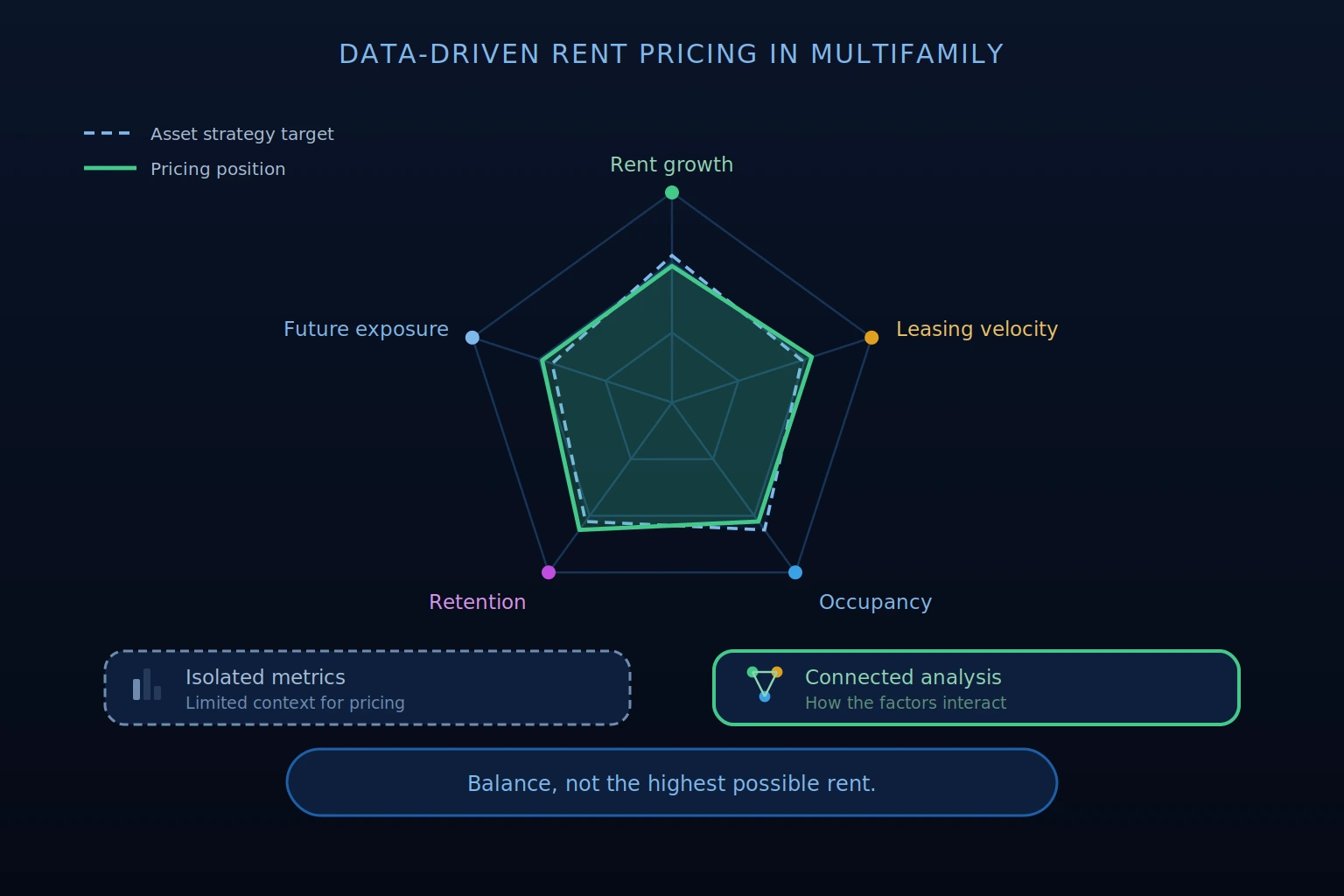
Rather than relying primarily on fixed pricing schedules, historical benchmarks, or isolated performance metrics, data-driven pricing evaluates how leasing demand, conversion, availability, renewals, and occupancy trends interact.
The defining characteristic is connected analysis.
Leasing velocity alone describes how quickly apartments have been leased. When evaluated alongside lead demand, funnel conversion, and future availability, it provides greater context for determining whether current pricing is supporting the property's leasing goals.
Similarly, current occupancy shows where a property stands today, but it does not necessarily indicate where occupancy is heading. Connecting current performance with renewal expectations, lease expirations, and forward availability helps operators evaluate whether pricing strategy remains aligned with future occupancy and revenue goals.
The purpose of data-driven pricing is not simply to achieve the highest possible rent. It is to support pricing decisions that balance rent growth, leasing velocity, occupancy, retention, and future exposure in alignment with the property's asset strategy.
What Internal Data Should Drive Pricing Decisions
Effective rent pricing requires visibility into the full leasing and resident lifecycle, from initial prospect demand through lease execution, renewal, and future availability.
Each stage provides information that helps revenue managers evaluate whether current pricing is supporting both immediate leasing needs and long-term asset performance.
Lead demand and leasing funnel conversion. Inquiry volume and prospect conversion help operators understand whether the property is generating sufficient demand to meet leasing goals. Evaluating conversion throughout the prospect journey can reveal where performance is weakening and whether further investigation into pricing, marketing, or the leasing experience is warranted.
Leasing velocity by layout. The pace at which apartments are leasing provides a retrospective measure of absorption. Evaluating leasing velocity by bedroom or custom unit group, alongside available inventory and occupancy goals, helps teams determine whether recent leasing activity is sufficient to support future performance.
Recently achieved rents and pricing performance. Executed lease rates, effective rents after concessions, and recent pricing movement provide visibility into actual leasing outcomes. Comparing these measures with leasing velocity and conversion trends helps revenue managers understand how pricing performance relates to current demand and occupancy conditions.
Current and future availability. Available inventory, upcoming vacancies, and forward exposure provide context for evaluating how much leasing activity will be needed in future periods. A layout with limited current availability but substantial upcoming exposure may require a different pricing evaluation than one with stable forward conditions.
Lease terms and expiration distribution. The lease lengths residents select influence when inventory may return to market. Evaluating lease-term distribution helps operators understand how current leasing decisions affect future exposure and supports pricing strategies aligned with short-term leasing needs and long-term revenue goals.
Renewal and retention performance. Renewal conversion, retention trends, and renewal pricing outcomes influence future availability and revenue performance. Connecting renewal activity with current leasing conditions helps teams evaluate the relationship between retention strategy, pricing, and occupancy risk.
Forecasted occupancy. Forward-looking occupancy analysis connects current leasing activity, renewal expectations, and future availability to show where occupancy appears to be heading. This provides important context for evaluating whether current pricing and leasing strategies are supporting the property's occupancy goals.
Asset strategy and performance goals. Pricing decisions should ultimately support the property's broader objectives. Lease-up, stabilized, and value-add properties may require different pricing approaches because their occupancy priorities, revenue expectations, and investment strategies differ.
Together, these internal performance signals provide a more complete foundation for pricing decisions than any single metric evaluated independently.
How to Identify Pricing Opportunities and Risks From Internal Data
Data-driven pricing helps revenue managers recognize where current pricing may warrant evaluation before smaller performance changes become larger operational or financial challenges.
The most useful signals are often combinations of related conditions rather than isolated movements in individual metrics.
Where pricing may be too conservative. A layout consistently leasing ahead of its required absorption pace, with strong demand and limited future availability, may present an opportunity to evaluate whether current pricing is capturing the revenue potential supported by property performance.
Faster leasing alone does not establish that rents should increase, but it provides a useful signal when considered alongside occupancy goals and asset strategy.
Where pricing may need adjustment to support occupancy. Softening leasing velocity, declining funnel conversion, and increasing forward availability within the same layout may indicate that current performance is not supporting the absorption pace required to achieve occupancy goals.
Evaluating these connected signals helps teams determine whether pricing is the appropriate lever to pull or whether other strategies, such as concessions, marketing adjustments, or temporarily adjusting occupancy targets to preserve rent roll value, would better support the property's broader asset strategy.
Where renewal pricing may create retention risk. Renewal offers that are materially higher than comparable new leases at the same property may create rent roll inversion and influence residents' renewal decisions.
Effective renewal strategy should also account for forward exposure, as periods of overexposure and underexposure may warrant different approaches to balancing rent growth and retention. Evaluating renewal pricing alongside achieved rents, loss to lease, retention trends, future availability, and occupancy goals helps teams determine the appropriate strategy for each expiration period in alignment with broader asset goals.
Where future exposure may influence pricing strategy. Concentrated lease expirations or increasing forward availability may indicate that future leasing demand will need to support a larger volume of inventory. Recognizing those conditions earlier allows teams to evaluate lease-term pricing, renewal strategy, marketing efforts, and other approaches to managing future availability.
Where performance is diverging from asset strategy. A property may be meeting current occupancy goals at the expense of declining effective rents, increasing concessions, or erosion of rent roll value. Data-driven analysis helps teams recognize when short-term occupancy results are compromising long-term revenue objectives and evaluate how to get performance back on track.
Depending on market conditions and asset goals, this may require adjusting pricing, concessions, occupancy targets, or retention strategy to better balance immediate leasing needs with long-term asset performance.
The goal is not to prescribe an automatic pricing response to each condition, but to equip revenue managers with the insights needed to understand what is changing, why it matters, and which strategic levers they can adjust to get performance back on track.
By connecting these signals to asset goals, teams can take proactive, informed action to address emerging challenges, capture revenue opportunities, and improve long-term performance.
Top Picks:
How AI Supports Data-Driven Rent Pricing
AI and revenue intelligence help multifamily operators move beyond periodic reporting and manual analysis by continuously evaluating connected property performance signals, identifying emerging trends, and surfacing opportunities to improve revenue and occupancy outcomes.
According to Multi-Housing News, AI offers opportunities to analyze large volumes of property management data more efficiently, with revenue management and pricing among its practical applications.
The greatest value is not simply analyzing data faster. It is transforming that analysis into meaningful insights and actionable opportunities without requiring teams to constantly investigate every metric themselves.
Traditional reporting often presents leasing velocity, renewal conversion, occupancy, pricing performance, and forward availability as separate metrics. Understanding how these conditions interact requires time and manual analysis, particularly across large portfolios where smaller performance changes can be difficult to recognize before they become larger challenges.
AI-powered analytics can evaluate these connected signals consistently, identifying what is changing, explaining why it matters, and highlighting opportunities to bring performance into closer alignment with asset strategy.
For example, declining leasing velocity may not be concerning when forward availability is limited and occupancy is tracking ahead of plan. However, when that same decline occurs alongside increasing exposure, weakening renewal conversion, and occupancy trending below target, the combined signals may indicate developing occupancy risk.
Rather than simply flagging a slowdown, AI can help revenue managers understand the underlying conditions and identify potential strategic responses, such as evaluating pricing, adjusting renewal strategy, reconsidering occupancy targets, or addressing leasing demand and conversion challenges.
The value of these insights is strengthened by transparency into the underlying performance data and reasoning. Revenue managers can understand what is driving an insight, evaluate the suggested opportunities, and determine which actions best support the property's goals.
Across large portfolios, this creates a more proactive operating model. AI can surface smaller changes, connect patterns across properties and layouts, and help teams prioritize opportunities without requiring constant manual analysis.
AI provides the analysis, context, and potential paths forward. Revenue managers apply their expertise to determine which strategic levers to adjust, ensuring decisions remain aligned with current operating conditions and long-term asset strategy.
Read Also:
- Best Unit-Level Pricing Strategy in Multifamily
- Apartment Rent Pricing Strategy: 7 Factors to Evaluate
How Rentana Supports Data-Driven Rent Pricing in Multifamily
Rentana connects internal property performance data, forward-looking analytics, and asset strategy to support transparent pricing recommendations and more informed revenue management decisions.
By evaluating connected operating conditions, Rentana helps teams understand what is changing, why it may matter, and where opportunities exist to better align performance with property goals.
- Pricing recommendations by bedroom or custom unit group are driven by internal property performance and aligned with asset strategy. Recommendations connect leasing velocity, forward availability, occupancy goals, and other relevant operating signals, with supporting reasoning that revenue managers can evaluate before making decisions.
- Predicted Occupancy connects current leasing activity, renewal trends, and future availability to show where occupancy appears to be heading. This helps teams evaluate whether current pricing and leasing strategies are supporting future occupancy goals rather than relying on current occupancy alone.
- Targeted Lead Rate evaluates whether current lead demand is sufficient to support occupancy goals based on recent conversion performance, helping teams recognize when leasing demand may not be keeping pace with upcoming availability.
- Exposure management surfaces where upcoming availability and lease expiration concentration are building by layout and time window, providing context for evaluating pricing, lease-term strategy, and future occupancy risk.
- Renewal metrics help teams evaluate retention trends, renewal pricing, loss-to-lease considerations, and forward availability to support renewal strategies that balance revenue growth and occupancy stability.
- AI-generated Insights connect property performance signals to highlight changing conditions, explain why they may matter, and identify opportunities for further evaluation in alignment with asset strategy.
- Lease Up Mode supports lease-up properties with data-backed planning, forecasting, AI insights, and pricing recommendations aligned with the property's path to stabilization. It helps teams evaluate absorption progress against lease-up goals while maintaining visibility into future occupancy risk as the initial rent roll develops.
Together, these capabilities help revenue managers move beyond isolated metrics and evaluate pricing decisions within a connected view of property performance.
Don’t Miss:
- Amenity Fee Pricing: How Multifamily Operators Get It Right
- The Best Multifamily Pricing Tool for Investors
Conclusion on Data-driven Rent Pricing in Multifamily
Data-driven rent pricing is a connected revenue management discipline that uses internal property performance to support informed decisions throughout the leasing and resident lifecycle. From prospect demand and leasing conversion through achieved rents, renewals, and future availability, each stage provides insight into whether current pricing supports immediate operating needs and long-term asset strategy.
By connecting these signals through forward-looking analytics and revenue intelligence, operators can recognize emerging risks, identify revenue opportunities, and evaluate pricing decisions before smaller performance changes develop into larger occupancy or financial challenges.
The goal is not simply to maximize asking rents. It is to balance revenue growth, leasing velocity, occupancy, retention, and future exposure in a way that supports sustainable asset performance.
Use Rentana to connect internal property performance, AI-generated Insights, occupancy forecasting, and transparent pricing recommendations into a consistent revenue management approach aligned with asset strategy.