
Did you know that the majority of multifamily underperformance is not caused by bad properties or bad markets? It is caused by a gap between what ownership expects and what operations are actually producing, and nobody in the middle whose job it is to close it.
That is exactly what a multifamily asset manager does. They sit between ownership strategy and property-level execution, responsible for ensuring that what is happening at the property level is actually moving the asset toward its investment objectives, and for coordinating the response when it is not.
The role has become significantly more consequential as operating conditions have grown more complex. According to the National Apartment Association's Income/Expense IQ report, since 2021, repairs and maintenance costs have risen nearly 28% while NOI has increased just 10% during the same period, highlighting how a larger share of revenue is now being absorbed by essential reinvestment rather than translating into incremental profit.
In that margin environment, the multifamily asset manager's ability to identify performance shifts early, prioritize attention across a portfolio, and coordinate the right response across teams is what separates assets that hit their targets from those that quietly miss them.
This article covers what a multifamily asset manager actually does, how the role differs from property management, what skills define the best in the field, and where the right tools are changing how the work gets done.
Related:
- What Is Asset Performance Management?
- Multifamily Asset Performance: 7 Key Strategies
Who Is a Multifamily Asset Manager?
A multifamily asset manager is a real estate professional responsible for overseeing the performance of one or more apartment assets on behalf of an ownership group or investment firm. The role spans the full hold period, from business plan execution after acquisition through capital improvement decisions, ongoing performance management, and ultimately disposition readiness.
Where a property manager focuses on executing day-to-day operations, a multifamily asset manager focuses on evaluating whether those operations are producing the results the investment strategy requires. They are not running the leasing office. They are asking whether the leasing office is performing well enough, and what needs to change if it is not.
In a multifamily organization, the asset manager sits between ownership and property management. Ownership sets the investment objectives. Property management handles execution. The multifamily asset manager is the connection layer, translating ownership goals into operational priorities and translating operational performance back into investment outcomes for ownership to evaluate.
Example: A stabilized asset is projected to finish below its occupancy target over the next several months. Leasing teams want an additional marketing budget. Revenue management believes pricing should be adjusted. Operations is concerned about the impact of concessions on revenue performance.
Ownership wants to protect NOI. The multifamily asset manager sits at the center of those competing priorities, evaluating the tradeoffs and determining which combination of actions best aligns with the asset's business plan. That responsibility, connecting operational decisions to investment outcomes, is what distinguishes asset management from property management.
What Does a Multifamily Asset Manager Actually Do? 5 Key Responsibilities

At its core, the multifamily asset manager's job is to ensure that a property's day-to-day operations are producing the investment outcomes ownership expects. They do this by setting performance objectives, monitoring changing conditions, identifying where performance is drifting from plan, and coordinating the operational response across teams.
A simple way to think about the role is that property managers operate assets, while asset managers evaluate whether those operations are producing the desired results and determine what adjustments may be needed when they are not.
In practice, this often means balancing competing priorities. Should the property increase marketing spend to support occupancy goals? Offer concessions to improve conversion? Moderate renewal increases to retain more residents? Protect effective rents even if occupancy softens temporarily? The asset manager is responsible for evaluating those tradeoffs in the context of the asset's business plan and long-term financial objectives.
Those responsibilities generally fall into five core areas.
1. Sets Asset Strategy
Every asset needs a clear business plan that defines what success looks like for that specific property at that specific stage of the hold period. The multifamily asset manager is responsible for establishing performance targets, occupancy and revenue objectives, NOI goals, and capital improvement priorities, and for ensuring that property-level activity is aligned with those objectives rather than operating on its own momentum.
This is not a one-time exercise at acquisition. Asset strategy needs to be revisited as market conditions shift, as the asset moves through different stages of its hold period, and as performance data reveals where the original assumptions were right and where they need to be adjusted.
2. Monitors Asset Performance
A multifamily asset manager does not just track occupancy and financials. They evaluate performance against goals, track the leading signals that predict where performance is heading, and identify where drift is building before it shows up in the numbers that get reported to ownership.
The distinction between monitoring lagging metrics and tracking leading signals is one of the most important in the role. Occupancy and revenue tell you what already happened. Leasing velocity trends, renewal conversion rates, and forward exposure concentration tell you what is likely to happen next. The multifamily asset managers who consistently outperform are the ones working from both viewpoints.
3. Coordinates Operational Decisions
The multifamily asset manager does not directly manage leasing teams, marketing, or operations. But they are responsible for ensuring that decisions across all of those functions are aligned with the asset strategy and informed by the same signals at the same time.
In practice this means working across leasing, revenue management, marketing, operations, and finance to ensure that a pricing adjustment reflects current leasing velocity, that renewal outreach is timed to the forward exposure picture, and that marketing spend is directed toward where conversion data shows demand is actually responding. When those functions operate in silos, small misalignments compound into performance gaps. The asset manager is the coordination layer that prevents that from happening.
4. Manages the Hold Period
The multifamily asset manager is responsible for the full arc of an asset's performance from acquisition through disposition. That includes overseeing renovation and capital improvement decisions, managing lease-up performance against initial projections, making market positioning decisions as competitive conditions shift, and preparing the asset for disposition when the time comes.
Capital decisions in particular require the kind of connected visibility that the role demands. A renovation program that produces the expected premium in leasing performance looks very different in the data from one that does not, and the multifamily asset manager who catches that distinction early can redirect capital more effectively than one who waits for the annual review to notice it.
5. Prepares Ownership and Investment Reporting
Ownership reporting is where the multifamily asset manager translates operational activity into investment outcomes. The best ownership reports do not just describe what happened. They explain what drove it, what it means for forward performance, and what the team is doing about it.
A monthly report that shows occupancy dropped 200 basis points is informational. A report that shows occupancy dropped 200 basis points, explains that leasing velocity softened in two-bedrooms due to new supply in the submarket, outlines the pricing and leasing response already in place, and projects where occupancy is heading over the next 60 days is actionable. That is the difference between reporting and the kind of forward-looking communication that builds ownership confidence.
Read Also:
- Best Leasing Solutions for Managing Multiple Multifamily Assets
- Best Asset Management Reporting Software for Multifamily
What Tools Do Multifamily Asset Managers Use?
The multifamily asset manager typically works across several tool categories, each serving a different part of the job. The challenge is rarely a lack of data. It is turning information spread across multiple systems into a clear, current picture of where performance stands and where it is heading.
- Property management systems (PMS) are the operational backbone, housing leasing activity, occupancy data, financial performance, and lease expiration schedules. Most multifamily asset managers spend significant time pulling and reconciling PMS data before any analysis can begin.
- Financial reporting systems consolidate income, expense, and NOI data for ownership reporting, budget tracking, and variance analysis. Useful for understanding what happened financially but typically backward-looking by design.
- Business intelligence and reporting tools aggregate data from multiple systems into dashboards and reports. They give asset managers a consolidated view of historical performance but generally require significant user interpretation before a decision can follow.
- Market intelligence platforms provide submarket-level data, supply pipeline information, and comp intelligence. Useful for understanding the competitive environment but not connected to property-level performance signals.
- Revenue intelligence platforms go further than traditional BI by connecting pricing, leasing velocity, renewal conversion, exposure forecasting, and predicted occupancy in a single forward-looking view. This is the category that most directly supports the continuous performance management the multifamily asset manager role now requires.
The common challenge across these tools is not access to information. It is turning information from multiple sources into a clear understanding of what is changing, where performance may be heading, and which assets require attention. As operating conditions have become more dynamic, the value of connected visibility has become increasingly important to the asset manager role.
How Rentana Supports Multifamily Asset Managers
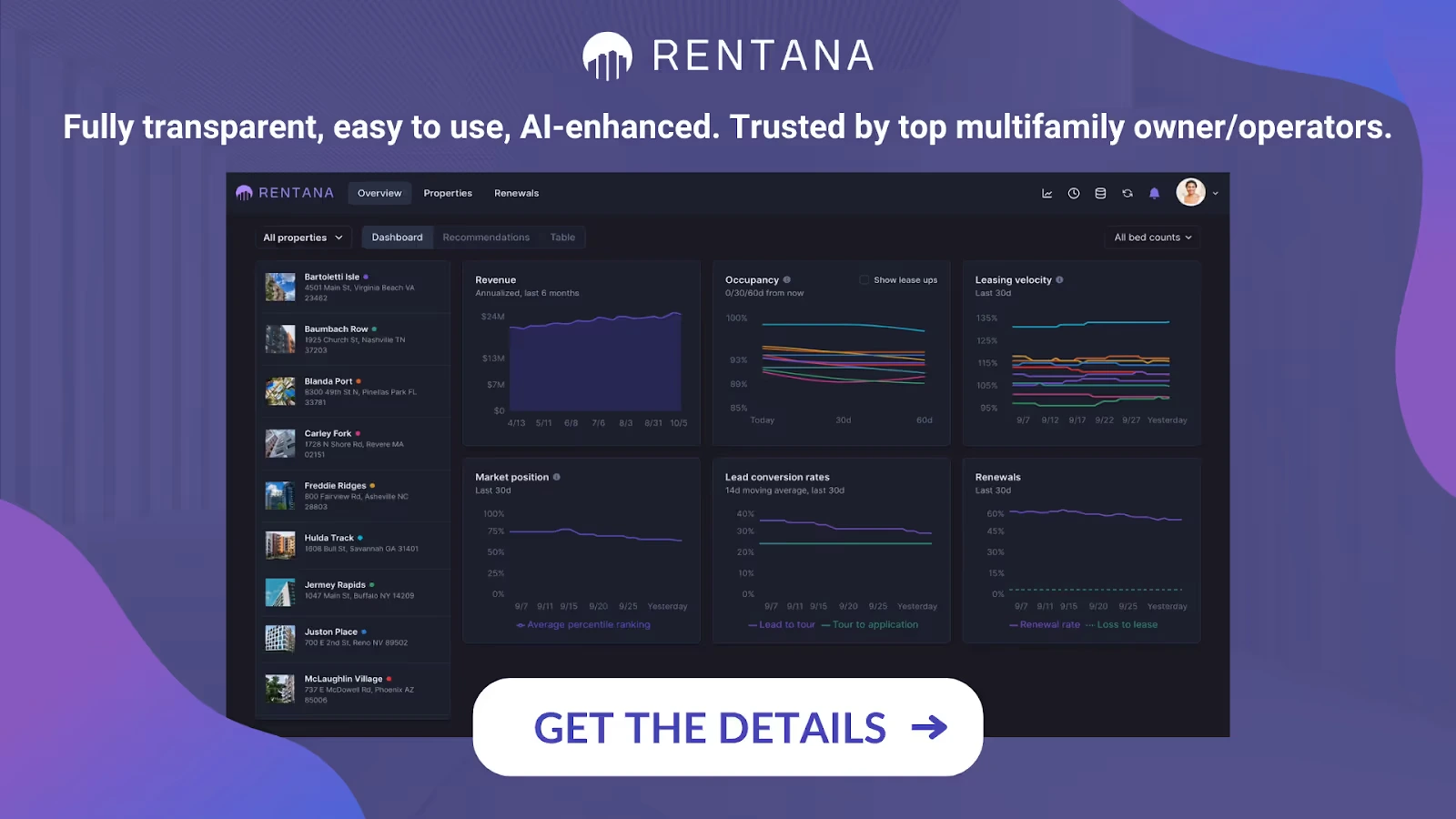
Rentana is positioned specifically as a visibility and prioritization platform for multifamily asset managers, connecting the signals that matter most into a single operational view without requiring manual data assembly before the analysis can begin.
- Portfolio dashboards with color-coded performance indicators give multifamily asset managers a real-time read on asset health across every property simultaneously. Which assets are on track. Which are drifting. Which needs attention now. No report required before the picture is visible.
- AI-generated property insights help surface changing conditions by summarizing what is happening at an asset, why it matters operationally, and the factors contributing to the shift. Rather than requiring teams to review dozens of reports and metrics individually, insights help focus attention on the performance changes most likely to influence occupancy, revenue, and asset performance.
- Predicted occupancy connects current leasing activity, renewal trends, and future availability to provide forward visibility into where occupancy is heading.
- Exposure forecasting surfaces where lease expiration concentration is building before it creates vacancy pressure, giving multifamily asset managers the lead time to respond strategically rather than reactively.
- Leasing velocity and renewal conversion visibility flag where pace is lagging against targets and where retention risk is building, so the multifamily asset manager can direct attention and coordinate the operational response before conditions have already shifted.
- Shared team visibility means leasing, revenue management, and asset management are all working from the same live data at the same time. The coordination work that used to require extra meetings happens naturally rather than sequentially.
- Metrics browser enables granular cross-portfolio analysis at the bedroom type and funnel stage level, surfacing patterns that property-level reviews are unlikely to catch on their own.
For multifamily asset managers who have been spending too much time assembling the picture and not enough time acting on it, Rentana is the platform built to change that ratio.
Don’t Miss:
- Real Estate Market Insights For Property Managers
- How to Create Multifamily Property Performance Dashboards
Conclusion
The multifamily asset manager role has always been about connecting ownership objectives to operational execution. What has changed is the amount of visibility, coordination, and forward-looking analysis required to do that effectively.
As multifamily performance becomes increasingly influenced by operational decisions rather than market momentum alone, asset managers are expected to identify changing conditions earlier, prioritize attention more effectively, and coordinate response across multiple teams. The role is evolving from performance reporting toward continuous performance management.
The asset managers who perform most consistently are not necessarily reviewing more reports. They are working from better visibility, stronger coordination, and a clearer understanding of how current operating conditions may influence future performance.