
Managing leasing at a single property is typically a contained operational challenge. Teams can usually identify where leasing momentum is strong, where friction is developing, and what operational response may be needed within a relatively visible environment.
Managing leasing across a multifamily portfolio is fundamentally different. The challenge is no longer just leasing execution. It becomes a coordination and visibility problem across assets operating under different strategies, responding to different market conditions, and moving at different operational speeds simultaneously.
One property is leasing well. Another in the same submarket is slowing for reasons that are not immediately obvious. A third is mid-renovation with temporarily reduced availability and a pricing strategy that does not match the rest of the portfolio.
A fourth is in lease-up and needs to be monitored against initial projections on a weekly basis. Each of these situations requires a different operational response, and without a connected portfolio view, attention often gets directed reactively rather than strategically toward the assets where operational risk or leasing pressure is actually greatest.
According to CBRE’s multifamily market outlook, the market has entered a more operationally focused phase where financial performance is being shaped less by aggressive rent growth and more by how efficiently properties are being managed. For portfolio-scale operators, that efficiency imperative is most acute in leasing, where the gap between knowing what is happening across every asset and reacting to what has already happened is where occupancy and revenue outcomes are ultimately determined.
This article is specifically for operators managing leasing activity across multiple properties simultaneously.
Related:
- Amenity Fee Pricing: How Multifamily Operators Get It Right
- How to Manage a Multifamily Portfolio Smarter
Why Leasing in Multifamily Gets More Complex as Portfolio Size Grows

The complexity of managing leasing across a portfolio is not simply a function of more units to fill. It is a function of more variables moving simultaneously, across assets that behave differently, managed by teams that are often working from disconnected systems with no common understanding of where portfolio leasing actually stands.
1. No Single Shared View of Leasing Activity
At a single property, a leasing manager can often maintain a relatively intuitive understanding of current leasing conditions. They know which units are available, which prospects are in the pipeline, which renewals are coming up, and where the team needs to focus.
At portfolio scale, that level of operational awareness becomes significantly harder to maintain manually. There are too many assets, moving variables, and disconnected data sources for any individual or team to reliably synthesize into a clear portfolio-wide view on a consistent basis.
Without a connected view, the default is to review each asset separately and sequentially. That process takes time, and by the time the full picture is assembled, conditions at the first asset reviewed have already moved on. Portfolio leasing management built around sequential property reviews is almost always operating slightly behind changing conditions at the asset level.
2. Conditions Vary Across Assets in Ways that are not Always Visible
Two properties in the same submarket can be performing very differently at the same time. One is leasing at pace. The other is softening. The reasons may be obvious, a pricing misalignment, a demand shift in a specific bedroom type, a funnel conversion problem at a specific stage. Or they may not be, and without the operational granularity to distinguish between a pricing issue, a demand issue, or a funnel execution issue, the response becomes less targeted and less reliable.
At portfolio scale, this problem multiplies. A leasing slowdown that looks like a market condition at one asset may be a property-specific issue at another. A conversion rate that looks healthy at the portfolio level may be masking significant underperformance at a specific funnel stage across multiple properties.
The operational patterns that matter most are often hidden inside portfolio averages and only become visible when teams can evaluate leasing performance at the right level of granularity across the full portfolio simultaneously.
3. Teams Working from Disconnected Systems
Leasing teams, asset managers, and marketing teams in a portfolio operation are often working from different systems with different data sets updating on different timelines. The leasing team is in their CRM. Asset management is pulling from the PMS. Marketing is looking at lead source performance in a separate platform.
Without shared operational visibility, coordinating marketing spend, aligning leasing focus with forward exposure, and responding to changing conditions across multiple assets becomes significantly more difficult because the information supporting those decisions remains fragmented across disconnected systems.
4. Attention Gets Distributed Rather than Directed
Perhaps the most consequential problem at portfolio scale is this one. Without a connected view that surfaces where leasing needs attention most urgently, attention gets distributed equally across assets rather than directed to the ones where the risk is greatest. An asset manager with fifteen properties to monitor cannot give each one the same level of attention and do it well.
The challenge is not monitoring every asset equally. It is proactively identifying quickly and reliably which assets require immediate attention, which conditions are beginning to shift, and which properties are performing within expectations without unnecessary intervention.
That question, which is fundamentally a data and visibility question rather than a capacity question, is what portfolio-scale leasing solutions need to answer. And it is where the gap between property-level tools and purpose-built portfolio platforms is most consequential.
Why Different Multifamily Asset Require Different Leasing Configurations
The visibility problem covered earlier is challenging enough on its own. What makes it significantly more complex is that the assets in a real portfolio are not all the same kind of problem.
A stabilized asset, a lease-up, a value-add renovation, an affordable housing property, and a student housing community all require fundamentally different leasing approaches, different occupancy targets, different pricing configurations, and different definitions of what good performance actually looks like.
Managing fundamentally different asset strategies with identical configurations and benchmarks may create operational consistency on paper, but it often produces leasing conclusions that are difficult to interpret accurately.
A leasing velocity that looks slow for a stabilized asset may be exactly right for a value-add property mid-renovation. An occupancy target appropriate for a stabilized market-rate asset may not translate appropriately to an income-restricted or phased-renovation property. When operational configurations do not align with actual asset strategy, the resulting leasing analysis becomes significantly less reliable.
Top Picks:
- Multifamily Marketing Strategies that Actually Drive Leasing
- How to Improve Leasing Speed in Multifamily
Stabilized Assets
The leasing objective at a stabilized asset is maintaining occupancy within a target range while protecting revenue quality, managing exposure distribution, and sustaining consistent leasing performance over time.
The focus is less on maximizing short-term leasing velocity and more on maintaining operational stability while identifying performance drift early, before it compounds into a larger occupancy or pricing issue.
A gradual softening in renewal conversion, increasing days vacant within a specific layout, weakening funnel conversion at a particular stage, or exposure concentration building in upcoming months are the types of operational shifts worth identifying early.
At stabilized assets, small performance changes often compound quietly over time before becoming visible in occupancy or financial reporting, which makes early operational visibility significantly more valuable than reactive correction later.
Value-add and Renovation Assets
Value-add assets introduce complexity that stabilized asset benchmarks cannot account for. Temporarily reduced availability during make-ready periods, occupancy targets that reflect phased renovation schedules, and pricing that is designed to improve over time as unit quality increases all require configurations that differ from a stabilized asset in the same portfolio.
There is also an ROI dimension. Understanding whether renovation premiums are actually generating the leasing velocity and pricing uplift that justified the capital spend requires tracking amenity performance data alongside leasing outcomes at the unit level.
Lease-up Assets
Lease-up properties are where leasing strategy has the longest compounding consequences. Filling units quickly is an obvious objective. What is less obvious, and more consequential, is how expiration timing is managed during the initial lease-up period.
Filling units rapidly without managing expiration distribution carefully can create what operators commonly refer to as a “lease-up hangover”. Units begin vacating in year two before the initial new leasing has completed its cycle. Occupancy dips, and the property effectively has to lease up a second time.
The initial renewal strategy in year one is critical to ensuring the property completes the lease-up without that year-two exposure problem building underneath it. Monitoring lease-up performance against initial projections, while closely tracking expiration concentration and future exposure, is often what separates a stable lease-up from one that creates downstream occupancy pressure in later years.
Affordable and Income-restricted Assets
Affordable housing properties operate under constraints that market-rate configurations cannot accommodate. Different occupancy calculations, rent control requirements, income qualification processes, and compliance obligations all affect how pricing and renewal strategy are configured. Blending affordable and market-rate performance data without separate configurations produces numbers that are difficult to interpret and impossible to act on accurately.
Rentana has specific affordable unit settings that allow these assets to be configured and tracked according to their actual operating parameters rather than being forced into a market-rate framework that does not apply.
Mixed-income Assets
Properties with both market-rate and affordable units require separate configurations and performance tracking within the same property. The market-rate units and the income-restricted units behave differently, respond to different demand signals, and require different renewal and pricing strategies. Treating them as a single asset for leasing performance purposes obscures the picture on both sides.
Why Manual Management of These Strategies Creates Inconsistency
When portfolio operators manage these fundamentally different asset strategies manually, with the same tool settings applied across every property, the configurations stop reflecting actual strategy almost immediately. Occupancy targets that do not match the asset's current phase.
Pricing guardrails set for a stabilized asset applied to a lease-up. Velocity benchmarks that do not account for a renovation period. Each of these configuration mismatches can create leasing data that appears operationally useful while failing to accurately reflect the actual objectives or lifecycle stage of the asset.
Property-level configuration is what allows each asset to operate within the right parameters for its specific strategy. Occupancy targets, pricing guardrails, leasing velocity expectations, and expiration management settings can all be configured at the property level so the data the team is working from reflects actual strategy rather than a generic framework applied uniformly across assets that are not generic.
Read Also:
- How to Centralize Leasing Without Losing Resident Experience
- The Best Lease Renewal Software for Real Estate
Rentana: The Best Leasing Solution for Managing Multiple Multifamily Assets
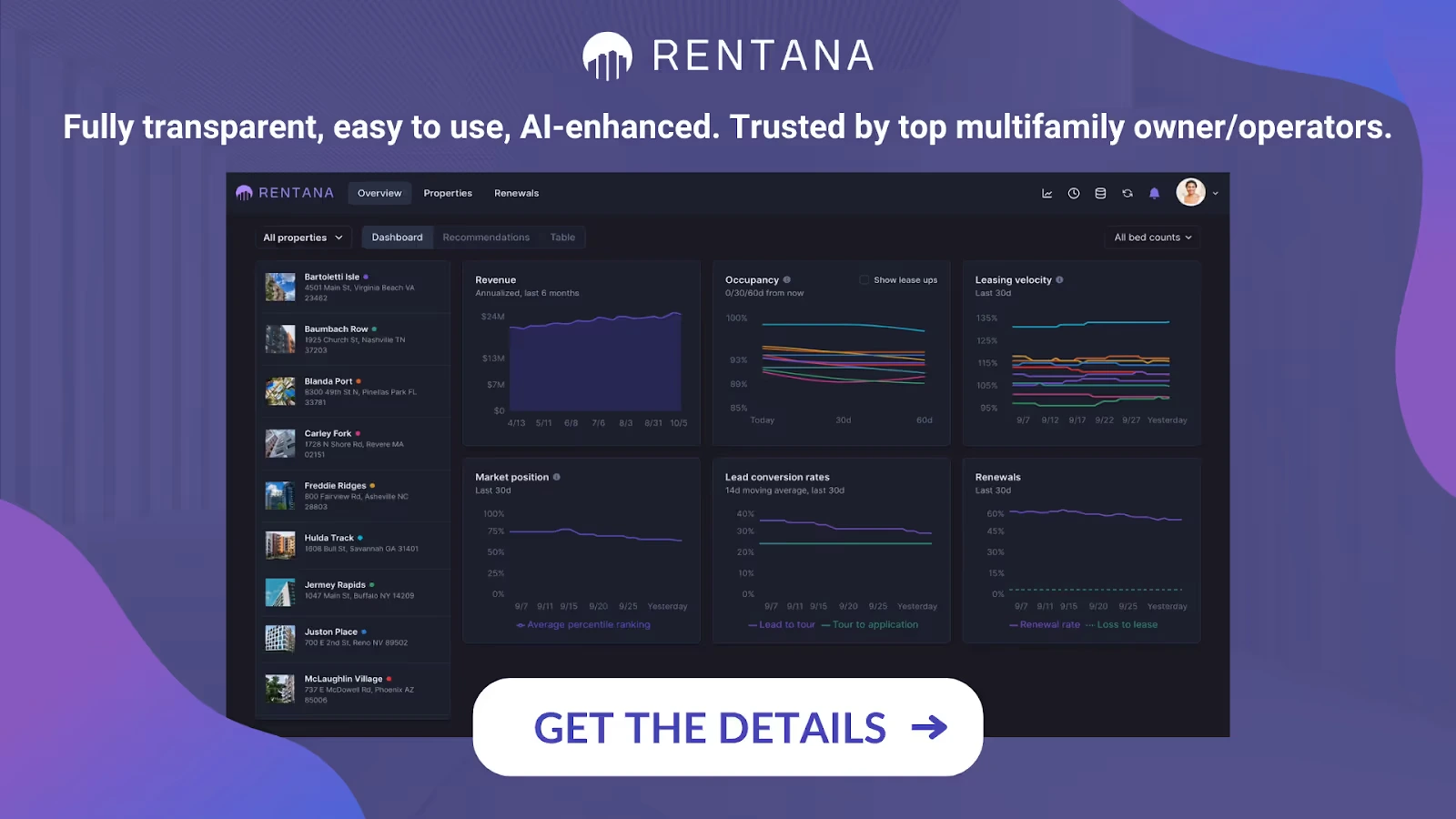
The right leasing solution for a portfolio-scale operator is built around the specific coordination, visibility, and configuration challenges that emerge when leasing activity is happening simultaneously across multiple assets with different strategies, different market conditions, and different definitions of what good performance looks like.
Rentana is built specifically for this. Not as a property-level leasing tool scaled up, but as a platform designed from the ground up around the requirements of operators managing portfolios where the complexity is not just volume but coordination, configuration, and the ability to direct attention to the right place at the right time.
1. Portfolio-level Visibility with Property and Bedroom-level Detail
Rentana's portfolio dashboard gives operators a color-coded read on leasing performance across every asset simultaneously. Which properties are leasing at pace. Which are drifting. Which property needs attention now. That visibility is available without relying on disconnected manual reporting workflows or sequential property-by-property review processes.
From the portfolio view, operators can drill down into an individual property and then into specific bedroom types or custom unit groups without switching systems. A leasing velocity gap that shows up at the portfolio level can be traced to a specific floor plan at a specific asset in a few clicks. The ability to move from portfolio-level visibility into the specific operational driver within the same workflow is what helps teams evaluate conditions more efficiently across multiple assets simultaneously.
2. Leasing Velocity Tracking Connected to Forward Availability
Knowing current leasing velocity is a useful context. Knowing whether that velocity is sufficient to hit occupancy targets given forward availability and upcoming expirations is what actually supports a decision.
Rentana connects leasing velocity to predicted occupancy and exposure forecasting so teams understand not just how fast units are leasing but whether that pace is enough given what is coming down the pipeline.
A property leasing eight units per month looks different when it has twelve expirations quietly building in a 45-day window than when it has four. That context, leasing velocity evaluated alongside forward availability and predicted occupancy, is what helps teams understand whether current leasing performance is aligned with future occupancy objectives rather than viewing leasing pace in isolation. Rentana surfaces both together so the response is calibrated to actual forward conditions rather than current pace alone.
For more on forward occupancy analysis and exposure forecasting, see Rentana’s article on multifamily portfolio analytics.
3. Funnel Conversion Signals that Distinguish Pricing from Demand from Execution
When leasing slows at a portfolio asset, the response depends entirely on what is driving the slowdown. A pricing problem requires a different response than a demand volume problem, which requires a different response than a funnel execution problem at a specific stage. Treating all three conditions the same way can lead teams toward operational responses that do not address the actual underlying issue.
Rentana's funnel conversion signals show where in the pipeline prospects are dropping off and whether the issue is volume at the top of the funnel or conversion at a specific stage within it.
A property with healthy inquiry volume but low tour-to-application conversion has a different problem than one with low inquiry volume and strong conversion on the prospects who do come through. Rentana helps teams evaluate those distinctions more clearly so operational responses can be aligned more closely with the actual source of leasing friction.
4. The Metrics Browser for Granular Cross-portfolio Analysis
One of Rentana's most distinctive capabilities for portfolio-scale operators is the metrics browser, a reporting tool that enables granular cross-portfolio analysis across dozens of metrics to evaluate very specific performance metrics. An operator can compare two-bedroom tour conversion rates across every asset in the portfolio at once, identifying where a specific funnel stage is underperforming portfolio-wide rather than reviewing each property individually and hoping to spot the pattern manually.
This type of cross-portfolio analysis helps operators identify operational patterns that are often difficult to detect through isolated property-level reviews alone. A funnel conversion problem that looks like a property-specific issue may be a portfolio-wide pattern in a specific bedroom type.
A pricing misalignment that is creating friction at one asset may be present at three others in the same form. The metrics browser allows those patterns to be evaluated in a centralized, queryable format rather than leaving them fragmented across separate property reports and disconnected workflows.
Read Also:
- The Best Lease Management Software for Multifamily Real Estate
- Types of Commercial Real Estate Leases Explained
5. Property-level Configuration Aligned to Each Asset's Strategy
Rentana's property-level configuration capability is what allows each asset in a portfolio to operate within the right parameters for its specific strategy rather than being measured against a generic framework that does not reflect its actual objectives. Occupancy targets, pricing guardrails, leasing velocity expectations, and exposure management settings can all be configured at the property level.
A lease-up asset gets the configuration appropriate for a property still building its initial rent roll, with close attention to expiration distribution and velocity against initial projections. A value-add asset mid-renovation gets settings that reflect temporarily reduced availability and a pricing trajectory designed to move with improving unit quality.
An affordable or income-restricted asset gets the specific configurations that reflect its compliance requirements and occupancy calculations. Each asset operates within the right framework for what it actually is, which means the data it produces reflects actual strategy rather than a uniform template applied across fundamentally different situations.
6. AI-generated Insights that Surface where Leasing Needs Attention and Why
The capabilities above give portfolio operators the visibility to see what is happening across every asset. Rentana’s operational insights build on that visibility by helping teams identify where leasing conditions may require additional attention, providing supporting context around what operational factors may be contributing to the shift, and helping teams evaluate potential responses more efficiently.
A leasing velocity gap building at a specific asset, driven by softening conversion at the tour-to-application stage in a specific bedroom type, surfaces as a specific insight with context and a supported response. Teams no longer need to rely entirely on manually reviewing disconnected reports to identify where operational conditions may be changing across the portfolio. The supporting operational context helps teams move more quickly from visibility into evaluation and coordinated response.
7. Shared Visibility Across Leasing and Asset Management
For portfolio-scale operators, one of the most persistent coordination challenges is that leasing teams and asset management are rarely working from the same information at the same time. Rentana's shared team visibility means both teams are looking at the same live data simultaneously.
When leasing velocity, exposure conditions, or predicted occupancy begin shifting at an asset, the relevant teams are working from the same operational view simultaneously. That shared visibility helps reduce delays between changing conditions and coordinated operational response across teams.
For operators managing leasing across multiple multifamily assets, Rentana is the platform built around the actual complexity of that challenge, not a property-level tool applied at scale, but a purpose-built portfolio leasing solution designed for the coordination, visibility, and configuration requirements that portfolio-scale operations actually demand.
Don’t Miss:
- How Do Companies Keep Track of Lease Expiration Dates
- Best AI Leasing Assistants for Multifamily Teams
Conclusion on Leasing Solutions for Multiple Multifamily Assets
Leasing at a portfolio scale is not the same as leasing at a single property, and the tools that support teams need to reflect that difference. The challenge is not just filling units. It is maintaining visibility across assets moving at different speeds, understanding what is driving performance gaps before they show up in occupancy, managing fundamentally different asset strategies without losing the configuration that makes each one work, and directing attention to the right place at the right time.
The operators managing this effectively are not necessarily the ones working harder. They are the ones working from a connected operational view that helps teams align on the right response faster and with more consistency across the portfolio.
That is the operational challenge Rentana is designed to support.