
Multifamily real estate enters 2026 at a transitional point. The wave of new apartment supply that pressured many markets over the past several years is beginning to moderate, rental demand remains supported by persistent barriers to homeownership, and capital markets are showing signs of improvement after a slower investment period.
But the case for multifamily in 2026 is not simply that the market is improving. It is that multifamily remains a durable asset class at a moment when performance depends more heavily on market selection, asset strategy, and operational execution.
According to CBRE's U.S. Real Estate Market Outlook 2026, would-be homeowners continue to face significant affordability barriers, including elevated mortgage rates, high home prices, a shortage of single-family homes, and a substantial monthly cost premium to buy versus rent. Those conditions continue to support rental demand by keeping many households in the renter pool longer than they may have expected.
At the same time, multifamily investment decisions in 2026 require a clear view of risk. Market performance remains uneven across geographies and asset classes, and higher operating costs, interest rate uncertainty, and lingering supply pressure in some markets continue to affect returns.
This article explains why multifamily real estate remains worth considering as an investment in 2026, the public market conditions supporting the asset class, the risks investors should evaluate, and why operational visibility matters more than ever during the hold period.
Related:
What the Multifamily Market Looks Like for Investors in 2026
The multifamily market in 2026 is not a uniform opportunity. It is a market in transition, where the conditions that created challenges over the past several years, elevated supply, slower rent growth in some markets, and elevated concession pressure, are beginning to improve, but unevenly across geographies and asset classes.
For investors, the opportunity is not simply based on the overall direction of the market. Performance will continue to depend on selecting the right markets, understanding asset-specific conditions, and having the operational visibility needed to execute effectively throughout the hold period.
1. Supply Is Moderating as the Construction Cycle Changes
The construction wave that created significant competitive pressure in many markets is beginning to moderate. As fewer new units enter the market, existing assets in markets where supply pressure has been absorbed may experience improving operating conditions.
However, supply trends remain highly localized. Some markets, particularly those that experienced significant development growth, are still working through elevated inventory and may continue to face competitive pressure before conditions fully normalize.
For investors, the opportunity is not simply that new supply is declining. It is understanding which markets have moved through the most difficult part of the cycle and which assets are positioned to benefit as competitive pressure decreases.
2. Demand Fundamentals Remain Supported by Housing Affordability Challenges
The long-term demand drivers supporting multifamily remain intact, particularly as homeownership continues to be challenging for many households.
According to CBRE’s U.S. Real Estate Market Outlook 2026, would-be homeowners continue to face affordability challenges, including elevated mortgage rates, high home prices, and a significant monthly cost premium to buy versus rent. These conditions continue to support rental demand by keeping many households in the renter pool longer than they may have expected.
Multifamily demand in 2026 is not driven by a single factor. It is supported by households who cannot afford to purchase, existing homeowners who are less likely to move because of favorable mortgage rates, and demographic trends that continue to support rental housing demand.
3. Investment Activity Is Recovering, but Selectivity Matters
Capital markets conditions have improved after a period of constrained transaction activity, creating more opportunities for investors evaluating multifamily assets.
According to Newmark’s multifamily capital markets research, improving debt liquidity and stronger transaction activity reflect a more constructive environment for multifamily investors entering 2026.
However, recovering investment activity does not mean every asset will perform equally. Investors will continue to differentiate between assets based on location, operating performance, public market conditions, and the ability of the management team to execute the business plan.
The Risks are Real and Worth Acknowledging
While the broader multifamily outlook is improving, performance remains highly dependent on geography and asset strategy.
Markets that experienced significant supply growth may continue facing elevated competition, slower rent growth, and higher concession pressure as they absorb newly delivered inventory. Class A assets in high-supply markets may experience different challenges than more supply-constrained Class B and C assets.
According to PwC and ULI’s Emerging Trends in Real Estate 2026, the real estate sector continues to face uncertainty from factors including construction costs, demographic shifts, and the path of interest rates. In this environment, performance increasingly depends on operational execution rather than market tailwinds alone.
For multifamily investors, that distinction matters. The assets that perform best will not necessarily be those in the strongest markets. They will be the assets where operators have the visibility, processes, and decision-making infrastructure needed to respond as conditions change.
Top 7 Reasons to Invest in Multifamily Real Estate in 2026
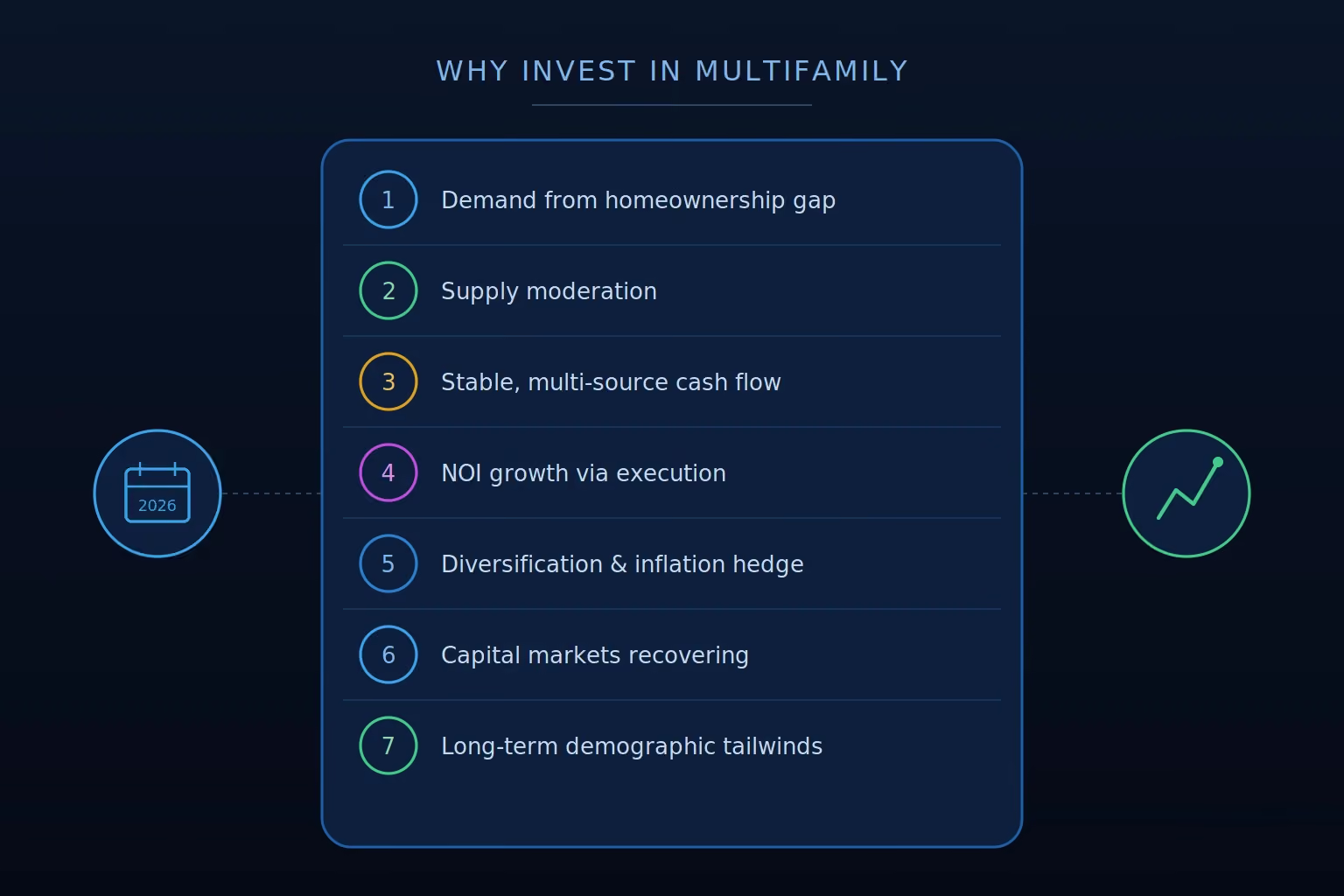
- Consistent Demand Driven by Homeownership Barriers
- Supply Moderation Creating Better Public Market Conditions
- Stable Cash Flow From Multiple Income Streams
- NOI Growth Potential Through Operational Execution
- Portfolio Diversification and Inflation Protection
- Recovering Investment Activity and Capital Markets
- Long-Term Demographic Tailwinds
1. Consistent Demand Driven by Homeownership Barriers
One of the long-term strengths of multifamily real estate is the continued demand for rental housing. While renter preferences and publicmarket conditions change over time, structural barriers to homeownership continue to support apartment demand.
In 2026, many households continue to face challenges entering the for-sale housing market due to elevated home prices, mortgage rates, and limited affordability. According to CBRE’s U.S. Real Estate Market Outlook 2026, these affordability challenges continue to support multifamily demand by keeping more households in the rental market for longer periods of time.
This does not mean every market or asset will perform equally. Demand fundamentals remain strongest when combined with the right location, employment drivers, affordability dynamics, and asset positioning.
For investors, the takeaway is that multifamily benefits from a broad and durable renter base supported by both lifestyle preferences and economic realities. The long-term demand foundation remains one of the reasons multifamily continues to be viewed as a resilient real estate category.
2. Supply Moderation Creating Better Market Conditions
The multifamily market is moving through the final phase of an unusually large construction cycle. New supply created meaningful competitive pressure in many markets over the past several years, impacting occupancy, rent growth, and concession levels.
As new deliveries begin to moderate, conditions are expected to improve in markets where the largest supply pressures have already been absorbed. Fewer new units entering the market can reduce competitive pressure on existing assets and create a more favorable operating environment for well-positioned properties.
However, supply trends remain highly localized. Some markets, particularly those that experienced significant development growth, will continue working through elevated inventory while other markets may experience improving fundamentals sooner.
For investors, the opportunity is not simply that supply is declining. It is identifying assets and markets where supply, demand, and operating conditions are moving in a direction that supports long-term performance.
Top Picks:
- What is Multifamily Syndication in Real Estate?
- How to Conduct a Tenant Retention Analysis for Multifamily Properties
3. Stable Cash Flow From Multiple Income Streams
Multifamily real estate provides investors with multiple sources of recurring revenue compared with many other real estate asset classes.
Rather than relying on a single tenant or lease, multifamily assets generate income across multiple units, which helps distribute vacancy risk across the portfolio. A single move-out in a 200-unit community has a different financial impact than losing a single tenant in a commercial asset with one or a small number of occupants.
Beyond base rental income, many multifamily assets also generate additional revenue through sources such as parking, storage, and other resident services.
The combination of recurring rental income and multiple revenue streams creates the cash flow characteristics that have historically made multifamily attractive to investors.
4. NOI Growth Potential Through Operational Management
In the current multifamily environment, returns are increasingly determined by how well an asset is operated rather than by public market conditions alone.
While acquisition strategy and market selection establish the investment opportunity, operational execution determines whether the asset ultimately delivers the performance that was projected. Pricing decisions, renewal retention, expense management, leasing performance, and exposure management all directly influence net operating income (NOI), which is a primary driver of asset value.
Small operational improvements can compound over the hold period. Improving renewal conversion reduces turnover costs and vacancy loss. Better pricing alignment helps capture available revenue opportunities. More proactive exposure management allows teams to address future occupancy risk before it affects performance.
For investors, this means the ability to understand what is happening at the asset level, and respond quickly when conditions change, has become a critical component of value creation. In 2026, operational visibility is not simply a management tool; it is an investment performance advantage.
5. Portfolio Diversification and Inflation Hedge
Multifamily has historically attracted investors because it combines recurring rental income with the ability to adjust rents more frequently than many other real estate asset classes.
Because multifamily leases typically reset annually, operators have more opportunities to adjust pricing as conditions change. This provides some ability to respond to inflationary pressures and changing operating costs.
However, inflation protection is not automatic. When markets experience oversupply or weaker demand, rent growth may lag behind expense increases. The current cycle has demonstrated that asset performance depends on the balance between demand, supply, and operating execution.
For investors, the value of multifamily diversification comes from the combination of recurring income, multiple revenue sources, and the ability to actively manage performance throughout the investment period.
6. Recovering Investment Activity and Capital Markets
After a period of constrained transaction activity, capital markets conditions are beginning to improve for multifamily investors.
Improving debt liquidity, stabilizing pricing expectations, and renewed investor interest are creating a more constructive environment for evaluating opportunities. According to Newmark’s 1Q26 U.S. Multifamily Capital Markets Conditions & Trends report, multifamily debt liquidity remained strong, with debt originations increasing year over year as public market conditions improved.
However, recovering investment activity does not mean every asset will perform equally. Investors remain focused on assets with strong fundamentals, realistic underwriting assumptions, and clear operational improvement opportunities.
The opportunities in 2026 are likely to favor investors who combine disciplined acquisition strategies with strong asset management capabilities.
Read Also:
- How to Maximize ROI on Multifamily Investments
- How to Improve Multifamily Operations Team Efficiency
7. Long-Term Demographic Tailwinds
Beyond current public market conditions, long-term demographic trends continue to support demand for rental housing.
Younger households are increasingly reaching major life milestones later, including homeownership, as affordability challenges, elevated home prices, and mortgage costs make purchasing a home more difficult for many households. These conditions have contributed to longer renter lifecycles and continued demand for well-located rental housing.
According to CBRE’s U.S. Real Estate Market Outlook 2026, affordability barriers to homeownership, including elevated home prices, mortgage rates, and limited housing supply, continue to support multifamily demand.
These demographic and housing trends are not short-term market cycles. They represent longer-term shifts in how and where households choose to live.
For investors, the opportunity is not simply owning rental housing. It is owning well-positioned assets in markets where employment growth, affordability dynamics, and renter demand support long-term performance.
What Matters Operationally for Multifamily Investment Performance
The reasons to invest in multifamily are largely based on structural and market-level fundamentals. However, whether a specific asset delivers on those fundamentals is determined by what happens operationally throughout the hold period.
In today’s market, investors cannot rely solely on broad market tailwinds to drive performance. Returns increasingly depend on how effectively an asset is managed, how quickly teams identify changing conditions, and how consistently operational decisions align with the investment strategy.
Operational execution influences the performance factors that directly impact NOI, including pricing decisions, renewal retention, leasing velocity, expense management, and future availability risk. The difference between a property that meets its underwriting expectations and one that underperforms often comes down to whether teams have the visibility needed to identify changes early enough to respond.
For multifamily investors, the operational questions that matter most include:
- Are pricing decisions reflecting current demand conditions at the unit type level, or are they based on outdated assumptions?
- Are renewal conversations happening early enough to influence outcomes?
- Is lease expiration concentration identified before it creates vacancy pressure?
- Is leasing velocity being evaluated alongside future availability and occupancy goals?
- Are teams working from forward-looking performance signals or only reviewing historical results?
The challenge for many operators is not a lack of data. It is connecting the right signals quickly enough to support better decisions.
How Rentana Supports Multifamily Investment Performance
Rentana provides the operational visibility layer that helps investors and operators stay connected to asset performance throughout the hold period.
Rather than replacing acquisition analysis or investment underwriting, Rentana helps teams understand how operational decisions are influencing the asset after acquisition. It connects the signals that drive revenue performance, including pricing, leasing activity, renewal trends, exposure, and occupancy conditions, into a shared view of portfolio performance.
Key capabilities include:
- Portfolio dashboards that provide visibility into asset performance and highlight where attention may be needed
- Predicted Occupancy that connects current leasing activity, renewal trends, and future availability to show where occupancy is heading
- AI-generated property insights that help teams understand what is changing and why conditions may be shifting
- Exposure forecasting that identifies upcoming lease expiration concentration, notices to vacate, month-to-month behavior, and early termination risk
- Shared visibility across teams so leasing, revenue management, and asset management are working from the same operational picture
The value is not simply faster reporting. It is the ability to identify changing conditions early enough to influence outcomes.
For multifamily investors, operational performance is where the investment thesis becomes reality. The assets that perform best will not only be those purchased in the right markets, but those managed with the visibility and decision-making infrastructure needed to protect and improve returns over time.
Don’t Miss:
- Multifamily Property Performance: 5 Key Metrics to Track
- Multifamily Rent Reporting: Complete Guide
Conclusion
Multifamily real estate in 2026 remains supported by durable demand drivers, improving supply conditions, and recovering investment activity. However, the current environment requires a more disciplined approach than previous market cycles.
The investors who perform best will not simply be those who acquire assets in strong markets. They will be the ones who understand how operational decisions influence performance throughout the hold period.
Pricing strategy, renewal execution, leasing performance, exposure management, and expense control all contribute to whether an asset achieves the returns originally projected. In a market where conditions vary significantly by geography and asset type, visibility into what is changing, and the ability to respond quickly, has become a critical component of investment performance.
Multifamily remains an attractive asset class because of its long-term demand fundamentals, but successful investing requires more than selecting the right property. It requires the operational discipline and decision-making infrastructure to protect NOI, identify opportunities, and adjust as market conditions evolve.
The opportunity in 2026 is not simply owning multifamily real estate. It is owning and operating assets with the visibility needed to maximize their potential over time.