Most multifamily professionals have a general sense of what a revenue manager does. They review pricing recommendations. They manage renewals. They monitor leasing performance.
That description is accurate, but incomplete.
A multifamily revenue manager is ultimately responsible for translating asset strategy into the day-to-day pricing, leasing, renewal, and exposure decisions that drive revenue performance.
That role has become more consequential as the market has shifted away from an environment where broad rent growth could mask weaker execution. According to the National Apartment Association, multifamily operators are placing greater emphasis on cost efficiency, pricing discipline, and operational performance as NOI growth becomes harder to achieve through rent growth alone.
In that environment, the revenue manager who identifies a shift in leasing velocity, exposure, or performance position early has more time and more options to respond than one working primarily from lagging reports.
This article covers what a multifamily revenue manager actually does, how the role differs from property and asset management, and the skills and tools that support strong revenue performance.
Related:
- How to Build a Multifamily Revenue Forecast for Budget Season
- Apartment Revenue Management: Complete Guide
What Is a Multifamily Revenue Manager?
A multifamily revenue manager is responsible for translating an asset’s short- and long-term strategy into the pricing, leasing, renewal, and exposure decisions that drive revenue performance.
That means more than determining whether rents should move up or down. Revenue managers evaluate how pricing should respond to occupancy goals, leasing velocity, forward exposure, seasonality, and the broader financial objectives of the asset.
When conditions are strong, the role may focus on capturing rent growth and strategically increasing premiums. When an asset faces headwinds, the revenue manager’s role becomes equally strategic: determining where to hold pricing, where to create demand, how aggressively to protect retention, and which additional levers, such as lease-term pricing, concessions, renewal strategy, or marketing investment, can help maintain performance.
The role sits between property-level execution and asset management oversight. Leasing teams provide the pipeline activity and conversion data that informs strategy. Asset managers and ownership establish the financial objectives and occupancy expectations. The revenue manager connects those inputs into a day-to-day operating strategy that keeps pricing, leasing, renewals, and exposure aligned with the asset’s goals.
How the role differs from property management and asset management
Property management focuses on executing day-to-day operations: leasing apartments, managing resident relationships, coordinating maintenance, and operating the property effectively.
Asset management focuses on whether those operations are producing the financial outcomes the investment strategy requires.
Revenue management sits between those two functions. The revenue manager translates asset-level objectives into the pricing, renewal, leasing, and exposure strategies that support occupancy, effective rent, and NOI goals.
That requires visibility into both current property performance and where conditions are heading. A property manager may be focused on what is happening at the asset today. An asset manager may be focused on whether the property is tracking toward its broader financial objectives.
The revenue manager needs to connect both perspectives to a forward view of demand, availability, lease expirations, leasing velocity, and public market data context so that decisions made today remain aligned with where the asset is expected to be in the months ahead.
Why the role has become more consequential
In a market where broad rent growth did much of the performance work, revenue management decisions had more room for error.
That margin has narrowed.
When rent growth is limited and operating costs are under pressure, the timing and precision of revenue decisions matter more. A revenue manager who identifies slowing leasing velocity, growing exposure, or weakening demand early has more options to respond before those conditions translate into vacancy or lost revenue.
That response may involve refining pricing, adjusting premiums, changing lease-term strategy, protecting renewals, increasing marketing support, or holding steady while short-term volatility works through the market.
The value of the role is therefore not simply making pricing decisions. It is recognizing when conditions are changing, determining what those changes mean for the asset strategy, and choosing the right response early enough to influence the outcome.
Top Picks:
What Does a Multifamily Revenue Manager Do?
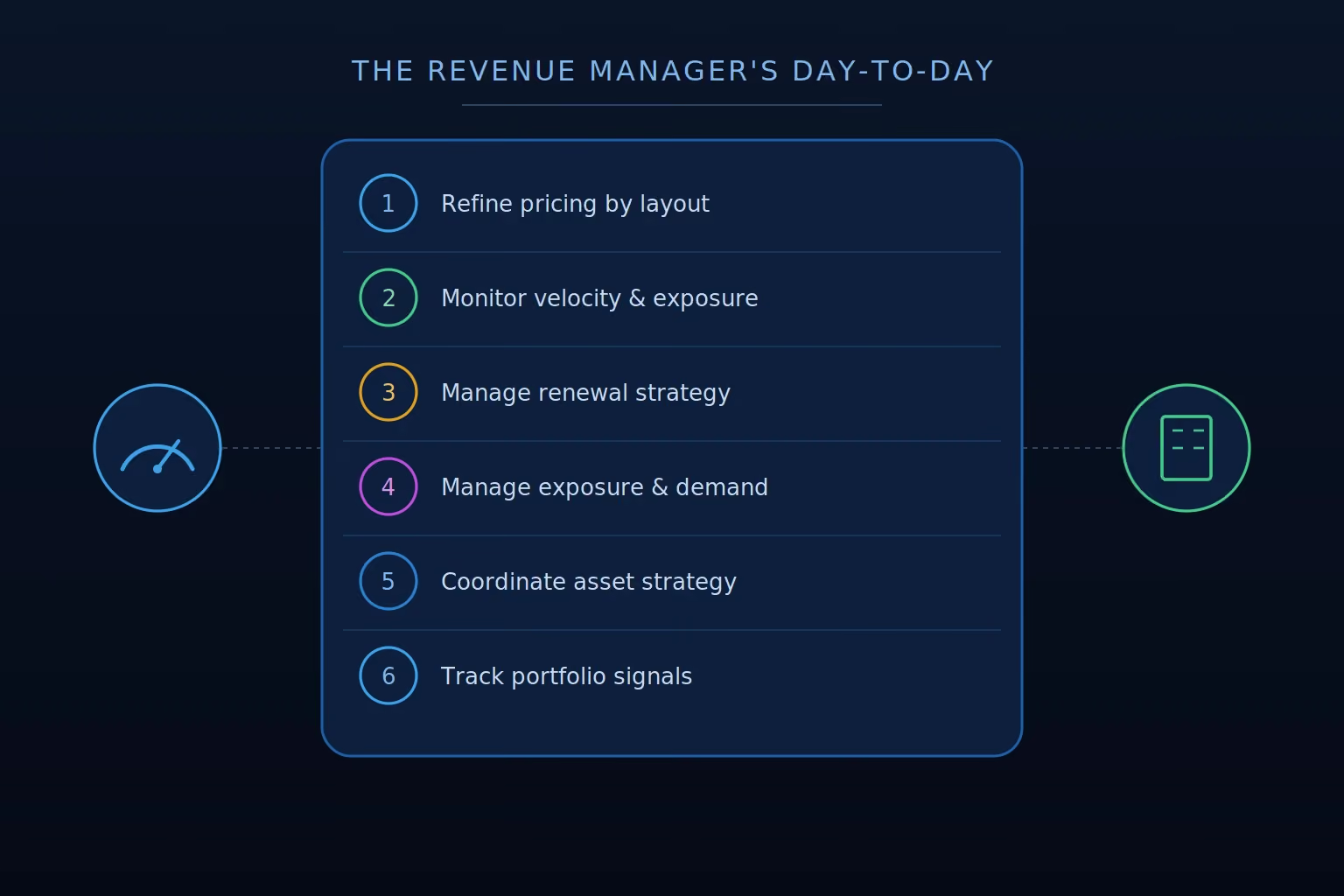
The day-to-day work of a multifamily revenue manager centers on continuously aligning asset strategy with current performance and forward-looking conditions.
- Continuously Refine Pricing by Layout
- Monitor Leasing Velocity, Exposure, and Occupancy Performance
- Manage Renewal Strategy
- Proactively Manage Exposure and Future Demand
- Coordinate Asset Strategy Across Teams
- Track Portfolio Performance and Surface Early Signals
1. Continuously Refine Pricing by Layout
Revenue managers continuously evaluate whether pricing is supporting the asset’s occupancy, revenue, and performance goals.
That includes reviewing base rents by layout, amenity premiums, leasing velocity, current and forward exposure, demand, and occupancy targets. The objective is not simply to keep rents competitive. It is to determine whether the current pricing structure is producing the leasing pace and revenue performance the asset strategy requires.
Pricing refinement may involve increasing or decreasing base rents, adjusting amenity premiums, changing lease-term pricing, or holding rates steady when short-term movement does not warrant a response.
Rentana supports this process with pricing recommendations by layout and the reasoning behind each recommendation, as well as amenity performance insights, giving revenue managers additional context while leaving the final strategy and decision in their hands.
2. Monitor Leasing Velocity, Exposure, and Occupancy Performance
Leasing velocity only becomes useful when it is evaluated against what the asset needs to achieve.
Revenue managers compare current leasing pace with occupancy goals, upcoming availability, and exposure by layout to determine whether demand is keeping pace with what is expected to return to market.
If a layout is leasing more slowly than the volume of upcoming availability requires, that may signal the need to adjust pricing, premiums, marketing support, lease terms, or another part of the strategy. The goal is to identify that imbalance early, before it becomes an occupancy problem.
3. Manage Renewal Strategy
Renewal strategy should support both retention and the broader revenue goals of the asset.
Revenue managers evaluate renewal pricing in the context of current pricing the resident’s existing rent, forward exposure, seasonal demand, replacement economics, and the asset’s desired rent growth.
The objective is to use consistent, fair housing-compliant criteria to balance rent growth, retention, and future exposure.
4. Proactively Manage Exposure and Future Demand
Exposure management is not simply monitoring how many leases are scheduled to expire. Revenue managers use forward exposure to shape strategy before availability reaches the market.
That can include adjusting lease-term premiums to redistribute future expirations, protecting renewals in periods where exposure is already elevated, increasing marketing investment ahead of anticipated softness, or using pricing and concessions strategically when demand is unlikely to absorb upcoming availability at the current pace.
Rentana’s exposure forecasting helps revenue managers identify where scheduled expirations are building by layout and time period. When Predicted Availability is enabled, teams can also incorporate notices to vacate, historical month-to-month behavior, and anticipated unplanned availability from early terminations into that forward view.
5. Coordinate Asset Strategy Across Teams
Revenue management decisions affect leasing, property operations, asset management, and ownership, so strong execution depends on alignment across teams.
The revenue manager helps translate asset-level goals into an actionable operating strategy and ensures that pricing, renewal, exposure, and leasing decisions remain consistent with those goals as conditions change.
That may mean explaining why pricing is being held despite short-term pressure, why a particular layout requires more aggressive demand support, or why retention should take priority over rent growth during a high-exposure period.
The role is not simply to communicate decisions. It is to make sure each team understands the strategy behind them and is working toward the same performance objective.
Related:
- 11 Multifamily Housing Trends Shaping the Market
- How to Prepare Multifamily Properties for Hurricane Season
6. Track Portfolio Performance and Surface Early Signals
For revenue managers supporting multiple assets, portfolio visibility is critical.
The goal is to identify where performance is beginning to shift before those changes become larger occupancy or revenue problems. That may include slowing leasing velocity, increasing exposure, weakening renewal activity, or an asset beginning to drift from its occupancy or revenue goals.
Rentana’s portfolio dashboards help revenue managers compare performance across assets, while AI-generated Insights can surface meaningful changes in property performance metrics and provide context around what may be driving them.
That allows revenue managers to prioritize where attention is needed most rather than relying on manual property-by-property reviews or waiting for issues to appear in historical reporting.
What Skills and Tools Make a Strong Revenue Manager
The revenue manager role sits at the intersection of data analysis, strategic thinking, commercial judgment, and cross-functional communication. Strong performance requires more than knowing how to read pricing recommendations or reports. It requires understanding what the data means for the asset and knowing which lever to use in response.
Core Skills
- Data literacy: Understanding leasing velocity, exposure, occupancy, pricing, renewals, and forward availability together rather than evaluating each metric in isolation.
- Pattern recognition: Identifying whether a performance issue is being driven by pricing, demand, funnel conversion, exposure, or another factor before deciding how to respond.
- Strategic thinking: Connecting day-to-day decisions to the asset’s short- and long-term goals rather than reacting to individual metrics.
- Commercial judgment and resourcefulness: Knowing how to use the full set of available levers, pricing, premiums, lease terms, renewals, concessions, marketing, and timing, to protect performance when conditions change.
- Cross-functional communication: Translating revenue strategy into clear direction that property teams, asset managers, and ownership can understand and execute.
- Judgment about when to act: Recognizing the difference between a meaningful signal that requires intervention and short-term movement that does not justify changing strategy.
- Comfort with forward-looking analysis: Managing based on where occupancy, availability, and demand are heading rather than relying only on historical performance.
What the Right Tools like Rentana can do for Revenue Managers
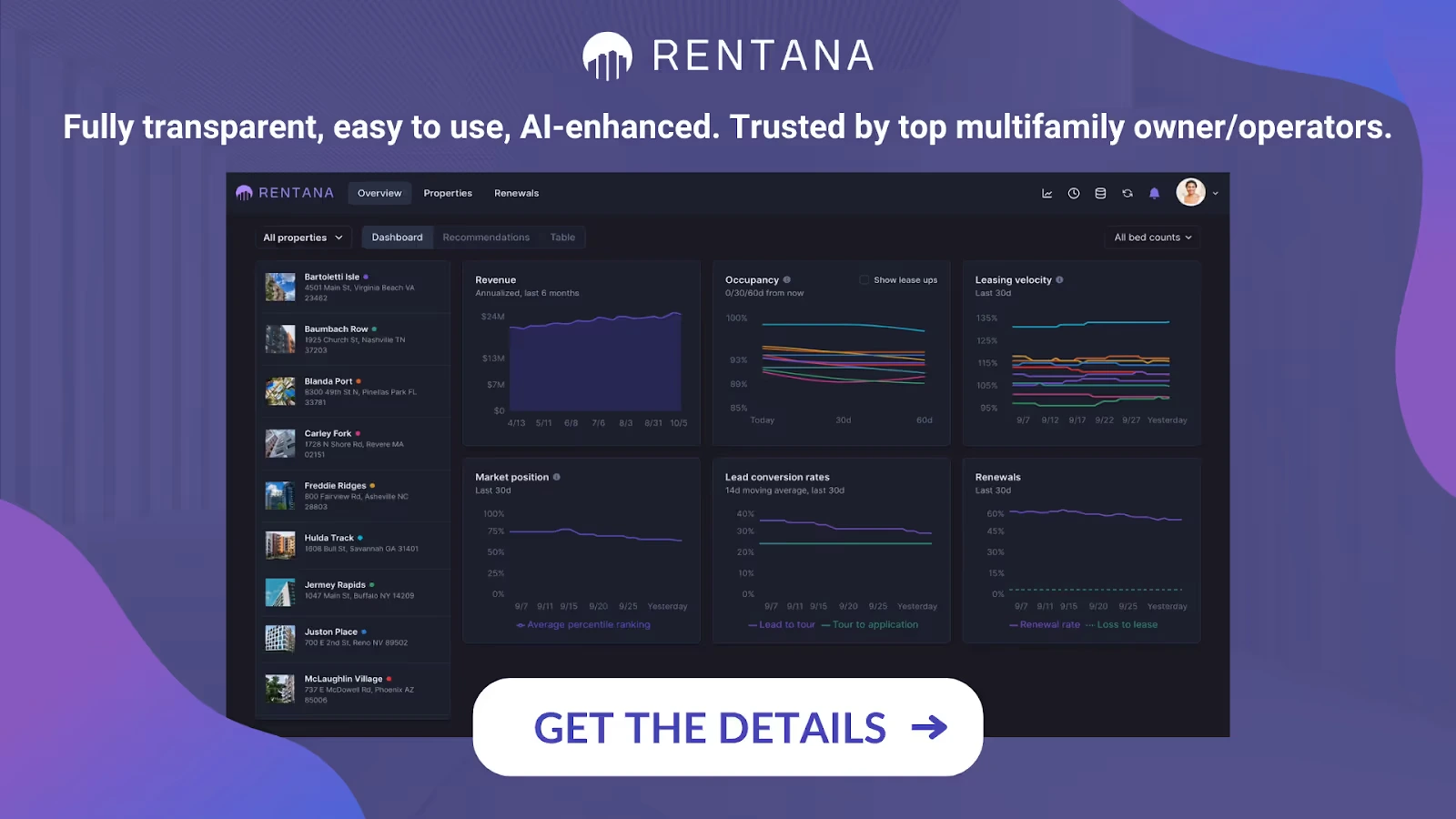
The right technology should reduce the manual work required to understand performance and give revenue managers better context for making decisions. It should support judgment, not replace it.
Rentana supports revenue managers with:
- Current operational data connected from the PMS: Reducing the time spent assembling information before analysis can begin.
- Pricing recommendations by layout with reasoning attached: Helping revenue managers evaluate how leasing velocity, exposure, occupancy goals, and other conditions are influencing a recommendation before deciding whether to act.
- Forward exposure visibility: Showing scheduled expirations against targets by layout and time period so teams can identify concentration early and adjust strategy proactively.
- Predicted Availability: When enabled, incorporating notices to vacate, historical month-to-month behavior, and anticipated unplanned availability from early terminations into the forward availability view.
- Predicted Occupancy: Connecting current leasing activity, renewal trends, and future availability to provide additional visibility into where occupancy may be heading.
- Portfolio-level visibility: Helping revenue managers compare performance across assets and prioritize attention based on what is changing rather than reviewing every property individually.
- AI-generated Insights: Proactively surfacing changes in areas such as leasing, pricing, occupancy, exposure, specials, and strategy, with context around why those changes may matter.
- Shared team visibility: Giving revenue management, property teams, and asset management a common view of performance so decisions can be made from the same operational picture.
The value of these tools is not simply faster reporting. It is giving revenue managers more time to analyze, strategize, and respond while there are still multiple options available.
Don’t Miss:
- Top 11 2026 Multifamily Housing Trends
- How to Build a Multifamily Revenue Forecast for Budget Season
Conclusion
A multifamily revenue manager does far more than review pricing recommendations. The role is responsible for translating asset strategy into the pricing, leasing, renewal, and exposure decisions that shape revenue performance over time.
Strong revenue managers combine forward-looking analysis with commercial judgment. They know when to pursue rent growth, when to protect occupancy, when to address exposure before it becomes a vacancy problem, and how to adjust strategy as conditions change.
The value of the role is ultimately in creating alignment between ownership goals and day-to-day execution, and making those decisions early enough to influence the outcome.