Rental property pricing in multifamily has always required judgment. The question is what that judgment is being applied to.
When pricing decisions are built on weekly comp surveys, manually assembled occupancy reports, and lagging PMS exports, the judgment being exercised is applied to a picture of conditions that may already be outdated. AI-powered pricing tools change what is available to evaluate before the decision is made, not who makes it.
According to Propmodo, multifamily analysts spend 80 to 90 percent of their time collating data and only 10 to 20 percent actually analyzing it. AI-supported pricing is one of the most direct responses to that ratio, shifting time from data assembly toward the evaluation that actually requires expertise.
This article covers what AI-powered rental property pricing means in practice, what it should and should not do, and how to evaluate whether a pricing tool is genuinely useful without treating pricing as a push for the highest possible rent.
Related:
What Is AI-Powered Rental Property Pricing?
AI-powered rental property pricing is the use of connected property performance data, leasing activity, availability conditions, renewal trends, and public market context to support pricing recommendations at the layout or unit group level.
In Rentana, pricing recommendations are shaped by the property’s configured asset strategy, including the occupancy objective and the timeframe the team is managing toward. The recommendation is not just a reaction to current market conditions; it is the suggested action to help the property move toward its configured objective based on current, historical, and projected performance.
The goal is not to push the highest possible rent. The goal is to support pricing decisions that align with occupancy targets, leasing velocity, renewal strategy, exposure management, and the asset’s broader operating plan.
The defining characteristic is connection. Manual pricing reviews evaluate each input separately, in whatever order the data becomes available. AI-powered pricing evaluates them together, in the context of each other, so the recommendation reflects how leasing velocity, forward availability, occupancy targets, and asset strategy are interacting rather than how each one looks in isolation.
The other defining characteristic is that AI supports the pricing decision. It does not make it. Every recommendation should be reviewed and approved by a revenue manager before any change is applied. The value is in the quality of the information supporting the decisions, not in removing the decision from human hands.
How AI-Powered Pricing Differs From Manual Pricing
Manual pricing reviews have a structural limitation that is worth understanding clearly. They are built on data that was current when it was assembled, which means the recommendation reflects conditions from when someone last had time to run the export, pull the comp survey, and reconcile the occupancy picture.
In a leasing environment where conditions can shift meaningfully over a week, the lag between when data is collected and when it informs a decision is not a small problem. A layout that was absorbing well at the start of a review period may be running behind by the next pricing review, and a manual process may not surface that shift until the trend has already affected performance.
AI-powered pricing addresses this by keeping pricing inputs more current and connected. Leasing velocity by layout, forward availability including confirmed notices and month-to-month behavior, renewal conversion trends, exposure concentration, occupancy targets, and public market context are evaluated together rather than assembled separately on an irregular schedule.
According to the NAA's Income/Expense IQ Report, since 2021 repairs and maintenance costs have risen nearly 28 percent while NOI has increased just 10 percent, compressing the margin between revenue and expenses in ways that make pricing precision more consequential than it was in a higher-growth environment. When margins are tight, the cost of pricing decisions made on incomplete or stale data is higher than it used to be.
Top Picks:
- AI for Lease Management: 5 Core Use Cases
- How to Use AI in Property Management
What Data Should AI Pricing Tools Consider?
A pricing recommendation is only as reliable as the inputs behind it. The data that matters most for rental property pricing:
- Current availability: What is available now and what is coming available in the near term, by layout
- Leasing velocity: How quickly layouts are absorbing relative to targets and forward availability, not only as a standalone number
- Recent achieved rents: What leases are actually closing at, including effective rent after concessions, rather than only asking rent
- Exposure and upcoming expirations: Where concentration is building in the forward calendar, incorporating confirmed notices, month-to-month behavior, and anticipated early terminations
- Renewal trends: How conversion is tracking by layout and expiration window, since renewal behavior directly affects forward availability
- Occupancy goals: The configured target the pricing is working toward, which should vary by asset stage and strategy
- Lease term strategy: Whether the current leasing mix is distributing future expirations in a way that supports the asset's forward management needs
- Public market context: Publicly advertised asking rents, specials, and availability from the surrounding market as external calibration, not as the primary driver
- Asset strategy: Whether the asset is in lease-up, stabilization, value-add, or a specific hold phase that defines what the pricing is trying to achieve
A pricing tool that evaluates only a subset of these inputs, particularly one that relies heavily on public market comps without connecting to the asset's own leasing performance and forward availability, is producing a recommendation built on an incomplete picture.
How AI Pricing Recommendations Work
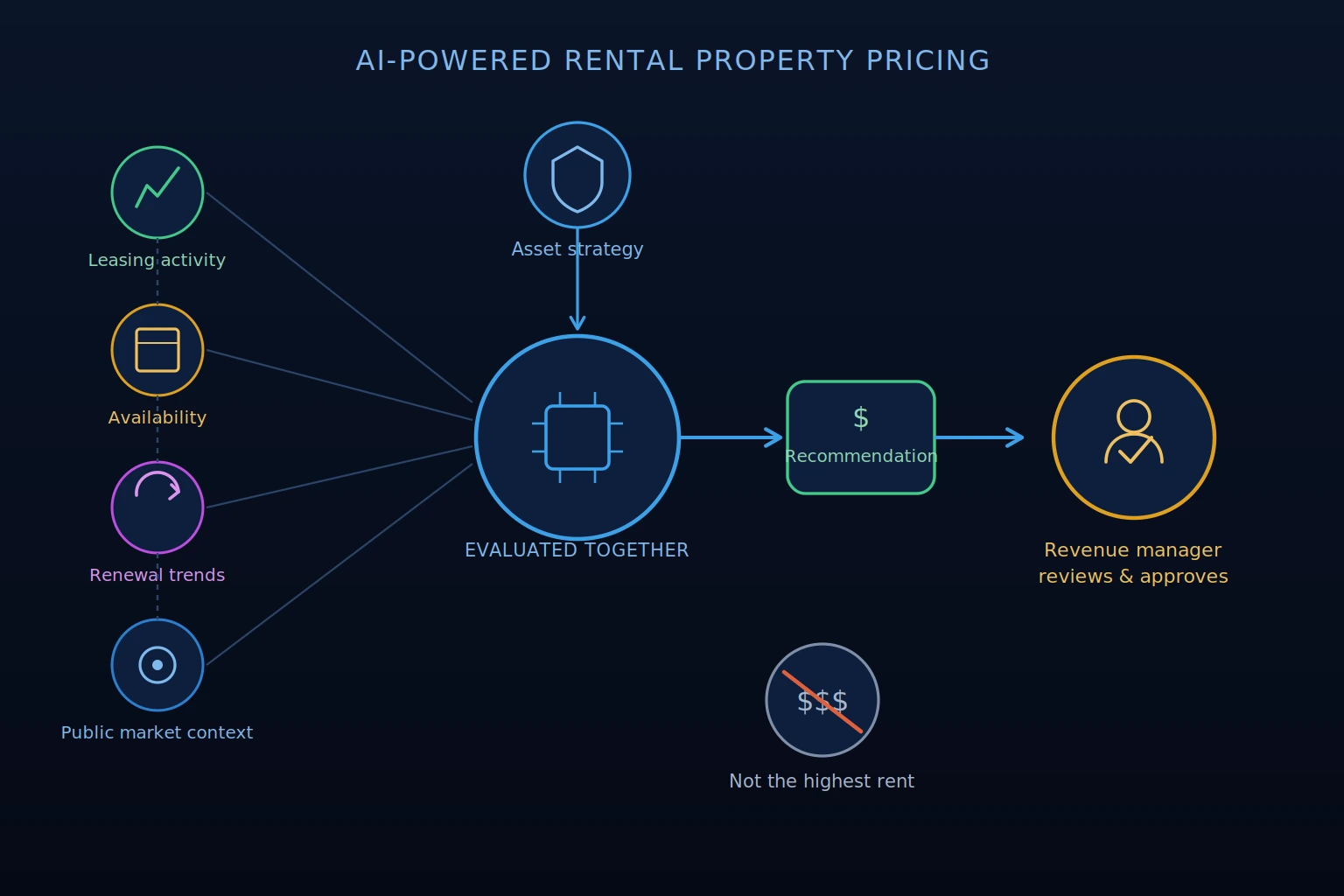
A well-constructed AI pricing recommendation starts with the asset’s configured strategy. The system evaluates what the property is trying to achieve, including its occupancy objective and management timeframe, and then weighs current, historical, and projected performance against that goal.
From there, leasing velocity in the affected layout, forward availability in the relevant time window, occupancy conditions relative to target, and renewal trends in the same segment help determine what pricing action may support the objective.
Public market context, including publicly advertised asking rents, specials, and availability from comparable properties, provides external calibration. It informs whether internal performance signals are consistent with the broader market environment or diverging from it.
When internal absorption is softening while the submarket appears stable, that contrast points toward a property-specific issue. When both are softening together, it points toward a market-wide condition. Either way, the public market data is context rather than the primary driver.
The recommendation that results should be presented with the reasoning visible. Not just a number, but an explanation of which signals contributed to it, what conditions are being considered, and what the recommendation is trying to support given the asset’s configured goals.
According to Multifamily Executive, operational performance increasingly defines competitive differentiation in multifamily, with AI adoption in property management tools growing 65 percent year-over-year. Pricing tools that explain their reasoning give revenue managers the ability to evaluate the logic rather than accept or reject a number without context.
You Might Like:
- The Best AI Tools for Real Estate Investors
- 7 Best AI-Powered Real Estate Platform Categories
Why Transparency Matters in AI Pricing
A pricing recommendation the revenue manager cannot evaluate is not useful decision support. It is a black box that produces a number without enough context to judge whether the recommendation makes sense.
Transparency in AI pricing means the revenue manager can see which inputs drove the recommendation, what assumptions are embedded in it, and whether the reasoning reflects the full operational context of the specific layout and asset. A recommendation that surfaces because leasing velocity has weakened for a specific layout, forward availability is increasing, or conversion is falling behind target is traceable and evaluable. A recommendation that produces a number from undisclosed inputs is not.
Transparency also supports appropriate skepticism. A revenue manager who reviews a pricing recommendation and notices that it does not account for a unit group characteristic that the system is not capturing can apply that judgment before acting. A recommendation accepted without review may not be corrected until after the impact has already shown up in performance.
How to Evaluate AI-Powered Rental Pricing Software
When evaluating a pricing tool, the criteria that matter most include:
- PMS integration: Direct connection to the PMS so leasing and occupancy data is current rather than manually uploaded
- Clear pricing logic: Reasoning visible to the revenue manager before any action is taken
- Forward-looking signals: Exposure, predicted availability, and occupancy projections connected to the recommendation
- Layout-level recommendations: Pricing at the bedroom or custom unit group level rather than at the property level where averages obscure the differences that matter
- Public market context: Publicly available market data incorporated as external calibration, not as the sole basis for pricing
- Human review and approval workflows: A clear process for reviewing, adjusting, and approving recommendations before they are applied
- Portfolio visibility: The ability to review pricing conditions and recommendations across multiple assets simultaneously rather than property by property
- Configurable asset strategy: Occupancy targets, pricing guardrails, and leasing velocity parameters that can be set at the asset level to reflect different investment objectives
- Human control: Recommendations that support review and approval rather than automatically replacing revenue manager judgment
How Rentana Supports AI-Powered Rental Property Pricing
Rentana provides pricing recommendations at the bedroom or custom unit group level, with reasoning attached so the revenue manager can evaluate the inputs before deciding whether to act.
Each recommendation is shaped by the property’s asset strategy and current performance context. Rentana connects relevant pricing, leasing, occupancy, renewal, exposure, and market signals so revenue managers can evaluate pricing actions in relation to the property’s goals.
Asset-level configuration allows occupancy targets, daily pricing limits, and leasing velocity expectations to be set for each property based on its specific strategy and stage, so recommendations for a lease-up asset reflect different objectives than those for a stabilized asset in the same portfolio. Once a pricing decision is reviewed and approved, Rentana helps streamline the workflow between recommendation and execution.
Portfolio dashboards surface where pricing conditions are shifting across assets, so revenue managers can prioritize attention toward the layouts and properties where conditions are changing rather than distributing review time equally across a portfolio.
Read Also:
- AI Adoption Challenges in Real Estate & How to Solve Them
- AI Leasing Assistants for Multifamily Teams
Conclusion on AI-Powered Rental property Pricing
AI-powered rental property pricing is a decision-support discipline, not an automation of the pricing decision itself. The value is in the quality and currency of the inputs available when the revenue manager evaluates the recommendation, the transparency of the reasoning behind it, and the connection between the recommendation and the property’s configured asset strategy.
Pricing tools that explain their logic, connect to forward-looking availability and occupancy conditions, and allow the revenue manager to evaluate before acting are better positioned to support pricing decisions over time. Tools that produce numbers without context shift the source of the decision without improving the quality of it.
Use Rentana to support AI-powered rental property pricing with transparent recommendations, forward-looking occupancy context, and pricing workflows connected to leasing velocity, renewals, exposure, and asset strategy.