Occupancy rate is the metric every multifamily team watches. It appears in every ownership report, every asset review, and every lender package. What it does not do is tell anyone where it is heading.
A property with healthy occupancy today can still be tracking toward a lower occupancy position based on softening renewal conversion, building expiration concentration, and a leasing pipeline not keeping pace with upcoming availability. The current occupancy number may be accurate. It describes where the asset stands at a point in time. What it cannot show is the operational picture developing underneath it.
According to CBRE's Q1 2026 U.S. Multifamily release, the national multifamily vacancy rate declined 20 basis points quarter-over-quarter to 4.8% in Q1 2026, falling below its long-term average of 5.0%, as net absorption outpaced new construction completions for the first time in three quarters.
In an environment where occupancy conditions are improving but unevenly across markets and asset classes, the operators managing occupancy most effectively are the ones with the clearest forward picture of where their specific assets are heading.
Related:
- How to Calculate Occupancy Rate (Formula + Examples)
- Occupancy Decline in Multifamily: How to Diagnose and Respond
What Is Occupancy Rate Optimization?
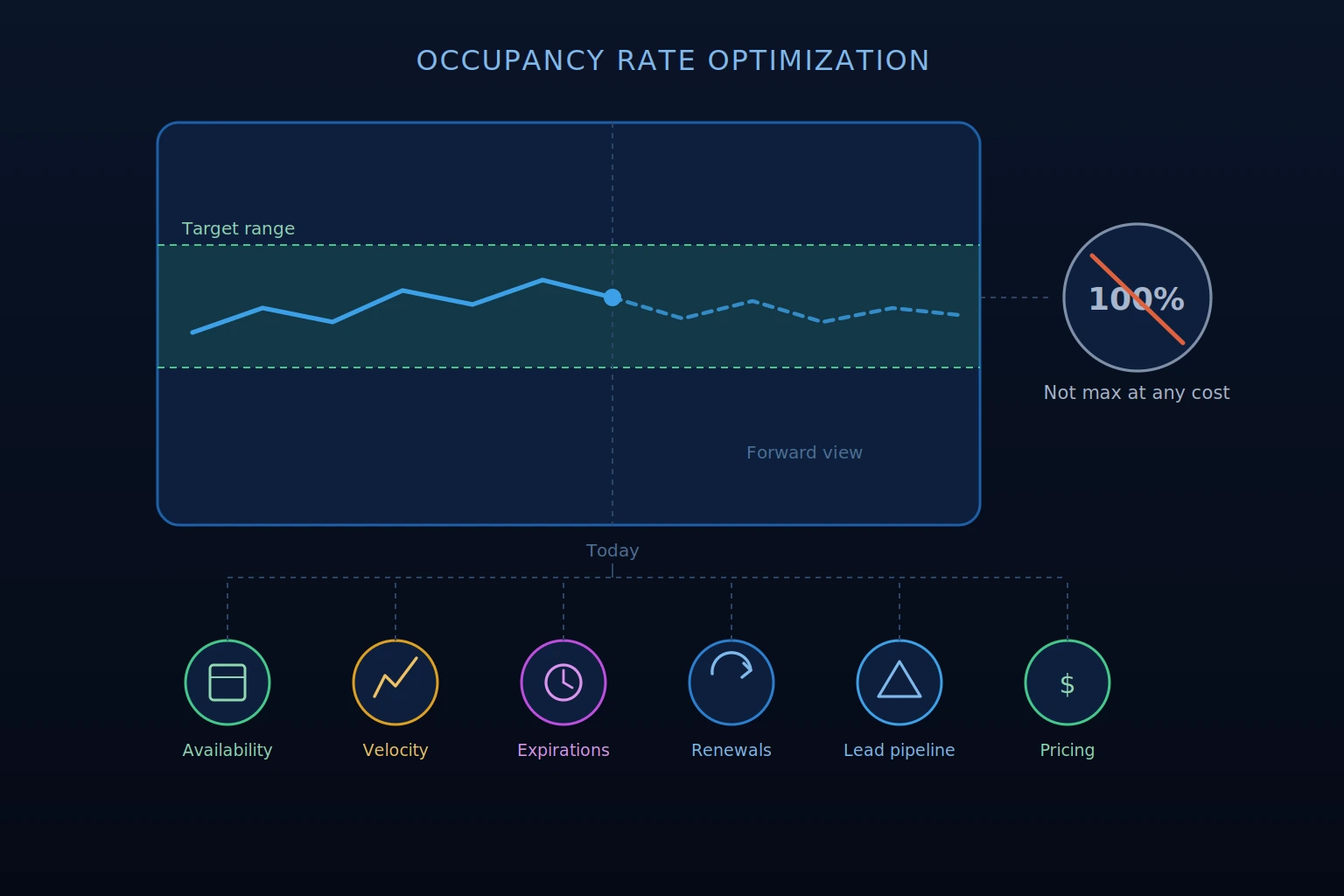
Occupancy rate optimization is the practice of using current performance data, forward-looking projections, lead demand, renewals, expirations, and pricing strategy together to maintain occupancy within the asset’s target range. It is the operational discipline of maintaining occupancy within a target range by evaluating and responding to the full set of signals that determine where occupancy is heading, rather than only where it currently stands.
It connects current availability and leasing velocity to upcoming expirations, renewal conversion trends, lead pipeline activity, pricing conditions, and forward occupancy projections. When those signals are evaluated together on a consistent cadence, the team has enough lead time to respond to conditions that are developing rather than conditions that have already arrived.
The goal is not maximum occupancy at any cost or rent reduction as the default response. It is occupancy within the range the asset strategy requires, sustained without the concession spend or pricing suppression that reactive management tends to produce when occupancy softens before the team sees it coming.
7 Strategies for Occupancy Rate Optimization
- Use Predicted Occupancy to See What Is Coming
- Run Daily Available Units Reporting for Leasing Focus
- Evaluate Demand With Targeted Lead Rate
- Align Pricing Recommendations With Occupancy Conditions
- Manage Expirations Before They Create Occupancy Risk
- Build Renewal Strategy Around Retention and Occupancy Goals
- Use AI Insights to Identify What Needs Attention
1. Use Predicted Occupancy to See What Is Coming
Current occupancy describes where the asset stands. Predicted occupancy shows where it appears to be heading.
Predicted occupancy connects current leasing activity, renewal trends, and future availability into a forward view of where occupancy appears to be heading compared against the property’s target. For stabilized assets, it surfaces whether current leasing pace, renewal conversion, and forward availability are collectively tracking toward that goal or diverging from it.
For lease-up assets, it compares predicted leased percentage against the plan's subsequent monthly goals, giving teams visibility into whether current absorption pace is consistent with the stabilization timeline.
The value is not in treating the projection as a guarantee. It is in the earlier context it provides for decisions that are still possible to influence. A projected decline identified 45 days out has significantly more available responses than the same decline identified after it has already arrived in the reported number.
2. Run Daily Available Units Reporting for Leasing Focus
Occupancy optimization starts with knowing what needs to be leased and where leasing effort should go each day. A daily available units report provides that picture without requiring a manual pull each morning.
It surfaces which units are currently available, which units are coming available, and where leasing attention may be needed by layout or availability timing. That visibility helps leasing teams focus on the units and layouts that need attention instead of treating all availability as equally urgent.
When the available units report is scheduled and delivered automatically each morning, the leasing team starts the day oriented toward where effort is most needed rather than assembling that picture from scratch before the first prospect interaction.
3. Evaluate Demand With Targeted Lead Rate
Knowing that units are available is only part of the occupancy equation. The other part is whether there is enough demand in the pipeline to absorb that availability at current pricing within the occupancy timeline.
Targeted lead rate helps evaluate whether the property has enough lead activity to meet occupancy goals based on recent conversion performance. If leads are coming in at a volume that, at current conversion rates, will not produce the leasing pace the occupancy target requires, that gap is the signal worth acting on before it becomes a vacancy problem.
When lead demand is insufficient, the response options include pricing adjustments that may stimulate additional inquiry, marketing support that improves top-of-funnel volume, or a combination of both. AI Insights can add context by identifying where in the leasing funnel performance may need closer evaluation, such as weak conversion for a specific layout or a gap between inquiry volume and completed applications.
Related:
- Multifamily Occupancy Management: 7 Best Practices
- How to Forecast Occupancy in Multifamily Real Estate
4. Align Pricing Recommendations With Occupancy Conditions
Pricing and occupancy are connected in both directions. Pricing that is too aggressive for current demand can slow absorption. Pricing that is too conservative when demand is strong can limit revenue without improving an occupancy position that is already on track.
Pricing recommendations should be evaluated in the context of lead volume, funnel conversion performance, current availability, upcoming expirations, Predicted Occupancy, and asset strategy. The goal is not simply to lower or raise rents. It is to align pricing with the property's occupancy target and the performance conditions currently shaping whether that target is reachable.
AI-supported pricing recommendations should connect current performance, forward occupancy context, and the property’s goals so teams can evaluate whether a pricing action supports occupancy, revenue, and asset strategy before deciding whether to act.
5. Manage Expirations Before They Create Occupancy Risk
Lease expiration concentration is one of the most predictable sources of occupancy risk in multifamily and one of the most consistently underaddressed before it creates pressure.
When a large volume of leases expires in a narrow window, the resulting availability may exceed what the leasing pipeline and demand conditions can absorb without vacancy accumulation or reactive concession spend. According to the National Apartment Association, since 2021 repairs and maintenance costs have risen nearly 28 percent while NOI has increased just 10 percent, compressing the margin between revenue and expenses in ways that make every preventable occupancy dip more consequential.
Proactive expiration management helps teams evaluate lease-term strategy, renewal timing, and pricing conditions before concentrated expirations create avoidable occupancy pressure. Rentana surfaces where overexposure is developing by layout and time window, helping teams evaluate forward availability before it becomes a reactive occupancy issue.
6. Build Renewal Strategy Around Retention and Occupancy Goals
Every resident who renews is a unit that does not return to market. Renewal performance is one of the most direct levers in occupancy management, and it is most effective when managed as a forward-looking operational discipline rather than an administrative calendar function.
Renewal insights help teams evaluate retention risk by layout and expiration window, assess renewal pricing in the context of current leasing conditions and loss to lease, and identify where renewal increases need to be balanced against occupancy goals. Renewal pricing that is materially out of step with current leasing conditions can increase retention risk, especially when residents have visible alternatives in the market.
Reviewing renewal conversion trends over time, rather than only at a single monthly snapshot, can surface where retention is softening early enough for teams to evaluate outreach timing, offer structure, or pricing strategy. According to Multifamily Executive, AI adoption in property management grew 65 percent year over year from 2024 to 2025, with smarter renewal management cited among the most direct applications driving occupancy improvement.
7. Use AI Insights to Add Context to Occupancy Reporting
Reporting that delivers numbers without explaining what they mean is useful for documentation. Reporting that surfaces what is changing and why it may matter is useful for decisions.
AI Insights add the analytical layer that connects data to direction. When a specific layout is showing weak funnel conversion, an insight that surfaces that pattern gives the team a starting point for investigation rather than leaving them to identify the signal manually. When expiration concentration is building in a future period, an insight that surfaces that condition gives the team lead time to evaluate whether lease-term strategy, renewal outreach, or pricing adjustments may be warranted.
The most useful AI Insights answer three questions consistently: what changed, why it may matter given current operational conditions, and where the team may need to evaluate or investigate further. They are a starting point for judgment, not a substitute for it.
Top Picks:
- How to Calculate Break-Even Occupancy in Multifamily
- Multifamily Lease-Up Strategy: Building Occupancy While Managing Future Exposure
How Rentana Helps Optimize Occupancy Rates
Rentana connects the reporting and analytical capabilities described in this article into a single operational view, organized around the signals that help teams understand where occupancy is heading rather than only where it currently stands.
Predicted Occupancy shows where occupancy appears to be heading under current leasing and renewal conditions, compared against the property’s target or, for lease-up assets, the plan’s next monthly goal.
Available Units Reporting, schedulable for daily delivery, gives leasing teams a current picture of what is available, what needs attention, and where leasing activity should be directed without requiring a manual pull each morning.
Targeted Lead Rate helps evaluate whether current lead volume is sufficient to meet occupancy goals based on recent conversion performance.
Pricing recommendations by layout connect current performance, forward occupancy context, and property goals into a supported pricing evaluation with reasoning attached, so teams can evaluate the logic before deciding whether to act.
Expiration management through exposure forecasting surfaces where concentration is building by layout and time window, helping teams evaluate forward availability before it creates avoidable occupancy pressure.
Renewal insights help teams evaluate retention trends by layout, renewal pricing in the context of current leasing conditions, and where renewal strategy may need adjustment given forward exposure and occupancy goals.
AI-generated Insights surface what is changing, explain why it may matter, and identify where the team may need to investigate further, adding the analytical context that makes reporting actionable rather than informational.
You Might Like:
Conclusion on Occupancy rate optimization
Occupancy rate optimization is a forward-looking operating discipline. The metrics that matter most are the ones that show where occupancy is heading rather than where it currently stands, and the reports that create the most operational value are the ones that surface those signals consistently enough to act on them before conditions have already shifted.
Use Rentana to optimize occupancy with predicted occupancy, targeted lead rate, pricing recommendations, expiration management, renewal insights, and AI-generated context that helps teams understand where performance needs attention before it shows up in the reported occupancy number.