Real estate investing has always required research, judgment, and the ability to evaluate large amounts of information before making consequential decisions. What AI changes is not the need for those things. It changes how much of the preparatory analysis can be organized before the judgment call is made.
According to JLL research, 92% of corporate real estate occupiers and 88% of real estate investors had already started piloting AI or planned to do so, with C-suite leaders broadly expecting AI to transform how real estate operates over the next five years. That level of adoption reflects how broadly the industry has recognized that AI is not a replacement for investment expertise, but a tool that can make the analytical work behind it faster, more consistent, and more connected.
This article covers seven specific ways AI can be used in real estate investing, the benefits it delivers when applied well, its limitations, and how Rentana supports AI-driven asset performance visibility in multifamily.
Related:
7 Ways AI Can Be Used for Real Estate Investing
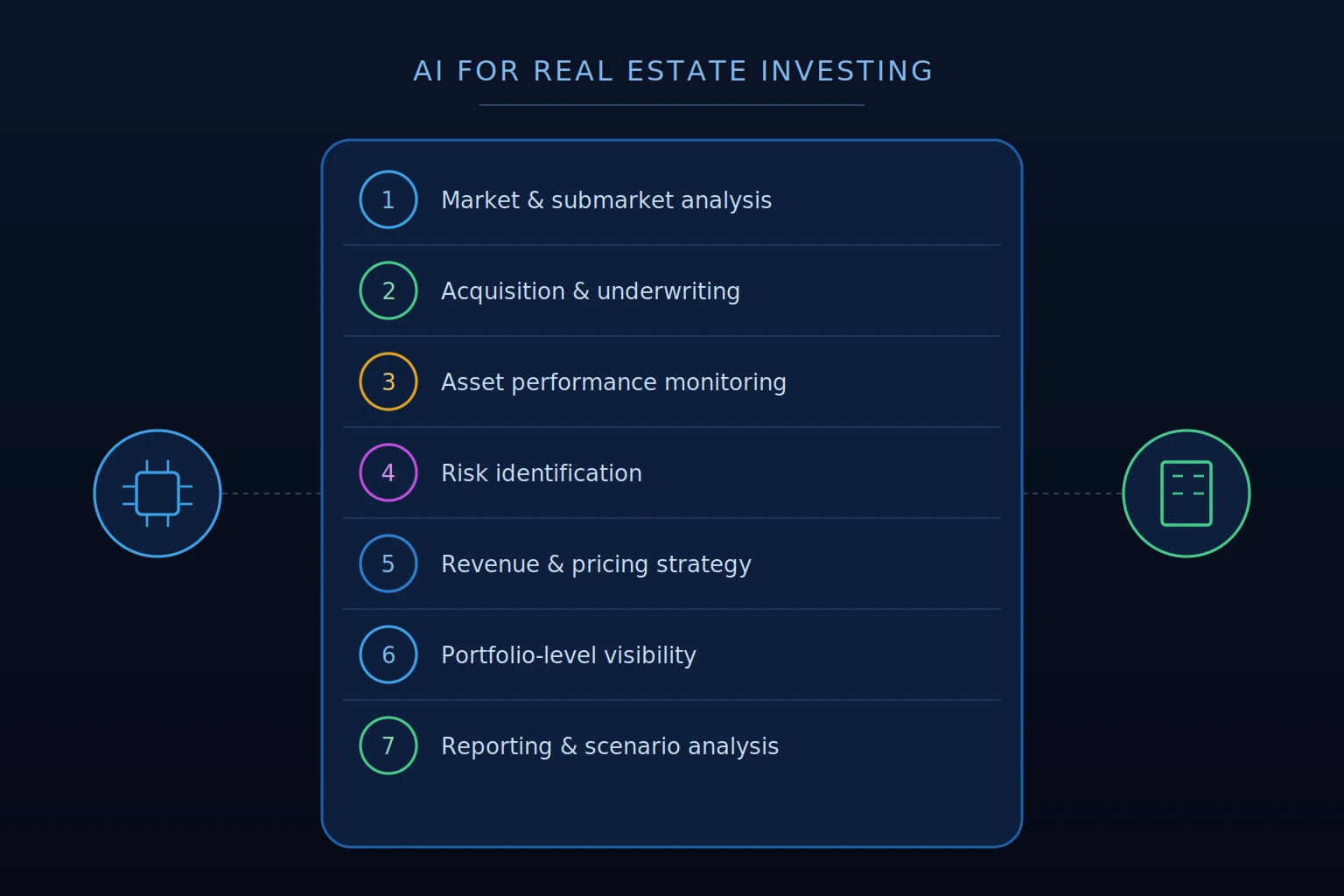
- Market and Submarket Analysis
- Acquisition and Underwriting Support
- Asset Performance Monitoring
- Risk Identification
- Revenue Management and Pricing Strategy
- Portfolio-Level Visibility
- Reporting and Scenario Analysis
1. Market and Submarket Analysis
Real estate investment decisions require understanding the market environment an asset is operating in: rent trends, supply pipeline, demand drivers, employment conditions, demographic shifts, and competitive conditions. Assembling that picture manually across multiple submarkets and asset types is time-consuming and inconsistent.
AI can help investors review large amounts of market data more efficiently, identifying patterns across rent movement, vacancy trends, absorption rates, and supply conditions that would take significantly longer to surface through manual research. The output supports the research phase of investment analysis rather than replacing the due diligence and judgment that follows from it.
The key limitation is data quality and source transparency. AI-assisted market analysis is only as reliable as the data it draws from, and investors should understand which sources are being used and how current they are before incorporating the output into investment decisions.
2. Acquisition and Underwriting Support
Underwriting a multifamily acquisition involves evaluating dozens of assumptions simultaneously, often across multiple scenarios, with significant time pressure during due diligence. AI can help organize those assumptions, compare scenarios, stress-test inputs against different demand or expense conditions, and identify questions or gaps that may not be obvious from a single-scenario analysis.
According to Deloitte's research, 72% of real estate firms globally plan to increase their AI investment by 2026, with underwriting support and investment analysis among the most frequently cited use cases. The value is in the speed and consistency of the analytical support rather than in any automated investment recommendation.
AI should support underwriting review, not make investment decisions automatically. The assumptions, risk assessments, and investment judgments that determine whether an acquisition makes sense remain the responsibility of the investment team.
3. Asset Performance Monitoring
After acquisition, the investment thesis needs to be tracked against actual performance. AI can help asset managers evaluate the operational signals that indicate whether the asset is performing as underwritten: occupancy conditions, leasing velocity by layout, renewal conversion trends, pricing performance, forward exposure concentration, and NOI-related metrics.
Manual review of these signals across a portfolio requires significant analytical time and often surfaces conditions after they have already moved rather than while they are still developing. AI that evaluates connected signals consistently across multiple assets can change what the asset management team spends its time on, from assembling the picture to evaluating what it shows.
Top Picks:
4. Risk Identification
Investment risk in multifamily manifests in operational signals before it shows up in financial reporting. Softening leasing velocity, weakening renewal conversion, building expiration concentration, rising concession depth, or market-level changes in supply and absorption all represent developing risks that are visible in data before they produce a financial outcome.
AI can surface these early signals more consistently than manual review by evaluating connected combinations of signals rather than each metric independently. A layout with softening velocity, declining conversion, and building expiration concentration carries a different risk profile than any of those signals appearing alone. An AI system that surfaces that combination can provide risk context that sequential metric reviews may not reliably produce.
Human judgment remains essential for determining what the risk signal means in the context of the specific asset, market, and investment strategy, and for deciding what response is appropriate.
5. Revenue Management and Pricing Strategy
Pricing is one of the highest-leverage operational decisions in multifamily investing. AI can help investors and operators evaluate pricing recommendations in the context of current leasing activity, forward availability, renewal trends, occupancy targets, and asset strategy, rather than relying only on manual comp reviews or lagging reports.
The goal of AI-supported pricing in multifamily is not to automatically change rents or push the highest possible rent. It is to give revenue managers and asset managers a more complete and current picture of the conditions that should inform pricing decisions, with the reasoning visible so that judgment can be applied before any change is made.
6. Portfolio-Level Visibility
As portfolios grow, the challenge of maintaining visibility across multiple assets simultaneously becomes harder to manage manually. Sequential property reviews can produce a picture that is partially stale and require significant time before any cross-portfolio comparison or prioritization is possible.
AI can help asset managers compare properties, prioritize attention toward assets where multiple conditions are shifting, identify where performance is drifting from the investment plan, and surface where the combination of operational signals points toward a condition that warrants closer review. The output supports the asset management team's prioritization decisions rather than making those decisions automatically.
7. Reporting and Scenario Analysis
AI can improve both the consistency of recurring investment reporting and the depth of scenario analysis available during active decision-making periods. Automated report generation that pulls from current operational data removes the manual assembly step from recurring reporting cycles. AI-assisted scenario analysis can help teams evaluate how different demand, expense, or market conditions may affect investment performance, supporting faster and more comprehensive stress-testing than manual modeling alone.
The limitation is that AI-generated reports and scenarios are only as useful as the assumptions and data behind them. Investors should understand which inputs drive each scenario and apply independent judgment to whether those inputs reflect realistic conditions for the specific asset and market being evaluated.
Read Also:
- Best AI Powered Real Estate Platforms
- AI Adoption in Multifamily: Top Trends for Operators
Benefits of AI in Real Estate Investing
When applied appropriately, AI delivers several consistent operational advantages for real estate investors and asset managers:
- Faster analysis. Research, market review, performance monitoring, and scenario analysis that previously required significant manual time can be completed more efficiently, freeing the investment team to focus on judgment rather than data assembly
- Better visibility. AI that connects multiple performance signals into a single view gives asset managers a more complete operational picture than any single metric or report can provide on its own
- Earlier risk detection. Evaluating operational signals consistently can surface developing conditions earlier, while more response options remain available
- More consistent reporting. Automated and AI-supported reporting delivers the same metrics on the same cadence regardless of team capacity, reducing the version control and timing inconsistencies that manual reporting produces
- Stronger scenario analysis. AI-assisted stress-testing across multiple demand, pricing, and expense scenarios can produce a more comprehensive range of outcomes than single-scenario underwriting
- Better coordination between asset management and operations. AI-powered platforms that give both teams shared visibility into the same current performance data reduce the information lag and data reconciliation that slow coordinated decision-making
Limitations and Risks of AI in Real Estate Investing
AI in real estate investing produces outputs that are dependent on the quality of the data behind them, the assumptions embedded in the model, and the design of the system generating the recommendation or analysis. These limitations are worth understanding clearly before incorporating AI outputs into investment decisions.
Data quality determines output quality. An AI system working from inconsistent PMS data, stale market information, or incomplete operational records will produce outputs that reflect those limitations. Garbage in, garbage out applies as directly to AI as to any analytical process.
AI does not replace due diligence. Market analysis, underwriting support, and risk identification produced by AI are inputs to the due diligence process, not substitutes for it. Site visits, independent market research, legal review, environmental assessment, and the full range of investment due diligence remain the responsibility of the investment team.
Investment accountability stays with humans. AI can surface a risk, support a pricing adjustment, or flag a performance condition. The decision about what to do with that output, and the accountability for the investment outcome that follows, belongs to the investor and asset manager, not to the system that generated the signal.
Compliance review is essential. AI tools used in pricing and leasing contexts carry fair housing compliance implications that require independent review. Pricing recommendations should be based on property performance data, asset strategy, and market conditions, not on any resident or prospect characteristics.
How Rentana Supports AI-Driven Real Estate Investment Decisions
Rentana is a revenue intelligence platform built for multifamily investors and asset managers who need forward-looking visibility into asset performance, not just backward-looking reports.
Rentana connects PMS-sourced operational data into a view organized around where performance is heading and where risk may be developing, supporting the asset management disciplines that help teams evaluate whether a multifamily investment is tracking against plan.
- Predicted Occupancy connects current leasing activity, renewal trends, and future availability into a forward view of where occupancy is heading at each asset, supporting earlier visibility into whether performance is tracking against plan
- Target Tracking evaluates performance against configured occupancy and revenue targets, giving asset managers and ownership groups a consistent view of where each asset stands relative to plan
- Pricing recommendations by layout connect leasing performance, forward availability, and property goals into a supported pricing evaluation with reasoning attached, so investment and operations teams can evaluate the logic before acting
- Exposure forecasting surfaces where lease expiration concentration is building by layout and time window, helping teams evaluate forward availability before it creates avoidable occupancy pressure
- Renewal insights help teams evaluate retention trends, renewal pricing in the context of current leasing conditions, and where renewal strategy may need adjustment given forward exposure and occupancy goals
- Portfolio dashboards give asset managers a portfolio-level view of performance across properties, surfacing where multiple conditions are shifting without sequential manual review
- AI-generated Insights surface what is changing at specific assets, explain why it may matter, and identify where the team may need to investigate further while there is still time to act
Don’t Miss:
- The Best AI Tools for Real Estate Investors
- Conversational AI in Real Estate: A Complete Guide
Conclusion on How AI Can Be Used for Real Estate Investing
AI can make real estate investing more efficient, more consistent, and more forward-looking by helping investors analyze markets, evaluate performance, identify risks, and review pricing and operational decisions with more complete and current information than manual processes reliably produce.
What it cannot do is replace the judgment, due diligence, compliance review, and investment accountability that remain essential to responsible investment management. The investors who get the most from AI are the ones who use it to improve the inputs to their decisions, not to automate the decisions themselves.
Use Rentana to support multifamily investment decisions with AI-powered visibility into pricing, occupancy, renewals, exposure, and portfolio performance across the assets already in operation.