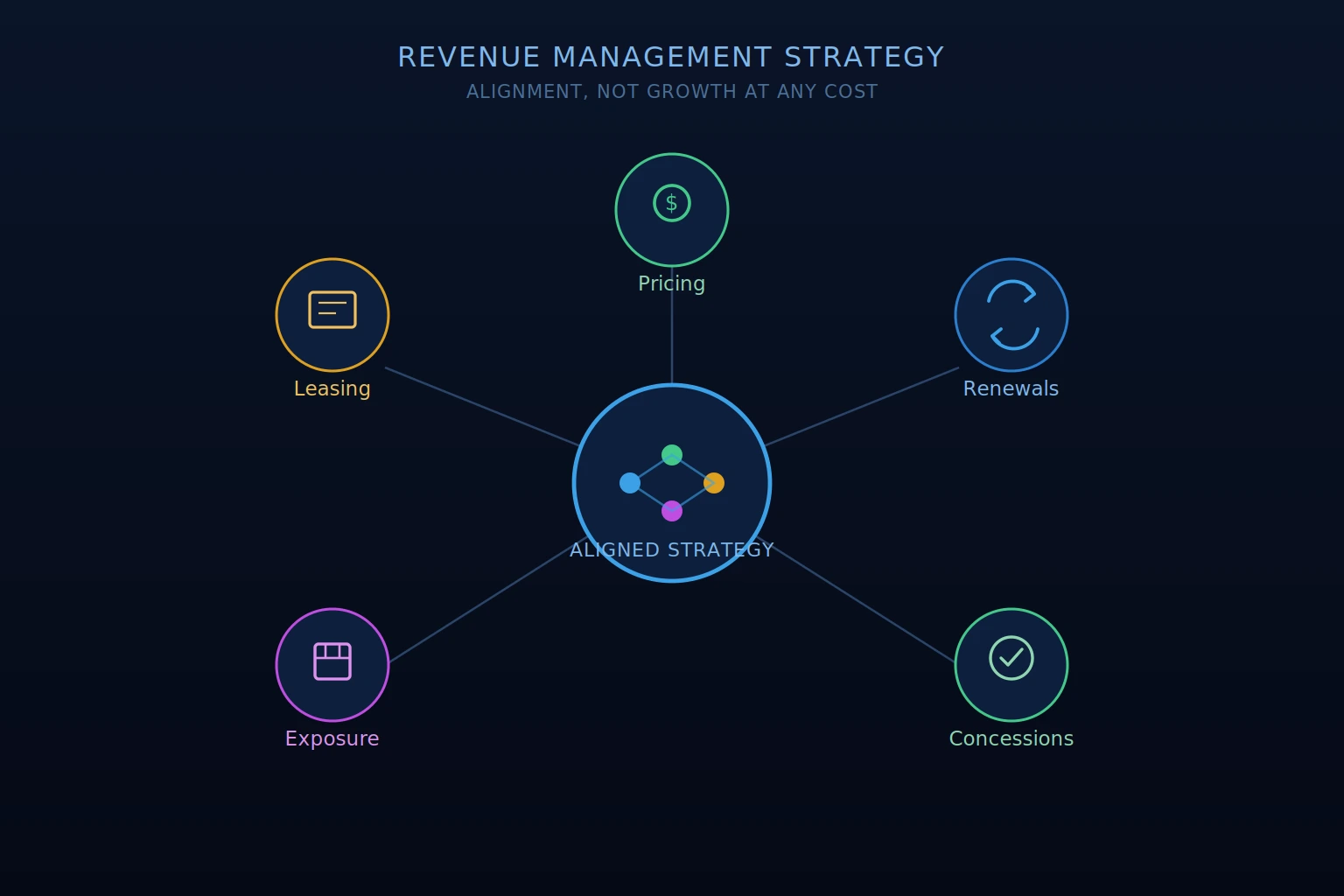
Revenue management in multifamily is not a pricing function. It is a connected operational discipline that spans pricing, leasing, renewals, exposure management, and concession strategy, each decision informed by the same set of internal performance signals and aligned with the same asset strategy goals.
The operators who produce the most consistent NOI outcomes are not the ones who review pricing most frequently. They are the ones who manage all of these levers together, with visibility into how each one affects the others, and with enough forward-looking context to act before conditions have already shifted.
This article covers the core strategies that drive NOI in multifamily revenue management, organized around the internal operational disciplines that matter most.
What Is Multifamily Revenue Management Strategy?
A multifamily revenue management strategy is the operational framework that connects pricing, leasing, renewals, exposure, and concession decisions into a coherent approach to maintaining stable and predictable revenue performance over time.
The goal is not growth at any cost. It is alignment: ensuring that pricing reflects current leasing conditions, that renewals are managed in the context of forward availability, that concessions are deployed deliberately rather than reactively, and that every operational decision reflects the specific goals of the asset it is being made for.
According to the National Multifamily Housing Council, revenue management systems leverage technology and data to systematically forecast supply and demand for a particular unit and price it accordingly, reflecting how the discipline has evolved from a static pricing exercise into a data-connected operational function across the industry.
Related:
- Apartment Revenue Management: Complete Guide
- 7 Revenue Management Mistakes in Multifamily to Avoid
9 Multifamily Revenue Management Strategies That Drive NOI
- Align Revenue Strategy With Asset Goals
- Continuously Refine Pricing by Layout
- Manage Forward Exposure Before It Creates Vacancy
- Build Renewal Strategy Around Retention and Replacement Economics
- Use Concessions Strategically
- Manage Lease Terms to Shape Future Availability
- Monitor Leasing Velocity and Funnel Performance
- Adjust Strategy When Conditions Change
- Use Portfolio Visibility and AI to Surface Early Signals
1. Align Revenue Strategy With Asset Goals
Every revenue management decision should be evaluated against what the specific asset is trying to achieve at its current stage. A lease-up asset pursuing occupancy growth operates under different parameters than a stabilized asset protecting effective rent. A value-add asset capturing renovation premiums requires different pricing logic than one maintaining a stable rent roll.
Occupancy targets, pricing guardrails, leasing velocity expectations, and renewal approaches should all be configured at the asset level rather than applied uniformly across a portfolio where no two assets are in the same situation. When settings reflect asset strategy, the decisions that follow are coherent. When they do not, decisions that look reasonable at the portfolio level may be exactly wrong for the specific asset they are being applied to.
Rentana's property-level configuration allows occupancy targets, daily pricing limits, and leasing velocity expectations to be set at the asset level, so every recommendation and insight is generated within the context of what that specific asset is trying to achieve.
2. Continuously Refine Pricing by Layout
Pricing at the property level averages out the differences that matter most. A layout absorbing in eight days and a unit type absorbing in thirty days within the same property are telling very different stories about where pricing sits relative to demand. Managing both under the same pricing approach leaves revenue on the table on the preferred end and creates friction on the less preferred one.
Effective pricing strategy in multifamily requires evaluation at the layout or custom unit group level, connecting:
- Base rents that reflect actual leasing conditions for each unit configuration
- Amenity premiums validated by leasing performance rather than set at onboarding and left unchanged
- Leasing velocity tracked by layout to surface where absorption is running ahead of or behind pace
- Occupancy goals that define the target the pricing is working toward for each asset
- Forward exposure that shows what upcoming availability looks like in each unit segment, so pricing reflects where conditions are heading rather than only where they stand today
Rentana generates pricing recommendations at the bedroom or custom unit group level, with the full reasoning attached, so teams can evaluate what conditions are being considered before deciding whether to act.
3. Manage Forward Exposure Before It Creates Vacancy
Lease expiration concentration is one of the most predictable risks in multifamily revenue management and one of the most consistently undermanaged. When a large volume of leases expires in a narrow window, the resulting availability may exceed what demand conditions can absorb at current pricing without vacancy loss or reactive concession spend.
The response to exposure concentration at 90 days is a strategy conversation. The same response at 20 days is damage control. Proactive exposure management means:
- Monitoring the full forward availability picture, including scheduled expirations and known upcoming availability, with additional anticipated availability such as month-to-month behavior and early terminations incorporated based on historical performance
- Identifying where concentration is building before it reaches a threshold that creates leasing pressure
- Using lease term pricing and proactive renewal outreach to shape how future availability distributes across the calendar
Rentana's exposure forecasting shows lease expirations against configured thresholds by unit type and time window, making concentration visible before it creates occupancy pressure. Where historical performance is incorporated, the forward view can also account for anticipated availability from month-to-month behavior and early terminations.
Read Also:
- 7 Core Revenue Management Principles for Real Estate
- Multifamily Revenue Manager: Duties & Responsibilities
4. Build Renewal Strategy Around Retention and Replacement Economics
Every renewal decision has a cost attached to it on both sides. The cost of the renewal offer. And the cost of losing the resident, which includes vacancy loss, make-ready, marketing spend, and re-leasing time.
Renewal strategy that accounts for both sides of that equation consistently produces better retention outcomes than one organized only around what the offer should be. Key principles:
- Start outreach earlier than feels necessary. Conversations that happen 90 days before expiration have more options available than those at 30 days
- Price renewal offers using current leasing conditions and forward availability context, not a fixed escalation applied uniformly across all expiring leases
- Prevent rent roll inversion by ensuring renewal offers are evaluated alongside what new lease pricing is doing in the same unit type
- Direct retention effort toward the unit types and expiration windows where forward exposure is most concentrated
Rentana's renewal conversion tracking surfaces where retention trends are moving by layout, while configurable renewal recommendations are based on company-defined settings designed to align offers with the property’s asset strategy.
5. Use Concessions Strategically
Concessions are a legitimate tool when they are deployed deliberately. They create problems when they are deployed reactively or broadly.
A concession applied across all unit types to hit an occupancy number suppresses effective rent on units that did not need the help and creates renewal conversations that are harder to navigate when the concession burns off. A concession applied to a specific unit type absorbing below pace, sized to close the gap and with a defined end date, addresses the actual problem without spreading the cost across the rest of the rent roll.
Effective concession strategy requires:
- Evaluating whether a concession is the right response to the specific leasing challenge, or whether the issue is funnel conversion, marketing reach, unit condition, or pricing.
- Tracking the effective rent impact of every concession, not just the occupancy impact
- Avoiding automatic or blanket concession programs that run without a defined scope or end date
- Measuring whether the concession is producing the intended absorption improvement before extending it
6. Manage Lease Terms to Shape Future Availability
The leases signed today determine the expiration calendar the asset will manage in 12 to 24 months. Lease term pricing that incentivizes lease lengths distributing expirations away from concentrated windows is one of the most proactive tools available for preventing the availability pressure that reactive management cannot easily undo.
During lease-up, this is especially consequential. Filling units quickly without distributing expirations thoughtfully creates a year-two cliff that is visible in the data long before it arrives. Lease term pricing during active leasing periods is what shapes the forward calendar rather than inheriting whatever distribution the leasing mix produces.
7. Monitor Leasing Velocity and Funnel Performance
Leasing velocity tracked as a volume number tells the team what happened. Leasing velocity tracked against occupancy targets and forward availability tells them whether what happened is enough.
The most actionable velocity monitoring connects:
- Pace by layout against the availability coming back to market in the relevant timeframe
- Funnel conversion by stage to distinguish between a volume problem at the top of the pipeline and a conversion problem at a specific stage
- Lead source performance by downstream conversion, not just inquiry volume
When velocity is running below what the occupancy timeline requires, the first diagnostic question is where in the funnel the gap is occurring, because pricing, marketing, leasing process, and product positioning each require a different response.
8. Adjust Strategy When Conditions Change
A revenue management strategy is not a fixed plan. It is a framework that should adjust as conditions change. The conditions worth monitoring most closely:
- Pricing: When leasing velocity softens on a specific unit type, evaluate whether the pricing relationship for that layout needs to be revisited
- Renewals: When conversion trends soften in a specific unit type or expiration window, evaluate whether outreach timing, offer structure, or both need adjustment
- Marketing support: When funnel volume drops at the top, evaluate whether lead source mix, listing presence, or campaign direction needs to change
- Concessions: When a targeted concession is not producing the intended absorption improvement, evaluate whether the problem is pricing or something further upstream in the funnel
- Lease term strategy: When forward exposure is concentrating in a specific window, evaluate whether lease term pricing needs to shift incentives toward lengths that distribute availability away from that window
The adjustment should match the signal. Small shifts in conditions warrant calibration. Significant shifts warrant strategy review.
Top Picks:
9. Use Portfolio Visibility and AI to Surface Early Signals
At portfolio scale, monitoring all of these dimensions simultaneously across multiple assets requires infrastructure that no manual process can reliably sustain. Portfolio visibility that surfaces where multiple conditions are shifting together, combined with AI-generated Insights that help identify patterns across operational data faster than manual review allows, changes what the team spends its analytical time on.
AI in portfolio analysis adds value through pattern recognition across connected signals, not through any single metric. When leasing velocity, renewal conversion, and forward exposure are all moving in the same direction at the same asset simultaneously, that combination is more significant than any of the three signals alone. Surfacing those combinations early is where AI earns its role in revenue management.
How Rentana Supports Multifamily Revenue Management
Rentana connects the disciplines described in this article into a single operational view, organized around the decisions revenue managers and asset managers are actually making.
- PMS integration brings leasing, occupancy, and performance data automatically so the operational picture is current before analysis begins
- Pricing recommendations by layout or custom unit group, with the full reasoning attached, support pricing decisions at the layout level using current leasing performance, forward availability, and asset strategy configuration
- Exposure forecasting surfaces upcoming lease expiration concentration by layout and time window, with known availability and additional anticipated availability informed by historical performance.
- Renewal batch management and configurable renewal recommendations Renewal batch management and configurable renewal recommendations help teams apply company-defined renewal strategy consistently across upcoming expirations.
- Predicted occupancy connects current leasing activity, renewal trends, and future availability to provide forward visibility into where occupancy is heading
- Portfolio dashboards give asset managers and revenue managers a shared view of performance across every property simultaneously, surfacing where attention is needed without sequential manual review
- AI-generated Insights surface what is changing at specific assets, explain why it may matter, and connect to a supported next step
Conclusion on Multifamily Revenue Management Strategy
Multifamily revenue management strategy is the practice of connecting pricing, leasing, renewals, exposure, and concession decisions into a coherent operational discipline aligned with asset goals. Each lever influences the others, and managing them in isolation creates the gaps that compound quietly into occupancy and revenue outcomes that are harder to recover from than they were to prevent.
The operators who produce the most consistent NOI outcomes are the ones who stay connected to current operational conditions, act on forward signals before they reach financial reporting, and adjust strategy when conditions warrant rather than maintaining a plan past its useful life.