
Multifamily operators make better decisions when they understand both what is happening inside their properties and what the broader rental market around them is doing. These are two different kinds of information, and they come from two different kinds of tools.
Market intelligence platforms help operators understand the external environment by organizing publicly available market data such as advertised rents, publicly posted concessions, available inventory, supply trends, and published rent trends. That external context is useful. It becomes most useful when it is evaluated alongside the internal operational data that shows how a specific asset is actually performing.
This article covers what multifamily market intelligence platforms do, what public data they can surface, how to evaluate them, and how internal operational analysis connects to but cannot be replaced by external market context.
Related:
- Multifamily Housing Trends Shaping the Market
- Multifamily Rent Growth: Public Market Trends
What Is a Public Multifamily Market Intelligence Platform?
A multifamily market intelligence platform is a tool that aggregates publicly available data about the rental market to help operators, investors, and analysts understand conditions in specific markets and submarkets. These platforms collect information from public listing sources, government filings, permit data, and other disclosed sources to give users a view of what is happening in the external market.
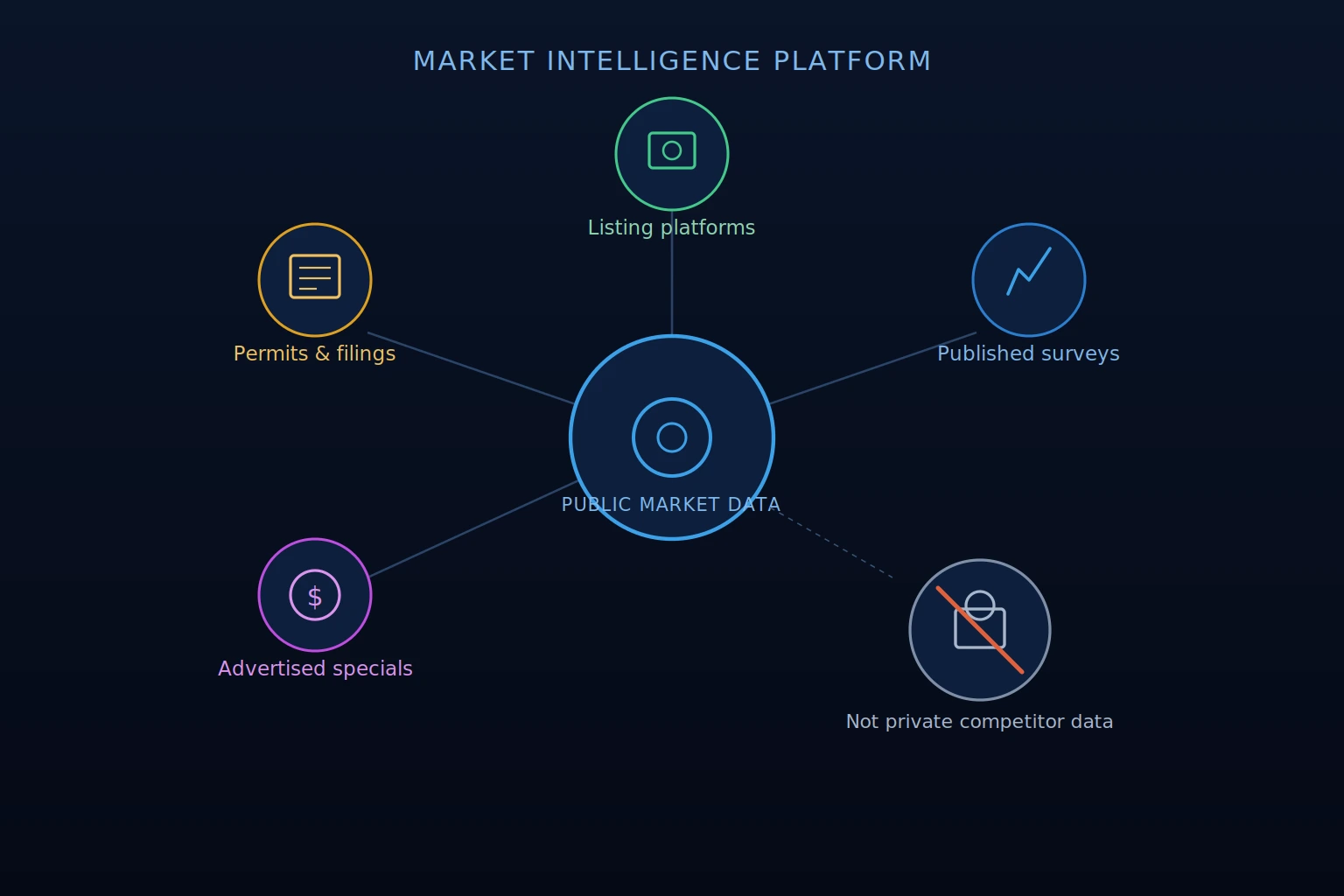
The key word is public. Reputable market intelligence platforms work with data that is publicly available or voluntarily disclosed, including advertised rents on listing platforms, publicly posted specials, filed permits, and reported vacancy data from published surveys. What these platforms do not and should not claim to have is access to non-public competitor data, private lease terms, or proprietary operational information that has not been voluntarily shared.
What Public Market Data Can Help Operators Understand?
When used appropriately, public market data provides useful external context across several dimensions.
Publicly advertised rents. Listing platforms publish asking rents for available units at competing properties. This is a useful reference point for understanding where the market is advertising, though advertised rents differ from effective rents, which reflect what residents are actually paying after concessions.
Publicly advertised concessions and specials. When competing properties post specials, those promotions are visible to prospective residents and to market intelligence platforms that track listing data. Understanding the prevalence and value of publicly advertised concessions in a submarket helps operators evaluate their own concession approach in context.
Available inventory. Public listing data shows what units are being actively marketed as available, providing a proxy for supply conditions in a specific area and unit type segment.
New supply and development activity. Permit filings, construction data, and reported development pipelines are publicly available through municipal records and published research. This data helps operators and investors understand how much new supply is entering specific submarkets and over what timeline.
Broader market trends from published sources. Organizations including CBRE, NAA, Cushman and Wakefield, and NMHC publish regular reports on occupancy, rent growth, and absorption at the market and submarket level. These published reports provide macro context that is useful for understanding where a submarket sits in its cycle.
Read Also:
- How to do a Comparative Market Analysis in Real Estate
- How To Do A Rental Market Analysis Like a Pro (With AI Tools)
What to Look for in a Public Market Intelligence Platform for Multifamily
Not all market intelligence platforms are equally transparent about their data sources or methodology. These criteria help evaluate whether a platform is worth relying on.
Clearly identified public data sources. A credible platform is transparent about where its data comes from. If a platform cannot clearly explain which public sources its market data originates from, that is a reason to question how the data was collected and what it actually represents.
Data freshness and transparency. Public market conditions change. A platform that cannot tell you when its data was last updated or how frequently it refreshes is providing a less useful picture than one with clear data currency and update cadence disclosure.
Geographic and property coverage. Coverage varies significantly across platforms. A platform with strong national coverage may have limited depth in specific submarkets. Evaluating whether the platform covers the markets that matter for a specific portfolio is essential before relying on it for operational decisions.
Ability to contextualize, not replace, property-level data. The most useful market intelligence platforms position their data as context for internal decision-making rather than as a substitute for it. Public market data tells operators what is happening in the broader environment.
It cannot tell them how their specific asset is performing within it. Platforms that encourage operators to use public data alongside internal performance data rather than instead of it are more operationally useful than those that imply external data alone is sufficient.
Public Market Intelligence vs. Property Performance Data
These are two distinct categories of information that serve different purposes in multifamily analysis.
Public market intelligence answers external questions: What are competing properties advertising? How much new supply is coming? What does published vacancy data show for this submarket? This information provides context about the environment an asset is operating in.
Property performance data answers internal questions: How quickly are our units absorbing? Where is our renewal conversion softening? What does our forward exposure look like? How is our effective rent performing relative to our occupancy targets? This information reflects what is actually happening at the asset and points toward the specific decisions that need to be made.
According to the National Multifamily Housing Council, data drives operational activity in multifamily, and the most effective use of that data comes from understanding what each source can and cannot tell you. Public market data and internal property data are not interchangeable. They answer different questions and they should be used that way.
The gap between what the public market shows and what internal performance data shows is often where the most operationally important signals live. A property where internal leasing velocity is softening while the public market looks stable has a property-specific issue. A property where internal performance is holding while the broader submarket is weakening may be performing more resiliently than surrounding conditions would suggest. Neither conclusion is reachable from public data or internal data alone.
Top Picks:
- Real Estate Market Insights For Property Managers
- Multifamily Data Analysis: What It Is and Why It Matters
How Revenue Managers Combine External Context With Internal Performance
Revenue managers who use market intelligence most effectively treat public data as one input among several rather than as the primary driver of pricing and leasing decisions.
Public market context is most useful for calibration. When internal leasing velocity is softening, checking whether publicly advertised concessions have increased across the submarket provides additional context for determining whether the change may reflect broader submarket conditions or a property-specific issue.
When a pricing adjustment is being considered, understanding where competing properties are publicly advertising their asking rents provides a reference point for evaluating whether the adjustment is in the right range.
What public data cannot do is tell a revenue manager whether their specific layouts are absorbing at the right pace given their forward exposure, whether renewal conversion is softening in a way that will affect occupancy in 60 days, or whether their current pricing is aligned with what their own leasing data is showing. Those answers require internal operational data.
The most effective analytical approach connects the two. Public market context establishes the environment. Internal performance data establishes the specific conditions at the asset. The decision that follows reflects both.
How Rentana Supports the Internal Side of the Analysis
Rentana is not a public market intelligence platform. It does not claim to provide proprietary competitor data or non-public market information. What Rentana does is connect PMS-sourced operational data into a forward-looking view of property performance that supports the internal side of the analysis revenue managers and asset managers need to make better decisions.
Rentana receives leasing, occupancy, renewal, and availability data through its PMS integration, keeping the internal picture current without manual assembly.
Rentana uses purpose-built pricing algorithms based on configured asset strategy to generate recommendations using property performance signals such as leasing activity, forward availability, occupancy conditions, and historical performance. Teams may also consider publicly available market data as external context when evaluating those recommendations. The recommendations are transparent, showing the inputs behind each one so teams can evaluate the reasoning rather than accepting a number without context.
Predicted Occupancy connects current leasing activity, renewal trends, and future availability to provide forward visibility into where occupancy is heading. Exposure analysis shows scheduled lease expirations against property targets, helping teams identify where future expiration concentration may be building.
AI-generated Insights surface what is changing at specific assets, explain why it may matter, and connect to a supported next step. The Metrics Browser enables granular analysis across the portfolio by layout, custom unit group, property, and time period.
Rentana helps teams understand what is changing in their own operational data, where to focus across the portfolio, and what decisions those conditions point toward. For external market context, operators can combine Rentana's internal operational view with the public market intelligence platforms that cover their specific markets.
Conclusion on Multifamily Market Intelligence
Public market intelligence and internal property performance data serve different analytical purposes. Public market intelligence platforms provide context on what is happening in the broader market around an asset. Internal operational platforms surface what the asset itself is doing and where it is heading.
The operators who make the most consistent revenue decisions are the ones who understand the difference, use each type of data for the questions it can actually answer, and build their analytical workflow around connecting the two rather than substituting one for the other.