
A lease is not just a legal document. It is the operational unit that determines rent roll performance, future availability, renewal timing, exposure concentration, and occupancy outcomes. Every lease signed today creates a set of future conditions: a rent that will be compared against market at renewal, an expiration date that will affect availability in a specific month, and a term length that will shape how expirations distribute across the forward calendar.
Lease analysis is the practice of reviewing that data systematically so revenue managers and asset managers understand how the existing rent roll is positioned and where it is heading, not just what it contains today.
According to CBRE's U.S. Real Estate Market Outlook 2026, because most widely reported rent growth figures are based on asking rents for new leases, they understate the actual performance of multifamily properties. Blended rent growth, which combines asking and renewal rents, is expected to remain higher than asking rent growth for new leases alone. That distinction is precisely why lease analysis matters: the full picture of how a portfolio is performing requires looking at the complete rent roll, not only at what new leases are signing at.
Related:
- Multifamily Lease-Up Strategy: Building Occupancy While Managing Future Exposure
- 7 Lease Renewal Strategies That Reduce Turnover Costs
What Is Lease Analysis in Multifamily?
Lease analysis in multifamily is the review of lease data, lease terms, rent levels, expirations, renewals, trade-outs, and occupancy impact to understand how signed leases affect property performance now and in the future.
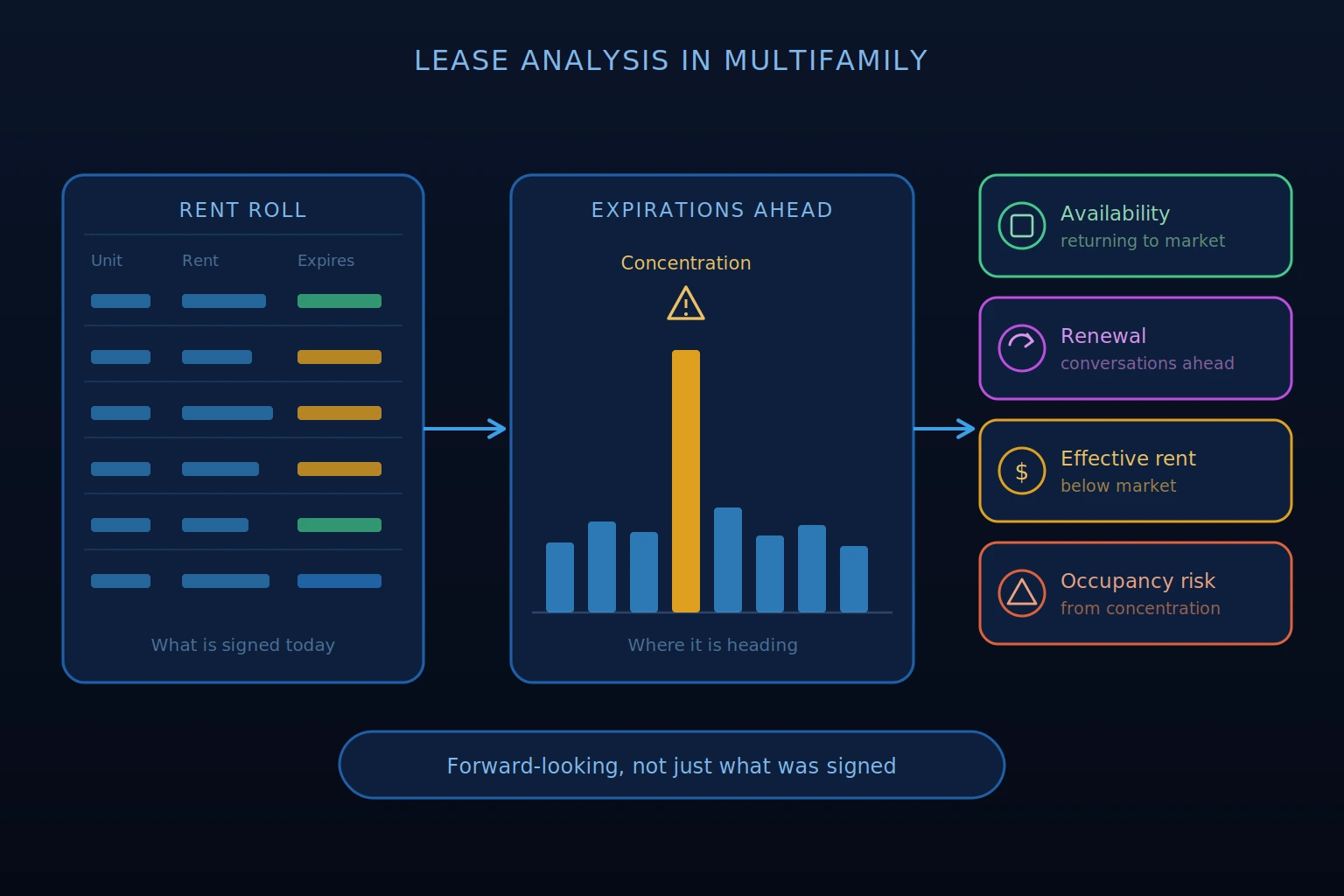
It covers both what the current rent roll contains, the collection of active leases, their rent levels, terms, and expiration timing, and what it implies about future conditions: where availability will be returning to market, where renewal conversations will need to happen, where effective rent may be below market, and where expiration concentration may create occupancy risk.
The most useful lease analysis is forward-looking. It connects what the current rent roll shows to where occupancy, availability, and revenue are heading rather than only describing what was signed in the prior period.
Why Lease Analysis Matters for Revenue Management
Revenue managers make decisions daily that are directly shaped by what the lease data shows: pricing adjustments, renewal offer levels, lease-term pricing during active leasing, and concession strategy. Without a clear view of what the current rent roll contains and what it implies for future availability and revenue, those decisions are made on an incomplete foundation.
According to Cushman and Wakefield's analysis of multifamily portfolio trends, headline lease trade-outs have stabilized across the industry with new lease trade-outs remaining negative while renewal trade-outs stayed positive, with total blended trade-outs remaining positive led by Class A assets. Understanding the trade-out picture at the asset level, not only the market level, is what connects lease analysis to actual revenue management decisions.
Lease Data Revenue Managers Should Review
The data fields that matter most for meaningful lease analysis:
- Lease start and end dates: The foundation of expiration analysis and forward availability planning
- Current rent: What each unit is collecting, which may differ from asking rent when concessions are embedded
- Market rent: The current asking or effective rent for comparable units, used to evaluate loss to lease and trade-out opportunity
- Lease term length: How long each lease runs, which shapes how expirations distribute across the forward calendar
- Move-in and move-out timing: Actual dates that affect availability and days vacant calculations
- Renewal status: Whether residents with upcoming expirations have been contacted, whether offers have been made, and where in the renewal process each lease stands
- Trade-out: The change between the prior lease rent and the new or renewed lease rent, measured in both dollar and percentage terms
- Loss to lease: The gap between current rent and market rent across the rent roll
- Expiration month: Which month each lease expires, used to identify concentration in specific windows
- Layout or pricing group: Which configuration each lease belongs to, enabling layout-level analysis rather than only property averages
- Concessions or specials: What incentives were offered and how they affect the effective rent collected versus the asking rent charged
- Effective rent: What units are actually collecting after concessions and adjustments, the revenue figure that matters most for NOI analysis
Lease Expiration Analysis
Lease expiration analysis evaluates how many leases are ending in each future time window, by layout and by month, to surface where upcoming availability is concentrating and what risk that concentration may create.
A property with 30% of its leases expiring in January, historically its slowest leasing month, has a materially different forward occupancy picture than one with expirations distributed evenly across the year, even if current occupancy looks the same in both cases. The concentration creates a window where the volume of units returning to market may exceed what demand conditions can absorb at current pricing without vacancy pressure or reactive concession spend.
Expiration analysis is most useful when it incorporates the full forward availability picture beyond just scheduled lease ends. Confirmed notices to vacate, month-to-month lease behavior based on historical patterns, and anticipated early terminations all contribute to what is actually coming to market in a specific window. The difference between what the scheduled expiration calendar shows and what predicted availability shows can be significant, and managing to the more complete picture is what makes proactive exposure management possible.
Rent Roll and Loss-to-Lease Analysis
Loss to lease is the gap between gross potential rent and what the property is actually collecting, evaluated across the rent roll. It reflects the accumulated impact of below-market leases, concessions, and leasing decisions made under conditions that may no longer reflect current demand.
Reviewing loss to lease by layout surfaces where the gap between potential and collected revenue is widest, which is not always where current occupancy is weakest. A fully occupied layout where every unit is leased significantly below current market rent due to concessions offered during a lease-up or a competitive period can have a larger loss-to-lease impact than a layout with modest vacancy but strong effective rent on occupied units.
Loss-to-lease analysis also informs renewal strategy. When a layout carries significant embedded loss to lease, the renewal conversation involves a larger increase than residents may expect, which creates a higher risk of non-renewal. Understanding where loss to lease is concentrated, and how it compares to what new leases in the same layout are signing at, is what allows renewal pricing to be positioned thoughtfully rather than as a fixed escalation that may not reflect the actual gap between current rent and market conditions.
Read Also:
- The Best Lease Renewal Software for Multifamily Real Estate
- Top 7 Multifamily Leasing Tips
Trade-Out Analysis
Lease trade-out measures the change between the rent on a prior lease and the rent on the new or renewed lease that replaced it. It shows whether the property is capturing more or less per unit than it was previously, and whether the direction of movement is consistent with where the market and the asset strategy point.
Three trade-out metrics matter for multifamily lease analysis:
- New lease trade-out shows the change between the expiring lease rent and the rent signed with a new resident. A positive new lease trade-out means the property is leasing to new residents at a higher rate than the resident who moved out was paying. A negative new lease trade-out means the replacement lease is lower, which reflects market softening, concession pressure, or pricing that has not kept pace with what the market will support.
- Renewal trade-out shows the change between the current resident's rent and the renewed lease rate. Renewal trade-outs tend to be more positive than new lease trade-outs in the current market, which is part of why blended performance is holding up even in markets where asking rent growth on new leases is negative.
- Effective trade-out accounts for concessions on both sides of the comparison. A new lease signed at a higher asking rent than the prior lease but with six weeks of free rent embedded may have a negative effective trade-out once the concession impact is factored into the actual rent collected over the lease term. Effective trade-out is the metric that most accurately reflects revenue performance rather than rate performance.
Renewal Lease Analysis
Renewal analysis evaluates how many residents are choosing to renew, at what rates, with what trade-outs, and how upcoming expiration timing interacts with current leasing demand and occupancy goals.
The renewal analysis questions worth reviewing consistently:
- What percentage of leases expiring in each upcoming window are expected to renew, based on current outreach coverage and resident response?
- How do offered renewal increases compare to current market rent and to what new residents are paying after concessions?
- Where is rent roll inversion risk present, meaning where are renewal rates being offered above what comparable new leases are signing at after concessions?
- How does renewal conversion by layout correlate with the forward exposure picture in those same layout windows?
Lease Term Analysis
Lease term analysis evaluates how the distribution of lease lengths across the current rent roll will shape future expiration timing. A portfolio where most leases are signed at 12-month terms will produce a highly concentrated expiration calendar if leasing is seasonal, because a large volume of leases signed during peak leasing season will all expire around the same time the following year.
Lease-term strategy addresses this by using dynamic lease-term pricing during active leasing periods to influence which term lengths residents choose. Configurable lease-term pricing can support both near-term leasing goals and longer-term asset strategy by helping teams manage pricing variation, expiration timing, and the future distribution of signed leases. During lease-up, when the entire forward expiration calendar is being created for the first time, lease-term strategy has the most direct influence on what exposure the asset will face in years two and three.
Lease term analysis is the analytical foundation for lease-term pricing strategy. Understanding what the current term distribution looks like and what the resulting forward expiration calendar shows is what makes proactive adjustment possible rather than reactive.
How Lease Analysis Supports Pricing Decisions
Pricing decisions in multifamily are most effective when they are grounded in what the lease data is showing about current conditions and forward implications. A pricing recommendation that reflects current asking rent by layout but not the loss-to-lease gap, the forward expiration concentration in that layout, or the renewal pricing being offered on comparable expiring leases is a recommendation built on an incomplete picture.
The lease analysis inputs that most directly inform pricing decisions:
- Loss to lease by layout, which shows where embedded below-market rents create both opportunity and renewal risk
- Forward expiration concentration, which shows where the urgency of filling units should affect how aggressively or conservatively pricing moves
- Trade-out trends, which show whether the market is supporting positive trade-outs on new leases or whether concession pressure is keeping effective trade-outs negative
- Renewal conversion, which affects how much inventory will return to market and at what effective rent levels
Pricing decisions evaluated against these lease analysis inputs are more precisely calibrated to where the asset actually is and where it is heading than decisions made from current occupancy and asking rent data alone.
How Rentana Supports Lease Analysis
Rentana connects lease data from the PMS into analytical capabilities organized around the forward-looking lease analysis questions that revenue managers and asset managers need to evaluate consistently.
- Exposure forecasting surfaces lease expiration concentration by layout and time window, helping teams evaluate forward availability before overexposure creates occupancy pressure.
- Predicted Occupancy connects current leasing activity, renewal trends, and future availability into a forward view of where occupancy is heading, translating lease analysis findings into an occupancy outlook that helps teams evaluate whether current leasing and renewal strategy is sufficient given the forward picture.
- Renewal insights help teams evaluate retention trends by layout and expiration window, renewal pricing in the context of current leasing conditions and market rent, and where renewal strategy may need adjustment given forward exposure concentration and occupancy goals.
- Loss-to-lease visibility by layout surfaces where the gap between gross potential and collected revenue is widest, connecting that gap to leasing velocity and forward availability context so teams can distinguish between a pricing opportunity and a leasing challenge in the same data.
- Pricing recommendations by layout connect leasing performance, forward availability, exposure conditions, renewal trends, and asset strategy alignment into a supported pricing evaluation with reasoning attached, so the lease analysis context is embedded in the recommendation rather than requiring separate assembly before any pricing decision can be made.
- Lease-Up Mode supports lease-up properties with data-backed planning, forecasting, AI insights, and pricing recommendations aligned to the property’spath to stabilization, while helping teams keep future occupancy risk in view as leases are signed.
- Target Tracking evaluates current performance against configured occupancy and revenue targets, giving asset managers and revenue managers a consistent view of how the rent roll and leasing outcomes are tracking against plan.
- Portfolio dashboards give teams a shared view of lease analysis conditions across properties, surfacing where expiration concentration, loss to lease, or renewal conversion warrant closer attention without requiring sequential manual review of each asset.
Don’t Miss:
- The Multifamily Leasing Funnel Explained
- Centralized Leasing: What It Is & How Does it Work?
Conclusion on Lease Analysis in Multifamily
Lease analysis in multifamily is the practice of understanding what the current rent roll contains and what it implies about future performance, not just what it shows about the present. The expirations that will create availability pressure, the loss to lease that will shape renewal conversations, the trade-out trends that show whether effective rent is moving in the right direction, and the term distribution that will determine how future exposure concentrates are all visible in lease data that most properties already have.
What determines whether that data produces useful insight is whether it is organized around the forward-looking questions that actually drive decisions, evaluated at the layout level where the differences that matter most are visible, and connected to the pricing, renewal, and occupancy management workflows that lease analysis is designed to support.
Use Rentana to turn lease data into clearer visibility on expirations, renewals, pricing, occupancy risk, and revenue performance.