Property managers make decisions every day that depend on understanding two things simultaneously: what is happening inside their properties and what the market around them is doing. Internal data tells the first story. Public data helps tell the second.
Public data is becoming more important as property managers look for transparent market context to support pricing, leasing, and operational conversations with owners and asset managers.
That context is especially useful when private data sources are incomplete, difficult to verify, or less appropriate for decision-making than publicly available market signals.
This article covers what property management public data analytics means in practice, what types of public data are most useful, how to combine external context with internal performance data, and how Rentana supports the internal side of that analysis.
Related:
What Is Property Management Public Data Analytics?
Property management public data analytics is the process of using publicly available market, listing, competitor, review, demographic, and local market data to add external context to property management decisions.
The defining characteristic is source transparency. Public data is information that is available to anyone: advertised rents on listing platforms, publicly posted concessions, permit filings, published market research, online resident reviews, and government employment and demographic data. It does not include private competitor data, non-public lease terms, or internal operational information that another operator has not voluntarily disclosed.
Public data should support and add context to decisions, not replace the internal property data that most directly determines how an asset is performing. The strongest property management analysis combines both, using public market context to calibrate internal performance signals rather than substituting external benchmarks for the asset's own leasing velocity, renewal conversion, and forward availability conditions.
Why Public Data Matters for Property Managers
Third-party managers often need to explain performance to owners, asset managers, and regional teams who are not in daily contact with the property's operational conditions. A leasing velocity slowdown that looks like a property-specific issue may reflect a broader concession environment that other operators in the same submarket are also navigating. A renewal rate that looks low may be more understandable when viewed against current competitive conditions.
Public data provides the external context that makes those conversations more complete and more credible. When a property manager can show that concession activity in the submarket has increased, that context supports a more informed conversation about occupancy performance than internal numbers alone would produce.
Types of Public Data Property Managers Can Use
The categories of publicly available data most relevant to property management decisions:
- Public apartment listings: What comparable properties are actively marketing, at what price points, and at what availability levels across different layout types
- Published asking rents: What properties are advertising on listing platforms, recognizing that advertised rents reflect what operators choose to post rather than what they are collecting after concessions
- Public concessions and specials: Promotional offers posted on listing platforms that shift the effective rent comparison for prospective residents evaluating multiple properties
- Competitor availability: The volume of units being publicly marketed across the competitive set, providing a proxy for visible supply conditions in the immediate submarket
- Online reviews and resident sentiment: Published resident reviews on platforms like Google, Yelp, and apartment rating sites that surface recurring themes around maintenance responsiveness, communication quality, amenity conditions, and management experience
- Local employment and population trends: Government and third-party data on employment conditions, population movement, and household formation that shape the demand environment in specific markets
- Market supply and development activity: Permit filings, construction data, and reported development pipelines that help indicate how much new supply may be entering the submarket and on what timeline
- Public demographic and housing data: Census data, household income distributions, and renter-to-owner ratios that provide demand context for specific markets and submarkets
Read Also:
- Best AI Tools for Multifamily Property Management
- The Role of Business Intelligence in Property Management
How Public Data Adds Context to Pricing Decisions
Publicly advertised rents and concessions provide a visible reference point for evaluating how a property's pricing sits relative to what comparable properties are choosing to show prospective residents. When a property’s asking rent is materially above what comparable units in the same submarket are publicly advertising, that gap may contribute to slower absorption, even if the property appears well positioned on other dimensions.
The important limitation is that publicly advertised asking rents are not the same as effective rents. For example, a property advertising several weeks free may have a materially lower effective rent than the asking rent suggests. Pricing comparisons built on asking rents without accounting for concession depth can produce a misleading picture of where the competitive set is actually pricing relative to the subject property.
Public data should be used as context alongside internal leasing velocity, forward availability, occupancy conditions, and asset strategy, not as the primary driver of pricing decisions. Rentana incorporates publicly available market data, including advertised rents, concessions, and specials, as external context alongside internal performance signals rather than in place of them.
How Public Data Helps Evaluate Demand
When internal leasing performance is softening, public data helps property managers evaluate whether the condition is property-specific or market-wide.
A leasing velocity decline at a specific property that is consistent with broader submarket softness and increased competitor concessions is a different situation than the same velocity decline in a market where comparable properties appear to be absorbing normally.
That distinction matters for how the response is framed internally and externally. A property-specific issue may point toward operational or pricing evaluation at that asset. A market-wide condition may point toward a broader competitive positioning review and a different performance conversation with ownership.
Public competitor availability data provides a proxy for supply conditions. When multiple comparable properties in the same submarket are showing elevated availability simultaneously, that suggests demand is being distributed across a larger supply pool rather than reflecting a condition specific to any single property's management or pricing.
How Public Reviews Can Support Operational Analysis
Online resident reviews are a form of public data that property managers often monitor informally but rarely analyze systematically. Review themes across a property’s own reviews and, where publicly visible, across competing properties can surface recurring patterns around maintenance responsiveness, communication quality, amenity reliability, move-in experience, and renewal pricing.
Review data should be used directionally and in aggregate rather than as a precise measure of resident satisfaction. A single negative review about maintenance responsiveness is anecdotal. A pattern of maintenance-related reviews across a six-month period, combined with internal work order closure data, is an operational signal worth investigating.
Why Public Data Alone Is Not Enough
Public data describes the external environment. It does not show what is happening inside the property or where internal conditions are heading.
What public data cannot surface: internal funnel conversion rates by stage, actual achieved rents after concessions, forward exposure concentration by layout and time window, renewal conversion trends, leasing pipeline quality, confirmed notices to vacate, or the specific occupancy and revenue goals the property is managing toward.
All of these are internal conditions that determine how the property is actually performing within whatever the external environment is showing. A property in a submarket where public data shows stabilizing conditions can have internal leasing velocity declining on a specific layout, renewal conversion softening, and forward exposure concentrating in a way that will create occupancy pressure regardless of what the market around it is doing. Public data would not surface that condition. Internal operational data would.
How to Combine Public Data With Internal Property Data
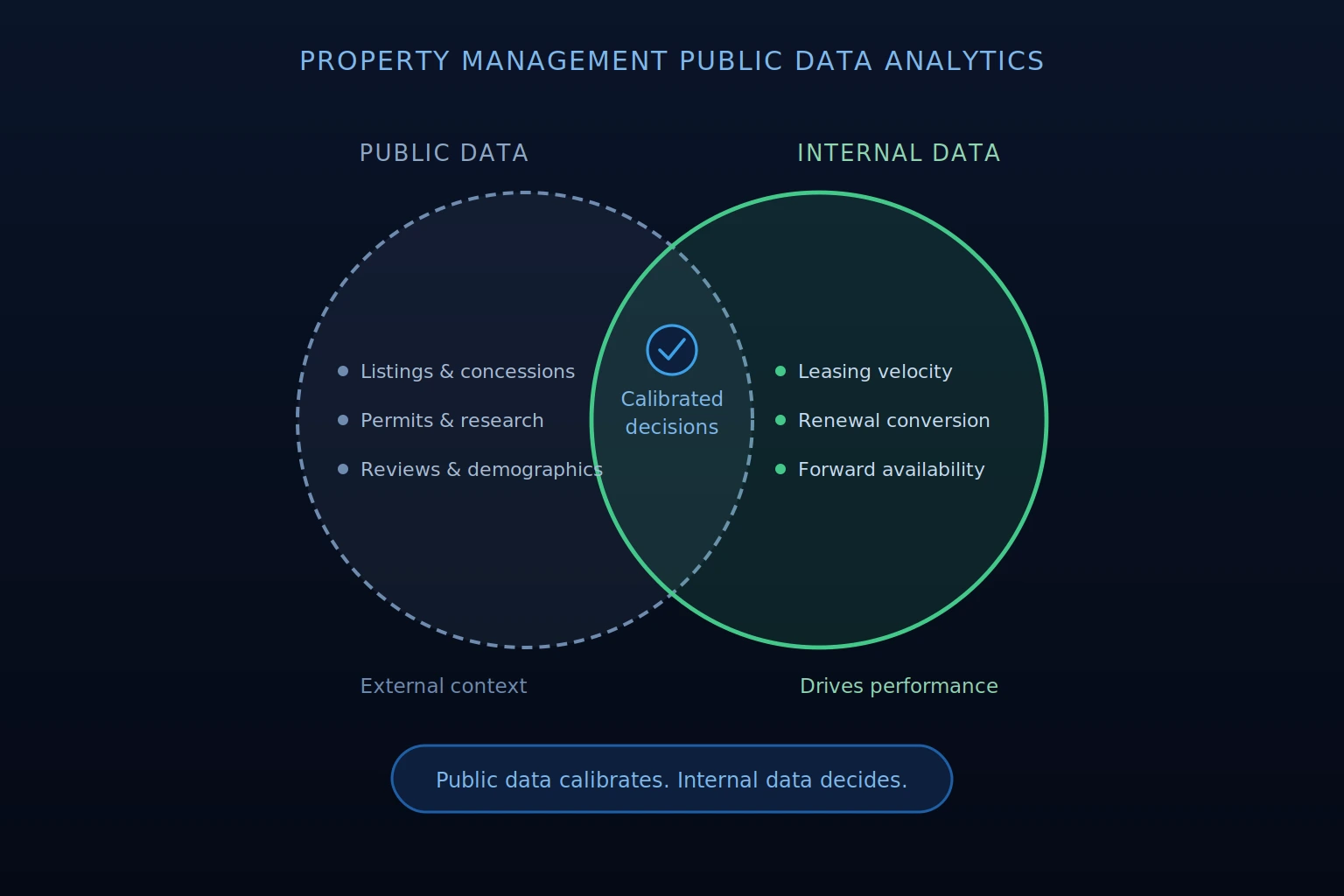
The most operationally useful analysis connects public market context to internal performance signals for each specific asset. The external picture establishes the environment. The internal data establishes how the property is performing within it.
Internal signals worth evaluating alongside public market context:
- Leasing velocity: How quickly available units are absorbing by layout relative to forward availability and occupancy targets
- Lead demand: Whether current inquiry volume is sufficient to meet occupancy goals based on recent conversion performance
- Conversion rates: Where in the leasing pipeline prospects are advancing and where they are dropping off, by stage and by layout
- Availability: What is currently available and coming available
- Expirations: The forward distribution of upcoming availability by layout and time window
- Renewals: Conversion rates by layout and expiration window over rolling periods and how they are trending
- Pricing performance: How pricing movement relates to leasing velocity, conversion, and occupancy conditions
- Target occupancy: The configured goal the pricing and leasing strategy is working toward
- Asset strategy: Whether the property is in lease-up, stabilization, or value-add phase, which shapes how performance should be evaluated
When a publicly advertised concession increase in the submarket is evaluated alongside softening internal leasing velocity and declining funnel conversion at the tour-to-application stage, the combined picture points toward a more specific and more actionable response than either data source would support alone.
Top Picks:
- What Are Property Management Systems?
- How Integrations Reduce Manual Data Entry in Property Management
How AI Can Help Analyze Public and Internal Data Together
Connecting public market data and internal property data manually requires assembling different information from different sources, evaluating it together, and identifying where the combination points toward a condition or decision worth acting on. That process takes time that competes with everything else property managers are managing.
AI can help surface patterns across public and internal data faster by evaluating connected signals rather than presenting each source separately. Examples include pricing gaps between internal asking rents, weak conversion that coincides with competitor concession increases, review sentiment themes that align with internal operational data, or demand changes by layout that appear in internal leasing velocity before they show up in published market reports.
The output of AI-assisted analysis should explain what the combination of signals suggests and where the team may need to investigate further, not produce a directive to act without human review. AI handles the pattern recognition and signal connection. The property manager applies the judgment and makes the decision.
How Rentana Supports Property Management Analytics
Rentana helps property managers connect public market context with internal property performance data through a set of capabilities organized around what is changing, why it may matter, and where teams may need to investigate further.
AI-generated Insights surface what is changing at specific assets, explain why it may matter given current operational and public market conditions, and help teams understand where to focus.
Pricing recommendations by layout incorporate publicly available market data, including advertised rents, concessions, and specials, as external context alongside internal leasing performance, forward availability, occupancy goals, and property strategy. The reasoning behind each recommendation is visible so property managers and revenue managers can evaluate the inputs before deciding how to act.
Predicted Occupancy connects current leasing activity, renewal trends, and future availability into a forward view of where occupancy is heading at each asset, supporting earlier evaluation of whether internal conditions are tracking toward property goals.
Targeted lead rate helps evaluate whether current lead demand is sufficient to meet occupancy goals based on recent conversion performance and upcoming exposure.
Exposure management surfaces where lease expiration concentration is growing by layout and time window, helping teams evaluate forward availability before it creates avoidable occupancy pressure.
Renewal visibility helps teams evaluate retention trends by layout, renewal pricing in the context of current leasing conditions, and where renewal strategy may need adjustment given forward exposure and occupancy goals.
Lease-Up Mode supports lease-up properties with data-backed planning, forecasting, AI insights, and pricing recommendations aligned to the property’s path to stabilization, while helping teams keep future occupancy risk in view as leases are signed.
Portfolio dashboards give property managers and asset managers a shared, current view of performance across every property simultaneously, supporting the conversations with owners and regional teams that third-party managers need to have on a consistent cadence.
Conclusion on Property Management Public Data Analytics
Property management public data analytics provides the external context that helps property managers understand the market environment their assets are operating in, support performance conversations with owners and asset managers, and evaluate whether internal conditions are consistent with or diverging from what the broader market is showing.
What it cannot do is replace the internal property data that most directly determines how an asset is performing. The strongest analysis connects both, using public market context to calibrate internal performance signals rather than substituting external benchmarks for the operational data that actually drives decisions.
Use Rentana to combine public market context with internal property performance data so property managers can support pricing, occupancy, leasing, renewal, and asset strategy decisions with better visibility.