AI is changing how real estate decisions get made, not by replacing the judgment those decisions require, but by improving the information available when they are made and reducing the time required to assemble it.
According to JLL's research on AI in real estate, 88% of real estate investors and owners had already started piloting AI or planned to do so, with C-suite leaders broadly expecting AI to transform how real estate operates. The gap between organizations that have embedded AI into their workflows and those still in the evaluation stage is beginning to show up in how quickly they can identify risk, act on performance signals, and make better-informed decisions across their portfolios.
This article covers seven specific ways AI impacts real estate decisions, the limitations worth understanding, and how Rentana supports multifamily teams making better decisions across pricing, occupancy, leasing, renewals, lease-ups, and portfolio management.
Related:
How Does AI Impact Real Estate Decisions?
AI impacts real estate decisions by helping teams analyze more data, identify patterns earlier, evaluate risk, prioritize where to focus, and make faster, better-informed decisions across acquisition, asset management, pricing, leasing, renewals, and operations.
The impact is not uniform across every function or every organization. Where AI is most consequential is in the functions where decision quality depends on how current, connected, and complete the information behind the decision is, and where the gap between what manual processes can produce and what connected AI-supported systems can surface is largest.
7 Ways AI Impacts Real Estate Decisions
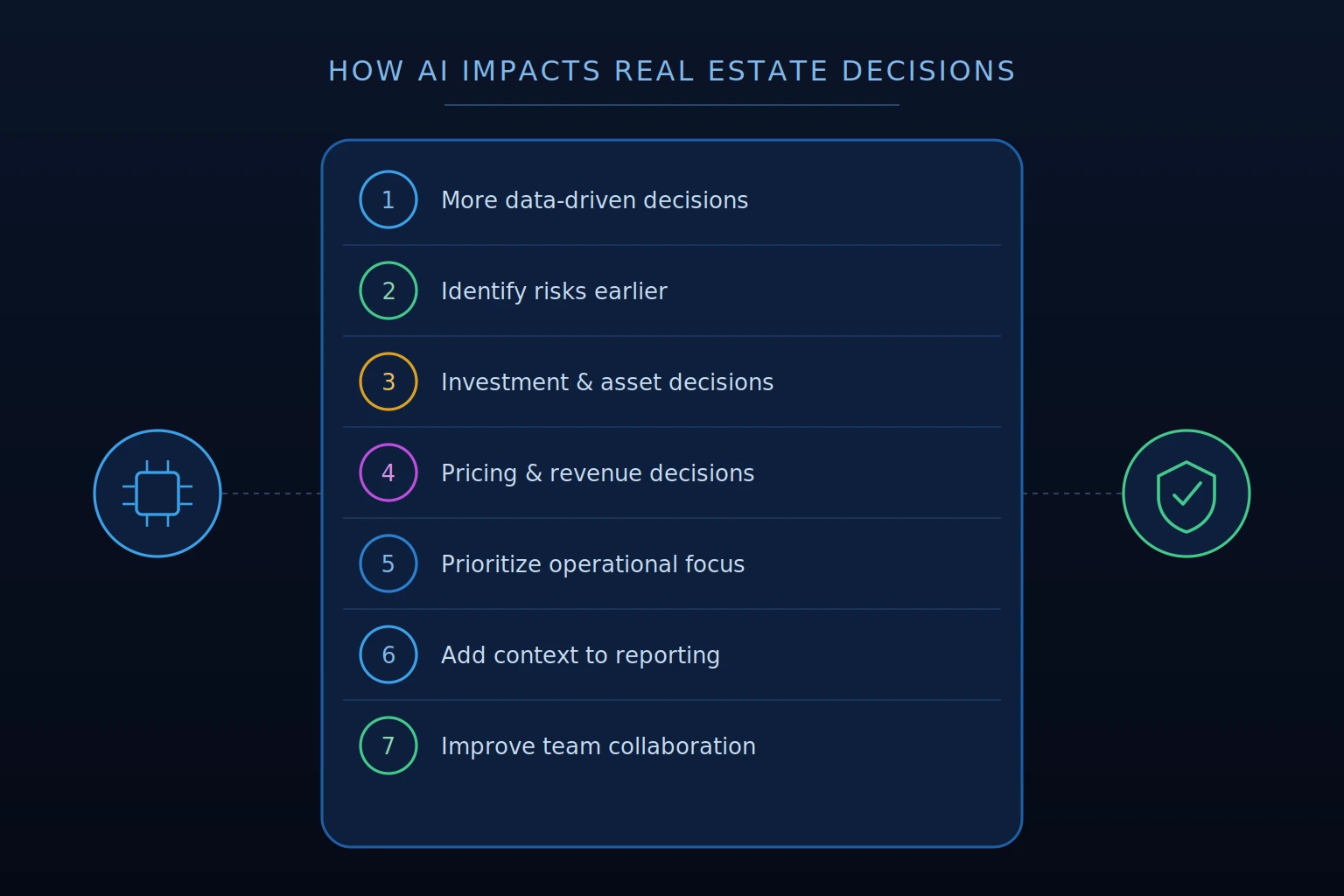
- AI Makes Real Estate Decisions More Data-Driven
- AI Helps Identify Risks Earlier
- AI Supports Better Investment and Asset Management Decisions
- AI Improves Pricing and Revenue Decisions
- AI Helps Prioritize Operational Attention
- AI Adds Context to Reporting
- AI Improves Collaboration Across Teams
1. AI Makes Real Estate Decisions More Data-Driven
Most real estate decisions are already data-driven in intent. The challenge is that the data informing them is often delayed, manually assembled, or organized around what was easy to pull rather than what was most important to know.
AI helps organize property, market, leasing, financial, and operational data into a current, connected view that decision-makers can use before a decision needs to be made. When leasing velocity, forward availability, renewal conversion trends, pricing performance, and occupancy conditions are evaluated together rather than assembled separately on different schedules, the decision that follows reflects a more complete picture of current conditions.
For real estate teams managing multiple assets, the value is not simply having more data. It is having the right signals organized in a way that helps teams understand where performance is changing, which assets need attention, and which decisions require deeper review.
2. AI Helps Identify Risks Earlier
Investment and operational risk in real estate almost always manifests in operational signals before it shows up in financial reporting. The conditions that produce an occupancy dip, a revenue shortfall, or an asset drifting from its business plan develop over weeks, and they are visible in the data during that development period.
AI can surface early risk signals more consistently than manual review by evaluating connected conditions that point toward a developing problem. Examples of the kinds of risk signals AI-powered property analytics can surface earlier than traditional reporting:
- Leasing demand risk: Softening lead volume, leasing velocity, or conversion in a specific layout before it reaches the reported occupancy number
- Forward availability risk: Rising availability, expiration concentration, or exposure building in a specific future time frame
- Renewal risk: Renewal conversion softening by layout or expiration window before it affects future occupancy
- Pricing and positioning risk: A layout absorbing more slowly than expected based on current pricing, demand, public market context, or comparable configurations
- Operational or amenity risk: Resident feedback, online reputation themes, or amenity-related signals that may affect demand, retention, or perceived value
- Asset performance risk: A property trending away from plan across multiple signals in a way that warrants closer review before it reaches financial reporting
Human judgment remains essential for determining what each signal means in the context of the specific asset, market, and investment strategy. As Newsweek argues in its discussion of AI and real estate, the risk is not only that AI gets an answer wrong, but that faster analysis can create false confidence if teams do not build in human verification.
Related:
- AI for Lease Management: 5 Core Use Cases
- The Impact of AI on Multifamily Operations and Revenue
3. AI Supports Better Investment and Asset Management Decisions
Asset managers overseeing multiple properties need two capabilities simultaneously: a portfolio-wide view of where conditions are shifting and the ability to move quickly from a portfolio signal to the property-level detail driving it.
AI supports asset management decisions by surfacing where assets may be drifting from plan without requiring sequential manual review of every property. When leasing velocity is softening, renewal conversion is declining, and forward exposure is concentrating at the same asset, that combination can surface as a connected signal rather than requiring the asset manager to notice the pattern across separate reports on separate schedules.
The most practical value for asset managers is often post-acquisition: understanding whether the asset is performing against plan, where operational signals are changing, and which properties need closer review before performance issues reach financial reporting. McKinsey has also found that advanced analytics can improve real estate decision-making by combining traditional and nontraditional data; in one multifamily example, machine-learning models predicted three-year rent per square foot with accuracy above 90%.
4. AI Improves Pricing and Revenue Decisions
Pricing decisions in multifamily depend on how current and connected the inputs behind them are. A recommendation built on a weekly comp survey and a month-end occupancy report reflects conditions from when those inputs were assembled rather than conditions as they exist today.
AI can support pricing decisions by connecting current leasing velocity by layout, forward availability, renewal conversion trends, occupancy targets, exposure concentration, publicly available market context, and property goals into a single evaluation rather than requiring the revenue manager to assemble those inputs separately before any analysis can begin.
The recommendation that results should be presented with the reasoning visible so the revenue manager can evaluate the logic before acting. AI supports revenue managers. It does not replace human review and approval, and it should not treat pricing as a push for the highest possible rent.
5. AI Helps Prioritize Operational Attention
At portfolio scale, not every property and not every metric needs the same level of attention at the same time. The challenge is knowing which ones do without reviewing everything at the same level of depth on the same schedule.
AI can surface which properties, layouts, or operational conditions may need evaluation first by identifying where multiple signals are shifting rather than presenting every metric with equal urgency. A property where leasing velocity is softening, renewal conversion is declining, and forward exposure is building simultaneously is a different priority than one where a single metric has moved in isolation. AI that surfaces that combination gives the asset manager a clearer basis for directing attention rather than relying on which property happens to be most visible or most recently reviewed.
6. AI Adds Context to Reporting
Reporting that delivers numbers without explaining what they mean is useful for documentation. Reporting that surfaces what changed, why it matters given current operational conditions, and where the team may need to investigate is useful for decisions.
AI can summarize what is changing at a specific asset, explain why a combination of conditions may matter given the asset’s goals and current performance, and help teams understand where further evaluation may be most useful. This is especially valuable for asset managers and operators reviewing portfolio performance who need to move quickly from a signal to an informed evaluation rather than spending time building the analytical picture before any evaluation can begin.
7. AI Improves Collaboration Across Teams
Real estate decisions rarely belong to one function alone. Pricing decisions affect leasing teams. Leasing conditions affect renewal strategy. Renewal outcomes affect forward availability. Asset management strategy shapes the parameters within which revenue management operates. When each function is working from different data on different timelines, the coordination these connections require starts from reconciliation rather than shared understanding.
AI-powered dashboards, insights, and shared reporting help asset management, revenue management, leasing, and operations work from the same current performance picture. When teams are working from the same leasing, exposure, occupancy, and pricing context, the conversation about what to do next starts from shared understanding rather than from reconciling what the data actually says.
Read Also:
Limitations of AI in Real Estate Decisions
Data quality determines output quality. AI outputs are only as reliable as the data feeding them. Inconsistent PMS records, stale availability data, and incomplete lease information all produce analytical outputs that reflect those limitations rather than actual performance conditions.
AI should not make high-stakes decisions automatically. Pricing changes, acquisition decisions, renewal strategies, and investment strategy decisions all carry downstream consequences that require human review, professional judgment, and accountability. AI should inform these decisions, not execute them without human approval.
Protected characteristics have no place in AI-supported decisions. Pricing recommendations, leasing decisions, and renewal strategies should be based on property performance data, demand conditions, and market factors. Resident demographics or any protected class characteristics should never influence AI-generated recommendations.
Due diligence and compliance review remain human responsibilities. AI-assisted analysis supports the due diligence process. It does not substitute for site visits, independent market research, legal review, environmental assessment, or the full range of professional evaluation that responsible real estate decision-making requires.
Integration and context matter. An AI system that is not connected to current property data or that works from manually uploaded inputs may produce outputs that are generic rather than grounded in the actual conditions of the specific asset being evaluated.
How Rentana Helps Real Estate Teams Make Better Decisions
Rentana supports multifamily decision-making through a set of AI-powered capabilities organized around what is changing, why it may matter, and where teams may need to investigate further.
AI-Generated Insights surface what is changing at specific assets, explain why it may matter given current operational conditions, and help teams understand where to focus while there is still time to respond.
Predicted Occupancy connects current leasing activity, renewal trends, and future availability into a forward view of where occupancy is heading at each asset, supporting earlier evaluation of whether current performance is tracking toward property goals.
Pricing Recommendations by layout connect leasing velocity, forward availability, exposure conditions, and property goals into a supported pricing evaluation with reasoning attached so revenue managers can evaluate the logic before deciding whether to act.
Target Tracking evaluates current performance against configured occupancy and revenue targets by property, giving asset managers and ownership groups a consistent view of where each asset stands relative to plan.
Scheduled reporting allows recurring report delivery to be configured once and delivered automatically, keeping leasing teams, revenue managers, asset managers, and ownership groups consistently informed without manual assembly.
Exposure management surfaces where lease expiration concentration is building by layout and time window, helping teams evaluate forward availability before it creates avoidable occupancy pressure.
Renewal visibility helps teams evaluate retention trends by layout, renewal pricing in the context of current leasing conditions, and where renewal strategy may need adjustment given forward exposure and occupancy goals.
Portfolio dashboards give asset managers a portfolio-level view of performance across properties, surfacing where multiple conditions are shifting without sequential manual review.
Lease-Up Mode supports lease-up properties with data-backed planning, forecasting, AI insights, and pricing recommendations aligned to the property’s path to stabilization, while helping teams keep future occupancy risk in view as leases are signed.
Conclusion On How AI Impact Real Estate Decisions
AI impacts real estate decisions by improving the quality and currency of the information available before a decision is made, surfacing risks and patterns earlier than manual processes reliably produce, and helping teams prioritize where to focus across portfolios where not every asset needs equal attention at the same time.
What it does not do is replace the judgment, due diligence, compliance review, and professional accountability that remain essential to responsible real estate decision-making. The organizations benefiting most from AI are the ones using it to make their decision-making processes better, not to automate the decisions themselves.
Use Rentana to support real estate decisions with AI-powered visibility into occupancy, pricing, leasing, renewals, exposure, lease-ups, and portfolio performance.