


Most people don’t lose money in real estate because they picked a “bad” property. They lose money because they didn’t have a clear idea of what they were actually looking for in the first place.
You’ll see a nice listing, run some quick numbers, convince yourself it could work and before you know it, you’re making decisions on the fly. That’s where things start to go wrong.
A buy box is what experienced investors use to avoid that. It’s a simple way of defining exactly what kind of property fits your strategy before you even start searching. Instead of reacting to every deal you see, you’re filtering opportunities based on rules you’ve already set.
Once you have a buy box, everything becomes clearer. You know what to ignore, what to look at more closely and what’s actually worth your time.
Top Pick:
- Are Townhomes Considered Multifamily?
- What is a Strip Mall? Key Characteristics and Features Explained
What is a Buy Box?
A buy box is a set of criteria that defines the exact type of property an investor is willing to buy.
In simple terms, it is a checklist you create before you start searching so you can quickly decide whether a deal fits your strategy or not. Instead of evaluating every property from scratch, you compare it against your predefined rules.
For example, your buy box might be: 3-bedroom single-family homes in Dallas, priced under $350,000, in neighborhoods with strong rental demand, and capable of generating at least $400 in monthly cash flow. Any property that doesn’t meet these criteria is automatically ignored.
What a Buy Box Includes
A buy box is made up of a few key criteria that help you quickly decide whether a property fits your strategy. While every investor’s buy box is different, most include some version of the following:
- Location (city, neighborhoods):
Where you want to invest. This could be as broad as a metro area like Atlanta or as specific as a few zip codes or neighborhoods with strong demand. - Property type:
The kind of property you’re targeting, such as single-family homes, duplexes, small multifamily, or short-term rentals like Airbnbs. - Price range:
The maximum (and sometimes minimum) price you’re willing to pay, based on your budget and financing strategy. - Expected returns:
The financial benchmarks the deal needs to meet, like minimum cash flow, cap rate, or return on investment. - Property condition:
Whether you’re looking for turnkey properties that are ready to rent or fixer-uppers that need renovation. - Tenant profile or rental strategy:
The type of tenants you’re targeting or how you plan to use the property, such as long-term rentals, short-term rentals, or student housing.
Together, these criteria act as a filter so you can quickly spot deals that fit and ignore the ones that don’t.
Read Also:
Why Real Estate Investors Use a Buy Box
A buy box is not just a nice idea. It is what makes investing feel controlled instead of chaotic.
- It speeds up decision-making:
When you already know your criteria, you don’t have to analyze every deal from scratch. You can quickly filter out properties that don’t fit and focus only on the ones that do. - It reduces emotional investing:
Without a buy box, it’s easy to get excited about a property and try to justify why it “might still work.” A buy box keeps you grounded by forcing every deal to meet your rules first. - It keeps your strategy consistent:
Real estate rewards consistency. A buy box helps you stick to the same type of deals, markets, and returns instead of jumping between different strategies. - It helps you scale your portfolio:
As you grow, you won’t have time to manually evaluate every listing. A buy box makes it easier to delegate, automate your search, and build a repeatable system for finding deals.
In short, a buy box turns investing from guesswork into a process you can follow and repeat.
- What Is Intrafamily Transfer and Dissolution?
- What is a Lender Inspection? Key Facts Explained
Example of a Buy Box
With this buy box, the investor isn’t trying to evaluate every property in Houston. They’re only looking at deals that match these exact criteria.
So if a listing comes up for a 2-bedroom condo downtown or a $400,000 home, it’s immediately ignored. On the other hand, if a 3-bedroom house in Cypress at $250,000 shows up, it’s worth a closer look.
That’s the power of a buy box. It turns a wide, overwhelming market into a focused set of opportunities that actually fit your plan.
Related:
Real Estate Buy Box Template: How to Create Your Own Buy Box
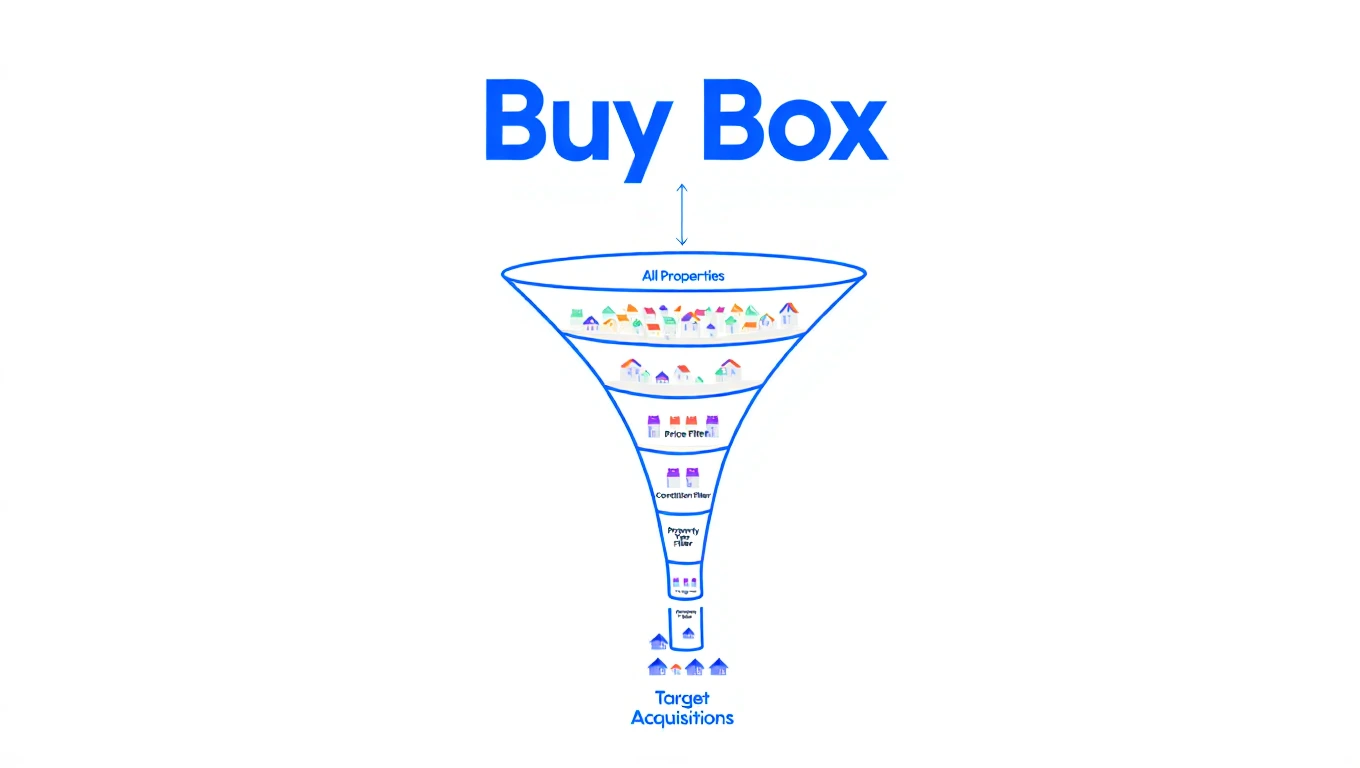
Creating a buy box does not have to be complicated. The goal is simply to get clear on what kind of property makes sense for you before you start looking at deals.
Here’s a simple way to build one:
1. Define your Budget
Start with what you can realistically afford. Think about your available cash, financing options, down payment, renovation budget, and how much risk you’re comfortable taking. Your buy box should match your actual buying power, not an ideal scenario.
2. Choose your Strategy
Next, decide what kind of investor you want to be. Are you looking for a long-term rental, a short-term rental, a fix-and-flip, or a BRRRR opportunity? Your strategy shapes everything else, from the type of property you target to the returns you expect.
3. Pick your Target Location
Choose the market you want to invest in, then narrow it down further if needed. That might mean selecting one city, a few neighborhoods, or even specific zip codes. The more focused you are, the easier it becomes to filter opportunities.
4. Set your Return Benchmarks
Decide what numbers a deal needs to hit before you’ll consider it. That could be a minimum monthly cash flow, cap rate, cash-on-cash return, or projected profit margin. These benchmarks help you screen deals quickly and stay disciplined.
5. Define Your Deal Breakers
Finally, be clear about what you will not buy. This might include properties above a certain price, major structural issues, low-demand areas, HOA restrictions, or anything else that doesn’t fit your strategy. Knowing your non-negotiables is just as important as knowing what you want.
Once you’ve set these five things, your buy box becomes a practical filter you can use every time you review a listing.
Top Pick:
- How to Buy Land With No Money Down: Financing Options
- Do you Still Pay Rent after a Concession?
How a Real Estate Buy Box Is Used in Practice
A buy box is only useful if you actually apply it. In practice, it becomes part of your day-to-day workflow and guides how you find and evaluate deals.
- Screening listings:
Instead of clicking into every property, you quickly scan listings and filter based on your criteria. If it doesn’t match your location, price range, or property type, you move on immediately. This saves hours of time and keeps you focused. - Working with agents:
A clear buy box makes it much easier to communicate with real estate agents. Instead of vague instructions like “send me good deals,” you can give them specific criteria. That way, they bring you properties that are actually relevant. - Automating deal sourcing:
As you get more serious, you can use your buy box to set up alerts and filters on listing platforms. This means deals that match your criteria come to you automatically, instead of you constantly searching manually. - Using platforms and tools:
Tools like Rentana take this a step further by helping you apply your buy box consistently across deals. Instead of manually checking every listing, you can quickly see which properties fit your criteria and meet your return targets.
In practice, a buy box turns your deal search into a system. You’re no longer reacting to listings, you’re running a repeatable process for finding the right ones.
Don’t Miss:
- What is the Standard Flooring Depreciation Life in Real Estate?
- What is a Convenience Fee for Rent?
FAQs on Buy Box in Real Estate
What is a Buy Box in Real Estate Investing?
A buy box is a set of criteria that defines the type of property an investor wants to buy. It includes things like location, price range, property type, and expected returns, and is used to quickly filter and evaluate deals.
Is a Buy Box Necessary?
It’s not strictly required, but it makes a big difference. Without a buy box, it’s easy to waste time on deals that don’t fit your strategy or make decisions based on emotion. A buy box helps you stay focused and consistent.
How Often Should You Update Your Buy Box?
You should revisit your buy box whenever your goals, budget, or market conditions change. For example, if prices rise in your target area or your strategy shifts, your criteria should be adjusted to reflect that.
Can Beginners Use a Buy Box?
Yes, and they probably should. A buy box is especially helpful for beginners because it simplifies decision-making and prevents you from chasing every deal. Even a basic buy box can help you stay on track early on.


