Concentric Zone Model
Main Idea
City grows in rings from one center
Structure
Circular layers around a single core


Why do some cities feel like they have more than one downtown?
You might notice a traditional city center with offices and government buildings. Then a few miles away, there is another busy area filled with shopping, restaurants, and high-rise apartments. Farther out, there might be a cluster of warehouses, a university district, or a business park near the highway. It can feel like the city has multiple hearts instead of just one.
The Multiple Nuclei Model helps explain this pattern.
Developed in the mid twentieth century, this urban model suggests that cities do not grow around a single core. Instead, they develop around several centers, each serving a different purpose. In this article, we will break down what the Multiple Nuclei Model is, how it works, and why it still helps us understand modern cities today.
Related: What is the 2 Rule in Real Estate?
The Multiple Nuclei Model was introduced in 1945 by geographers Chauncy Harris and Edward Ullman. At the time, many urban theories assumed that cities revolved around a single central business district. Harris and Ullman observed that this did not accurately reflect how many American cities were developing.
After World War II, transportation networks expanded, automobile ownership increased, and cities began spreading outward. Industrial zones, universities, airports, and suburban business districts were emerging outside the traditional downtown core.
Harris and Ullman proposed that cities develop around multiple activity centers, or nuclei, rather than a single core. Each nucleus forms because certain land uses attract similar activities and repel others. For example:
Their model reflected the growing complexity of mid-20th century cities and helped explain patterns that earlier models could not.
The model suggests that cities do not grow around a single central business district. Instead, they develop around multiple centers, or “nuclei,” that emerge over time.
Each nucleus serves a different purpose. One area might become a financial district. Another might develop as an industrial zone. A separate area could form around a university, an airport, or a major shopping center. As the city expands, these centers grow and influence the surrounding neighborhoods.
Rather than picturing a city as a set of rings spreading out from one downtown core, the Multiple Nuclei Model encourages us to see it as a collection of activity hubs. These hubs shape how people live, work, and move within the city.
By shifting the focus from one central core to several interconnected hubs, Harris and Ullman provided a framework that still helps us understand modern metropolitan areas today.
Read Also: Does Garage Space Count as Square Footage?
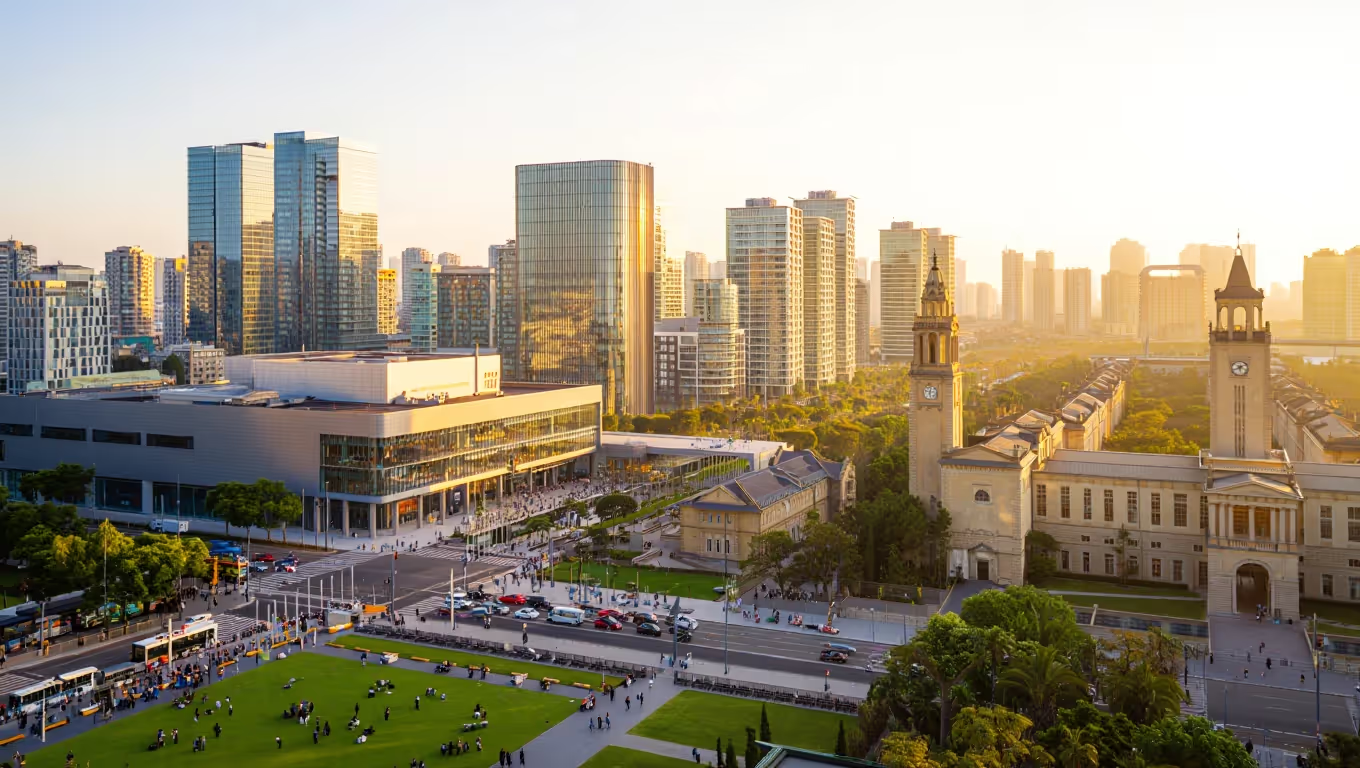
To understand the Multiple Nuclei Model, it helps to compare it with earlier urban models.
Before Harris and Ullman introduced their idea, geographers used simpler models to explain city growth. Two of the most well known are the Concentric Zone Model and the Sector Model.
The Concentric Zone Model was developed by Ernest Burgess in the 1920s. It suggests that cities grow outward in rings from a single central business district.
In this model:
The city is viewed as organized in a circular pattern, with one main center driving growth.
The Sector Model, introduced by Homer Hoyt in 1939, proposes that cities grow in wedges or sectors instead of rings.
In this model:
For example, high income housing might develop along one corridor, while industrial zones extend along rail lines.
The key difference is that the Multiple Nuclei Model does not assume one dominant center.
Instead of rings or wedges growing from a single downtown, it recognizes that cities can develop several distinct centers. These nuclei may form because of transportation hubs, specialized industries, universities, or suburban growth.
This makes the model especially useful for understanding modern metropolitan areas, where business districts, shopping centers, and employment hubs often exist outside the traditional downtown.
Top Pick: What Is Intrafamily Transfer and Dissolution?
Cities do not randomly form multiple centers. There are practical reasons why new hubs develop over time. As urban areas grow, different forces shape where businesses, housing, and services are located.
Here are some of the main drivers behind multiple nuclei.
Different industries have different needs.
Manufacturing requires large parcels of land and access to transportation routes. Financial services often cluster in office districts. Universities create education-focused areas with student housing, retail, and research facilities nearby.
Over time, these specialized activities form their own centers. A tech district may grow around a group of startups. A medical hub may form near a major hospital. These economic clusters become nuclei within the larger city.
Land in the traditional downtown core is often expensive.
As prices rise, some businesses and residents look for more affordable alternatives. Retail centers, office parks, and residential developments begin to appear in other parts of the city where land costs are lower.
These new areas can grow into major hubs of activity. Over time, they function almost like secondary downtowns.
Transportation plays a major role in shaping urban growth.
Highways, rail lines, ports, and airports attract development. For example, a major highway intersection might become a retail and office cluster. An airport may anchor hotels, logistics companies, and business parks.
As transportation options expand, activity is no longer limited to the original city center. New nuclei form around these key access points.
City planning decisions also influence where development occurs.
Zoning laws may designate certain areas for industrial use, commercial activity, or high-density housing. Over time, these designated areas attract similar types of development, reinforcing their identity as separate centers.
For example, if a city encourages mixed-use development in a specific corridor, that area may evolve into a lively district with offices, apartments, and entertainment venues.
As cities grow, people move outward.
Suburbs often begin as residential areas, but as populations increase, they attract shopping centers, offices, schools, and healthcare facilities. Eventually, these suburban areas develop their own economic and social hubs.
What started as a bedroom community can become a fully functioning center of activity, contributing to the city’s multiple nuclei.
Together, these forces explain why many modern cities no longer revolve around a single downtown. Instead, they grow into networks of connected but distinct centers, each shaped by economic, geographic, and social factors.
Read Also: How to Buy Land Without Any Money Down: Financing Options
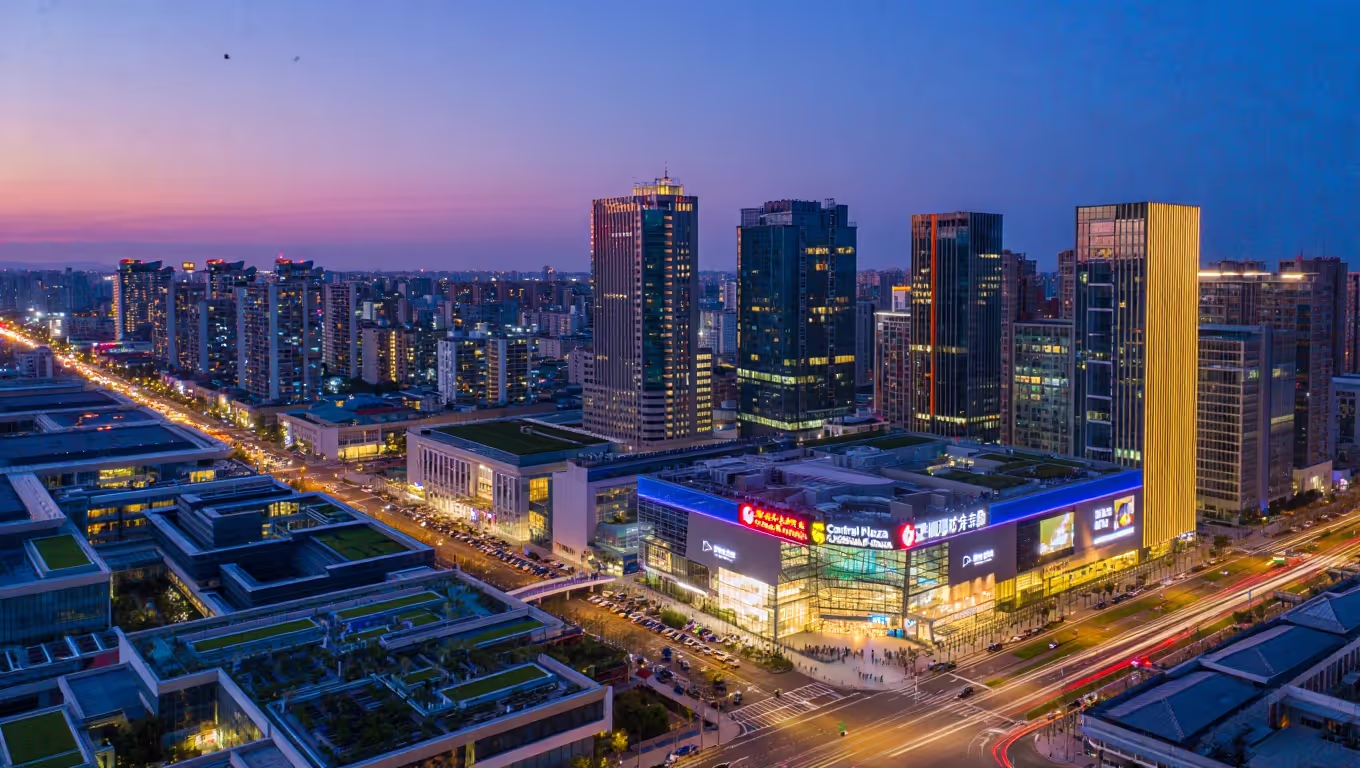
The Multiple Nuclei Model becomes much easier to understand when you look at real cities. Many major metropolitan areas clearly show how different centers develop for different purposes.
Take a large city like Los Angeles.
Instead of one dominant downtown, Los Angeles has several major centers. Downtown LA serves as a financial and government hub. Hollywood functions as an entertainment center. Silicon Beach has become a technology-focused area. Other districts specialize in fashion, manufacturing, or international trade.
Each area developed because of a specific industry or function, and over time, those areas became distinct nuclei within the broader city.
New York City also reflects this pattern. Manhattan contains multiple economic centers, while Brooklyn and Queens have their own commercial and residential hubs that operate independently from the traditional financial district.
In many metropolitan areas, suburbs have grown into major economic centers.
For example, cities around Dallas or Atlanta include suburban districts that host corporate offices, shopping complexes, and residential communities. These areas may be miles from the historic downtown but function as independent hubs of activity.
What began as residential suburbs gradually developed their own office parks, retail centers, and entertainment areas. Over time, they became nuclei in their own right.
Airports often act as powerful growth anchors.
Around major airports, you will often find clusters of hotels, logistics companies, warehouses, and business parks. This is sometimes referred to as an “aerotropolis,” where the airport becomes the central driver of economic activity in that area.
For example, areas surrounding Chicago O’Hare or Atlanta’s Hartsfield-Jackson Airport have developed into major commercial zones. These districts operate as separate centers tied to transportation and trade rather than the traditional downtown.
These examples show how the Multiple Nuclei Model reflects real patterns of urban development. Modern cities often function as networks of connected hubs, each shaped by economic needs, transportation access, and population growth.
Related: What is a Lender Inspection? Key Facts Explained
Even though the Multiple Nuclei Model was introduced in 1945, it remains highly relevant.
Modern metropolitan areas rarely grow in perfect circles or simple wedges. Instead, they expand outward and develop new centers of activity along highways, near transit hubs, and within growing suburbs. The model helps explain why cities today often feel decentralized and spread out.
As populations increase and transportation improves, development is no longer tied to one downtown core. Business districts, shopping centers, and residential communities form in multiple locations.
The Multiple Nuclei Model provides a framework for understanding this sprawl. It shows that growth is not random. It often follows economic clusters and infrastructure patterns.
Urban planners and developers use similar concepts when thinking about land use.
Knowing that certain industries cluster together or that transportation hubs attract development helps planners design more efficient cities. It also helps them anticipate where new growth centers might emerge.
Transportation planning is closely tied to where activity centers form.
If a city has several major hubs, it needs transit routes that connect them. Highways, rail lines, and public transit systems are often designed around these multiple centers rather than just one downtown.
Developers and investors also consider multiple nuclei when making decisions.
They may choose to build near an emerging business district, a university hub, or a suburban commercial center rather than in the traditional city core. Understanding how cities function as networks of hubs helps guide those choices.
Don’t Miss:
The Multiple Nuclei Model helps explain why modern cities feel more like interconnected networks than single-centered systems.
By recognizing that cities grow around several activity hubs, we gain a clearer understanding of urban sprawl, transportation planning, and development patterns. Even decades after it was introduced, the model still offers a practical way to understand how cities evolve and function today.
The purpose of the Multiple Nuclei Model is to explain how modern cities develop around multiple centers, or “nuclei,” rather than one central business district. It shows how different activities such as residential areas, industry, and retail cluster in separate zones based on land use and economic factors.
The Multiple Nuclei Model was created by geographers Chauncy Harris and Edward Ullman.
The Multiple Nuclei Model was introduced in 1945 as a way to better explain the growth patterns of large, modern cities.
The model was not based on just one city, but it was influenced by the development patterns of large American cities such as Chicago and Los Angeles, which showed multiple commercial and industrial centers.
A real-life example of the Multiple Nuclei Model is Los Angeles, where there are several business districts such as Downtown LA, Hollywood, and Santa Monica, along with separate industrial and residential zones spread throughout the metropolitan area.


