
The question of what to charge, when to adjust, and how to stay competitive has always been part of running a multifamily portfolio. But revenue management as a formal discipline, with systematic pricing logic, demand driven adjustments, and performance tracking across unit types and time windows, is a more recent evolution. It took root in hospitality and airlines before making its way into multifamily, and even now the way operators practice it varies enormously from portfolio to portfolio.
The 2024 operating performance data tells a clear story. According to the National Apartment Association's Income/Expense IQ report, the market is no longer driven by momentum, but by management.
Financial performance is being shaped less by rent growth, which has largely stabilized amid increased supply, and more by cost structure, pricing strategy, and how efficiently properties are being run.
In that environment, a pricing decision made a week late, a renewal conversation that happened after a resident had already decided to leave, or an expiration concentration that nobody flagged until it was already creating vacancy pressure, all of those carry a real cost that compounds quietly over a hold period.
The operators pulling ahead right now are not the ones in the best markets or with the newest assets. They are the ones making better pricing and leasing decisions, faster, with more current information than their competitors. That gap between slow decisions and good decisions is what revenue management software is supposed to close.
The problem is that most tools marketed under that label are not built for the way that gap needs to be closed today. Static comp surveys, weekly pricing reviews, and reports that tell you what happened last month are documentation of decisions that have already been made, or missed. And some of the most widely adopted platforms in this category have compounded the problem by treating pricing as something that happens to operators rather than something operators decide.
Recommendations come out of a system nobody can fully explain, and teams are left choosing between trusting a black box or doing the analysis themselves. Neither is a good use of the technology or the people using it.
According to McKinsey, real estate firms have long made decisions based on a combination of intuition and traditional, retrospective data, and by the time an investor can collect, compile, and process the data needed to distill action, the best opportunities are gone.
AI changes that by making it possible to process leasing velocity, renewal trends, pricing performance, and forward availability simultaneously, and surface what the data is actually pointing toward before conditions have already shifted.
That is what this article is about. What AI revenue management actually does, how it differs from the tools that came before it, what good looks like when evaluating a platform, and how to know whether the one you are considering is built around decisions or just around data.
Related:
What is Revenue Management in Real Estate?
Revenue management in real estate is the ongoing process of aligning four interconnected variables, pricing, leasing velocity, renewal retention, and availability exposure, in a way that protects and grows NOI across the hold period. Get one of them wrong and it affects the others. Get all of them right, consistently, at the unit type level, across multiple assets, and the compounding effect on performance is significant.
The traditional approach to managing these variables was built around periodic review cycles. A revenue manager pulls comp data, checks occupancy, reviews the lease expiration schedule, and makes pricing adjustments based on what the data showed a few days ago. The process is manual, the inputs are already stale by the time they are acted on, and the tools involved, spreadsheets, PMS reports, and static comp surveys, were not designed to connect these variables to each other in real time.
That approach worked well enough in a market that moved slowly and forgave slow responses. According to the NAA 2024 Income/Expense IQ report, since 2021, repairs and maintenance costs have risen nearly 28% while NOI has increased just 10% during the same period.
Leasing expenses increased an additional 4.6% in 2024 to $292 per unit, largely driven by a 17.5% increase in turnover costs year-over-year. Taken together, a larger share of revenue is being absorbed by essential operating costs rather than translating into incremental profit. In that margin environment, the cost of a delayed pricing decision or a missed renewal conversation is not abstract. It shows up directly in the numbers.
The other problem with traditional revenue management is that it is inherently backward looking. Comp surveys tell you what competitors were charging last week. Occupancy reports tell you where the asset stands today. Expiration schedules show you what is coming, but only if someone is actively pulling and reviewing them on the right cadence. None of these tools tell you where performance is heading or flag when conditions are shifting before the shift shows up in revenue.
According to McKinsey, conventional analytical methods and data sources make it challenging to draw clear hypotheses and build robust business cases. By the time an investor can collect, compile, and process the data needed to distill action, the best opportunities are gone.
That is the gap traditional revenue management tools have never closed. The data exists. The signals are there. But pulling them together fast enough, at the unit type level, across multiple assets, with enough context to act on them before conditions have already shifted, has always required more time and more manual effort than most teams have.
That is the problem AI is built to solve.
How to Evaluate an AI Revenue Management Software for Real Estate
Most platforms in this category look compelling in a demo environment. Clean dashboards, real-time data, pricing recommendations that appear instantly. The harder evaluation happens when you start asking specific questions about how the tool actually works inside your operations, with your systems, and for the people who will be using it every day.
Here are four questions worth asking firmly before you commit.
1. Does it Explain its Recommendations or Just Generates Them?
This is the single most important question on the list. A pricing recommendation without reasoning is asking your team to trust a black box. Most experienced revenue managers will not do that, and they should not. If a system cannot show you why it recommended a specific price move, in plain language, connected to the actual variables that drove it, it has not improved your decision-making. It has just added a step.
What to look for is a platform that accompanies every recommendation with a visible explanation of the inputs behind it, leasing velocity, availability, public market conditions, renewal trends, so the team can validate the logic, override it with their own read, or use it as a starting point for a more informed conversation. The explanation is not a nice-to-have feature. The explanation is not a nice-to-have feature. It is the difference between a tool your team will actually use and one they will work around.
Consider a scenario where a pricing recommendation suggests reducing rents on a specific bedroom type due to low demand data. Without visibility into what is driving that recommendation, the team accepts the adjustment and effective rent declines. What the system was actually responding to was a data entry error, a new leasing agent incorrectly tagging tours to the wrong bedroom count, which skewed the conversion metrics that fed the recommendation.
The price reduction was unnecessary, the revenue impact was real, and without transparent reasoning the error may never have been caught. A platform that shows its work gives teams the context to validate recommendations before acting on them, and to identify when the data behind a recommendation does not reflect operational reality.
2. Does it Connect Pricing to Leasing Velocity and Forward Availability, or Treat them Separately?
Pricing and leasing performance are not independent variables, and a platform that treats them as separate reporting categories is creating manual work rather than eliminating it. Consider what actually needs to be visible before a pricing decision is made: current leasing velocity for that bedroom type, where conversion is breaking down in the funnel if at all, how much availability is coming in the next 30 to 60 days, how that forward availability compares to what demand conditions can absorb, and whether renewal conversion trends are adding to or reducing the supply picture.
A platform that surfaces all of that in a single connected view changes how quickly and confidently a pricing decision can be made. One that stores those signals in separate sections of the platform and expects the team to connect them manually has not actually solved the problem.
What good looks like: a platform where the pricing recommendation for a specific bedroom type is displayed alongside current leasing velocity for that layout, the forward availability picture over the next 30 to 60+ days incorporating not just known expirations but predicted notices and month-to-month behavior, and how that forward supply compares to what demand conditions can absorb.
When that picture shows concentration building beyond what demand can handle, it should be reflected in the recommendation automatically. And the team should be reviewing and validating that recommendation before any action is taken, not finding out after the fact that a price change was pushed without their input.
Ask specifically how any platform you are evaluating surfaces the relationship between pricing recommendations and current leasing and availability signals. If the answer is that they live in different parts of the platform and your team synthesizes them, that is a gap worth understanding before you sign.
3. Does it Give Teams Shared Visibility or Create another Silo?
A revenue management platform that only the revenue manager logs into is solving a smaller problem than it looks like on paper. Leasing teams, asset managers, and ownership need to be working from the same signals for the decisions made at each level to be coordinated rather than sequential.
What good looks like: a leasing manager who can see the same forward occupancy projection and pricing recommendation that the revenue manager is working from, without requesting a report or waiting for a summary email. An asset manager who can see which properties are drifting on predicted occupancy or renewal conversion before scheduling a call with the operator.
An ownership group that can review portfolio level performance indicators, color coded against configured targets, without anyone having to build a presentation first. When those views are all drawing from the same underlying data in real time, the conversations across levels become faster and more aligned.
When each role is working from a different version of the picture, the coordination tax compounds quietly across every decision cycle.Ask how the platform handles visibility across roles. If the leasing manager, revenue manager, asset manager, and ownership group are each logging into different dashboards or receiving different reports, the platform is creating a new information bottleneck while solving an old one.
Related:
4. Does it Work with your Existing PMS or Require Replacing it?
A revenue management platform that does not connect cleanly to your property management system is creating a data problem from day one. Pricing shown in the platform needs to reflect what is actually in the PMS. Availability data needs to be current. Lease activity needs to flow in the right direction without requiring manual reconciliation between two systems.
What good looks like: pricing recommendations generated from data synced directly from the PMS, with the ability to trigger an on demand sync at any time rather than waiting for an overnight batch process.
If something changes in the PMS mid-cycle, a unit comes back available, an amenity tag gets updated, a lease gets corrected, the team should be able to run a manual sync immediately, adjust their pricing settings to reflect the new conditions, and re-run pricing recommendations on demand without waiting until the next morning or submitting a request to a support team.
That kind of real time control over the data and recommendation cycle is not standard in this category. Most platforms run overnight and require teams to work around the lag. The ability to sync, adjust, and recalculate on demand means pricing decisions are always working from current data rather than yesterday's snapshot. And when the team accepts a recommendation, the update writes back to the PMS automatically rather than requiring a manual entry that introduces lag and the risk of transcription error.
The right tool should make every pricing and leasing decision faster, more informed, and easier to execute. A platform that introduces reconciliation steps, overnight lag, and manual workarounds is adding operational cost rather than reducing it.
How Rentana Brings AI Revenue Management in Real Estate Together
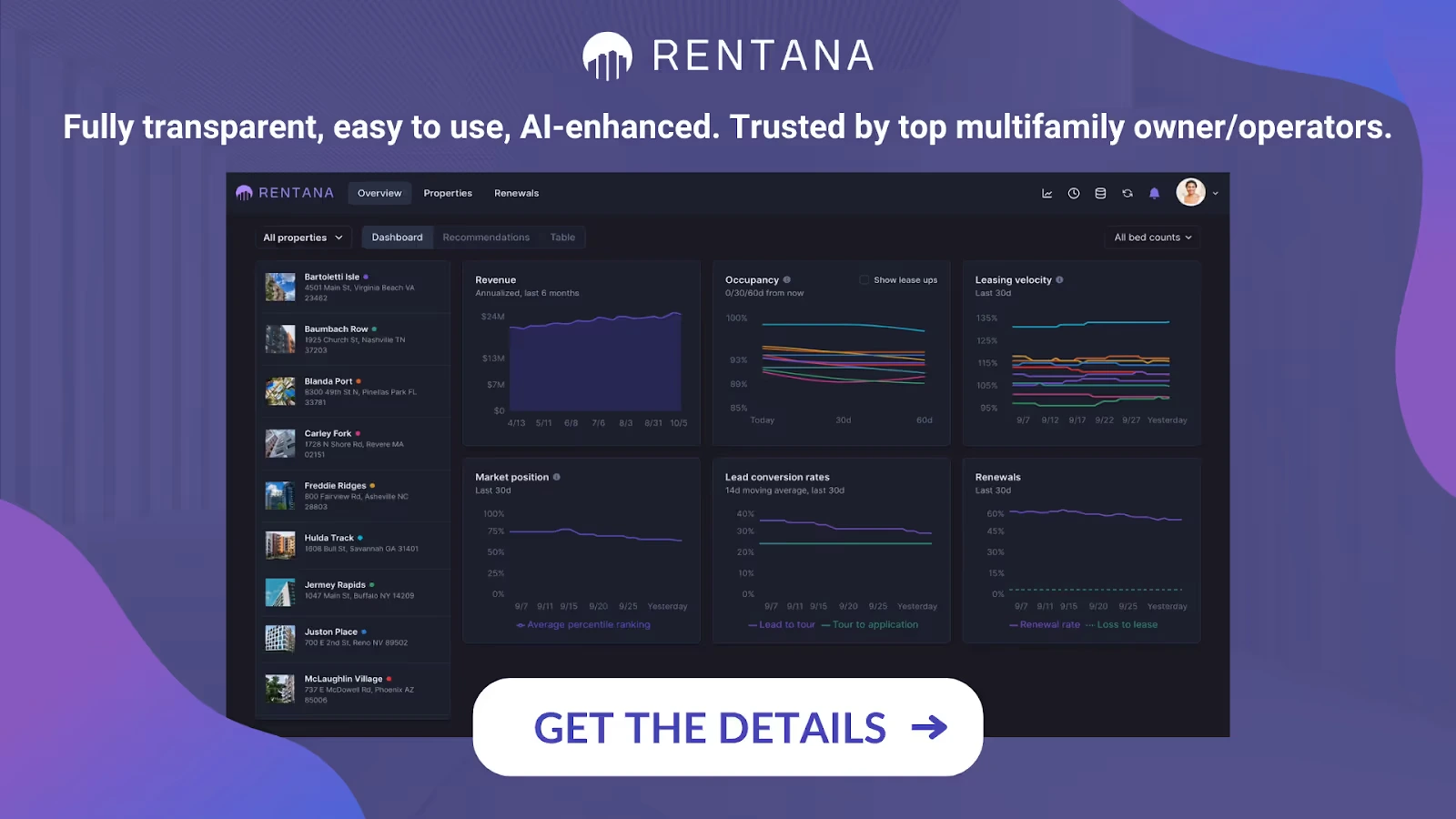
Here is what that looks like in practice.
AI-generated Property Insights with Summary, Action, and Reasoning
Every insight Rentana surfaces follows the same structure. What is changing at this asset? Why it matters given the current context. What action is supported by the data? The team is not handed a dashboard to interpret. They are handed a briefing that is already connected to a response. For a revenue manager supporting multiple assets, or an asset manager reviewing portfolio performance before an ownership call, that structure is what makes the difference between spending time on analysis and spending time on decisions.
Pricing Recommendations by Customizable Layout Configuration with Full Explanation
Rentana surfaces pricing recommendations at the bedroom or custom unit group level, configured around the specific layout groupings that match how your team actually prices. Every recommendation comes with a full explanation of the variables behind it, leasing velocity, availability, public market conditions, renewal trends, so the team can see exactly what the system is responding to.
They can accept the recommendation, override it, or adjust it based on something the system does not have visibility into. If something changes in the PMS mid-cycle, the team can run an on demand sync, adjust settings, and recalculate recommendations immediately without waiting for the next overnight batch. And when they decide to act, the update writes back to the PMS.
Predicted Occupancy and Exposure Forecasting
Rentana surfaces two distinct forward views. The 30 and 60 day occupancy figures reflect known move-ins and move-outs already in the system, a near term picture based on executed activity. Predicted occupancy connects current leasing activity, renewal trends, and future availability to provide forward visibility into where occupancy is heading.. Together they give teams a layered forward view, what is already locked in and what is likely to happen if current conditions hold or if changes need to be made.
Exposure forecasting sits alongside predicted occupancy and surfaces where lease expiration concentration is building across the portfolio, which bedroom types and assets carry the most risk in a given window, and how that exposure interacts with current renewal trends and predicted availability. When concentration is building beyond what demand conditions can absorb, it feeds directly into pricing recommendations so the urgency of the situation is reflected in the suggested response. The result is a forward view of where the portfolio is vulnerable with enough time to build strategy around it rather than scramble when it arrives.
Related:
- The Best Pricing Optimization Software for Multifamily Real Estate
- What Is Multifamily Revenue Management?
Renewal Conversion Tracking and Leasing Velocity Signals
Rentana tracks renewal conversion trends alongside forward availability so teams can see where retention risk is building before it shows up in occupancy. The leasing velocity and funnel conversion signals tell teams where leasing is slowing and at what stage and at which bedroom type, so the response is targeted, a pricing adjustment on a specific layout, a change in leasing focus at a specific point in the funnel, rather than a broad reaction to a number that has already moved.
Portfolio Dashboards with Shared Team Visibility
The portfolio dashboard gives every stakeholder, leasing, asset management, and ownership, a color coded read on asset health across the full portfolio. Which assets are on track. Which are drifting. Which needs attention now. No report required. No call needed to understand the basic picture. The shared visibility means decisions at every level are made from the same signals at the same time, rather than from different versions of the data with a lag between them.
Conclusion on AI Revenue Management in Real Estate
For multifamily operators and investors who are evaluating platforms right now, the bar is clear. The right tool should make your next pricing decision faster, your next renewal conversation better timed, your next ownership call easier to prepare for, and your next quarter's NOI outcome more predictable than it would have been without it.
If it is not doing at least one of those things, it is just another dashboard.