


If you’ve spent any time looking at real estate listings or investment deals, you’ve probably come across the term “multifamily housing.” It shows up everywhere, from small duplexes to large apartment buildings, but it’s not always clear what actually counts as multifamily and what doesn’t.
At its core, multifamily housing is about multiple units within a single property, but the way it works in practice can vary quite a bit. The structure, the way it’s managed, and how it generates income all depend on the type of property and how it’s used.
Understanding multifamily housing is important whether you’re buying your first rental, comparing property types, or trying to scale a portfolio. Once you know how it works, it becomes much easier to evaluate deals and see where the opportunities are.
Related:
What Is Multifamily Housing?
Multifamily housing is a type of residential property that contains two or more separate housing units within a single building or property.
In simple terms, it means multiple households live in the same property, with each unit having its own living space. These units can be rented out to different tenants, making multifamily housing a common choice for real estate investors looking to generate rental income.
Examples of multifamily housing include duplexes, triplexes, fourplexes, and apartment buildings, ranging from small properties with a few units to large complexes with hundreds of units.
Types of Multifamily Housing
Multifamily housing comes in different forms, and each type varies in size, complexity, and how it’s managed. Understanding these categories helps you see where a property fits and what to expect from it.
1. Duplex, Triplex, and Fourplex
These are small multifamily properties with 2 to 4 units in a single building. Each unit is typically similar in layout and may share walls, entrances, or utilities.
They are often considered the most accessible entry point into multifamily investing because they are easier to manage and sometimes qualify for residential financing. Many investors start here before moving into larger properties.
2. Low-Rise Apartments
Low-rise apartment buildings usually have 1 to 3 floors and multiple units within the same structure. They are commonly found in suburban areas and smaller cities.
These properties are larger than small multifamily homes but still relatively manageable. They often have shared amenities like parking or small common areas, and they generate more consistent rental income due to the higher number of units.
3. Mid-Rise Apartments
Mid-rise apartments typically range from 4 to 7 floors and are more common in urban areas. They may include features like elevators, structured parking, and additional amenities.
These properties require more active management and higher upfront investment, but they also offer greater income potential. They are often owned by more experienced investors or real estate companies.
4. High-Rise Apartments
High-rise apartment buildings have 8 or more floors and are usually located in dense city centers. They often include amenities such as elevators, security, gyms, and shared facilities.
These are large-scale investments that generate significant rental income but also come with higher operating costs and management complexity. They are typically owned and operated by institutional investors or large real estate firms.
Read Also: Is Multifamily Considered Commercial?
Multifamily vs Single-Family Housing
Multifamily and single-family homes are two of the most common residential property types, but they serve different purposes and work very differently, especially from an investment perspective.
Key Differences
- Number of units:
A single-family home is one unit designed for one household, while multifamily housing includes multiple units within the same property. - Income potential:
Single-family homes generate income from one tenant, whereas multifamily properties generate income from multiple tenants at the same time. - Risk exposure:
With a single-family home, vacancy means zero income. In a multifamily property, one vacant unit still leaves other units generating rent.
Related: Multifamily vs Single Family: Which is a Better Investment?
How Multifamily Housing Works

Multifamily housing is built around the idea of having multiple rental units operating within a single property. Each unit functions as its own living space, but they are all part of one overall asset.
1. Multiple Units Under One Property
A multifamily property contains several separate units, each occupied by different tenants. These units can range from just two in a duplex to hundreds in a large apartment building. Each tenant signs their own lease and pays rent independently.
2. Shared Infrastructure
Even though tenants live in separate units, many parts of the property are shared. This can include walls, roofs, hallways, parking areas, and sometimes utilities. In larger buildings, it may also include amenities like elevators, gyms, or common spaces.
3. Rental Income Model
The property generates income by collecting rent from multiple tenants at the same time. This creates a more stable income stream compared to single-family homes, because even if one unit is vacant, the others can still produce revenue.
Because of this structure, multifamily housing is often seen as a more scalable and predictable way to generate rental income, especially for investors looking to grow their portfolio over time.
Related:
- Are Townhomes Considered Multifamily?
- What is a Rent Roll in Real Estate? How to Create One
Why Investors Buy Multifamily Properties
Multifamily properties are a popular choice for investors because they offer a more reliable and scalable way to generate rental income.
1. Multiple Income Streams
With multifamily properties, income comes from several units at once instead of just one tenant. This creates a more stable cash flow and reduces dependence on a single source of rent.
2. Lower Vacancy Risk
Vacancy has less impact because other units continue generating income. Even if one unit is empty, the property can still produce revenue from the remaining tenants.
3. Easier to Scale
Investors can grow their portfolios faster by adding multiple units through a single purchase. Instead of managing several separate properties, they can increase their unit count within one building.
4. Operational Efficiency
Managing units in the same location is often more efficient than managing properties spread across different areas. Maintenance, leasing, and day-to-day operations can be handled more easily.
5. Stronger Long-Term Income Potential
Multifamily properties tend to provide steady income over time as rents increase and occupancy stabilizes. This makes them attractive for investors focused on building consistent cash flow and long-term value.
Related:
- The Best AI Tools for Real Estate Investors
How Multifamily Housing Is Valued
Multifamily properties are primarily valued based on the income they generate, not just comparable sales like single-family homes.
In simple terms, investors and lenders look at how much money the property produces and use that to determine what it’s worth.
1. Based on Income, Not Just Comparables
Unlike single-family homes, which are often priced based on similar nearby sales, multifamily properties are evaluated based on their rental income and performance. A property that generates higher income is typically worth more, even if it looks similar to another building.
Net Operating Income (NOI)
One of the key metrics used is Net Operating Income (NOI). This is the income the property generates after operating expenses are deducted, but before debt payments.
- NOI = Rental Income − Operating Expenses
This gives a clearer picture of how profitable the property is.
Cap Rate (Capitalization Rate)
Another important concept is the cap rate, which helps estimate the property’s value based on its income.
- Cap Rate = NOI ÷ Property Value
Investors often use this to compare different properties. Lower cap rates usually indicate lower risk and more stable assets, while higher cap rates may offer higher returns but come with more risk.
Related: How To Calculate the Value of a Multifamily Property Easily
Rentana: Multifamily Software Built for Multifamily Housing Investors
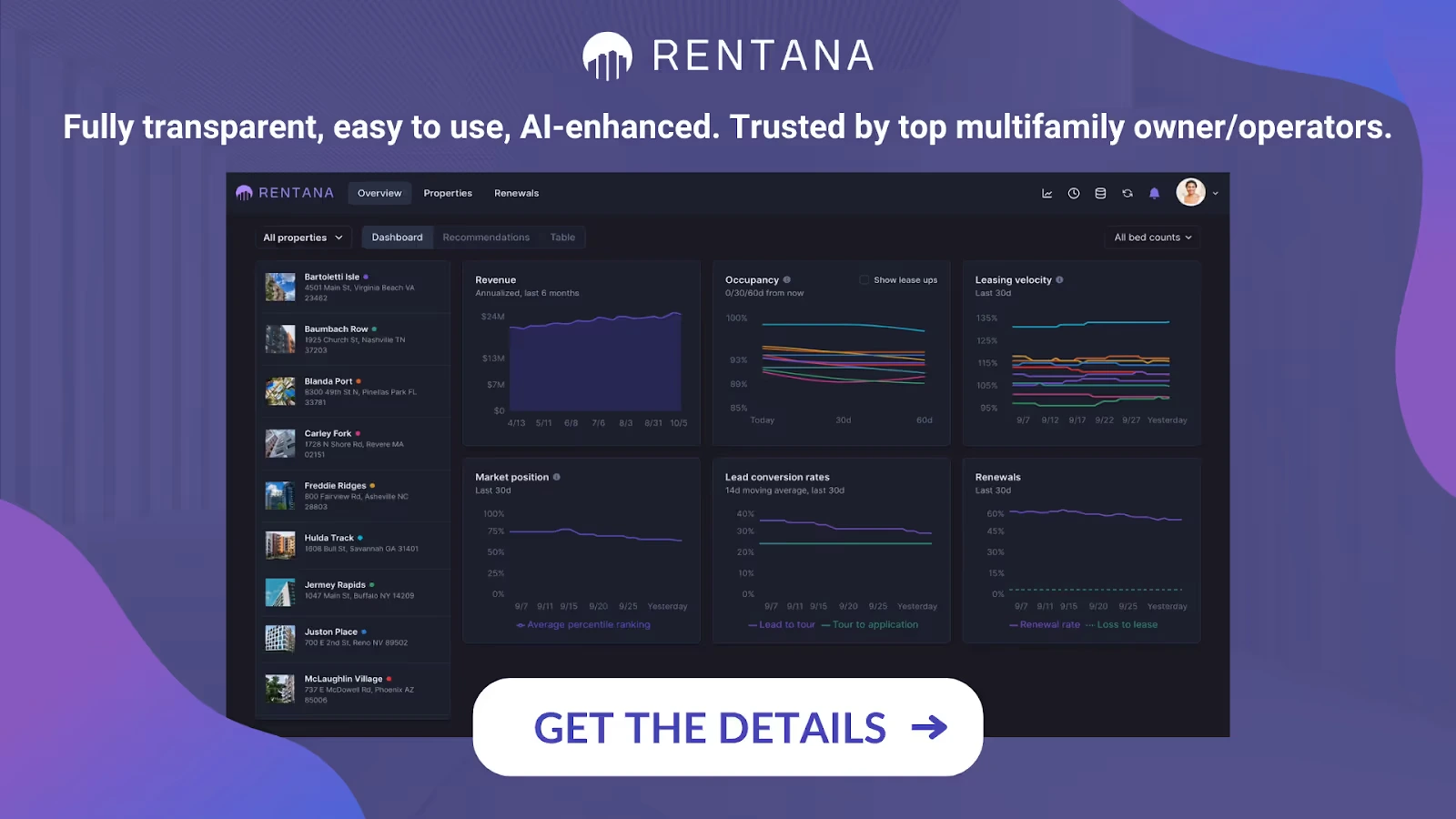
Managing multifamily properties means dealing with a constant flow of data across units, leases, pricing, and market conditions. Rentana is designed to bring all of that into one place and make it easier to understand and act on.
Built Around Real Estate Data and Workflows
Rentana is designed specifically for multifamily owners and operators, not as a generic analytics tool. It brings together portfolio, property, and unit-level data so teams can move from a high-level view down to individual assets in just a few clicks.
This makes it easier to see what’s happening across an entire portfolio and quickly identify where attention is needed.
AI That Explains, Not Just Recommends
Rentana uses artificial intelligence throughout the platform to analyze trends and support decision-making. What sets it apart is transparency. Every recommendation is paired with a clear explanation and supporting data, so you can understand how it was generated and decide whether to act on it.
This keeps teams in control while still benefiting from advanced analysis.
Powered by Public Market Data
Rentana’s insights are based on publicly available market data, combined with your internal property data. This ensures that the analysis reflects real, observable market conditions without relying on opaque or proprietary data sources.
For operators, this means you can trust where the data is coming from and how it’s being used.
Clear Visibility Across Portfolio Performance
The platform gives a clear view of portfolio health using simple visual signals, helping teams quickly understand which properties are on track and which need attention.
Instead of digging through spreadsheets or disconnected systems, you can see performance at a glance and drill down into details when needed.
Flexible, Connected, and Easy to Use
Rentana is built to fit into existing workflows. It connects with property management systems, supports data exports, and allows teams to create custom reports based on the metrics that matter to them.
At the same time, the platform is designed to be simple and intuitive, so teams can adopt it quickly without adding complexity.
Overall, Rentana acts as a data and decision layer for multifamily operations. It helps investors and operators understand their portfolio, stay aligned with market conditions, and make more informed decisions across their properties.
Don’t Miss:
Conclusion on Multifamily Housing
Multifamily housing is built around one core idea: multiple units working together to generate income from a single property. Once you understand how it works, it becomes much easier to evaluate deals, compare property types, and decide what fits your goals.
From small duplexes to large apartment buildings, the structure stays the same, but the scale and complexity change. The key is knowing how to assess income, stability, and performance across those units.
As you go deeper into multifamily investing, tools and data become just as important as the property itself. The more clearly you can see what’s happening across your portfolio, the better decisions you can make over time.


