

Buying multifamily with an LLC has become standard practice among serious investors, and for good reason.
The appeal is straightforward. An LLC creates a legal separation between you and your investment property, which means that in most circumstances a lawsuit arising from the property stays contained to the LLC rather than reaching your personal assets. For multifamily investors who own assets with multiple tenants, that separation is meaningful protection worth the cost and complexity of setting up and maintaining the structure.
But buying through an LLC is not as simple as forming a company and putting it on the deed. It affects your financing options, your tax filing, your ongoing compliance obligations, and how the property is managed day to day. This guide walks through the process step by step so you know exactly what's involved before you close.
Related:
How to Buy a Multifamily Property With an LLC: 7 Key Steps
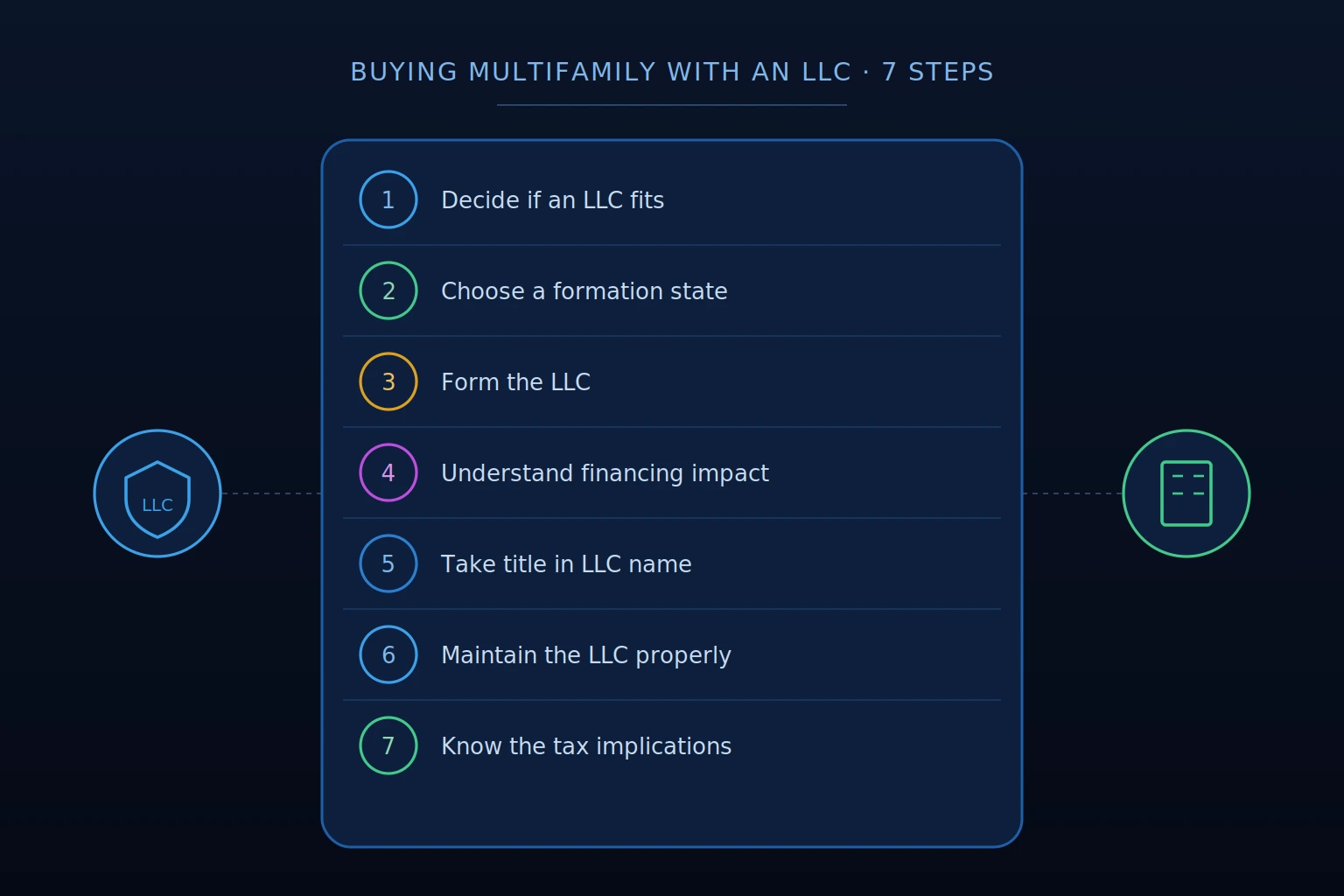
- Decide Whether an LLC Is the Right Structure for Your Purchase
- Choose the Right State to Form Your LLC
- Form the LLC and Get It Ready to Transact
- Understand How LLC Ownership Affects Your Financing Options
- Take Title in the LLC Name at Closing
- Keep the LLC Properly Maintained After Closing
- Understand the Tax Implications of Owning Through an LLC
Step 1: Decide Whether an LLC Is the Right Structure for Your Purchase
Before you decide to buy multifamily property with an LLC, it's worth confirming that the structure actually makes sense for your specific situation. For most multifamily investors the answer is yes, but the calculus depends on a few key factors.
The primary benefit of an LLC is liability protection. If a tenant or visitor is injured on the property and sues, the lawsuit is directed at the LLC rather than you personally, which means your personal bank accounts, home, and other assets are generally shielded from the judgment. For a multifamily property with multiple tenants and more foot traffic than a single family rental, that protection is more valuable than it might be for a single unit investment.
The tradeoff is financing complexity. As covered in step four, LLCs cannot access conventional residential financing, which means you'll pay higher rates and put more down than you would buying in your personal name. For smaller two to four unit properties where residential financing offers significantly better terms, some investors choose to buy in their personal name initially and transfer to an LLC afterward, accepting the risks that come with that approach.
If you're buying with partners, an LLC is almost always the right structure because it provides a legal framework for defining each partner's ownership percentage, decision-making authority, and profit distribution rights through the operating agreement. Owning investment property jointly with another person without a formal entity structure creates significant legal and financial exposure for all parties.
Step 2: Choose the Right State to Form Your LLC
Most multifamily investors should form their LLC in the state where the property is located. This is the simplest and most straightforward approach, and for most investors it is also the most cost-effective. Forming in your home state avoids the need to register as a foreign entity in the property's state, which is required if you form elsewhere and own property in a different state.
The appeal of forming in business-friendly states like Delaware or Wyoming is real but often overstated for individual real estate investors. Delaware and Wyoming offer strong asset protection laws and charging order protections that can shield LLC membership interests from personal creditors, but those benefits are most meaningful for investors with significant assets and complex legal exposure.
For most investors buying one or a few multifamily properties, the added complexity and cost of a multi-state LLC structure outweighs the incremental protection benefits.
If you do form outside the state where the property is located, you will need to register as a foreign LLC in the property's state, appoint a registered agent in that state, and file annual reports in both states. Those additional administrative requirements and costs add up over time and should factor into your decision.
Read Also:
- Student Housing vs Conventional Multifamily: Key Differences
- How Does Financing Differ in Small vs Large Multifamily Properties?
Step 3: Form the LLC and Get It Ready to Transact
Once you've decided on the formation state, the process of setting up the LLC is relatively straightforward. Here are the steps in sequence:
File articles of organization with the secretary of state in your chosen formation state. This is the foundational document that legally creates the LLC. Most states allow online filing with fees ranging from $50 to $500 depending on the jurisdiction.
Appoint a registered agent who will receive official legal and government correspondence on behalf of the LLC. In most states this can be you personally if you have a physical address in the state, or a registered agent service for a nominal annual fee.
Draft an operating agreement that governs how the LLC is managed, how profits and losses are distributed among members, what happens if a member wants to exit, and how major decisions are made. Even for a single-member LLC, an operating agreement is important because it reinforces the legal separation between you and the entity and demonstrates that the LLC is being operated as a genuine business rather than a personal alter ego.
Obtain an EIN from the IRS. An Employer Identification Number is the LLC's tax identification number and is required to open a business bank account, file taxes, and complete many real estate transactions. It can be obtained online through the IRS website at no cost in minutes.
Open a dedicated business bank account in the LLC's name before closing. All property-related income and expenses must flow through this account to maintain the legal separation between you and the LLC. Commingling personal and business funds is one of the most common ways the liability protection of an LLC is compromised.
Step 4: Understand How LLC Ownership Affects Your Financing Options
Financing is where LLC ownership creates the most significant practical complications for multifamily investors, and understanding those complications before you start the purchase process prevents expensive surprises.
Conventional residential loans from Fannie Mae and Freddie Mac are not available to LLCs. These loan programs require the borrower to be an individual rather than a legal entity, which means the favorable rates, low down payments, and flexible qualifying criteria available for two to four unit residential multifamily purchases are generally off the table when buying through an LLC.
For properties with five or more units, this is less of an issue because those properties require commercial financing regardless of ownership structure. Commercial and portfolio lenders are accustomed to lending to LLCs and underwrite the loan based primarily on the property's income rather than the borrower's personal financials, though a personal guarantee from the LLC's members is almost always required.
For two to four unit properties where you want both LLC ownership and favorable financing, the most common approach is to obtain conventional financing in your personal name at closing and then transfer the property to an LLC afterward. This approach carries risk because most residential mortgages include a due on sale clause that technically allows the lender to call the loan due when ownership is transferred, though lenders rarely enforce this clause on residential properties transferred to a closely held LLC. Consulting a real estate attorney before attempting this approach is strongly recommended.
Portfolio lenders, credit unions, and private lenders are the primary financing sources for LLC-owned two to four unit properties that need entity-level financing from the start. These lenders hold loans on their own balance sheets rather than selling them to Fannie Mae or Freddie Mac, which gives them flexibility to lend to LLCs. The tradeoff is typically higher interest rates, higher down payment requirements, and shorter loan terms than conventional financing.
Step 5: Take Title in the LLC Name at Closing
Taking title correctly at closing is one of the most important and most frequently mishandled steps in the process. The deed transferring ownership of the property must be made out to the LLC, not to you personally, for the property to be owned by the entity rather than by you as an individual.
Before closing, confirm with the title company and closing attorney that the vesting on the deed will read in the LLC's name exactly as it appears in the articles of organization. A mismatch between the LLC name on the deed and the LLC name in the formation documents can create title issues that are expensive and time-consuming to correct after the fact.
Bring a copy of the LLC's articles of organization and operating agreement to closing. The title company will typically require these documents to confirm that the LLC exists, that it is authorized to purchase real estate, and that the person signing on behalf of the LLC has the authority to do so. Some title companies also require a certificate of good standing from the state confirming that the LLC is current on its filings and in active status.
If you purchase the property in your personal name and need to transfer it to an LLC afterward, you will need to execute a new deed transferring ownership from yourself to the LLC and record it with the county. This transfer may trigger a deed transfer tax depending on the state and county, and as noted in step four, may technically trigger the due on sale clause in your mortgage. A real estate attorney should be involved in any post-closing title transfer to an LLC.
Top Picks:
- Who Provides Managed WiFi for Multifamily Buildings?
- What is a Good Cap Rate for Multifamily Properties?
Step 6: Keep the LLC Properly Maintained After Closing
Forming an LLC and taking title correctly is only the beginning. The liability protection an LLC provides is not automatic or permanent. It depends on the LLC being operated as a genuine, separate legal entity rather than as a personal alter ego. Courts can pierce the corporate veil and hold LLC members personally liable when the LLC has not been properly maintained, which defeats the entire purpose of using the structure.
The most important ongoing maintenance requirements are:
Keep finances completely separate. All rental income should be deposited into the LLC's business bank account. All property expenses should be paid from that account. Never pay personal expenses from the LLC account or deposit LLC income into your personal account. Commingling funds is the single most common basis for piercing the corporate veil.
File annual reports. Most states require LLCs to file an annual report and pay a filing fee to remain in good standing. Missing these filings can result in administrative dissolution of the LLC, which eliminates the liability protection entirely. Set a calendar reminder for the annual filing deadline in your formation state.
Maintain proper records. Keep copies of the operating agreement, articles of organization, annual reports, and any amendments to those documents. For multi-member LLCs, document major decisions through written resolutions or meeting minutes that reflect how and why those decisions were made.
Use the LLC's name consistently. All contracts, leases, insurance policies, and correspondence related to the property should be in the LLC's name rather than your personal name. Signing property-related documents in your personal name rather than as a member or manager of the LLC can blur the legal separation between you and the entity.
Step 7: Understand the Tax Implications of Owning Through an LLC
LLCs are pass-through entities for federal tax purposes by default, meaning the LLC itself does not pay income tax. Instead, the income and expenses of the LLC flow through to the members' personal tax returns in proportion to their ownership percentage. For a single-member LLC, all of the property's income and expenses are reported on Schedule E of your personal Form 1040. For a multi-member LLC, the entity files a partnership return on Form 1065 and issues K-1s to each member showing their share of income, expenses, and deductions.
Depreciation is one of the most significant tax benefits of owning investment real estate through an LLC. The property's improvement value is depreciated over 27.5 years for residential real estate, generating an annual non-cash deduction that reduces taxable income without representing an actual cash outflow. That depreciation flows through to the members' personal returns and can offset rental income and in some cases other passive income depending on the member's income level and participation in the property's management.
The tax treatment of an LLC-owned rental property is generally the same whether the property is owned personally or through a single-member LLC, since both report on Schedule E and access the same deductions. The tax implications become more complex with multi-member LLCs where the operating agreement determines how income, losses, and depreciation are allocated among members, and where the partnership tax rules introduce additional compliance requirements including the Form 1065 filing and K-1 preparation.
Given the complexity of real estate taxation and the specific implications of LLC ownership for your individual tax situation, working with a CPA who specializes in real estate investors is strongly recommended before making final decisions about entity structure and tax treatment.
Conclusion on How to Buy a Multifamily Property With an LLC
Buying a multifamily property through an LLC is a well-established strategy that provides meaningful liability protection and operational flexibility for real estate investors. The process is straightforward when you know the steps, but the details matter. The wrong state formation, a missed annual filing, commingled finances, or a deed made out to the wrong name can each undermine the protection the LLC was set up to provide.


