

A duplex and a 200-unit apartment complex are both multifamily properties, but the loans that fund them come from completely different parts of the lending market, are underwritten on entirely different criteria, and carry very different terms, rates, and requirements.
The dividing lines in multifamily financing are driven primarily by property size, specifically unit count, which determines whether a property is treated as residential or commercial real estate for lending purposes. That classification affects everything from who the lender is to how much you need to put down to what your personal financial profile has to do with whether you get approved.
Understanding where those dividing lines fall and what changes on either side of them is foundational knowledge for anyone buying, refinancing, or investing in multifamily real estate at any scale.
Related:
- How to Buy a Multifamily Property with no Money (Financing Options)
- Who Provides Managed WiFi for Multifamily Buildings?
How Does Multifamily Financing Differ by Property Size?
Multifamily financing differs by property size primarily because lenders classify properties differently depending on unit count, and that classification determines which loan products, underwriting standards, and lending institutions apply to the transaction.
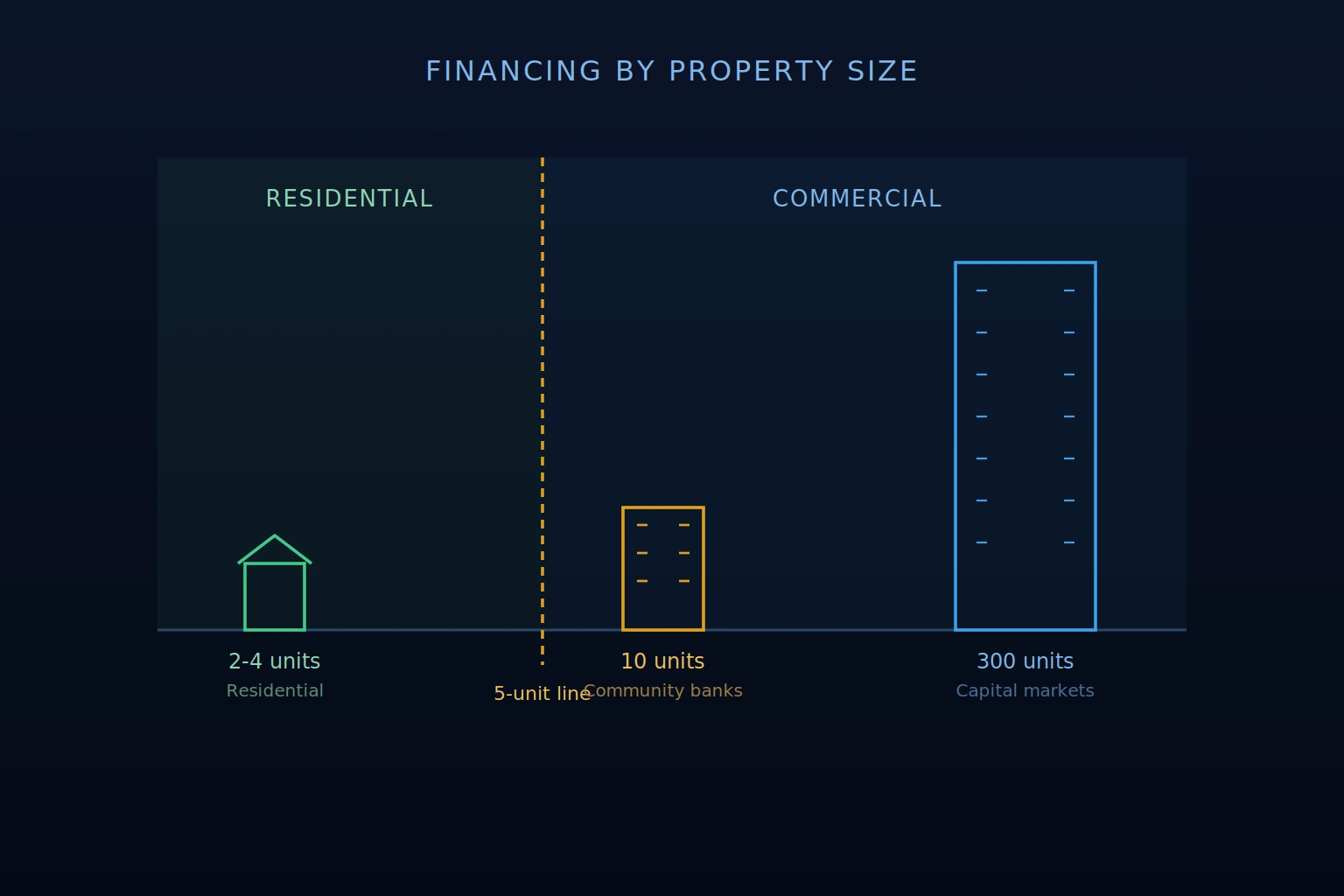
The most significant dividing line in multifamily financing sits at five units. Properties with two to four units are classified as residential real estate and can be financed with conventional, FHA, or VA mortgage products using the same lending infrastructure that finances single family homes.
Properties with five or more units are classified as commercial real estate, which means they require commercial financing with different lenders, different underwriting criteria, higher down payments, and loan structures that bear little resemblance to a residential mortgage.
Above five units, size continues to matter. A 10-unit building and a 300-unit apartment complex are both commercial real estate, but they access very different capital markets. Smaller commercial multifamily properties are typically financed through community banks, credit unions, and regional lenders.
Small Multifamily Financing: How 2 to 4 Unit Properties Are Underwritten
Properties with two to four units occupy a unique position in the lending market. Despite generating rental income from multiple units, they are classified as residential real estate for financing purposes, which means they qualify for the same loan products available for single family home purchases.
This classification gives small multifamily buyers access to the most favorable financing terms available in the real estate market, including low down payments, competitive interest rates, and qualification criteria based primarily on the borrower's personal income and credit profile rather than the property's cash flow.
Key characteristics of small multifamily financing:
- Loan products available: Conventional loans, FHA loans, VA loans, and USDA loans in eligible rural areas all apply to 2 to 4 unit properties using standard residential underwriting guidelines
- Down payment requirements: Conventional loans typically require 15% to 25% down on non-owner-occupied 2 to 4 unit properties. Owner-occupied purchases where the borrower lives in one unit can qualify for as little as 3.5% down with FHA financing
- Qualification criteria: Lenders primarily evaluate the borrower's personal income, credit score, and debt-to-income ratio rather than the property's NOI or DSCR
- Rental income treatment: A portion of the projected rental income from the non-owner-occupied units can typically be counted toward the borrower's qualifying income, improving DTI and increasing borrowing capacity
- Loan limits: Conforming loan limits for 2 to 4 unit properties are higher than for single family homes, with FHA limits for a 4-unit property reaching $1,867,275 in high-cost markets as of 2026
- Personal guarantee: Always required since the borrower is the primary basis for loan approval
- Recourse: Fully recourse, meaning the lender can pursue the borrower's personal assets in the event of default
- Interest rates: Comparable to single family home mortgage rates, typically the most favorable rates available in real estate financing
The owner-occupancy advantage is worth highlighting specifically. A borrower who purchases a 2 to 4 unit property and lives in one of the units can access significantly more favorable financing than one buying as a pure investment property, including lower down payments, better rates, and more flexible qualifying criteria. This makes the small multifamily owner-occupant strategy one of the most capital-efficient entry points in real estate investing.
Read Also:
Mid-Size Multifamily Financing: The 5 to 50 Unit Transition
The moment a property crosses the five-unit threshold, everything about the financing changes. Five units or more means commercial real estate, and commercial real estate means a completely different lending infrastructure, underwriting approach, and borrower experience.
This transition catches many investors off guard, particularly those moving up from smaller residential properties who expect the qualification process to work the same way. It doesn't. At five units, the property's income-generating ability becomes the primary basis for loan approval, and the borrower's personal financial profile, while still relevant, moves to a secondary position.
Key characteristics of mid-size multifamily financing:
- Loan products available: Community bank portfolio loans, credit union loans, regional bank commercial loans, SBA 504 loans for owner-occupied commercial real estate, and in some cases agency small balance loans from Fannie Mae and Freddie Mac for properties above a minimum loan threshold
- Down payment requirements: Typically 20% to 30% of the purchase price, with most community bank and portfolio lenders sitting at 25% as a standard requirement
- Qualification criteria: Lenders underwrite primarily on the property's NOI, DSCR, and LTV rather than the borrower's personal income. Most lenders require a minimum DSCR of 1.20 to 1.25 and a maximum LTV of 75% to 80%
- Borrower experience requirements: Most commercial lenders want to see relevant real estate experience, particularly for larger properties within this range. A first-time borrower seeking a 40-unit loan will face more scrutiny than an experienced operator with a demonstrated track record
- Personal guarantee: Almost universally required on community bank and regional lender loans, particularly for borrowers without an established relationship with the institution
- Recourse: Typically full recourse at this property size, though some lenders offer partial recourse structures for stronger borrowers
- Loan terms: Commonly 5, 7, or 10-year fixed terms with 20 to 25-year amortization schedules, with balloon payments at maturity requiring refinancing
- Interest rates: Higher than residential rates, reflecting the commercial classification and the additional risk assessment involved in property-level underwriting
- Appraisal requirements: Commercial appraisals using the income approach are required, adding cost and time to the underwriting process compared to residential appraisals
The most important mindset shift for borrowers moving into mid-size multifamily financing is that the property has to qualify as much as the borrower does. A strong personal financial profile cannot compensate for a property with insufficient NOI to support the requested loan amount.
Getting the property's financials in order before approaching a lender, including verifiable rent rolls, clean operating statements, and a realistic assessment of stabilized NOI, is the most important preparation step in the commercial financing process.
Top Picks:
Large Multifamily Financing: How Institutional Properties Are Financed
Properties above 50 units, and particularly those above 100 units, move into a different tier of the capital markets entirely. At this scale, the primary lenders are no longer community banks and regional institutions but agency lenders, CMBS conduits, life insurance companies, and institutional bridge lenders who operate at a level of sophistication and scale that smaller lenders simply cannot match.
The loan products available at this size are generally more favorable in terms of rates, leverage, and amortization than what mid-size properties can access, but the underwriting process is significantly more rigorous and the borrower requirements are substantially higher.
Key characteristics of large multifamily financing:
- Loan products available: Agency debt from Fannie Mae and Freddie Mac, CMBS loans, life insurance company debt, bridge loans from institutional lenders and debt funds, and mezzanine financing for deals requiring leverage above senior debt capacity
- Agency debt: Fannie Mae and Freddie Mac are the dominant financing source for stabilized large multifamily properties, offering the most competitive long-term rates available in the market, non-recourse structures, and loan terms of 5, 7, 10, and 12 years with 30-year amortization
- Down payment requirements: Agency loans typically allow LTVs of 75% to 80% on stabilized properties, meaning 20% to 25% equity required. Bridge loans are often structured at higher LTVs of 80% to 85% of total project cost on value-add deals
- DSCR requirements: Agency lenders require a minimum DSCR of 1.25, stress tested at higher vacancy and expense assumptions. Bridge lenders may underwrite to a stabilized DSCR rather than in-place performance
- Non-recourse structure: Agency and CMBS loans are typically non-recourse, meaning the lender's primary recourse in default is the property itself rather than the borrower's personal assets. Non-recourse carve-outs, sometimes called bad boy provisions, create personal liability for specific borrower actions like fraud or environmental violations
- Borrower requirements: Institutional lenders require demonstrated experience operating properties of comparable size, a minimum net worth typically equal to the loan amount, and liquidity reserves of 10% to 15% of the loan amount post-closing
- Reserves: Agency lenders require funded replacement reserves at closing, typically $250 to $400 per unit annually, held in escrow and released for approved capital expenditures
- Prepayment: Agency loans typically carry yield maintenance or defeasance prepayment provisions that can be expensive to exercise in the early years of the loan term, making them best suited for long-term holds
- Third party reports: Full suite of third party reports required including appraisal, property condition assessment, phase one environmental report, and in some markets seismic or flood studies
- Loan sizing timeline: Agency loan origination typically takes 45 to 90 days from application to closing, significantly longer than community bank timelines but with more predictable outcomes once the process is underway
The non-recourse structure available at this property size is one of the most significant advantages of large multifamily financing.
For investors with substantial equity at risk in a property, the ability to limit personal liability to the property itself rather than their entire net worth is a meaningful risk management benefit that is simply not available at smaller property sizes. That structural advantage, combined with the most competitive long-term rates in the multifamily capital markets, is a primary reason why institutional investors actively seek scale in their multifamily portfolios.
Don’t Miss:
Conclusion on How Financing Differs in Small vs Large Multifamily Properties
Multifamily financing isn't a single market. It's three distinct markets that happen to share an asset class, each with its own lenders, products, underwriting criteria, and borrower requirements.
Understanding which market applies to your property and what that means for how you qualify, how much you need to put down, and what loan structure you'll end up with is foundational knowledge for anyone operating across different property sizes.
The progression from residential to commercial to institutional financing is ultimately a progression toward more favorable terms and more sophisticated products, but also toward stricter underwriting, higher borrower requirements, and more complex loan structures. Knowing where you are in that progression, and what it takes to access the next tier, is one of the most useful frameworks in multifamily real estate investing.


