


The question of whether a condo is multifamily or single family comes up more often than you might expect, and the answer depends entirely on what context you're asking in. For financing purposes, a condo is treated differently from both.
For zoning purposes, the building it sits in is almost always classified as multifamily. For investment purposes, a single condo unit behaves more like a single family rental than a multifamily property. And for tax purposes, the classification can shift again depending on how the property is used.
The confusion is understandable. A condo exists simultaneously as a single unit owned by one person and as part of a larger multi-unit building owned collectively. That dual nature means it doesn't fit cleanly into either the single family or multifamily category, which is why different parts of the real estate industry classify it differently depending on what question they're trying to answer.
This guide cuts through that confusion by explaining exactly how condos are classified across financing, investment, zoning, and tax contexts, and what those classifications mean in practice for buyers, owners, and investors.
Related:
- Student Housing vs Conventional Multifamily
- How Does Financing Differ in Small vs Large Multifamily Properties?
Are Condos Multifamily or Single Family?
The answer is both, depending on the context, and neither, depending on how strictly you apply the definitions.
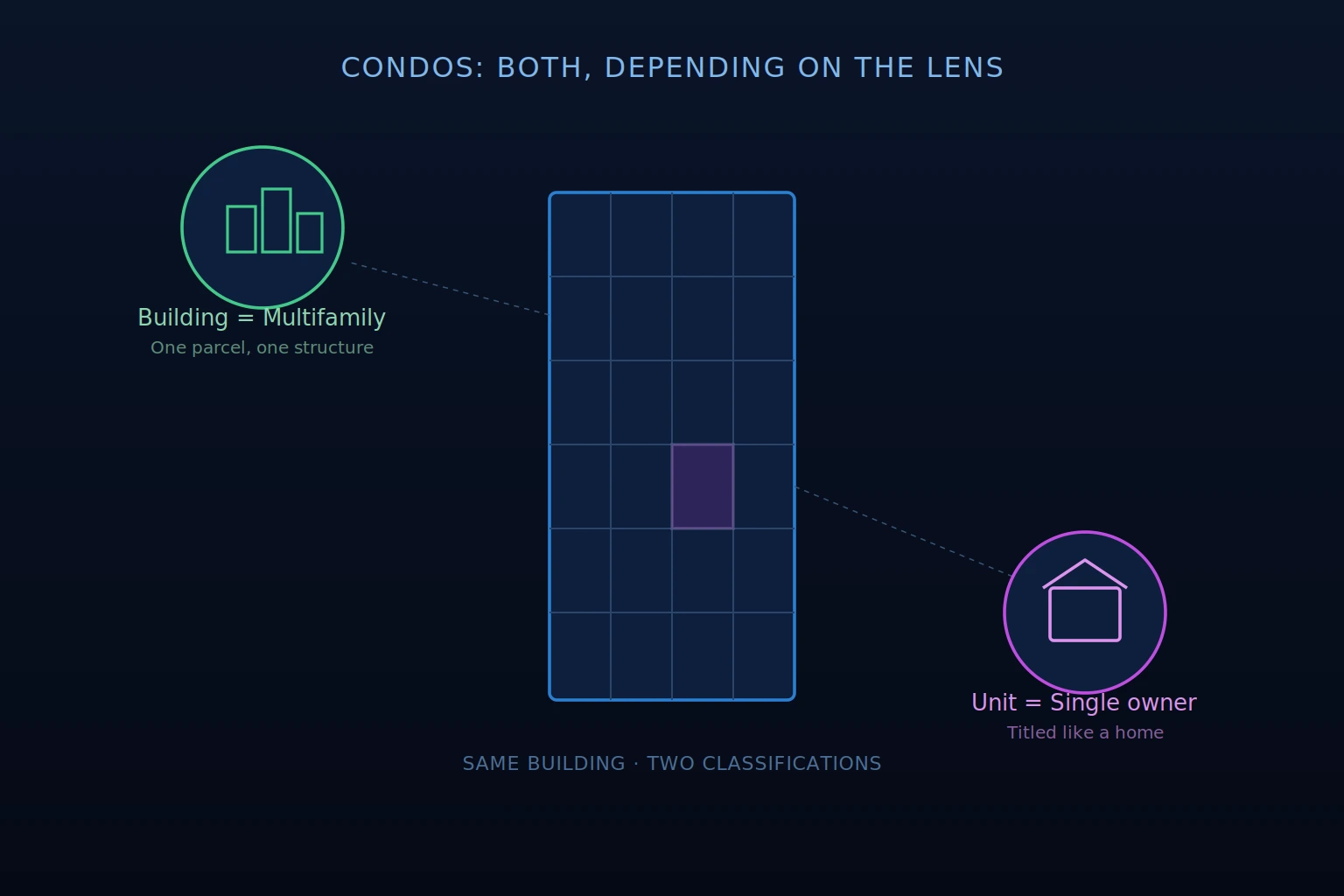
A condominium is a form of property ownership rather than a property type. The condo building itself, which contains multiple residential units under one roof, is multifamily real estate by any standard definition. It houses multiple households, sits on a single parcel of land, and is governed by a single set of legal documents that cover the entire structure. From a zoning, appraisal, and building classification standpoint, a condo building is multifamily.
An individual condo unit, however, is owned separately by one person or entity, just like a single family home. The unit owner holds title to the interior of their unit and has an undivided interest in the common areas, but they do not own the building or the land. In that sense, owning a condo unit is structurally similar to owning a single family home: one owner, one unit, one set of ownership rights.
That distinction, between the building and the unit, is what makes condos sit awkwardly between the two classifications. Here's how different parts of the real estate industry handle that ambiguity:
For financing: Lenders treat a condo unit purchase as residential real estate similar to a single family home, but with additional requirements around condo project approval that don't apply to single family purchases.
For zoning: The building is classified as multifamily in most jurisdictions, which affects what can be built on the site and how it is taxed at the property level.
For investment: A single condo unit generates income from one tenant, which makes it behave operationally like a single family rental rather than a multifamily investment property.
For real estate classification: Most MLS systems and appraisal frameworks treat condos as a separate property type distinct from both single family homes and multifamily properties, recognizing that the ownership structure doesn't fit cleanly into either category.
Read Also:
How Condos Are Classified Across Four Key Contexts
Since condos don't fit cleanly into either the single family or multifamily category, the most useful way to answer the question is to look at how they're treated across the four contexts where classification actually matters.
1. Financing: Condos Are Neither Single Family Nor Multifamily
For lending purposes, condos occupy their own distinct category. A condo unit is financed with residential mortgage products similar to a single family home, including conventional, FHA, and VA loans, but with an additional layer of requirements that don't apply to single family purchases.
Lenders require condo project approval before they will finance a unit purchase, meaning the entire development must meet specific criteria around owner-occupancy rates, HOA financial health, insurance coverage, and pending litigation.
This project approval requirement is what sets condo financing apart from both single family and multifamily financing. A single family home purchase has no equivalent project-level review. A multifamily property with five or more units requires commercial financing with entirely different underwriting criteria. A condo sits in between, using residential loan products but subject to project-level scrutiny that can affect whether conventional financing is available at all.
The warrantable versus non-warrantable distinction is particularly important. A warrantable condo meets Fannie Mae and Freddie Mac's project approval criteria and can be financed with conventional loans at standard rates.
A non-warrantable condo, typically one with high investor concentration, pending litigation, or HOA financial problems, cannot be financed through agency channels and requires portfolio lending at higher rates and less favorable terms.
2. Zoning: The Building Is Multifamily, the Unit Is Not
For zoning purposes, the condo building is almost universally classified as multifamily residential. Local zoning codes govern what can be built on a parcel of land, and a building containing multiple residential units is multifamily by definition regardless of how individual ownership is structured.
This means condo developments are subject to the same density limits, setback requirements, parking minimums, and land use restrictions as apartment buildings in the same zone.
The individual unit owner has no meaningful interaction with the zoning classification of the building. What matters for the unit owner is the HOA's rules and the building's legal structure, not the zoning designation.
However, for developers, investors evaluating development sites, and municipalities assessing housing supply, the condo building's multifamily zoning classification is the relevant framework.
3. Investment: A Condo Unit Behaves Like a Single Family Rental
For real estate investors, a single condo unit behaves operationally like a single family rental rather than a multifamily investment.
It generates income from one tenant, requires one lease, and is managed as a single unit rather than as a portfolio of units under one roof. The investor has no economies of scale, no ability to spread vacancy risk across multiple units, and no control over the exterior maintenance or common area condition of the building, all of which are managed by the HOA.
This makes condo investing fundamentally different from multifamily investing even when both involve residential rental properties. A multifamily investor who owns a 10-unit building controls the entire asset, makes decisions about the whole property, and benefits from scale in management, maintenance, and financing. A condo investor who owns 10 individual condo units in different buildings has 10 separate HOA relationships, 10 separate financing arrangements, and 10 separate sets of rules governing how each unit can be used and rented.
For most investors focused on building a scalable rental portfolio, small multifamily properties offer more operational control and better economies of scale than an equivalent number of individual condo units.
Where condo investing makes sense is as a lower-barrier entry point into real estate investment in markets where single family homes are expensive and small multifamily properties are scarce.
4. Tax: Classification Shifts Based on How the Property Is Used
For tax purposes, how a condo is classified depends primarily on how it is used rather than what it is. An owner-occupied condo qualifies for the same tax benefits as a primary residence, including the mortgage interest deduction and the capital gains exclusion on sale.
A condo used as an investment rental property is treated as investment real estate, subject to depreciation, rental income reporting, and the passive activity rules that govern all rental properties.
The depreciation treatment is worth understanding specifically. An investment condo is depreciated over 27.5 years as residential rental property, the same schedule that applies to a single family rental or a unit in a multifamily building.
The land component is not depreciable, and in a condo the land value is embedded in the overall property value rather than separately allocated, which can complicate the depreciation calculation compared to a single family home where land and improvement values are more clearly separated.
For investors using a 1031 exchange to defer capital gains on the sale of an investment condo, the property qualifies as like-kind real estate that can be exchanged for other investment real estate including single family rentals, multifamily properties, and commercial assets, provided the exchange meets the standard IRS requirements around timelines and qualified intermediaries.
Don’t Miss:
- How To Calculate the Value of a Multifamily Property Easily
- Who Provides Managed WiFi for Multifamily Buildings?
- Where to Find Multifamily Properties: 20 Platforms
Conclusion
The reason condos don't have a clean answer to the single family versus multifamily question is that they were never designed to fit either category perfectly. The ownership structure of a condo, one person owning one unit within a collectively owned building, creates a property type that borrows characteristics from both without fully belonging to either.
For practical purposes, the most useful framework is to answer the question based on context. If you're financing a purchase, treat it as a condo with its own specific requirements. If you're evaluating it as an investment, treat it as a single unit rental with the constraints that come with HOA governance. If you're thinking about the building from a zoning or development perspective, treat it as multifamily.
Getting that context right is what prevents the misclassification mistakes that show up most often in financing, where buyers assume condo approval works like a single family purchase, and in investment analysis, where buyers assume a condo delivers the same scalability and control as a multifamily property.
Frequently Asked Questions on Are Condos Multifamily or Single Family?
What Is the Difference Between a Condo and a Multifamily?
A condo is a form of individual ownership within a multi-unit building, where each unit is owned separately. A multifamily property is owned by a single entity who owns the entire building and all units within it. The building a condo sits in is multifamily by structure, but the individual unit is owned like a single family home.
What Type of Residence Is a Condominium?
A condominium is a privately owned residential unit within a larger multi-unit building or community. The owner holds title to the interior of their unit and shares ownership of common areas with other unit owners through a homeowners association. It is neither purely single family nor multifamily but a distinct ownership structure that combines elements of both.
What Is the Difference Between a Single Family and a Condo?
A single family home owner holds title to both the structure and the land it sits on with no shared ownership obligations. A condo owner holds title only to the interior of their unit while the land, exterior, and common areas are owned collectively through an HOA.
What Is an Individual Dwelling in a Condominium?
An individual dwelling in a condominium is a single privately owned unit within the larger condo building or development. It typically includes the interior living space, fixtures, and finishes within the unit's boundaries as defined in the condo declaration. Everything outside those boundaries, including exterior walls, roof, hallways, and land, is common property owned collectively by all unit owners.
What Kind of Property Is a Condo?
A condo is a residential property structured around individual unit ownership within a collectively governed building or community. For financing it is treated as a distinct property type with its own approval requirements. For zoning the building is classified as multifamily. For investment purposes a single condo unit behaves more like a single family rental than a multifamily asset.
What Is the Difference Between an Apartment and a Condo?
An apartment is a rental unit within a building owned by a single landlord or entity. A condo is a unit that is individually owned, either occupied by the owner or rented out. Physically they can look identical, but the key difference is ownership: apartment residents rent from a landlord while condo residents or their tenants occupy a unit that someone owns outright.


