

AI marketing in multifamily has moved well past the hype stage. Operators across the country are using it to target better prospects, respond to leads faster, generate listing content, personalize follow-up sequences, and protect their online reputation, all with less manual effort than traditional marketing approaches require.
The tools have matured, the use cases are proven, and the gap between operators who are using AI effectively in their marketing stack and those who aren't is becoming visible in leasing performance metrics. Cost per lease, days to lease, and lead-to-tour conversion rates are all areas where AI-driven marketing is producing measurable differences at the property level.
This guide covers how AI is actually being used in multifamily marketing today, which tool categories matter most, and what to watch out for as you build or refine your AI marketing approach.
Related:
- AI-Driven Demand Generation for Multifamily: Explained
- AI for Lease Management: 5 Core Use Cases
What Is AI Marketing for Multifamily?
AI marketing for multifamily refers to the use of artificial intelligence and machine learning to automate, personalize, and optimize marketing activities across the leasing funnel. It covers everything from how a property attracts prospective residents at the top of the funnel to how it nurtures leads, converts them into signed leases, and retains existing residents through renewal.
The defining characteristic of AI marketing is that it uses data to make decisions that would otherwise require human judgment, and it does so at a speed and scale that human marketing teams cannot match.
An AI tool that scores 500 leads in real time based on behavioral signals and prioritizes the top 50 for immediate leasing agent follow-up is doing in seconds what would take a leasing team hours to do manually, and doing it more consistently.
AI marketing is not a single tool or platform. It is a set of capabilities that can be applied across multiple stages of the leasing and retention process, and the most effective implementations are those that deploy the right AI capability at the right stage rather than adopting technology for its own sake.
Top 7 Uses of AI in Multifamily Marketing
1. Automated Lead Scoring and Prioritization
AI-powered CRM tools analyze prospect behavior including website visits, floor plan views, email opens, and chatbot interactions to score each lead based on their likelihood to convert. Leasing teams receive a prioritized list of the highest-probability prospects rather than a flat queue of every inquiry, which means their outreach is concentrated where it is most likely to produce a signed lease.
Properties using AI lead scoring consistently report higher lead-to-tour conversion rates because leasing agents are spending their time on the right prospects at the right moment.
2. Virtual Leasing Assistants and Conversational AI
AI-powered chatbots and virtual leasing assistants handle initial prospect inquiries immediately, at any hour, without leasing agent involvement. They answer availability and pricing questions, qualify prospects against unit criteria, schedule tours, and hand off to human agents only when the prospect is ready for a deeper conversation.
For properties that receive significant after-hours inquiry volume, virtual leasing assistants capture leads that would otherwise go unanswered until the next business day, by which point many prospects have already moved on.
3. AI-Generated Listing Content and Property Descriptions
Generative AI tools can produce high-quality listing descriptions, unit-specific marketing copy, and amenity highlights at scale and at a fraction of the time required for manual copywriting.
For operators managing large portfolios where keeping listing content fresh and accurate across dozens of properties is a persistent operational challenge, AI content generation reduces the time burden significantly while maintaining quality and consistency. The output still requires human review and editing, but the first draft that previously took an hour now takes minutes.
Related:
4. Predictive Audience Targeting for Paid Advertising
AI-powered advertising platforms analyze behavioral data, search intent signals, and demographic patterns to identify the highest-probability prospects for a specific property and concentrate ad spend on those audiences.
Instead of running broad awareness campaigns that reach large audiences with low conversion probability, AI targeting delivers ads to people who are actively in the market for housing that matches the property's profile. The result is lower cost per qualified lead and higher return on advertising spend without increasing the total marketing budget.
5. Personalized Email and SMS Campaigns
AI tools use behavioral and preference data to deliver personalized follow-up sequences to prospects based on how they've engaged with the property rather than sending the same generic message to every lead. A prospect who spent time viewing two-bedroom floor plans with den layouts receives different follow-up content than one who focused on studio units near public transit.
Personalized campaigns consistently outperform generic ones on open rates, click-through rates, and ultimately conversion rates because the content is relevant to the individual rather than the average prospect.
6. AI-Driven Reputation Management
Online reviews on Google, Yelp, and apartment-specific platforms have a direct and measurable impact on leasing performance. AI reputation management tools monitor review platforms in real time, flag new reviews for management attention, analyze sentiment patterns across large volumes of feedback, and in some cases generate suggested responses to both positive and negative reviews.
For operators managing multiple properties, AI reputation tools make it possible to maintain consistent review monitoring and response practices at scale without dedicating significant staff time to the task.
7. AI-Driven Reputation Management
Online reviews on Google, Yelp, and apartment-specific platforms have a direct and measurable impact on leasing performance. AI reputation management tools monitor review platforms in real time, flag new reviews for management attention, analyze sentiment patterns across large volumes of feedback, and in some cases generate suggested responses to both positive and negative reviews.
For operators managing multiple properties, AI reputation tools make it possible to maintain consistent review monitoring and response practices at scale without dedicating significant staff time to the task.
Top Picks:
- Multifamily Profit and Loss Statement: Template and Guide
- The Best AI Tools for Real Estate Investors
AI Marketing Tools for Multifamily: Key Categories
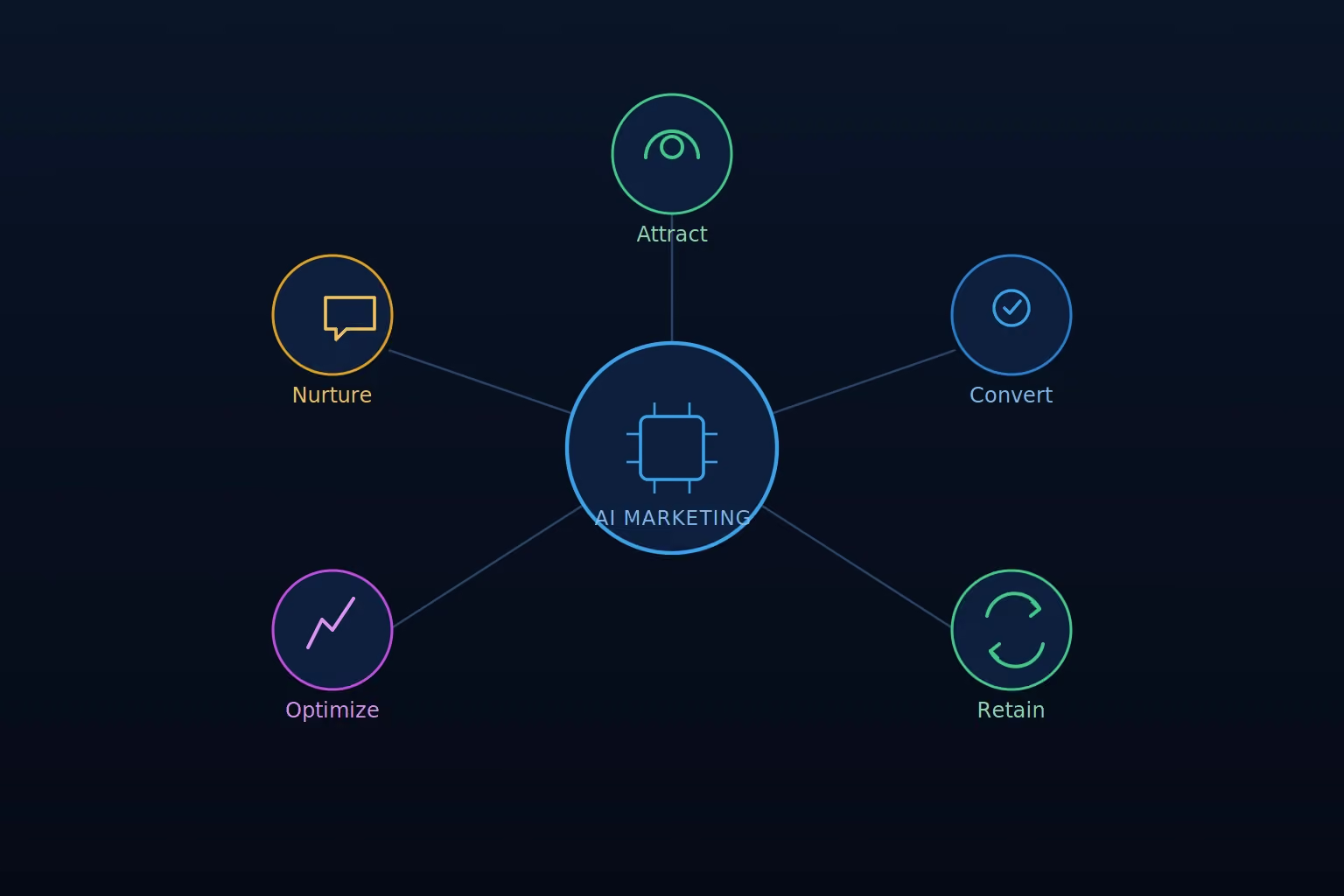
The AI marketing tool landscape for multifamily breaks down into several distinct categories. Here's what each one covers and what to look for when evaluating options:
CRM and Lead Management
- AI-powered CRM platforms that score, prioritize, and route leads based on behavioral signals
- Look for: integration with your property management software, real-time lead scoring, automated follow-up sequencing, and clear attribution reporting
Virtual Leasing Assistants
- Conversational AI tools that handle prospect inquiries, qualify leads, and schedule tours around the clock without leasing agent involvement
- Look for: natural language quality, seamless handoff to human agents, integration with your availability calendar, and multilingual capability if relevant to your resident base
Paid Advertising and Audience Targeting
- AI-driven advertising platforms that optimize audience targeting, ad creative, and budget allocation across search, social, and ILS channels
- Look for: transparency in how audiences are built, fair housing compliance controls, real-time performance reporting, and integration with your lead tracking system
Content Generation
- Generative AI tools that produce listing descriptions, email copy, social media content, and marketing materials at scale
- Look for: real estate-specific training, brand voice customization, human review workflows built into the process, and fair housing compliant output
Reputation Management
- AI platforms that monitor review sites, analyze sentiment, suggest responses, and track reputation trends across multiple properties
- Look for: coverage of all major review platforms, response time SLAs, sentiment trend reporting, and integration with your resident communication tools
Retention and Renewal
- AI tools that analyze resident behavior to identify renewal risk and trigger personalized retention campaigns before residents give notice
- Look for: integration with your property management system, configurable risk scoring thresholds, and automated campaign triggers tied to lease expiration timelines
Limitations and Risks of AI Marketing in Multifamily
AI marketing tools deliver real results, but they come with limitations and risks that operators need to understand before deploying them at scale.
1. Fair Housing Compliance
This is the most significant risk in AI multifamily marketing and the one that deserves the most attention. AI targeting algorithms that optimize for conversion can inadvertently discriminate against protected classes by learning patterns in historical data that reflect past discriminatory practices.
An algorithm trained on historical leasing data from a property with a historically homogeneous resident base may replicate that pattern in its targeting recommendations without any explicit discriminatory intent.
Before deploying any AI targeting or lead scoring tool, confirm that the vendor has built fair housing compliance controls into the platform, understands the specific requirements of the Fair Housing Act as it applies to algorithmic decision-making, and can provide documentation of how the tool is tested for discriminatory output.
The Department of Housing and Urban Development has made clear that algorithmic discrimination carries the same legal exposure as intentional discrimination, and responsibility does not transfer to the vendor simply because the decision was made by software.
2. Data Quality Dependencies
AI tools are only as good as the data they run on. A lead scoring model trained on incomplete or inaccurate CRM data will produce unreliable scores. A retention model built on a property management system with inconsistent data entry will miss at-risk residents that a well-maintained dataset would have flagged.
Before investing in AI marketing tools, assess the quality and completeness of your underlying data, because no AI platform can compensate for a garbage-in-garbage-out data problem at the source.
3. Over-Automation of Resident Communication
The leasing process ultimately depends on human connection. Prospects choose where to live based on how they feel about the community and the people managing it, not just on how quickly they received an automated response. Over-automating resident and prospect communication to the point where every interaction feels like it's coming from a bot erodes the trust and warmth that drive lease signings and renewals.
The most effective AI marketing implementations use automation to handle the parts of the process where speed and consistency matter most, initial response, lead qualification, tour scheduling, and then hand off to human leasing agents for the conversations that require relationship and judgment.
Knowing where to draw that line is one of the most important operational decisions in deploying AI marketing tools.
4. Vendor Lock-In and Integration Risk
Many AI marketing platforms are designed to become deeply integrated into your leasing operations, which creates meaningful switching costs if the tool underperforms or a better alternative emerges.
Before signing any AI marketing contract, understand the data portability terms, what happens to your data if you terminate the relationship, and how difficult it would be to migrate to a different platform. Favor vendors with open API integrations over those requiring proprietary data silos that make exit difficult.
Don’t Miss:
- AI Adoption in Multifamily: Why it's Accelerating So Fast
- Will AI Replace Real Estate Agents? Or Transform Them?
Conclusion on AI Marketing for Multifamily
AI marketing for multifamily is not a future capability. It is a present one, and the operators getting the most out of it are those who have moved past the question of whether to use it and focused instead on where to use it, how to measure it, and how to use it responsibly.
The tool categories covered in this guide, from lead scoring and virtual leasing assistants to reputation management and retention campaigns, each address a specific and well-defined problem in the leasing funnel.
The best implementations start with the problem, find the tool that addresses it most directly, and measure the impact before expanding to the next use case.
Fair housing compliance, data quality, and the balance between automation and human connection are not afterthoughts.
They are the factors that determine whether AI marketing becomes a genuine competitive advantage or a source of legal and operational risk. Get those right and the tools will do what they're designed to do.


