Revenue management in property management connects pricing, leasing, renewals, and future availability with the occupancy and revenue goals of each asset. It helps teams evaluate how decisions made today may affect performance over the weeks and months ahead.
The National Multifamily Housing Council describes the technology behind revenue management as using data to forecast supply and demand and inform unit pricing. In daily operations, the discipline also includes evaluating concessions, managing lease expiration distribution, supporting resident retention, and reviewing how leasing decisions translate into revenue over time.
This article explains the five core responsibilities of revenue management, how they connect with property management, and how teams can align them with each property’s strategy.
Related:
- Revenue Management Solutions for Multifamily Housing
- 9 Multifamily Revenue Management Strategies That Drive NOI
What is Revenue Management in Property Management?
Revenue management is the ongoing practice of evaluating property performance and coordinating leasing-related decisions to support an asset’s occupancy and revenue objectives.
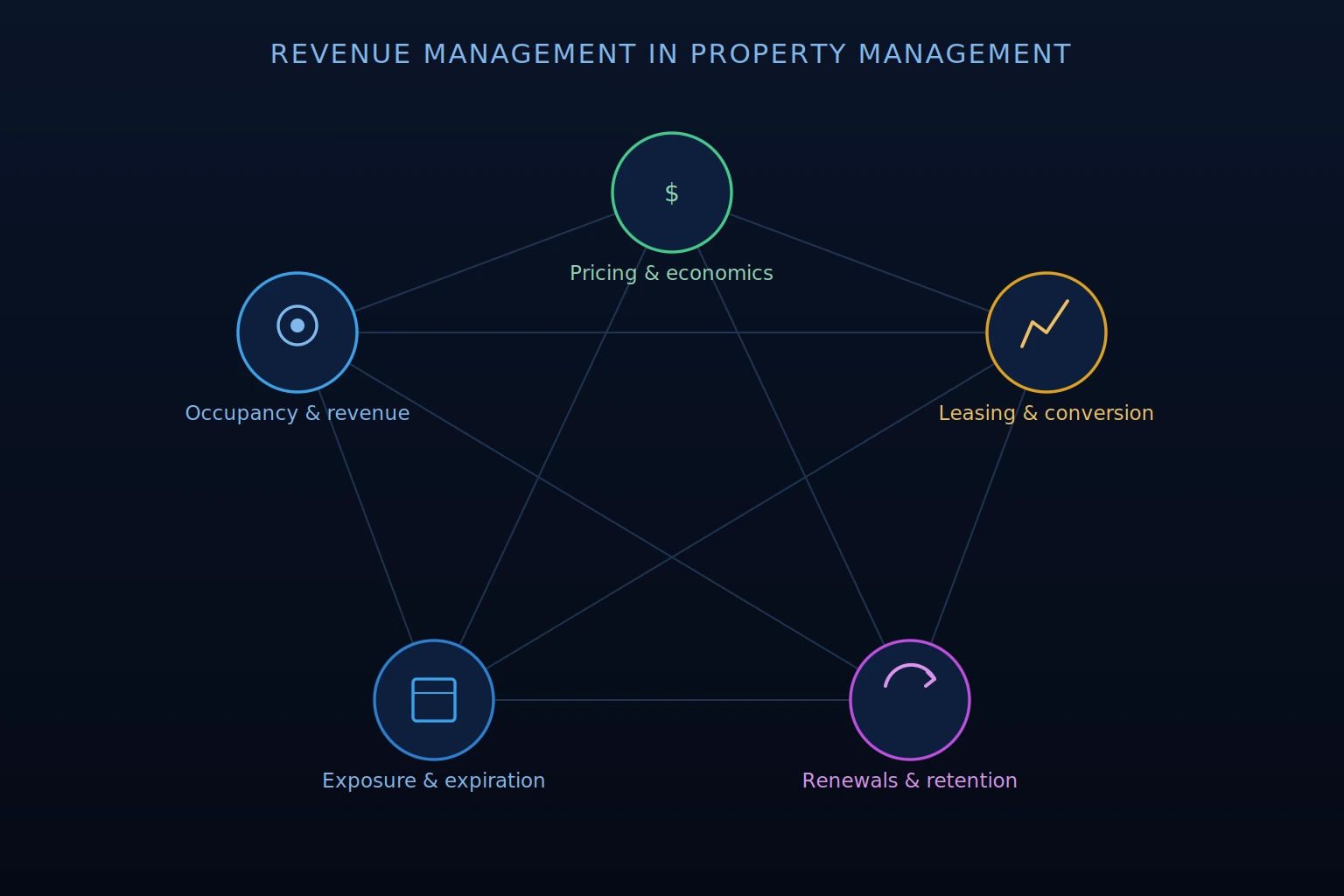
It connects five responsibilities: pricing and lease economics, leasing demand and conversion, renewals and retention, exposure and lease expiration management, and occupancy and revenue performance. Teams evaluate these areas together because a change in one can affect the others. A concession may improve leasing pace while reducing effective rent. A renewal may preserve occupancy while changing the property’s future expiration distribution.
The work follows a consistent cycle: identify what is changing, investigate the contributing factors, evaluate a response against asset strategy, and review the results. This gives teams a shared basis for decisions while allowing the approach to reflect each property’s conditions and goals.
How Revenue Management Differs From Property Management
Property management oversees the day-to-day operation and performance of an asset, including leasing, resident relationships, maintenance, collections, and financial reporting. It also involves planning ahead, managing budgets, and translating ownership goals into operational priorities.
Revenue management focuses more specifically on how pricing, leasing activity, renewals, and lease expiration decisions work together to support occupancy and rental revenue goals. It brings a recurring analytical process to those decisions, using current performance and forward availability to evaluate where adjustments may be warranted.
The functions depend on each other. Property teams contribute context that the numbers alone may not explain, such as unit readiness, prospect feedback, or unresolved resident concerns. Revenue analysis helps those teams evaluate how leasing pace, offer terms, and upcoming availability fit the asset’s strategy.
In smaller organizations, a property manager or owner may handle both responsibilities. Other operators use a dedicated revenue manager across several properties. In either structure, clear responsibilities and shared information help teams connect strategy, execution, and performance review.
Related:
- How to Build a Multifamily Revenue Forecast for Budget Season
- Apartment Revenue Management: Complete Guide
Core Revenue Management Responsibilities
1. Pricing and Lease Economics
Revenue management evaluates pricing alongside the full economics of a lease. Asking rent establishes the starting offer, while concessions, lease length, and unit-specific premiums influence the agreement ultimately signed.
Review pricing by layout using current leasing performance, available inventory, forward exposure, and the property’s occupancy goals. Base rents and amenity premiums should be evaluated with enough comparable leasing activity to understand whether a pattern warrants closer review. Fast or slow leasing alone does not establish that a price is wrong.
Effective rent helps teams evaluate signed lease pricing after accounting for concessions over the lease term. Reviewing it alongside asking rents and concession usage makes it easier to understand whether changes in advertised pricing are translating into stronger lease economics.
Lease length also matters. An offer that supports leasing today may place another expiration into an already concentrated future window. Pricing decisions should therefore consider both the agreement’s economics and how its timing fits the property’s longer-term occupancy and revenue strategy.
2. Leasing Demand and Conversion
Revenue management connects prospect demand with the pace of signed leases to evaluate whether leasing activity supports the property’s occupancy and revenue goals. Lead volume shows how much interest the property is generating, funnel conversion shows how prospects progress, and leasing velocity shows how quickly available inventory is being leased.
Review these measures together over consistent periods and by layout where the data supports it. Declining inquiries may warrant investigation into marketing reach or seasonal demand. Steady inquiries with fewer signed leases may call for a closer look at response times, tour availability, follow-up, unit readiness, pricing, or lease terms. A change in conversion identifies where to investigate without establishing the cause on its own.
Evaluate signed leases alongside upcoming move-ins, known availability, and anticipated departures. The same leasing pace may be sufficient for a property with limited availability but fall short when more units are expected to become available.
Revenue management helps teams connect these findings to an appropriate response, whether that involves leasing execution, offer review, or pricing. Reviewing the results afterward helps determine whether the action is supporting the asset’s strategy.
Related:
- What Does a Multifamily Revenue Manager Do?
- What Are Property Management Systems?
3. Renewals and Resident Retention
Revenue management treats renewals as both a resident retention priority and a decision about future occupancy and lease economics. Retaining a resident can reduce turnover-related vacancy, make-ready expenses, and re-leasing work, while the renewal rate and lease term affect revenue and future expiration timing.
Begin outreach early enough to understand residents’ plans and address concerns the team can resolve. Maintenance experiences, communication, perceived value, and changing household needs can all influence whether a resident stays. Offer pricing is one part of that decision.
Apply a consistent renewal approach aligned with the property’s asset strategy. Review proposed offers alongside renewal trade-out, retention outcomes, potential turnover costs, and forward exposure. Evaluate term options for how they fit the desired expiration distribution, and keep completed renewals, confirmed departures, and residents needing follow-up clearly visible.
The National Apartment Association’s analysis of 2024 operating results found that repairs and maintenance costs had risen nearly 28% since 2021, while NOI increased approximately 10%. Those pressures reinforce the importance of evaluating retention economics carefully. Teams should weigh the terms of a renewal against potential vacancy and turnover costs rather than assume every retention offer produces a better financial outcome.
4. Exposure and Lease Expiration Management
Exposure management connects the lease terms offered today with the availability a property may face in the future. When many leases expire within a narrow window, the property can face added vacancy pressure if renewals and new leasing do not keep pace.
Review scheduled expirations against targets that reflect seasonal leasing demand, layout-level performance, and asset strategy. Evaluate new lease and renewal term options for how they contribute to that distribution, while considering their pricing and appeal to residents.
The forward view should distinguish scheduled expirations from confirmed departures. Known upcoming availability can be supplemented with anticipated availability, such as month-to-month behavior and early terminations, informed by historical performance. These estimates provide planning context without treating every potential move-out as certain.
Reviewing exposure regularly gives teams time to adjust term offerings, prioritize renewal outreach, and prepare for upcoming inventory. It also helps teams evaluate pricing against the leasing pace required in each future window, rather than relying only on current occupancy.
5. Occupancy and Revenue Performance
Revenue management evaluates whether pricing, leasing, renewal, and exposure decisions are supporting the property’s goals. Occupancy establishes how much of the property is occupied, while revenue measures show the economics behind that result.
Review physical occupancy against asset-specific targets and alongside signed leases awaiting move-in, confirmed departures, and forward availability. A property meeting its occupancy target may still face pressure ahead, while one below target may be progressing toward its goal.
Connect occupancy with effective rent, concession usage, and new lease and renewal trade-out. Trade-out shows how signed rents compare with the prior leases for those units, helping teams understand how individual agreements are changing rent levels over time. Use consistent comparisons, particularly when accounting for concessions.
In-place rent and scheduled rental revenue trends show how those lease-level outcomes accumulate across the property. Average rent can increase while total scheduled revenue declines if fewer units are occupied. Scheduled revenue also differs from cash collected, so collections, delinquency, operating expenses, and NOI provide additional financial context.
Evaluating these measures together helps teams assess whether their decisions are supporting sustained performance, and where the approach may need to change.
Related:
Revenue management decisions should reflect what each property is expected to achieve and over what timeframe. A lease-up working toward stabilization may prioritize leasing pace and occupancy growth. A stabilized property may focus on retention and sustained rental revenue. A property undergoing renovations needs to evaluate unit downtime, completed inventory, and the lease economics achieved after improvements.
Translate those priorities into clear occupancy targets, pricing parameters, renewal settings, and lease expiration targets. Teams should understand how the settings support the business plan and when changes in performance warrant a review. The same leasing result may call for different responses at properties with different goals.
Teams need consistent information to put asset strategy into practice. The National Apartment Association highlights the importance of shared data definitions and metrics tied to property goals, including renovation, occupancy, and rent objectives. For revenue management, that means giving property, revenue, and asset management teams a common basis for evaluating results while preserving the targets and priorities specific to each asset.
Review results regularly against the asset’s objectives. As leasing conditions, renovation schedules, or ownership priorities change, teams may need to revisit the settings and actions supporting the strategy.
Revenue Management for Third-Party Managers
Third-party property managers may oversee assets for several ownership groups, each with different business plans, revenue expectations, and investment timelines. Revenue management helps translate those priorities into property-level decisions that teams can apply and explain consistently.
Start by agreeing on occupancy and revenue objectives, pricing and concession parameters, renewal strategy, and decision-making authority. Clarify which adjustments the management team can make independently and which require ownership review. This gives teams a practical basis for responding as conditions change.
Ownership reporting should connect performance with the decisions behind it. Explain what changed, which factors contributed, what action was taken, and how results compare with the asset’s goals. Include forward exposure and upcoming availability so discussions address potential pressure as well as completed results.
A consistent review process can support every property while preserving the strategy specific to each owner. That helps third-party managers communicate trade-offs clearly, document decisions, and keep operational execution aligned with ownership expectations.
How Rentana Supports Revenue Management
Rentana connects PMS-sourced operational data with pricing, renewal workflows, exposure analysis, and performance reporting, helping teams apply asset strategy across the revenue management responsibilities described above.
- Purpose-built pricing recommendations by layout draw on property-level performance signals, forward availability, and configured asset strategy. Supporting data and reasoning help teams evaluate recommendations before deciding whether to act.
- Renewal workflows support scheduled offer prompts based on configured timing, offers generated from asset strategy, and offer syncing. Batch views help teams review completed renewals and identify residents who need outreach or follow-up.
- Exposure analysis shows scheduled lease expirations against configured targets by layout and time window. Known upcoming availability and additional anticipated availability informed by historical performance provide context for evaluating lease terms, pricing, and renewal strategy.
- Predicted Occupancy connects leasing activity, renewal trends, and future availability to provide a forward-looking view alongside current occupancy results.
- Dashboards, charts, and reports give property, revenue, and asset management teams a shared view of performance. Configurable timeframes and layout-level analysis support investigation and ownership reporting.
- AI-generated Insights highlight operational changes, explain why they may matter, and help teams identify where closer review is warranted.
- Ask Rentana, the AI analyst, helps teams investigate questions about absorption, retention, concessions, conversion, and property performance. Explained reasoning, interactive charts and tables, and downloadable analysis help teams evaluate findings and communicate them to colleagues and ownership.
These capabilities bring supporting information into the review process, helping teams spend more time evaluating decisions and following through on them. Strategy, judgment, and accountability remain with the people managing the assets.
Don’t Miss:
Conclusion on Revenue Mmanagement in Property Management
Revenue management in property management extends beyond pricing. It connects lease economics, leasing demand, resident retention, future availability, and revenue performance with the goals of each asset.
Effective practice depends on reviewing those responsibilities together. A pricing adjustment affects leasing pace, a renewal changes future availability, and a lease term influences expiration concentration. Evaluating those connections helps teams understand the trade-offs behind each decision.
With consistent information, clear responsibilities, and regular performance reviews, property teams can translate asset strategy into coordinated action and assess whether their decisions are supporting occupancy and long-term revenue goals.