
Managing multifamily buildings means making connected decisions across pricing, leasing, renewals, occupancy, and reporting simultaneously, often with imperfect visibility and limited time. The challenges that compound most quietly are the ones where a gap in one function creates pressure in another before anyone notices the connection.
According to GlobeSt, rising operating costs have made the current environment one of the most challenging for multifamily performance in years, with expenses compressing the margin between revenue and operational capacity in ways that make every management decision more consequential than it used to be.
This article covers nine of the most consistent challenges in multifamily building management and the operational approaches that address them most effectively.
Read Also:
9 Challenges With Managing Multifamily Buildings and How to Fix Them
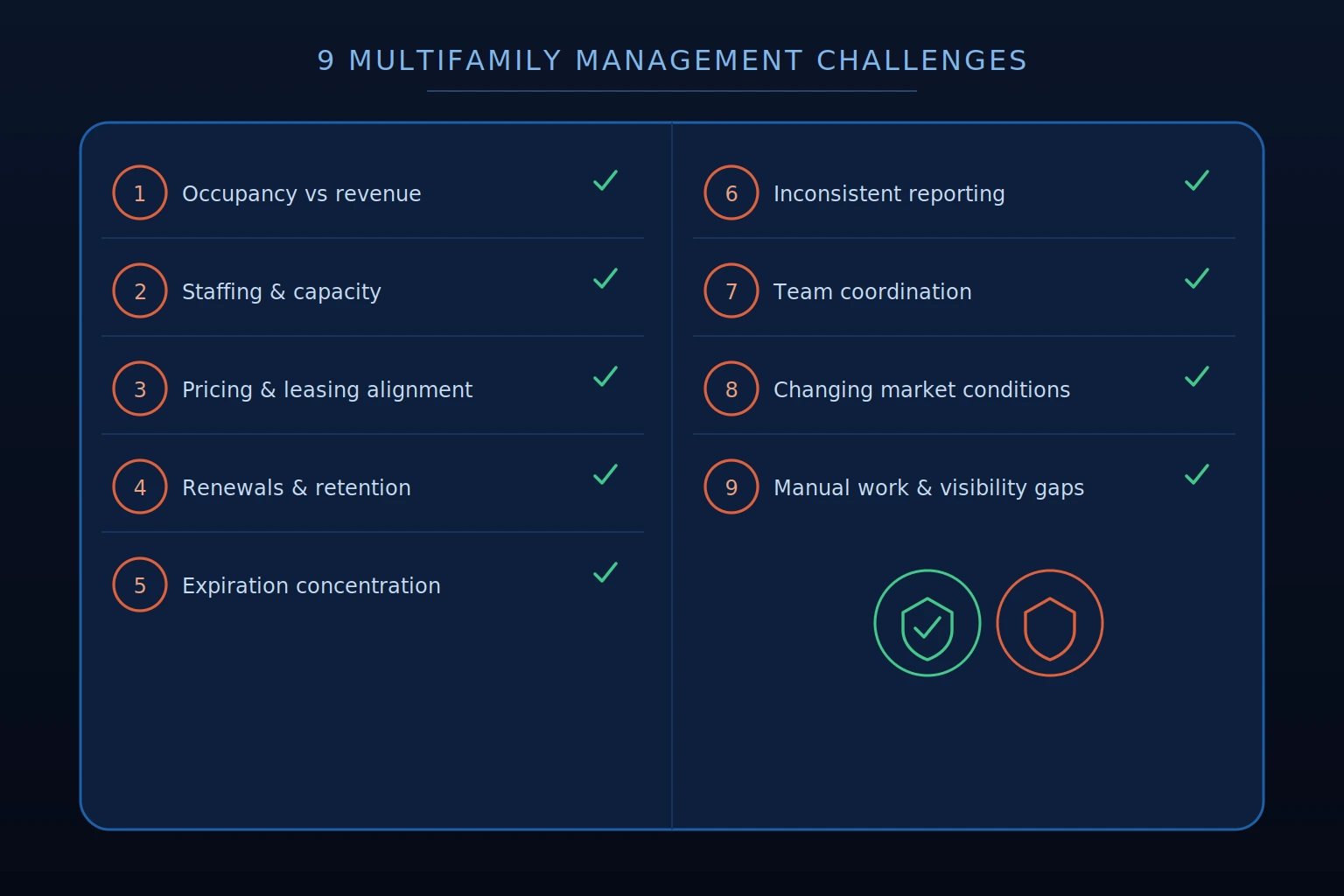
- Maintaining Occupancy While Protecting Revenue
- Managing Staffing and Operational Capacity
- Keeping Pricing and Leasing Strategy Aligned
- Managing Renewals and Resident Retention
- Preventing Forward Exposure and Lease Expiration Concentration
- Keeping Reporting Consistent Across Properties
- Coordinating Property, Revenue, and Asset Management Teams
- Responding to Changing Market Conditions
- Where Technology Can Reduce Manual Work and Improve Visibility
1. Maintaining Occupancy While Protecting Revenue
The challenge: Occupancy and effective rent pull in different directions when expiration clustering is misaligned with demand. Filling units quickly can require concessions that suppress revenue for the duration of those leases. Holding pricing firm when demand is insufficient can prolong vacancy. Managing both without sacrificing one for the other is one of the most persistent balancing acts in multifamily operations.
The fix: Proactively manage lease expiration distribution for long term occupancy and revenue stability. For periods of misalignment, evaluate pricing and occupancy targets together at the layout level rather than independently at the property level.
A pricing adjustment should reflect current leasing velocity, forward availability, and the occupancy timeline the asset strategy requires. Concessions should be targeted to specific layouts absorbing below pace with a defined scope and end date rather than applied broadly to move an occupancy number.
Rentana’s exposure analysis shows lease expiration concentration against configured targets, helping teams evaluate lease term options that support long-term occupancy and revenue stability. Pricing recommendations generated by purpose-built algorithms help teams evaluate adjustments by layout using leasing performance, forward availability, and asset strategy, with supporting reasoning available for review. AI-generated Insights highlight operational changes that may warrant closer attention.
2. Managing Staffing and Operational Capacity
The challenge: Multifamily operations depend on people handling a high volume of recurring tasks, leasing follow-up, maintenance coordination, resident communication, reporting, and renewals. As portfolios grow, the volume scales faster than headcount, and the tasks that require the least judgment tend to consume the most time.
The fix: Identify which workflows are high-volume and consistency-dependent rather than judgment-dependent, and build systems around those first.
AI-assisted leasing tools handle inquiry response and follow-up sequences outside office hours and during periods of high inquiry volume. Standardized reporting processes reduce the time spent assembling data before any analysis can begin. Centralized pricing and renewal workflows allow a smaller revenue management team to support more assets effectively.
Rentana’s AI-generated Insights highlight what is changing and why it matters, while streamlined pricing workflows bring recommendations, supporting data, and clear reasoning into one view. Teams can evaluate pricing decisions without searching across reports or reconstructing the rationale behind each recommendation, leaving more time for review and action.
3. Keeping Pricing and Leasing Strategy Aligned
The challenge: Pricing and leasing strategy can fall out of sync when teams review rents separately from leasing performance and upcoming availability. A layout may be leasing too slowly to absorb the units becoming available, while another has limited availability and sustained demand. Property-level averages can hide those differences, making it harder to identify where pricing, concessions, or leasing execution need review.
The fix: Connect pricing evaluation to internal leasing data at the layout level, including current absorption pace, days on market by configuration, and forward availability in the relevant expiration windows. The adjustment that is right for a layout absorbing well is different from the one right for a layout sitting, and property-level averages obscure that distinction.
Rentana uses purpose-built pricing algorithms to generate recommendations by layout or custom unit group based primarily on property-level performance signals, forward availability, and configured asset strategy, with supporting inputs and reasoning available for teams to review before acting.
Related:
- Unit-Level Pricing Strategy in Multifamily
- The Best Multifamily Pricing Tool for Investors
4. Managing Renewals and Resident Retention
The challenge: Renewal management is frequently treated as an administrative process on a fixed calendar rather than an ongoing effort to retain residents. By the time an offer is sent, unresolved maintenance issues, communication gaps, or concerns about value may already have shaped a resident’s decision to leave. A preventable departure can create vacancy loss, make-ready expenses, marketing costs, and additional leasing work. Across a portfolio, those costs compound quickly.
The fix: Start renewal conversations early enough to understand residents’ plans, identify concerns, and address issues the team can resolve. Evaluate renewal offers alongside the resident experience and the cost of turnover, using a consistent approach aligned with the property’s asset strategy. Track renewal conversion and reasons for non-renewal to understand where pricing, service, or other factors may be affecting retention, and review forward exposure to identify where potential departures could create added occupancy pressure.
Rentana helps teams stay ahead of renewals with scheduled offer prompts, offers generated from configured asset strategy, and batch views showing completed renewals and residents who need outreach or follow-up. Teams can review exposure to inform renewal strategy and use Ask Rentana, the AI performance analyst, to explore renewal conversion performance and identify trends that warrant closer attention.
5. Managing Forward Exposure and Lease Expiration Concentration
The challenge: Lease terms offered today shape future occupancy and revenue pressure. When too many leases expire in the same window, particularly during periods of weaker demand, renewals and new leasing may not keep pace with the units becoming available. Reviewing only current vacancy can leave teams reacting with concessions or pricing changes after the opportunity to manage that concentration has passed.
The fix: Set lease expiration targets that reflect seasonal leasing demand and the property’s asset strategy, then evaluate new lease and renewal term options against those targets. Review scheduled expirations alongside known upcoming availability, with additional anticipated availability such as month-to-month behavior and early terminations informed by historical performance. Use that combined view to guide lease term offerings, term pricing, and renewal outreach before concentrated expirations become near-term vacancy pressure.
Rentana’s exposure analysis shows scheduled lease expirations against configured targets by layout and time window, helping teams evaluate how lease term choices fit their desired expiration distribution. Visibility into known and anticipated availability adds context for reviewing pricing and renewal strategy, so teams can address potential pressure while more options remain available.
6. Keeping Reporting Consistent Across Properties
The challenge: Even across a handful of properties, reporting can become inconsistent when teams use different metrics, date ranges, or spreadsheets. The National Apartment Association highlights consistent data definitions as a foundation for reliable reporting and notes that multiple tools and platforms can create challenges for operators of all sizes. For lean teams, reconciling those differences takes time away from understanding performance and deciding where to act.
The fix: Establish shared metric definitions, reporting periods, and a regular review cadence across properties. Use connected operational data to reduce manual assembly, and evaluate results against each property’s targets and asset strategy. Consistent reporting helps teams distinguish actual performance differences from differences in how the numbers were prepared.
Rentana brings PMS-connected data into dashboards and reports, giving teams a consistent foundation for property and portfolio reviews. Configurable timeframes and layout-level analysis help teams move from a shared performance view into the detail behind a change, supporting clearer discussions with property teams, revenue managers, and ownership.
7. Coordinating Property, Revenue, and Asset Management Teams
The challenge: Leasing, marketing, revenue management, and asset management each touch different parts of the same operational picture. When they are working from different data sources on different timelines, the coordination that multifamily performance requires starts from reconciliation rather than shared understanding. Decisions that should inform each other happen in sequence instead of in context.
The fix: Give every team visibility into the same current operational picture simultaneously. When leasing velocity, pricing performance, renewal conversion trends, and forward exposure are visible to all relevant team members at the same time, the coordination conversation starts from shared context rather than from establishing what the numbers are.
Rentana's shared team visibility means leasing, revenue management, and asset management are working from the same PMS-connected operational picture simultaneously, reducing the version control and communication gaps that slow coordinated decisions.
Related:
- Apartment Rent Pricing Strategy
- Multifamily Rent Pricing Strategy: Complete Guide for Investors
8. Responding to Changing Market Conditions
The challenge: According to the National Apartment Association, since 2021 repairs and maintenance costs have risen nearly 28% while NOI has increased just 10%, compressing margins in ways that make the current operating environment significantly less forgiving than the one that preceded it. When conditions shift, operators managing from lagging financial data are always responding to what already happened rather than positioning for what is coming.
The fix: Supplement financial reporting with operational signals that can provide earlier visibility into changing performance. Leasing velocity trends, renewal conversion rates, and forward exposure concentration can help teams identify potential occupancy and revenue pressure before it is fully reflected in monthly financial reporting. Building the operational habit of reviewing these signals on a weekly cadence, rather than waiting for the monthly report, is what creates the response window that allows strategy adjustments rather than reactive interventions.
9. Where Technology Can Reduce Manual Work and Improve Visibility
The challenge: Much of the time multifamily teams spend on data preparation, pulling reports, reconciling systems, and assembling portfolio pictures before any analysis can begin, produces no operational insight on its own. It is a prerequisite to insight, and it competes with the time available for the judgment calls that actually require expertise.
The fix: Connect technology infrastructure around decisions rather than reports. The goal is a system that surfaces what is changing, provides context around why it matters, and helps teams prioritize where to focus, without requiring data assembly before the evaluation can begin.
Ask Rentana, Rentana’s AI analyst, lets teams ask complex questions about pricing, leasing, and property performance and receive analysis in seconds, with explained reasoning, interactive charts and tables, and suggested next steps. Teams can explore what is driving absorption, retention, concessions, and conversion performance, then download the analysis to share with ownership or colleagues. That gives lean teams more capacity to investigate performance and communicate findings, while keeping judgment and decisions with the people managing the properties.
Don’t Miss:
- What Is Multifamily Data Analysis? Tools to Use
- Multifamily Reporting Template: What to Include and Why
Conclusion on Challenges With Managing Multifamily Buildings
The challenges in this article are not isolated problems. They compound across functions, and the gaps between pricing, leasing, renewals, exposure, and reporting are where performance pressure accumulates most quietly.
The operators managing these challenges most consistently are the ones with current operational visibility, forward-looking signals that arrive early enough to act on, and the right infrastructure connecting the teams responsible for each function. Getting that infrastructure right is what separates management as a reactive discipline from management as a proactive one.