Apartment demand and occupancy are not static. They shift in response to leasing activity, renewal behavior, upcoming availability, and seasonal patterns that develop over weeks before they show up in reported metrics. The question for multifamily operators is not whether those shifts can be anticipated. It is whether the right signals are being monitored consistently enough to act before conditions have already moved.
AI can support that process. It can surface patterns in operational data, summarize what is changing, and help teams prioritize where to focus attention. What it cannot do is replace the asset-specific judgment that determines what the right response is, or substitute for the PMS-connected operational data that makes any forward-looking analysis reliable.
This article covers what forward-looking occupancy analysis actually requires, where AI genuinely helps, and how Rentana supports that visibility for multifamily operators.
Related:
- The Impact of AI in Multifamily Operations and Revenue
- AI for Lease Management: 5 Core Use Cases
What Does Apartment Demand and Occupancy Forecasting Mean?
In multifamily, forward-looking occupancy analysis is the practice of connecting current operational signals to an informed view of where occupancy appears to be heading, so teams can evaluate and respond while options are still available rather than after the outcome is already set.
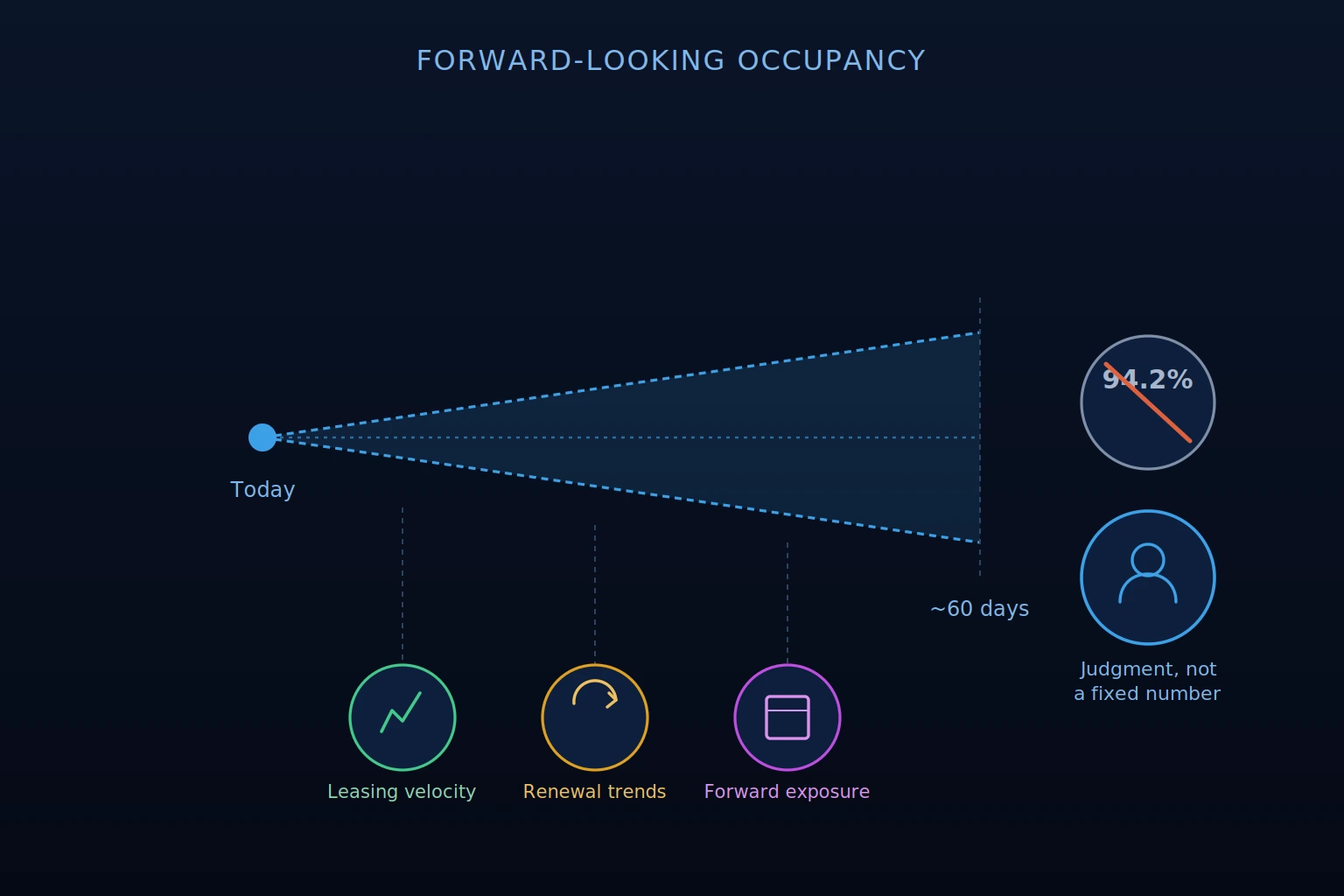
The word forecasting can imply precision that operational analysis does not deliver. No analytical tool, AI-supported or otherwise, can predict with certainty what occupancy will be in 60 days. What forward-looking analysis can do is surface the conditions that are currently influencing where occupancy is heading, make those conditions visible earlier than standard reporting would, and help teams identify where attention or adjustment may be warranted.
The distinction matters because it shapes how these tools should be used. Forward-looking visibility is a starting point for evaluation and judgment, not a number to be accepted and acted on without review.
How Data Supports Forward-Looking Occupancy Analysis
The signals that support meaningful forward-looking occupancy analysis are almost entirely internal operational data. External market conditions provide useful context but cannot tell an operator what is happening inside their own asset or where their specific occupancy is heading. Apartment demand and occupancy are related but distinct. Lead volume and leasing funnel conversion help teams evaluate demand, while occupancy also reflects move-ins, move-outs, renewals, and available inventory.
The most relevant internal signals:
- Current occupancy: The baseline from which all forward analysis starts, evaluated by layout rather than only at the property level to surface divergences that property averages would obscure
- Leasing activity: How quickly available units are absorbing relative to targets and forward availability, by layout and time period
- Leasing demand and conversion: Lead volume and conversion across the leasing funnel, evaluated alongside leasing velocity to understand whether changes reflect prospect demand, conversion performance, or both
- Upcoming availability: Units currently available and known upcoming availability, including confirmed notices and expected return-to-service dates for units under renovation
- Lease expirations: The scheduled distribution of expiring leases by layout and time window, evaluated alongside renewal trends and confirmed notices to understand potential future availability
- Renewal trends: How many residents are choosing to renew and how that conversion rate is trending over rolling periods, since softening renewal conversion directly increases future availability before it is visible in occupancy numbers
- Notices and anticipated move-outs: Confirmed notices to vacate, supplemented by anticipated availability from month-to-month behavior and early terminations based on historical performance
According to McKinsey, advanced analytics applied to real estate data, both traditional and nontraditional, make it possible to surface patterns and relationships across large datasets that conventional analytical methods and manual review cannot efficiently process. In multifamily, the practical value of that capability is connecting these internal operational signals into a coherent forward picture rather than reviewing each one separately.
Read Also:
The Role of AI in Forecasting Apartment Demand
AI in forward-looking occupancy analysis adds value in specific and bounded ways. Understanding where it genuinely helps is what prevents over-reliance on outputs that require more human context to interpret than they might appear to.
Surfacing patterns across connected signals: When leasing demand is softening, renewal conversion is declining, and forward exposure is concentrating simultaneously at a property or in a specific layout, that combination is more significant than any of the three signals reviewed independently. AI-generated Insights that analyze these signals together and surface related changes can help teams focus their analytical review.
Summarizing what is changing: Translating combinations of operational signals into plain-language summaries of what is changing and why it may matter reduces the time required to move from data to a starting point for evaluation. This is most useful at portfolio scale, where reviewing every asset individually would take more time than the review cadence allows.
Highlighting unusual shifts: Flagging where a specific layout or property is diverging from its own historical performance, or from comparable assets in the same portfolio, surfaces anomalies that may be harder to identify through manual review at scale.
Helping teams prioritize where to investigate. At portfolio scale, not every signal warrants the same level of attention at the same time. AI that surfaces where multiple conditions are shifting simultaneously helps teams direct analytical attention toward the assets and layouts where forward visibility matters most, rather than distributing attention equally across a portfolio where not everything is moving.
According to Multi-Housing News, AI technology offers the potential to analyze vast amounts of data more quickly and efficiently than manual processes allow, with portfolio management among the clearest practical applications. The value is in the consistency and speed of pattern recognition, not in replacing the judgment that follows from what AI surfaces.
Why Forecasting Should Not Rely on General AI Alone
General-purpose AI tools used without access to current, validated property data are not a reliable basis for property-specific occupancy forecasts. Their outputs may reflect general assumptions rather than the asset’s actual leasing, renewal, and availability conditions. Even when operational data is supplied, teams need to validate the methodology, assumptions, and results before using the analysis to inform decisions.
Purpose-built analytics platforms that integrate directly with the PMS and work with current operational data are the appropriate infrastructure for forward-looking occupancy analysis. The AI in those platforms works with actual leasing records, actual renewal behavior, and actual forward availability conditions, which is what makes the output operationally meaningful rather than generically reasonable.
According to CBRE's U.S. Real Estate Market 2026 Outlook, because most widely reported rent growth figures are based on asking rents for new leases, they understate the actual performance of multifamily properties. The same principle applies to occupancy analysis: signals drawn from actual internal operational data are more useful for forward-looking decision-making than external or generalized estimates that do not reflect the specific conditions of a given asset.
Top Picks:
The Difference Between AI-Assisted Analysis and Pricing Logic
Forward-looking occupancy analysis and pricing recommendations are related but distinct functions, and it is worth being clear about how they connect and where they diverge.
Occupancy analysis surfaces where occupancy appears to be heading based on current leasing activity, renewal trends, and forward availability. It is a visibility function: it helps teams understand what is changing and where to focus attention.
Rentana uses purpose-built pricing algorithms to generate recommendations by configured layouts based primarily on property-level performance signals, forward availability, and configured asset strategy. Publicly available market data may provide additional context when evaluating a recommended change, while pricing direction remains grounded in the property’s own performance.
AI-generated Insights help teams interpret operational changes alongside these capabilities. They are separate from the purpose-built algorithms that generate pricing recommendations. Neither should be treated as automated decisions. The human review and judgment that determines whether an output is appropriate for a specific asset, in its current stage, against its configured goals, is what makes AI-assisted analysis operationally sound rather than operationally risky.
How Rentana Supports Forward-Looking Visibility
Rentana supports forward-looking occupancy visibility through several connected capabilities, each drawing on PMS-connected operational data rather than external estimates or general market assumptions.
Predicted Occupancy connects current leasing activity, renewal trends, and future availability to provide a forward-looking view of occupancy at each asset. Teams can use that view to evaluate current strategy against occupancy targets, with results interpreted in light of the underlying data and assumptions.
Exposure Forecasting shows the distribution of upcoming lease expirations by layout and time window against configured exposure thresholds, making concentration visible before it creates leasing pressure. When multiple leases are expiring in a narrow window, the exposure view surfaces that concentration before it has already resulted in the availability pressure that reactive responses are trying to address.
Forward Availability View combines scheduled lease expirations and known upcoming availability with additional anticipated availability, such as month-to-month behavior and early terminations, incorporated based on historical performance.
AI-generated Insights surface what is changing at specific assets, explain why it may matter given current operational conditions, and connect to a supported next step. The insights are drawn from Rentana's PMS-connected operational data and are organized around the three questions that forward-looking analysis should consistently answer: what changed, why it matters, and what to evaluate next.
Don’t Miss:
Conclusion on The Role of AI in Forecasting Apartment Demand
Forward-looking occupancy visibility changes the starting point for operational decisions. It does not make those decisions.
A Predicted Occupancy signal that shows occupancy trending lower over the next 45 days is a prompt to evaluate what is driving the trend and what response is appropriate. The right response depends on the specific asset, its configured occupancy targets, its stage in the hold period, the leasing and renewal conditions driving the forward signal, and the judgment of the team managing it. Rentana provides forward-looking occupancy visibility, while AI-generated Insights help teams interpret operational changes. Asset strategy and human judgment guide the response.
This is the appropriate relationship between AI-assisted analysis and operational decision-making in multifamily. The teams that get the most value from forward-looking visibility are the ones that treat it as high-quality input to a judgment process, not as a directive to act on without review.