
Understanding the rental market around a multifamily asset is a legitimate part of revenue management. Knowing what comparable properties are publicly advertising, how much new supply is entering a submarket, and what published market reports are showing about occupancy and rent trends all provide context that can inform how internal performance signals are interpreted.
That context has limits. Public market data describes the external environment. It cannot tell an operator how their specific units are absorbing, where renewal conversion is trending, or whether current pricing is producing the leasing pace their occupancy targets require. For those questions, internal operational data is what matters most.
Related:
- Public Market Intelligence Platform for Multifamily: What to Look For
- AI Tools for Multifamily Performance and Market Analysis
What Is Public Rental Market Intelligence?
Public rental market intelligence is information about rental market conditions derived from publicly available or voluntarily disclosed sources. It includes data visible to anyone, prospective residents, operators, investors, and analysts alike, because it has been published, posted, or filed through a public channel.
The key distinction is transparency about source. Credible market intelligence draws on information that is genuinely public: advertised listing data, published research from industry organizations, government permit filings, and voluntary survey data. It does not involve access to private competitor data, non-public lease terms, or internal operational information that another operator has not chosen to share.
What Types of Public Information Can Be Used?
Publicly advertised rents. Listing platforms publish asking rents for available units at competing properties. This reflects what properties are choosing to advertise, which is different from what they are collecting after concessions and adjustments. Because most widely reported market rent growth figures are based on asking rents for new leases, they understate the actual performance of multifamily properties. Advertised rents are a useful reference point, with that limitation clearly understood.
Publicly advertised specials. When competing properties post concession offers on public listing platforms, those specials are visible to anyone tracking listing data. Understanding the prevalence and value of publicly advertised concessions in a submarket helps operators evaluate their own concession approach in context.
Public availability data. Public listing activity provides a proxy for available inventory in a submarket, showing what is actively being marketed at what price points across unit configurations.
Published market reports. Organizations including CBRE, NAA, Cushman and Wakefield, NMHC, and Newmark publish regular research on occupancy, rent growth, absorption, and supply at the market and submarket level. According to Multi-Housing News, standard metrics analyzed in multifamily market data include property values, rent movement, occupancy, operational expenses, and ROI, with these data systems becoming increasingly sophisticated as technology advances.
Development and supply data. Permit filings, construction data, and reported development pipelines are publicly available through municipal records and published research. Developers have responded to higher financing costs and compressed operating margins by slowing new starts, with industry forecasts anticipating a meaningful reduction in completions beginning late 2025 and carrying through 2026. Understanding that supply pipeline helps operators evaluate how future supply may affect broader submarket conditions.
What Public Rental Market Intelligence Can Help Operators Understand
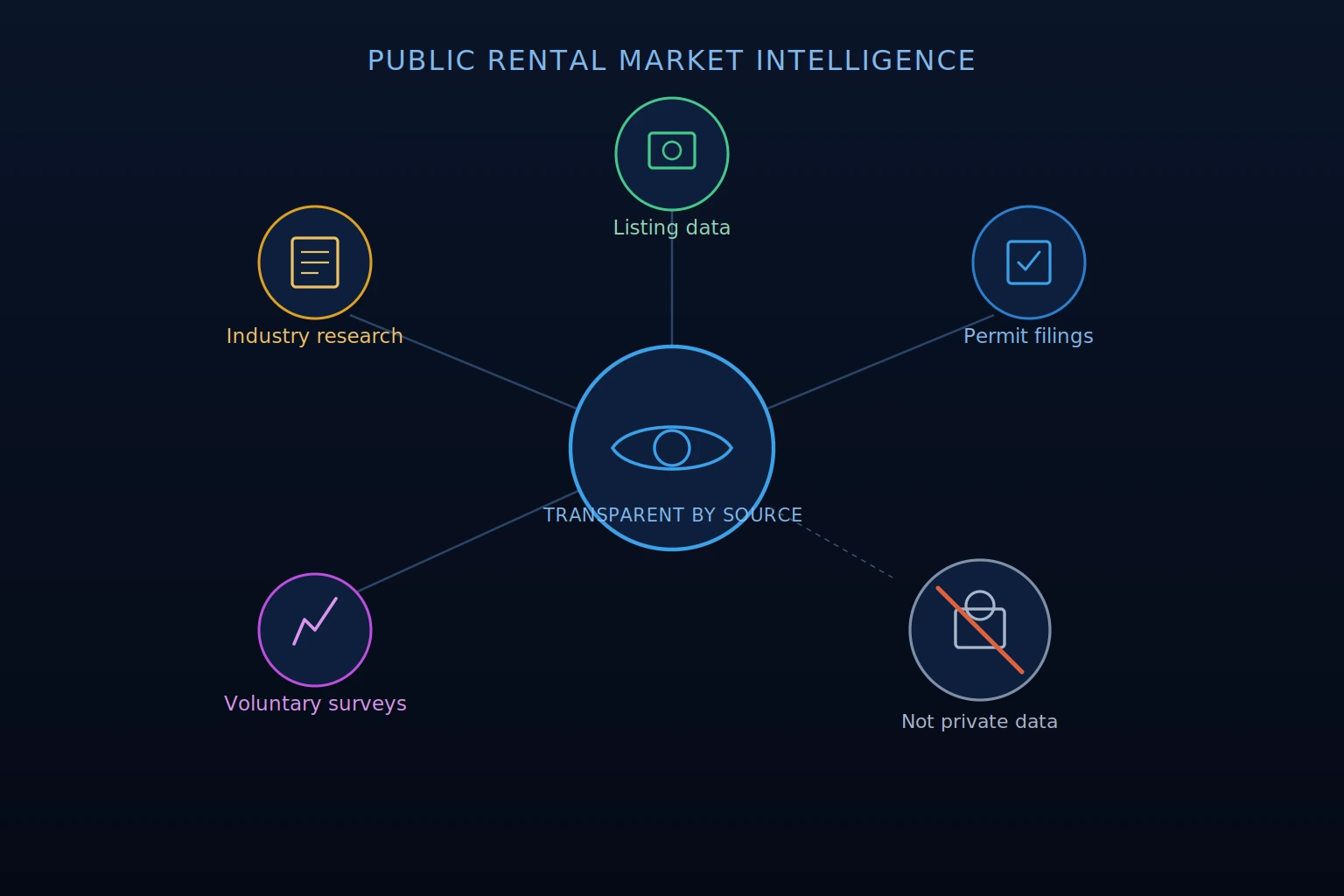
When used appropriately, public market intelligence provides useful external context across several analytical questions.
It can help operators understand where publicly advertised asking rents sit relative to their own asking rents, providing a reference point for evaluating competitive pricing position. It can surface whether publicly advertised concessions have become more prevalent or increased in value within a specific submarket.
Multifamily operators are strategically choosing to maintain occupancy rates rather than aggressively pursuing rent increases on newly signed leases, with the near-term focus on offering significant concessions to new tenants supported by historically strong renewal rates of 57% of all leasing activity, up from 51% in 2015 and 48% in 2005. Knowing the concession environment across the submarket helps operators evaluate whether their own approach is aligned with or diverging from what the market is showing.
It can also show how much new supply is entering a submarket and when. The growing bifurcation between high-supply and supply-constrained metros underscores a key theme: rents are no longer uniformly influenced by national forces, but instead by local development cycles, migration patterns, and affordability pressures shaping metro-level outcomes. For operators in high-supply markets, tracking that development pipeline is essential context for understanding the competitive environment an asset is operating in.
Top Picks:
- 11 Multifamily Housing Trends Shaping the Market
- Multifamily Rent Growth: Public Market Trends
What It Cannot Tell You About Your Own Property
Public market intelligence describes the environment around an asset. It cannot answer the operational questions that determine how that asset actually performs within that environment.
It cannot show how specific layouts are absorbing relative to forward availability. It cannot surface where in the leasing funnel prospects are dropping off. It cannot reveal renewal conversion trends by layout or expiration window. It cannot show achieved lease pricing after concessions, where loss to lease is concentrated, or whether forward exposure is building toward a concentration that may create leasing pressure.
These questions require internal operational data. The gap between what the public market is showing and what internal performance data reveals is often where the most operationally significant signals live. A property where internal leasing velocity is softening while the broader submarket looks stable has a property-specific issue that no public market data will surface or explain.
Why Internal Property Data Still Matters More for Day-to-Day Revenue Decisions
Day-to-day revenue decisions in multifamily are driven primarily by what is happening at the asset. A pricing decision on a specific layout requires visibility into current absorption pace, forward availability for that layout, renewal conversion trends in that segment, and what the occupancy target for the asset requires. None of that comes from public market data. All of it comes from the PMS and the operational platform connected to it.
For example, consider a submarket that experienced flat rent growth from 2024 to 2025 and is now expected to see pricing strengthen in 2026 and 2027, with annual rent growth approaching 2.0%. That broader public market context may be useful for underwriting and asset strategy conversations.
For a pricing decision on a specific two-bedroom layout this week, however, the asset’s own leasing velocity, forward availability, renewal conversion, and exposure are more directly relevant.
Public market context is most useful as calibration. When internal leasing velocity is softening, checking whether publicly advertised concessions have increased in the submarket provides additional context for evaluating whether the change may reflect a property-specific issue or broader submarket conditions.
When a pricing adjustment is under consideration, publicly advertised asking rents provide a reference point for what prospects may see when comparing available options. But neither replaces the internal performance signals the decision needs to be grounded in.
How Revenue Managers Combine Public Context With Internal Performance
The most effective revenue managers treat public market data as one input among several rather than as the starting point for pricing and leasing decisions.
In practice, this means evaluating internal performance signals first: leasing velocity by layout, renewal conversion trends, forward exposure, effective rent relative to occupancy targets, and funnel conversion by stage. When those internal signals raise a question that public market context can help answer, that context is brought in as calibration.
Revenue managers who start with public market data and work backward to internal performance tend to make less precise decisions than those who start with internal signals and use public context to validate or contextualize what they are seeing.
Don’t Miss:
- How to do a Comparative Market Analysis in Real Estate
- How To Do A Rental Market Analysis Like a Pro (With AI Tools)
How Rentana Helps
Rentana is a revenue intelligence platform built around internal operational data. It connects PMS-sourced leasing, occupancy, pricing, renewal, and exposure data into a forward-looking performance view that supports the revenue decisions asset managers and revenue managers make day to day.
Rentana uses property-level performance signals as the primary basis for revenue analysis and pricing recommendations, with publicly available market data providing additional external context where relevant. Rentana does not provide proprietary competitor data or non-public pricing information. Public market context can help inform the evaluation of a recommendation, while pricing direction remains grounded in the property’s own performance.
Specifically, Rentana supports:
- Pricing recommendations generated through purpose-built pricing algorithms by layout or custom unit group, using property-level performance signals, forward availability, and configured asset strategy, with publicly available market data providing additional context where relevant
- Predicted occupancy connecting current leasing activity, renewal trends, and future availability into a forward view of where occupancy is heading at each asset
- Exposure analysis showing scheduled lease expirations and known upcoming availability, with additional anticipated availability such as month-to-month behavior and early terminations incorporated based on historical performance
- Renewal batch management and configurable renewal recommendations based on company-defined settings designed to align offers with the property’s asset strategy
- Property Performance Insights surface what is changing within a property’s own leasing, occupancy, renewal, pricing, and exposure data and why it may matter
- Portfolio dashboards providing a shared, portfolio-wide view of performance conditions across all assets simultaneously
- Comp Insights connect publicly available competitor pricing and availability with the property’s own performance signals to highlight where pricing relationships, demand, or forward occupancy may warrant closer review. Comp Insights provide context only and do not impact Rentana’s pricing recommendations
Conclusion on Public Rental Market Intelligence
Rental market intelligence based on publicly available data provides useful external context for multifamily revenue decisions It helps operators understand the competitive environment their assets are operating in and calibrate internal performance signals against broader submarket conditions.
What it cannot do is replace the internal operational analysis that drives day-to-day revenue management. Leasing velocity, renewal conversion, forward exposure, effective rent, and funnel performance are all internal signals that require internal data to surface and operational judgment to act on.
The most effective revenue management approach connects both: internal performance data as the primary driver of decisions, and public market context as calibration when external conditions are relevant to what the internal data is showing.