AI has moved from a topic of intrigue in multifamily to a practical operational reality. Leasing teams are using it to respond to prospects faster. Maintenance teams are using it to route work orders more efficiently. Revenue managers are using it to surface performance signals that would take significantly longer to identify manually.
The impact is real and uneven. Some applications are delivering measurable operational improvements. Others are adding complexity without proportional value. Understanding where AI is changing multifamily operations, and where it is not yet delivering on what it promises, is what separates operators making effective use of these tools from those managing the consequences of deploying them without enough clarity about what they can and cannot do.
Related:
Impact of AI in Multifamily: Top 5 Use Cases
According to Multi-Housing News, AI in multifamily is starting to look less like a set of handy tools and more like something operators must manage like core infrastructure, governed, integrated, and measured, with the real competitive advantage coming not from producing more content faster but from ensuring that every AI-assisted interaction across every community is accurate, compliant, and consistent with what prospects actually experience on the ground.
AI in multifamily is not one capability. It is a set of distinct applications that each address a specific operational problem, and the impact varies significantly depending on which problem is being addressed and how well the tool is matched to it.
The clearest operational changes are happening in four areas: leasing, maintenance, revenue management, and performance analysis. Each has a different adoption profile, a different risk surface, and a different relationship between what AI handles and what human judgment still owns.
1. AI in Leasing
AI has had its most visible and most broadly adopted impact in leasing, primarily through inquiry response automation and follow-up consistency.
Prospects expect fast responses. A property that replies within minutes has a materially better conversion rate than one that replies the following business day. AI leasing tools close that gap by handling initial inquiry response, prospect qualification, tour scheduling, and follow-up sequences automatically, regardless of time of day or inquiry volume.
The operational impact is measurable: faster response times, more consistent follow-up, and leasing team time redirected from top-of-funnel volume work toward the closing conversations that require human judgment.
The limitation is that AI leasing tools handle the funnel efficiently but do not surface whether the funnel itself is performing. Knowing that responses are going out faster is different from knowing whether those responses are converting and at what stage prospects are dropping off.
According to Multifamily Dive , AI applications in leasing and marketing have moved from experimental tools to operational infrastructure across the industry, with operators deploying AI across inquiry response, lead qualification, tour scheduling, and follow-up sequences at a scale that manual processes could not sustain. The shift reflects how AI in leasing has become less about individual tool adoption and more about workflow integration that keeps the leasing pipeline moving consistently regardless of inquiry volume or time of day.
2. AI in Maintenance and Operational Workflows
AI in maintenance and operational workflows is delivering value primarily through work order routing, vendor coordination, and predictive maintenance.
Intelligent work order routing assigns maintenance requests based on skill, availability, and priority rather than manual dispatch, reducing response time and improving first-visit resolution rates. Predictive maintenance tools use equipment sensor data and historical patterns to flag failure risk before it produces a resident impact or an emergency repair cost.
3. AI in Revenue Management
AI in revenue management connects leasing performance, forward availability, renewal behavior, and pricing signals into a view that supports faster and better-informed pricing and renewal decisions.
The most operationally impactful applications:
- Generating pricing recommendations through purpose-built pricing algorithms using property-level performance signals, forward availability, and configured asset strategy, with reasoning attached so revenue managers can evaluate the inputs before deciding whether to act
- Surfacing renewal conversion trends by layout and expiration window before they materially affect occupancy numbers, giving teams earlier context for outreach and offer timing
- Connecting forward exposure, leasing velocity, and occupancy targets into a combined view that shows where performance appears to be heading rather than only where it currently stands
- Flagging where multiple performance conditions are shifting simultaneously at the same asset, so the combination is visible as a signal rather than as separate data points requiring manual connection
AI in revenue management supports decisions. It does not make them. The strategy and the accountability for every pricing and renewal outcome remain with the revenue management team.
Related:
- Multifamily AI Leasing Assistants: Use Cases & Benefits
- AI for Multifamily Rental Operational Efficiency
4. AI in Reporting and Performance Analysis
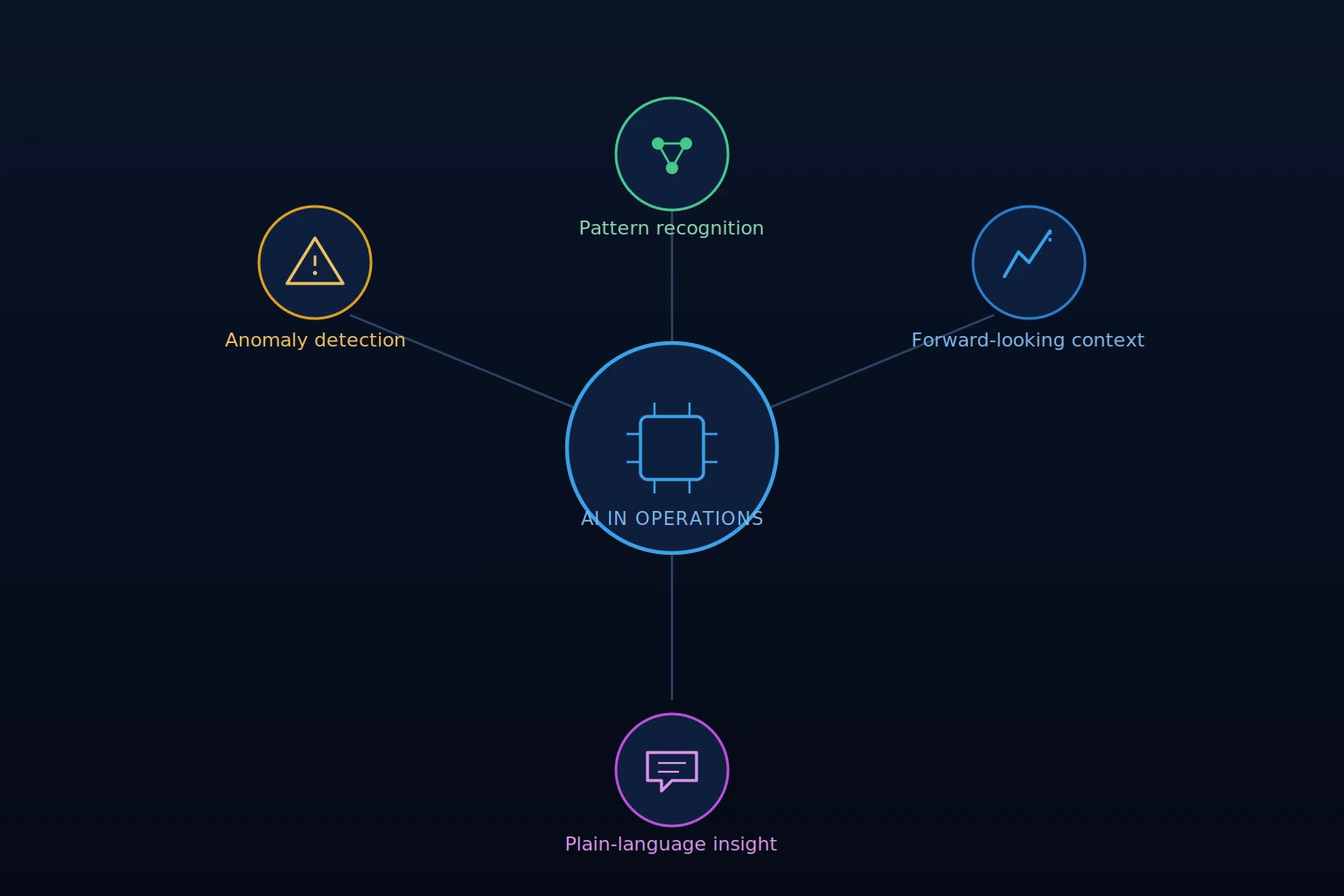
AI in reporting and performance analysis changes what teams spend their analytical time on. Instead of assembling data from multiple systems before any analysis can begin, AI-supported platforms surface what is changing, at what level of the portfolio, and why it may matter, before the team opens the report.
The practical impact: pattern recognition across large datasets that would take significant manual time to surface, anomaly detection at the layout level where property averages would miss the signal, and portfolio-level prioritization that shows where multiple conditions are shifting simultaneously rather than requiring sequential asset-by-asset review.
The limitation is data quality. AI in performance analysis is only as reliable as the operational data feeding it. Inconsistent unit tagging, stale availability statuses, and incomplete lease records all produce unreliable AI outputs regardless of how sophisticated the platform is.
5. AI for Forward-Looking Visibility
One of the highest-value capabilities in modern multifamily revenue management is forward-looking visibility. Connecting current leasing activity, renewal trends, scheduled expirations, and upcoming availability helps teams understand where performance may be heading rather than only where it has been. AI-generated Insights can complement that visibility by surfacing and explaining important changes in the underlying performance signals.
This matters because the decisions that protect NOI need to be made before occupancy moves, not after. A renewal conversion decline identified six weeks before expiration is a strategy conversation. The same decline identified in a monthly report is already partially a reactive situation. A leasing velocity gap visible against forward availability 60 days out has more available responses than the same gap identified at 15 days.
Forward-looking revenue management tools provide visibility into occupancy conditions, exposure concentration, and renewal activity shifts the starting point for operational decisions from what happened to what is changing and where it is heading.
Where Human Judgment Still Matters
AI surfaces patterns, connects signals, and helps teams interpret performance changes. Human judgment owns everything that happens next.
In multifamily operations, human judgment remains essential for:
- Evaluating whether a recommendation or AI-generated insight fits the specific asset context, including conditions the platform may not fully capture
- Deciding how aggressively to act on a signal given the asset strategy, and team capacity
- Managing the resident relationships that renewal conversations, maintenance escalations, and leasing decisions involve
- Taking responsibility for outcomes that AI tools informed but did not determine
- Recognizing when an AI output looks wrong and investigating before acting on it
The operational risk in AI adoption is not that the tools are too powerful. It is that teams may over-rely on AI outputs without applying the judgment that distinguishes a useful signal from a misleading one.
Top Picks:
Risks and Limitations
Hallucinations. General-purpose AI tools, including large language models, can produce confident, plausible-sounding outputs that are factually incorrect. In multifamily operations, this risk is reduced when AI is used to generate written communications, summarize reports, or answer factual questions. Every AI-generated output that will be acted on or distributed externally requires human review and verification.
Poor data quality. AI in operational platforms is only as reliable as the data feeding it. Inconsistent unit tagging, stale PMS data, incomplete lease records, and fragmented systems all produce AI outputs that reflect the data quality problems rather than actual performance conditions. Auditing data quality at the source is a prerequisite for reliable AI-supported analysis, not an optional follow-up step.
Over-automation. Automating decisions that require human judgment is the most consequential risk in AI adoption for multifamily operations. Pricing changes, renewal offers, and concession decisions all have downstream consequences that compound over time. AI should inform these decisions, not execute them automatically without human review and approval.
Fair housing and compliance considerations. AI tools used in leasing, pricing, or renewal workflows carry fair housing implications that require deliberate evaluation before deployment. Any AI application that influences decisions about prospects or residents should be reviewed against fair housing requirements to ensure that its outputs do not produce discriminatory patterns, even inadvertently. This review belongs before deployment, not after a compliance issue has already occurred.
According to the National Multifamily Housing Council's AI Fact Sheet, housing operators using AI platforms acknowledge the need for continual internal review and oversight of AI models, processes, and outcomes to ensure that both business operations and resident impact are understood and negative outcomes are prevented. NMHC and NAA members have engaged in industry-driven standard setting, underscoring that responsible AI deployment is an operational discipline, not a one-time compliance check.
How Rentana Uses AI to Support Revenue Decisions
Rentana combines purpose-built revenue management capabilities with AI-generated Insights to support revenue and operational decision-making, while keeping operators in control of the actions that follow.
- AI-generated Insights surface what is changing at specific assets, explain why it may matter given current operational conditions, and connect to a supported next step, so the analytical work of identifying where to focus is done before the team opens the platform
- Predicted Occupancy connects current leasing activity, renewal trends, and future availability to provide forward visibility into where occupancy is heading, giving teams earlier context for pricing and leasing decisions
- Pricing recommendations are generated at the bedroom or custom unit group level using leasing performance, forward availability, occupancy targets, and asset strategy configuration, with the full reasoning attached so revenue managers can evaluate the inputs before deciding whether to act
- Exposure analysis shows scheduled lease expirations and known upcoming availability, with additional anticipated availability such as month-to-month behavior and early terminations incorporated based on historical performance.
- Renewal recommendations are based on company-configured settings designed to align offers with the property’s asset strategy, with current pricing, exposure, and performance providing additional context for evaluation.
- Ask Rentana allows users to ask conversational questions about their own property and portfolio performance data, navigate the platform, and explore operational conditions without requiring manual report assembly first
- Portfolio dashboards provide visibility into performance across assets, while AI-generated Insights can help surface where multiple conditions are shifting and where attention may be needed
Don’t Miss:
- How to Choose a Conversational AI Assistant for Multifamily
- AI Adoption in Multifamily: Top Trends for Operators
Conclusion on Impact of AI in Multifamily
AI is changing multifamily operations in ways that are already measurable across leasing efficiency, maintenance cost control, revenue analysis, and forward-looking performance visibility. The impact is most significant where AI is matched to the right operational problem, supported by clean and current data, and deployed with clear human oversight of the decisions that follow from what it surfaces.
The risks are real and worth managing deliberately: data quality, over-automation, hallucination in general-purpose tools, and fair housing compliance in leasing and pricing workflows. Operators who build AI into their operations with those risks in view are the ones getting the most value from it without creating the problems that come from deploying it without enough care.