Identifying potentially underpriced units starts with understanding how current pricing relates to a property’s leasing performance, available inventory, and asset strategy. Fast leasing may warrant a pricing review, but it does not establish that rents are too low. Seasonality, concessions, limited availability, and differences between units can all influence how quickly a lease is signed.
The National Apartment Association’s analysis of 2024 operating results found that repairs and maintenance costs had risen nearly 28% since 2021, while NOI increased approximately 10% over the same period. That pressure makes disciplined pricing evaluation more important, but higher operating costs alone do not establish that a unit is underpriced. Any adjustment still needs to be evaluated against the property’s leasing performance, availability, and asset strategy.
The useful question is whether current pricing continues to support the property’s occupancy and revenue goals. A layout with sustained leasing demand and limited upcoming availability may warrant a different approach from one facing a concentrated expiration window, even when both are leasing well today.
This article explains how to investigate potential pricing opportunities using internal property data, distinguish in-place rent gaps from new lease pricing questions, and evaluate layout pricing and amenity premiums alongside leasing conditions. The goal is a consistent, evidence-based review that helps teams decide whether an adjustment is warranted.
Related:
- Real-Time Public Market Data Insights for Multifamily Pricing
- The Best Multifamily Pricing Tool for Investors
What Indicates a Potential Pricing Opportunity in a Rental Property
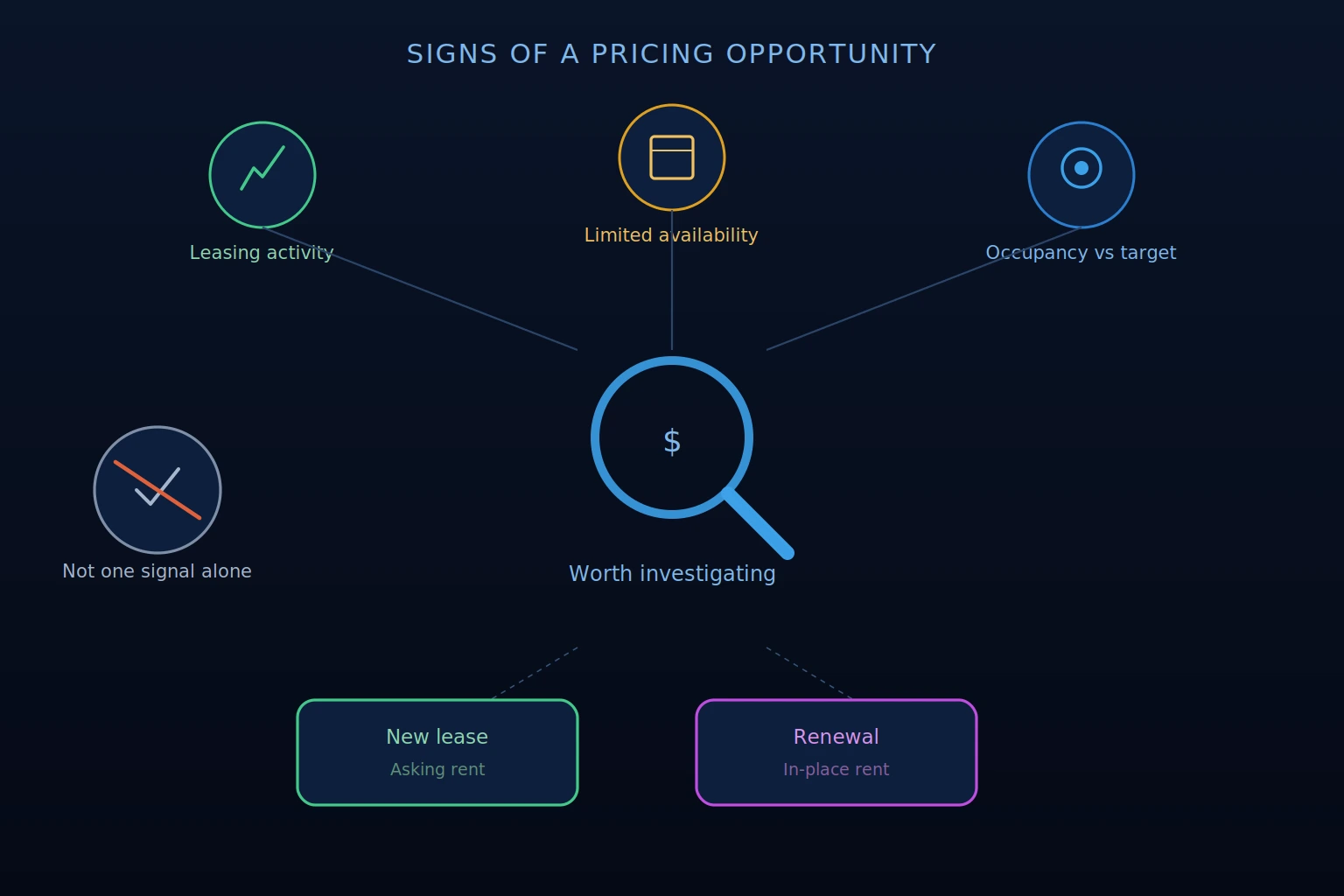
A potential pricing opportunity exists when a pattern in the property’s performance suggests current asking rents or unit premiums warrant review. Sustained leasing activity, limited upcoming availability, and occupancy performance against targets can help teams identify where to investigate.
No single measure establishes that a unit is underpriced. Short days on market may reflect strong demand, an effective concession, or a small number of available units. Differences between layouts may reflect unit condition, lease terms, or prospect preferences. Review enough comparable leasing activity to distinguish a persistent pattern from an isolated result.
It also matters which pricing question the team is trying to answer. Reviewing asking rents for available units is different from evaluating in-place rents as leases approach renewal. A gap between an existing lease rate and the property’s current pricing does not establish that asking rents should increase.
CBRE’s 2026 Multifamily Outlook highlights this distinction, noting that blended rent growth incorporating renewals can differ from asking rent growth on new leases. For property teams, that reinforces the importance of reviewing new lease pricing and renewal outcomes separately before drawing conclusions about potential pricing opportunities.
The goal is to identify where pricing deserves closer analysis, understand the factors behind the signal, and evaluate whether a change would support the property’s occupancy and revenue strategy.
How to Identify Pricing Opportunities in a Rental Portfolio
1. Compare Pricing With the Property’s Own Leasing Performance
Start by reviewing current asking rents alongside recent signed lease terms, concessions, and leasing activity for each layout. This helps teams understand both the pricing being offered and the economics prospects are accepting.
Look for sustained patterns across comparable units. A layout that consistently leases quickly with limited concessions may warrant closer review, particularly when occupancy is meeting targets and upcoming availability is limited. That pattern is a reason to investigate whether current pricing still fits the asset’s strategy.
Make comparisons over consistent periods and account for lease length, unit condition, available inventory, and seasonality. A handful of quick leases during peak season provides less evidence than a recurring pattern across a larger set of leasing activity.
Identify the layouts that warrant further analysis, then review base rents, amenity premiums, and forward availability before deciding whether an adjustment is appropriate.
2. Distinguish Loss to Lease From New Lease Pricing Opportunities
Loss to lease measures the difference between the property’s current market rent and the in-place rent charged on occupied units. It helps teams understand how existing leases compare with the property’s current pricing, but it does not establish that asking rents for available units are too low.
For example, an occupied unit renting for $1,800 per month against a current market rent of $1,900 has a monthly loss to lease of $100. That gap may reflect when the lease was signed or subsequent changes in the property’s pricing. It does not, by itself, support increasing the asking rent above $1,900.
Review loss to lease by layout alongside expiration timing, renewal offers, retention outcomes, and lease trade-out. Use comparable units and consistent rent definitions so differences in amenities, renovation status, or concession treatment do not distort the analysis.
This separates two decisions: how to evaluate existing rents as leases approach renewal, and whether current asking rents warrant review based on leasing performance and forward availability. Each requires its own supporting evidence and consideration of asset strategy.
GlobeSt’s coverage of rising operating costs highlights the pressure on multifamily performance. For teams reviewing loss to lease, the practical question is how potential rent changes fit with retention, turnover costs, and occupancy goals. A larger gap warrants investigation, rather than an assumption that closing it will improve overall revenue.
3. Evaluate Base Rent by Layout
Base rent establishes the starting price for a layout before unit-specific amenity premiums or other adjustments. Reviewing it by layout helps teams evaluate whether differences in size, bedroom count, floor plan, and functionality are reflected appropriately in the property’s pricing structure.
Compare base rents alongside leasing velocity, days on market, concessions, and available inventory over consistent periods. Account for unit-specific premiums so differences in views, floor location, or renovation status do not get mistaken for differences in layout demand.
A layout that repeatedly leases faster than others may warrant review, but the comparison needs context. Limited inventory, favorable lease terms, or a concession may explain the pattern. Likewise, slower leasing does not establish that base rent is too high without examining unit readiness, prospect interest, and conversion.
Use the analysis to identify where the relationship between layout prices deserves closer attention. Evaluate any proposed adjustment against upcoming availability, occupancy targets, and asset strategy rather than assuming every layout should lease at the same pace.
Read Also:
- Apartment Rent Pricing Strategy: 7 Factors to Evaluate
- Unit-Level Pricing Strategy in Multifamily
4. Review Amenity Premiums Against Leasing Performance
Amenity premiums account for unit-specific features such as views, floor location, outdoor space, or renovated finishes. These premiums should be reviewed periodically to understand how units with each feature are performing at their current total asking rent.
Compare units with and without the feature while accounting for layout, condition, lease terms, concessions, and the period in which they were available. Review days on market, days vacant, and signed lease economics across enough observations to avoid drawing conclusions from a few unusually fast or slow leases.
Units carrying a premium and leasing at a similar pace to comparable units without it may indicate that the premium is supported. Faster leasing may warrant further investigation, but it does not establish that the premium should increase. Slower leasing may prompt a review of the premium alongside other factors affecting conversion.
Consider how features overlap. A renovated unit with a balcony and a preferred view carries several differences that can influence leasing behavior, making it difficult to attribute performance to one amenity alone. Use the analysis to identify premiums that deserve closer review, then evaluate any change against overall unit pricing and the property’s leasing goals.
5. Evaluate Pricing Alongside Occupancy and Forward Exposure
A potential pricing adjustment needs to fit both current leasing conditions and the inventory the property expects to lease. Strong leasing activity today may support a different decision when upcoming availability is limited than when a concentrated expiration window is approaching.
Review leasing velocity by layout alongside occupancy targets, signed leases awaiting move-in, and known upcoming availability. Evaluate scheduled expirations separately from confirmed departures, with additional anticipated availability such as month-to-month behavior and early terminations informed by historical performance.
A layout meeting its occupancy target with sustained leasing activity and limited upcoming availability may warrant consideration of a measured pricing increase. The same leasing pace may be insufficient for a layout facing more availability, making occupancy stability a higher priority. Neither situation determines the response on its own.
Before acting, consider how a change could affect leasing pace, vacancy duration, concessions, and revenue over the relevant planning period. The appropriate decision is the one supported by the property’s performance and asset strategy, with results reviewed after any adjustment.
6. Assess Whether Pricing Needs to Change in Either Direction
A pricing review may support an increase, a decrease, or maintaining current rents. The purpose is to evaluate whether pricing supports the leasing pace and revenue goals the property needs to achieve.
When a layout leases slowly, investigate prospect demand, funnel conversion, unit readiness, concessions, and lease terms before attributing the result to price. If those factors do not explain the pattern and available inventory continues to build, a pricing adjustment may warrant consideration.
When a layout leases quickly, review how much inventory was available, which concessions were offered, and whether the pattern persists across multiple leases. Strong leasing may indicate that current pricing is working as intended, particularly when the property is building occupancy or preparing for upcoming availability.
For any adjustment, document the reasoning and establish when results will be reviewed. Evaluate subsequent leasing activity, signed lease economics, and occupancy progress together, accounting for other changes during the period. This helps teams assess whether to maintain, revise, or reverse the adjustment.
7. Use Consistent, Documented Pricing Criteria
A repeatable pricing review helps teams distinguish meaningful patterns from short-term fluctuations. Establish which signals warrant investigation, what supporting information is needed, and how recommendations will be evaluated against the property’s asset strategy.
Use consistent definitions for leasing velocity, days on market, effective rent, and loss to lease. Define comparison periods and consider the number of leases behind each result. Two quick leases during peak season provide a different basis for review than sustained leasing activity across several months.
Document the factors supporting a decision, including current pricing, concessions, available inventory, upcoming exposure, and occupancy goals. For amenity reviews, record how comparable units were selected and which differences may affect the comparison.
Apply the same review process consistently while allowing decisions to reflect each layout’s conditions. Clear criteria help teams explain why pricing changed or stayed the same, and evaluate the outcome at the next review.
You Might Like:
- What is a Good IRR For a Rental Property?
- How To Do A Rental Market Analysis Like a Pro (With AI Tools)
How Rentana Supports Pricing Opportunity Analysis
Rentana connects PMS-sourced operational data with pricing recommendations, performance reporting, and AI-assisted analysis to help teams identify where pricing warrants closer review.
Purpose-built pricing recommendations by layout draw on property-level performance signals, forward availability, and configured asset strategy. Supporting inputs and reasoning help teams understand each recommendation and evaluate whether an adjustment fits the property’s goals.
Dashboards, charts, and reports bring leasing activity, availability, occupancy, concessions, and revenue performance into a shared view. Configurable timeframes and layout filters help teams investigate whether a pricing signal reflects a sustained pattern or a short-term change.
Exposure analysis and Predicted Occupancy provide forward-looking context for pricing reviews. Teams can evaluate scheduled expirations against configured targets, known upcoming availability, and additional anticipated availability informed by historical performance.
AI-generated Insights highlight operational changes and explain why they may warrant attention, giving teams a starting point for further investigation.
Ask Rentana, the AI analyst, helps teams explore questions about absorption, concessions, conversion, and property performance. Explained reasoning, interactive charts and tables, and downloadable analysis support deeper review and clearer communication with colleagues and ownership.
Together, these capabilities help teams evaluate pricing opportunities with the supporting information in view. Teams retain responsibility for deciding whether to adjust pricing and how to assess the results.
Conclusion on How to Identify Underpriced Units in a Rental Portfolio
Identifying potentially underpriced units requires more than spotting fast leases or a gap between current and in-place rents. It means reviewing layout pricing, amenity premiums, concessions, and leasing performance together, then evaluating those findings against upcoming availability and asset strategy.
Consistent comparisons and documented criteria help teams distinguish a pricing opportunity from a temporary pattern or an operational issue. The review may support an increase, a decrease, or keeping rents unchanged. What matters is that the decision is supported by the property’s own performance and followed by a review of leasing, occupancy, and revenue outcomes.