Every resident who moves out takes more with them than their belongings. They create a vacancy period, a make-ready process, marketing effort, leasing follow-up, and a replacement lease that must be signed under whatever market conditions exist when the unit returns to market.
According to GlobeSt, the multifamily market's revenue resilience in 2025 and 2026 has been built from within existing portfolios rather than through new rent surges, with operators increasingly relying on renewal strength to offset concession pressure and slower new lease absorption. High retention rates translate directly to steadier expense management, since turnover costs from marketing and unit preparation fall when residents stay longer.
According to a survey by the National Apartment Association, a single non-renewal can cost multifamily companies approximately $4,000 once turnover costs, marketing expenses, and lost rent during vacancy are considered. At scale, that makes renewal strategy a direct NOI issue rather than a routine administrative workflow.
But reducing turnover costs does not mean pushing every resident to renew at any price, sending renewal offers as early as possible, or applying concessions broadly. A strong renewal strategy evaluates the full economics of the decision: in-place rent, public market rent, likely replacement rent, vacancy loss, turn costs, concession activity, forward exposure, and seasonal demand.
That is the difference between a renewal process and a renewal strategy.
This article covers seven lease renewal strategies that help multifamily operators reduce turnover costs, protect revenue, and make renewal decisions with better operational context.
Related:
- Lease-Up Strategy: How To Build Occupancy Without Creating Future Exposure
- The Best Lease Management Software for Multifamily Real Estate
Why Turnover Costs More Than Most Operators Account For
The $4,000 non-renewal benchmark from the National Apartment Association is a useful starting point, but the true cost of turnover depends on the asset, unit condition, leasing environment, and how long the home sits vacant.
Some costs are direct and easy to identify: cleaning, painting, repairs, maintenance labor, vendor work, marketing, and leasing effort. Others are less visible but often more consequential, including vacancy loss, concession use, delayed rent collection, and the risk that the replacement lease signs at a lower effective rent than the resident who moved out.
That is why turnover should not be evaluated as a simple move-out event. It is a replacement economics problem.
A resident paying below current public market rent may still be worth retaining if the likely replacement lease would require weeks of vacancy, a make-ready expense, a publicly advertised concession, and additional leasing effort. Conversely, a resident paying materially below market may represent an opportunity to improve revenue if demand is strong, exposure is limited, and the replacement economics support the risk.
The compounding effect is what makes renewal strategy so important at portfolio scale. A 200-unit property running 30% annual turnover is processing 60 move-outs per year. At $4,000 per non-renewal, that represents approximately $240,000 in annual turnover cost before considering any additional revenue impact from concessions, vacancy duration, or replacement rent differences.
Reducing unnecessary turnover even modestly can have a meaningful NOI impact. The goal is not retention at any cost. The goal is to understand when preserving the resident is financially stronger than replacing the lease, and when the asset is positioned to absorb the turnover risk.
Top Picks:
- How to Improve Multifamily Operations Team Efficiency
- How to Monitor and Improve Leasing Activity
7 Lease Renewal Strategies That Reduce Turnover Costs
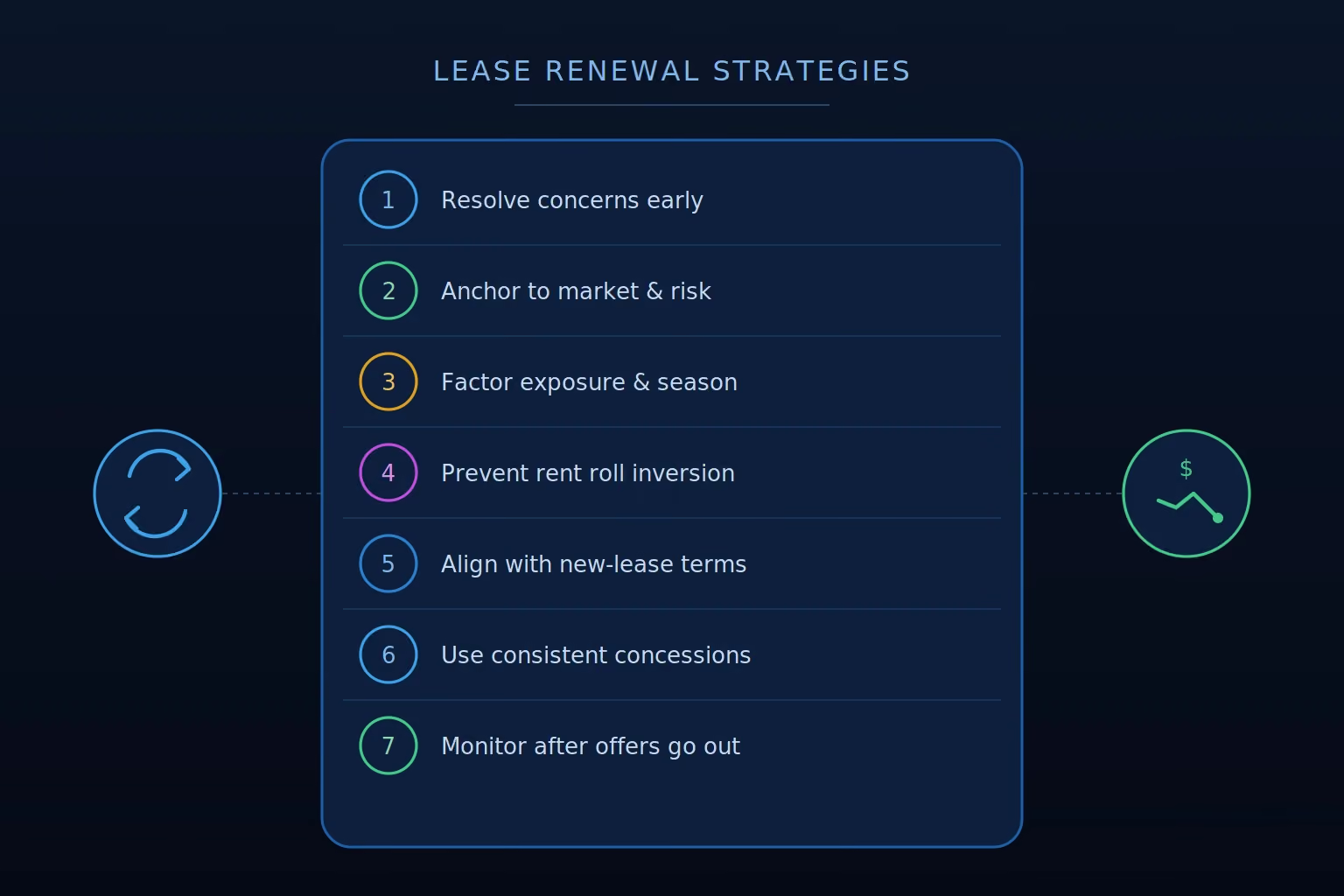
- Resolve Resident Concerns Before the Renewal Offer Window
- Anchor Renewal Pricing to Rent and Replacement Risk
- Connect Renewal Pricing to Forward Exposure and Seasonal Demand
- Prevent Rent Roll Inversion
- Align Renewal Strategy with New Lease Concession Conditions
- Use Strategic Renewal Concessions with a Consistent, Compliant Framework
- Monitor Renewal Performance After Offers Are Generated
1. Resolve Resident Concerns Before the Renewal Offer Window
The renewal process begins before the offer is sent.
By the time a resident receives a renewal offer, they’ve often already decided how they feel about staying, and that decision is rarely based on rent alone. Maintenance issues, communication delays, unresolved service concerns, amenity reliability, and overall day-to-day experience all influence how the offer is received.
The goal isn’t necessarily to send offers earlier. In some cases, doing so can backfire, especially when current market rents are temporarily lower than where pricing is expected to be closer to lease expiration. Residents who start shopping too early may see short-term concessions and assume moving is the better deal, even if conditions are likely to shift.
The more effective approach is to start service recovery earlier.
Before the renewal window, teams should identify and address any issues that could drive non-renewal, such as open maintenance requests, communication gaps, unresolved complaints, or inconsistent service experiences.
Resolving these issues in advance improves the context of the renewal conversation. Residents who feel heard and supported are more likely to evaluate the offer on its merits rather than through lingering frustration.
2. Anchor Renewal Pricing to Rent and Replacement Risk
Renewal pricing should be connected to current pricing conditions, but the strongest renewal decisions consider more than the current rent comparison alone.
The key question is not only: Where should this renewal offer be positioned relative to current rent?
It is also: What is the likely financial outcome if this resident does not renew and the unit must be replaced?
A replacement scenario includes more than the new lease rent. It includes potential vacancy loss, make-ready costs, marketing and leasing effort, expected days vacant, concession activity, seasonal demand at the time the unit returns to market, and the overall exposure position for that unit type.
A renewal offer that appears aggressive relative to current conditions may still be the stronger financial decision if replacing the resident would require a lower effective rent, additional concessions, and turnover costs. Conversely, a resident whose rent is significantly below market may represent an opportunity to improve revenue when demand, exposure, and replacement economics support that decision.
Renewal strategy also requires evaluating whether the assumptions behind the original offer remain accurate after the offer is generated. In many markets, renewal offers are created well before the resident makes a final decision, and market conditions may change during that window.
If conditions soften after offers are generated, teams should evaluate whether the original offer remains aligned with current replacement risk and retention objectives. If conditions strengthen, teams may identify opportunities to maintain stronger renewal economics without unnecessary concession use.
If conditions improve but the original offer cannot be increased, that information can still inform future renewal strategy and offer positioning.
Rentana supports this ongoing evaluation by connecting renewal recommendations with public market context, renewal conversion trends, exposure, and future availability. This allows teams to evaluate not only how offers are generated, but whether the renewal strategy is producing the intended occupancy and revenue outcomes over time.
Effective renewal pricing is not about maximizing every individual increase. It is about balancing market position, replacement economics, and asset strategy to make the strongest financial decision for the property.
3. Connect Renewal Pricing to Forward Exposure and Seasonal Demand
Not all renewals carry the same operational impact.
As Multi-Housing News notes, one of the most effective ways to mitigate seasonal turnover pressure is to distribute lease expirations more evenly throughout the year, with revenue management platforms now standard tools for tracking and strategically timing those expirations.
A renewal in a low-exposure layout during peak leasing season should be evaluated differently than one in a high-exposure layout heading into a slower period. While the resident and unit may look similar, the operational consequences of a move-out can differ significantly.
This is why forward exposure and seasonality should be part of renewal strategy.
If multiple leases in the same layout are already set to expire in a future window, each additional non-renewal increases pressure on a concentrated pool of availability. That risk is amplified if it coincides with a slower leasing season, when absorption is more difficult.
Conversely, if exposure is limited and demand is strong, the property may be better positioned to absorb a move-out without aggressive retention pricing.
Linking renewal pricing to forward exposure and seasonal demand ensures decisions reflect portfolio-level impact, not just individual lease outcomes.
Recommended:
- The Best Multifamily Pricing Tool for Investors
- Apartment Rent Pricing Strategy: 7 Factors to Evaluate
4. Prevent Rent Roll Inversion
Rent roll inversion happens when the effective rent available to a new resident is lower than what an existing resident is being asked to pay at renewal.
This can happen when new lease concessions, specials, or market rent adjustments create a gap between renewal pricing and the current new lease environment. A resident who sees that they could move to a comparable apartment at a lower effective rent has a clear financial reason to question the renewal offer.
Preventing rent roll inversion requires visibility into both renewal pricing and new lease pricing. Teams need to compare the renewal offer against the effective rent a new resident would likely receive after concessions, not just against the face rent on the rent roll.
This does not mean renewal pricing should always match new lease pricing. Renewals and new leases are different decisions, and renewal pricing also needs to account for turnover costs, vacancy loss, forward exposure, and resident retention goals. But when public new lease concessions make the renewal offer appear materially out of step with the current leasing environment, teams should understand that gap before the offer is sent.
The goal is to avoid creating a situation where the resident has to leave the property to access economics that are already being offered to the market.
5. Align Renewal Strategy with New Lease Concession Conditions
Renewal strategy should account for the concession environment the property is already operating in.
If a unit would likely need to be offered with a concession after a resident moves out, the renewal decision should compare that replacement scenario against the cost of preserving the in-place lease. In many cases, offering a comparable or smaller renewal concession may be more financially effective than absorbing vacancy loss, turn costs, marketing effort, leasing follow-up, and a concessioned replacement lease.
This is especially true when the resident’s in-place rent is close to, equal to, or above the effective rent the property expects to achieve on a new lease after concessions. If the property would need to offer a concession to attract a new resident anyway, the question becomes simple: why not evaluate whether a structured renewal concession could preserve the existing resident and avoid the cost of turning the unit?
That does not mean every renewal should receive a concession. Renewal concessions should be considered only within an approved strategy and applied consistently based on defined criteria such as current price conditions, publicly advertised concession activity, forward exposure, seasonal demand, effective new lease pricing, and turnover cost.
When used strategically, renewal concessions can help maintain occupancy while reducing the amount of new lease concession pressure the property may need to absorb later. Preserving the resident can protect the rent roll, avoid vacancy drag, and give the property more flexibility to peel back new lease concessions sooner as availability pressure improves.
The goal is not to discount renewals by default. The goal is to evaluate renewal economics against the true cost of replacement.
6. Use Strategic Renewal Concessions Within a Consistent, Compliant Framework
Renewal concessions can be useful, but they should never be informal, inconsistent, or discretionary.
A strategic renewal concession should be tied to a defined business rationale and applied through a consistent framework. That framework should consider approved asset strategy, current price conditions, forward exposure, effective new lease pricing, renewal conversion trends, and the documented cost of turnover.
This protects the property from both financial leakage and inconsistent application.
The goal is not to offer concessions broadly or negotiate case by case without structure. The goal is to define when a renewal concession may be economically justified and ensure that the same criteria are applied consistently.
For example, a property may decide that renewal concessions will only be considered when a specific layout has elevated forward exposure, new lease concessions are publicly advertised, or replacement economics indicate that preserving the resident is financially stronger than re-leasing the unit.
When used this way, renewal concessions are not a default retention tactic. They are a controlled strategy for managing revenue, occupancy risk, and turnover costs within a compliant operating process.
Related:
- Rent Concession Meaning: Top 7 Examples
- Apartment Concession Strategy: When and How to Use
7. Monitor Renewal Performance After Offers are Generated
Renewal strategy does not end when offers are sent.
In many markets, renewal offers must be generated well in advance of the resident’s actual expiration date. The market conditions, competitive environment, and availability position at the time an offer is created may not be the same conditions the property is managing when the resident makes their final renewal decision.
That makes ongoing renewal visibility critical.
Teams should evaluate how renewal offers are performing after they are generated, including:
- Renewal conversion trends by property and unit type
- Where acceptance rates are stronger or weaker than expected
- Whether public market conditions have changed since offers were created
- Whether future renewal strategies need to be adjusted based on observed outcomes
For example, if market conditions soften after renewal offers are generated and residents are seeing more competitive alternatives, teams may need to evaluate whether the original offer strategy is still appropriate. Conversely, if market conditions strengthen, strong renewal conversion may indicate that the property has retained pricing power and does not need to rely on additional concessions.
The goal is not to continuously change offers or react to every market movement. It is to understand whether the renewal strategy is producing the intended outcome and identify where future decisions may need to adjust.
Rentana supports this ongoing review by providing visibility into renewal conversion trends, renewal pipeline performance, and how renewal outcomes are affecting future availability and exposure. By connecting renewal performance with leasing conditions, pricing context, and forward availability, teams can evaluate whether their renewal strategy is supporting occupancy and revenue objectives over time.
Multi-Housing News reports that the most effective operators are treating resident retention not as a renewal event but as an ongoing NOI discipline, connecting retention activity to forward availability, market conditions, and revenue performance throughout the lease cycle.
A strong renewal strategy is not a single offer generated at a point in time. It is an ongoing process of evaluating market conditions, resident decisions, and asset performance to make better decisions throughout the renewal cycle.
Don’t Miss
- 9 Tenant Retention Strategies that Improve Multifamily NOI
- Unit-Level Pricing Strategy in Multifamily
Conclusion on Lease Renewal Strategies
Lease renewal strategy is not simply about generating renewal offers. It is about making informed decisions that balance resident retention, revenue performance, and future occupancy needs.
Every renewal decision has a broader operational impact. A resident who renews avoids vacancy loss, make-ready costs, marketing effort, and the uncertainty of replacing that lease in a changing market. But retaining every resident at any cost is not the goal. The strongest operators evaluate each renewal within the context of public market conditions, replacement economics, forward exposure, seasonal demand, and asset strategy.
A successful renewal process requires more than a single offer generated at a point in time. It requires proactive resident communication, thoughtful pricing decisions, visibility into future availability, awareness of concession conditions, and ongoing evaluation of whether renewal strategies are producing the intended outcomes.
The most effective multifamily operators do not treat renewals as an administrative task that happens before expiration. They treat renewal strategy as a revenue and occupancy management discipline.
By connecting renewal decisions to market conditions, operational performance, and forward-looking visibility, teams can reduce unnecessary turnover, protect revenue, and make more confident decisions across the portfolio.