AI is changing how real estate professionals research investments, run properties, forecast performance, and make strategic decisions. The shift moves teams away from reactive management based on historical reports and toward earlier, more data-informed decisions.
According to BCG's 2026 analysis of AI in real estate, only 25% of surveyed firms in the real estate-related sector qualified as AI leaders, compared with 40% across industries. While AI presents opportunities across investment analysis, property operations, and asset management, these findings highlight a gap between the technology's potential and the industry's ability to implement it at scale.
This article covers seven ways AI will affect the real estate industry, grounded in applications that are working now, plus the limits that keep human judgment at the center.
Related:
7 Ways AI Will Affect the Real Estate Industry
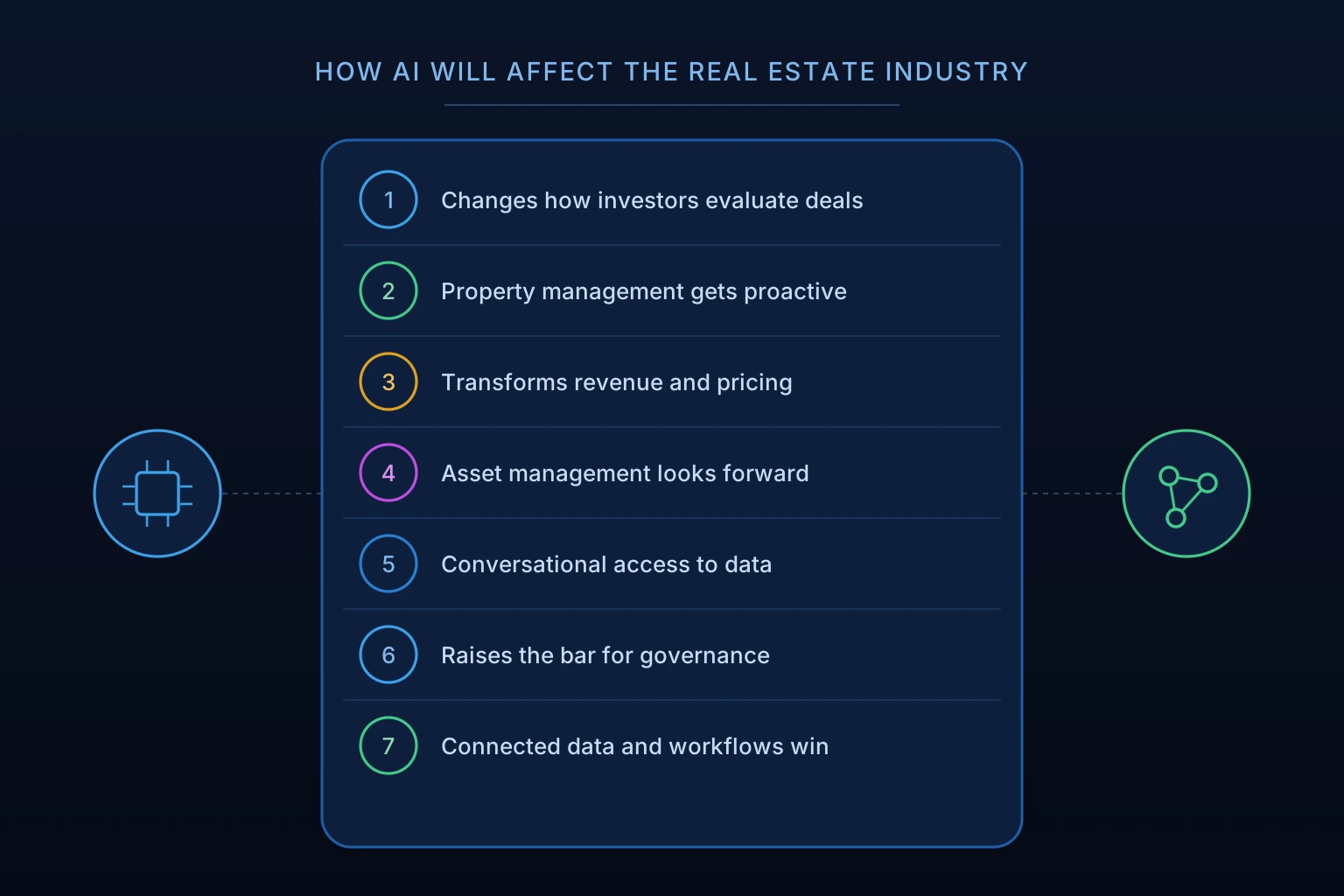
- AI Is Changing How Investors Evaluate Opportunities
- Property Management Is Becoming More Automated and Proactive
- AI Is Transforming Revenue Management and Pricing Decisions
- AI Is Making Asset Management More Forward-Looking
- Conversational AI Is Changing How Professionals Access Data
- AI Raises the Bar for Governance and Human Judgment
- The Biggest Gains Will Come From Connected Data and Workflows
1. AI Is Changing How Investors Evaluate Opportunities
Investors use AI to speed up market research, acquisition analysis, underwriting, and risk assessment. Common applications include reviewing supply and demand data, spotting market trends, comparing investment scenarios, and stress-testing financial assumptions.
The National Apartment Association identifies investment opportunity analysis and lending underwriting among the ways AI and emerging technologies are being applied in real estate. By processing large volumes of property, financial, and market information, AI can help investment teams identify opportunities and evaluate potential risks more efficiently. However, faster analysis does not replace due diligence, local market expertise, or the judgment required to make investment decisions.
2. Property Management Is Becoming More Automated and Proactive
Daily property operations are where many teams first see AI at work:
- Prospect communication, lead qualification, and tour scheduling run around the clock
- Maintenance requests are triaged, and predictive maintenance flags equipment risk early
- Resident communication and service workflows follow consistent steps
- Automated reporting delivers performance views on a schedule
According to Multi-Housing News, multifamily operators are increasingly using predictive maintenance technology to identify potential equipment failures before they escalate. By analyzing equipment performance, maintenance histories, and operating conditions, these tools can help teams prioritize preventive work, reduce unexpected disruptions, and make more informed maintenance decisions.
Two uses of AI are worth separating. Automating a repetitive task saves time. Using AI to improve an operational decision changes outcomes. If analytics shows leasing conversion declining at the tour-to-application stage, a property manager can review the follow-up process before vacancy increases. Rentana supports this side through scheduled reports and AI-generated Property Insights that show what changed and where to look.
3. AI Is Transforming Revenue Management and Pricing Decisions
AI-supported revenue management evaluates internal property performance, leasing velocity, current and future availability, renewal trends, and asset objectives to support pricing recommendations. Forward-looking occupancy analysis helps operators anticipate shifts, so teams respond to where occupancy is heading and not only where it has been.
Property-specific performance and the operator’s own strategy guide the pricing decision. Public market data adds external context about what the surrounding market shows publicly. Operators should prioritize transparent recommendations supported by clear reasoning, with appropriate human review and authorization before pricing changes are implemented.
Related:
- The Best AI Tools for Real Estate Investors
- AI Tool for Public Rental Market Analysis by Zip Code
4. AI Is Making Asset Management More Forward-Looking
Asset managers use AI to monitor portfolio performance, find properties drifting from investment objectives, and investigate what is behind a change.
Consider a property that meets its current occupancy target while projected availability points to a significant decline. Lease expirations are concentrated in a slower leasing season. AI analytics can surface that emerging risk, so the asset manager can evaluate renewal strategy, expiration management, and pricing before the impact reaches financial reporting.
5. Conversational AI Is Changing How Professionals Access Data
Natural-language analytics lets professionals ask questions about performance and skip the manual work of navigating multiple reports or building spreadsheets. Questions such as these become a starting point for investigation:
- Why is leasing performance declining at this property?
- Which assets are falling behind their occupancy targets?
- What is driving differences in renewal performance across the portfolio?
- Which layouts are creating the greatest future exposure risk?
Ask Rentana is a multifamily example. Users can ask questions about their properties and portfolios in natural language and receive explanations supported by charts and tables. By analyzing connected property data and relevant performance information, Ask Rentana helps teams investigate trends, understand potential performance drivers, and make more informed decisions.
6. AI Raises the Bar for Governance and Human Judgment
AI depends on data quality, complete information, and operational context. Forecasts carry uncertainty, and no system guarantees a financial outcome. Asset strategy, resident relationships, market expertise, ethics, and accountability stay with people.
Housing operators using AI platforms recognize the need for continual internal review and oversight of AI models, processes, and outcomes. Several areas deserve attention:
- Fair housing and responsible use: AI tools should be evaluated for accuracy, potential bias, and compliance with applicable housing requirements.
- Data privacy and security: Operators should understand what information AI systems access, how it is protected, and how customer and resident data is used.
- Transparency and accountability: AI-generated recommendations should provide sufficient context and supporting information for teams to evaluate their reliability.
- Human oversight: While routine administrative tasks can be automated, consequential decisions involving pricing, leasing, and resident outcomes require appropriate human judgment and accountability.
7. The Biggest Gains Will Come From Connected Data and Workflows
Several developments appear likely to continue:
- Closer integration between property management, leasing, financial, and revenue management systems
- More sophisticated forecasting and earlier identification of performance risks
- AI assistants that can investigate complex operational questions
- More property-specific analytics and recommendations
- More automation of administrative workflows, which frees professionals for strategy and execution
The greatest value may come not from individual AI features, but from connecting information across systems and turning analysis into action. When leasing, occupancy, renewals, and financial performance can be evaluated together, operators gain a clearer understanding of how day-to-day decisions affect broader property objectives.
The challenge for real estate organizations will be ensuring that technology, data quality, and operational workflows evolve together so AI-generated insights can consistently support better decisions.
Read Also:
- How Real Estate Agents Can Use AI Easily
- Will AI Replace Real Estate Agents? Or Transform Them?
How Rentana Is Applying AI to Multifamily Asset Management Today
Rentana uses AI to support multifamily revenue management and asset management with PMS-connected data. Operators define property-specific goals through configurable asset strategy settings, and analytics help teams evaluate performance and consider adjustments.
- Lease Up Mode builds data-backed monthly leasing targets around each property's pre-leasing and stabilization timeline. Pricing recommendations, forecasting, and AI Insights help teams evaluate performance against absorption goals rather than stabilized occupancy targets.
- Transparent pricing recommendations at the bedroom or custom unit group level show their reasoning, so teams can review them before acting
- Predicted Occupancy connects current leasing activity, renewal trends, and future availability into a view of where occupancy is heading
- AI-generated Property Insights surface what changed, why it may matter, and where to investigate
- Ask Rentana allows teams to investigate property and portfolio performance through natural-language questions, with supporting explanations, charts, and tables that help inform analysis and decision-making.
- Configurable asset strategy settings carry occupancy, pricing, renewal, and expiration goals for each property
Rentana supports real estate professionals with deeper analysis, and their expertise remains central to every decision.
Conclusion on How AI Will Affect Real Estate
AI is reshaping real estate by changing not just how quickly information is processed, but how effectively professionals can use it to make decisions. From investment analysis and property operations to revenue management and portfolio strategy, the greatest opportunity lies in moving beyond reactive reporting to anticipating risks, identifying opportunities, and acting with greater confidence.
As adoption accelerates, the competitive advantage won't come simply from using AI. It will come from integrating reliable data, meaningful analytics, and human expertise into everyday decision-making. The organizations that succeed will be those that use AI to strengthen their strategies, not replace the judgment behind them.