A successful asset strategy keeps long-term objectives at the forefront, even when short-term operational pressures demand attention. Many properties establish occupancy, rent, and renewal goals in an annual business plan, but those priorities can get lost amid changing market conditions, leasing challenges, and day-to-day decisions. The challenge is maintaining alignment between immediate actions and the property's long-term financial and operational objectives.
According to the National Apartment Association, two-thirds of surveyed rental housing operators reported worsening operating expenses, while confidence in rent growth and leasing demand remained comparatively weak. These pressures reinforce the importance of a property-specific asset strategy that connects occupancy, pricing, renewals, and revenue objectives to measurable performance goals.
This article covers how asset managers can define measurable goals, turn them into configurable property settings, and use forward-looking analytics to check whether each property is tracking toward them.
Related:
- Portfolio Performance Solutions for Asset and Property Managers
- Multifamily Asset Valuation: Complete Guide
What Is Multifamily Asset Strategy?
A multifamily asset strategy is the property-specific operating and financial plan that guides occupancy, pricing, revenue growth, renewals, and long-term asset performance. The asset manager defines the objectives based on the owner’s investment goals.
Each strategy should reflect the property’s investment objectives, market, operating stage, and risk tolerance. A lease-up property, a stabilized property, and a value-add property in the same portfolio call for different targets, so uniform goals across a portfolio fit none of them well.
7 Ways to Build a Multifamily Asset Strategy That Works
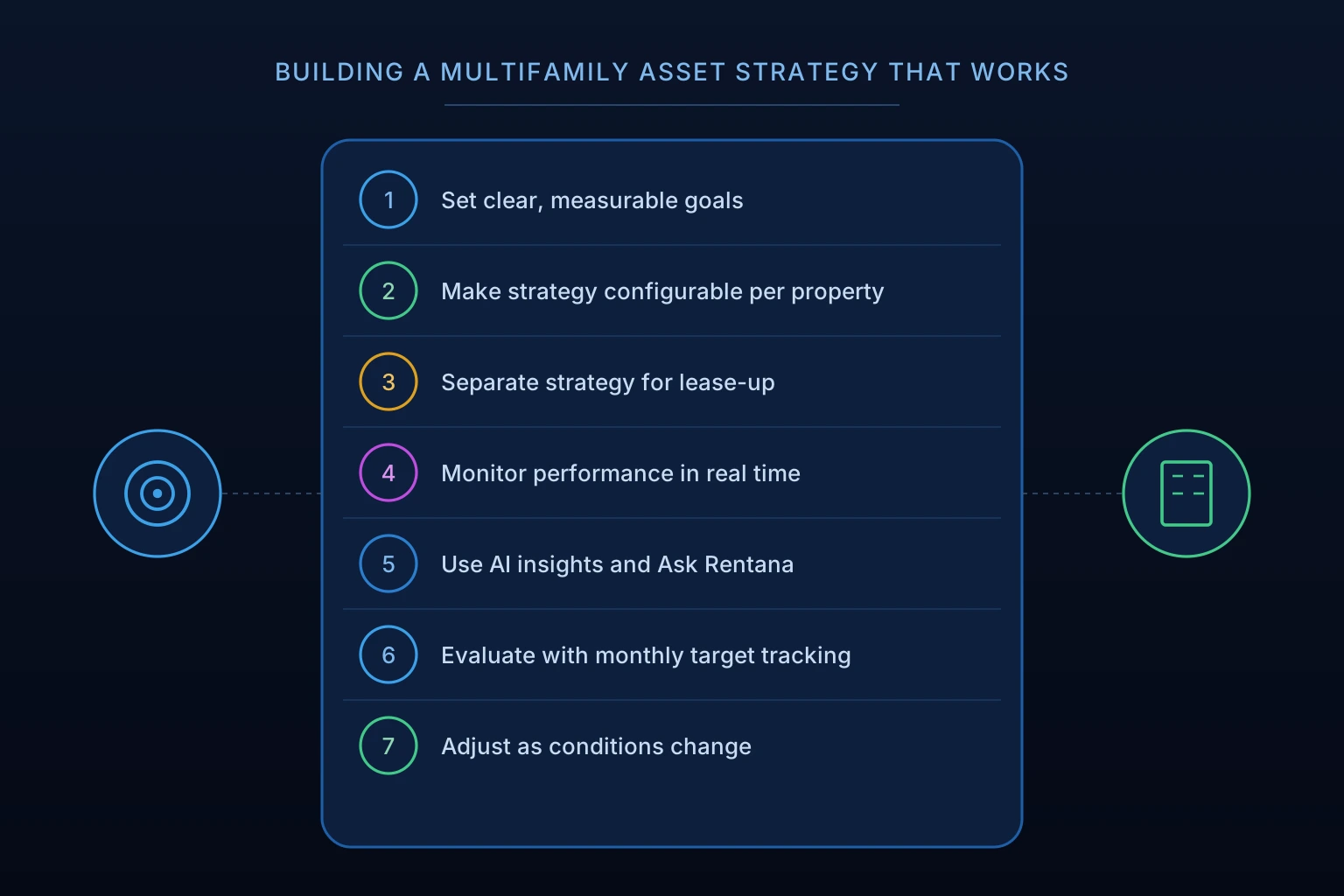
- Establish Clear, Measurable Performance Goals
- Translate Strategy Into Configurable Property Settings
- Build a Separate Strategy for Lease-Up Properties
- Monitor Performance Against Strategy in Real Time
- Use AI Insights and Ask Rentana to Find Risks and Opportunities
- Evaluate Results Through Monthly Target Tracking
- Adjust Strategy as Property Conditions Change
1. Establish Clear, Measurable Performance Goals
Asset managers translate investment objectives into operational targets that teams can act on. The core targets to define:
- Occupancy target and the timeframe for reaching it
- Revenue growth, achieved rents, and rent roll performance
- Renewal conversion and retention goals
- Lease expiration distribution and seasonal exposure
- Lease-up absorption and stabilization milestones, where applicable
These goals involve trade-offs. A property that prioritizes occupancy may accept lower rent growth, and one that prioritizes rent preservation may tolerate temporary vacancy. Writing the priority down in advance keeps pricing and leasing decisions consistent with it.
2. Translate Strategy Into Configurable Property Settings
Goals shape daily decisions once they become settings. In Rentana, asset managers configure revenue management settings for each property, including:
- Target occupancy and timeframe
- Bedroom-level occupancy goals
- Renewal targets
- Minimum and maximum pricing adjustments
- Lease-term options
- Expiration management preferences
These settings translate the owner's asset strategy into parameters that guide Rentana's pricing recommendations. By evaluating current property performance, including leasing velocity, availability, renewal trends, and future exposure, against configured occupancy targets and timeframes, Rentana generates pricing recommendations aligned with the property's objectives.
For example, an asset prioritizing rent preservation may tolerate temporary vacancy rather than discounting to meet a near-term occupancy target, while a property facing significant exposure may prioritize accelerating leasing activity. Each property's configuration allows recommendations to reflect its individual strategy.
3. Build a Separate Strategy for Lease-Up Properties
Lease-up sets the foundation for long-term performance. Initial pricing, absorption targets, unit mix performance, and lease expiration distribution all influence stabilization timing, future occupancy, and rent roll growth.
Rentana's Lease-Up Mode builds a data-backed leasing plan around each property's pre-leasing start date and stabilization timeline. Monthly leasing targets are informed by public demand signals, ramp-up patterns, and seasonality, with flexibility to adjust targets by unit type or building as delivery schedules change.
Unlike stabilized properties, where pricing recommendations are guided by occupancy targets, Lease-Up Mode aligns recommendations with the number of leases needed to achieve each month's absorption goals.
For example, a lease-up property may be tracking almost exactly to its overall leasing plan while individual layouts tell a different story. Studios and three-bedroom units are meeting or exceeding their leasing targets with limited remaining availability, while two-bedroom units are falling behind their absorption goals.
Rather than applying a uniform pricing strategy, asset managers can evaluate opportunities to preserve rental rates on high-performing layouts while considering targeted pricing adjustments or additional demand-generation efforts for underperforming unit types. AI-generated Insights help identify these differences and keep individual decisions aligned with the property's broader stabilization strategy.
Related:
4. Monitor Performance Against Strategy With Forward-Looking Analytics
Dashboards and analytics help asset managers see whether results match established goals. The most useful view connects current and predicted occupancy, leasing velocity, conversion, achieved rents, renewal performance, and expiration exposure.
Consider a property whose current occupancy meets target while predicted occupancy shows a decline in 60 days because expirations are concentrated in one window. Today’s number looks healthy, and the forward view shows a gap. The team can evaluate renewal strategy, marketing efforts, pricing, or lease-term adjustments before the issue reaches monthly financial results.
5. Use AI Insights and Ask Rentana to Find Risks and Opportunities
AI-Generated Property Insights proactively analyze performance across occupancy, leasing, pricing, renewals, exposure, and asset strategy to identify emerging risks and opportunities. Each Insight provides supporting analysis to help asset managers understand what is changing, why it matters, and where attention may be needed, without requiring them to initiate an investigation.
Ask Rentana complements these proactive insights by allowing asset managers to investigate specific property or portfolio questions on demand, explore performance drivers, and access supporting analysis. For example:
- Why is this property falling behind its occupancy target?
- Which floorplans are underperforming, and is the issue demand, conversion, or exposure?
- How is the lease-up performing against its stabilization plan?
- What factors are contributing to weaker revenue performance?
Answers come back with explanations, supporting charts and tables, and downloadable analysis for ownership discussions. The asset manager applies judgment to what comes back and decides the response.
6. Evaluate Results Through Monthly Target Tracking
Rentana’s Target Tracking Report helps asset managers compare actual performance against occupancy, renewal conversion, and pricing targets each month. The review focuses on three questions: where performance varies from target, what is causing the variance, and whether the fix belongs in operational execution or in the strategy itself.
Portfolio dashboards extend that view across properties. Asset managers can see which assets are on track, which are drifting from plan, and where management attention belongs this week.
According to CBRE’s U.S. Real Estate Market Outlook 2026, renewals represent 57% of all leasing activity, up from 51% in 2015 and 48% in 2005. With renewals carrying that share, renewal conversion targets deserve the same monthly attention as occupancy.
7. Adjust Strategy as Property Conditions Change
Asset strategy deserves review throughout the year, outside of budgeting or quarterly financial reporting. Shifts in demand, leasing velocity, renewal performance, seasonality, and future exposure may warrant changes to property settings, occupancy timelines, pricing strategy, or renewal priorities.
Before changing strategy, separate temporary fluctuations from structural challenges. One slow week can reflect seasonality or a short-lived traffic dip. Several consecutive weeks of softening conversion, declining renewal rates, and rising exposure in the same layout point to a condition worth acting on. Matching the size of the adjustment to the persistence of the signal keeps strategy stable while still responsive.
How Rentana Helps Asset Managers Execute and Monitor Their Strategy
Rentana helps asset managers translate investment objectives into revenue management settings, monitor execution, and adjust before gaps grow. The asset manager defines the objectives, and Rentana supports the work of acting on them.
- Configurable Asset Strategy and Pricing: Property-specific settings translate occupancy, renewal, pricing, and expiration management objectives into parameters that guide transparent pricing recommendations alongside current performance data.
- Lease-Up Mode: Builds data-backed monthly leasing targets aligned with pre-leasing timelines, stabilization goals, and seasonal demand, with pricing recommendations and AI Insights supporting progress against the plan.
- Predicted Occupancy and Target Tracking: Provide forward-looking visibility into occupancy risks and evaluate actual performance against configured occupancy, pricing, and renewal targets.
- AI-Generated Insights and Ask Rentana: Proactively identify performance risks and opportunities, while allowing asset managers to investigate specific property and portfolio questions with supporting analysis.
- Portfolio Dashboards and Reporting: Consolidate performance visibility across assets, helping asset managers identify deviations from strategy, prioritize attention, and communicate results to stakeholders.
Read Also:
- Best Leasing Solutions for Managing Multiple Multifamily Assets
- Best Asset Management Reporting Software for Multifamily
Conclusion on Multifamily Asset Strategy
A multifamily asset strategy earns its value when it guides decisions all year. Measurable goals, configurable settings, forward-looking visibility, and a regular review cadence keep each property aligned with the objectives the asset manager set.
Use Rentana to turn your multifamily asset strategy into measurable, configurable goals with AI-powered performance analysis, transparent pricing recommendations, and portfolio-wide visibility that helps keep properties aligned with their investment objectives.