
A property can post healthy occupancy while one of its floorplans is quietly losing pricing power. Property-wide averages blend strong layouts and weak ones into a single number, and that number rarely points to where the next decision belongs.
Floorplan-level analysis separates the layouts that are driving performance from those limiting it. According to CBRE's 2026 U.S. Real Estate Market Outlook, multifamily operators are prioritizing occupancy over rent growth, with elevated supply in some markets contributing to pricing pressure and increased concessions. Understanding which layouts are experiencing weaker demand, greater exposure, or slower leasing velocity helps revenue managers make more targeted decisions rather than applying property-wide pricing adjustments.
This article covers how revenue managers evaluate floorplan performance, diagnose what is driving it, and respond with pricing, renewal, and exposure decisions that fit each layout.
Related:
What Is Floorplan Performance in Multifamily?
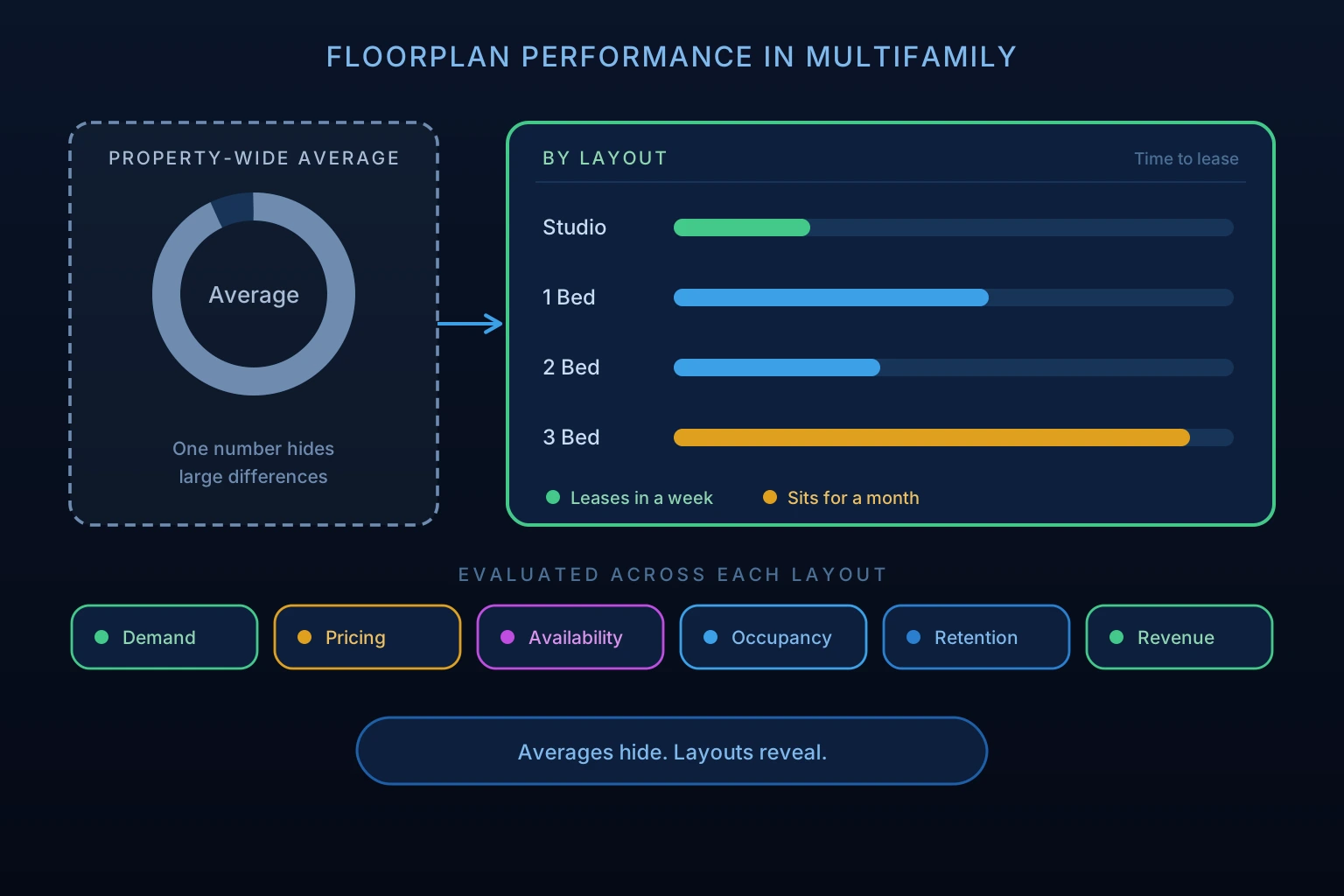
Floorplan performance is the evaluation of leasing demand, pricing, availability, occupancy, retention, and revenue outcomes across the different layouts in a property. Layouts can represent floorplans, unit configurations, or custom unit groups, depending on how the property is organized.
A property-wide average can conceal large differences between them. One layout may lease in a week while another sits for a month, and both roll up into the same occupancy figure. Granular analysis shows which layouts are shaping revenue and where a response is warranted.
Why Floorplan-Level Performance Matters for Revenue Management
Layouts within the same property can experience very different leasing velocity, occupancy, retention, and pricing power.
Consider a property with healthy overall occupancy where the one-bedroom layouts carry a concentration of upcoming lease expirations. As those units return to market together, available inventory within the same layout competes against itself. Pricing power weakens, and the team may need concessions or rent reductions on one-bedrooms while other layouts continue to achieve rent growth.
That weakness can affect property-wide performance. Increased concessions and prolonged vacancy reduce effective rental revenue, even when other layouts continue achieving rent growth. Over time, persistent underperformance in one layout can erode the revenue gains generated elsewhere in the asset.
Key Metrics for Evaluating Floorplan Performance
Four categories of metrics give a complete view of a layout.
Demand and Leasing
- Lead volume and lead conversion
- Leasing velocity
- Days on market and vacancy duration
Availability and Exposure
- Current availability and notices
- Upcoming expirations and expected renewals
- Expiration concentration by month
Pricing and Revenue
- Asking, achieved, and effective rents
- Concessions and lease trade-outs
- Rent per square foot
- Amenity premiums
Occupancy and Retention
- Occupancy by layout
- Renewal conversion and turnover rates
- Performance against occupancy targets
Compare layouts within the same bedroom category, and compare performance across bedroom types. Two one-bedroom layouts may lease at different speeds because of desirability or pricing. Studios and two-bedrooms may show different retention patterns that call for distinct renewal strategies.
How to Evaluate and Improve Floorplan Performance in Multifamily, in 4 Steps
Once you've identified differences in performance across layouts, the next step is understanding what's driving them and determining where adjustments may be needed. The following four steps provide a practical framework for evaluating performance and aligning pricing, exposure, and renewal strategies with property goals.
1. Diagnose the Root Cause: Demand, Pricing, or Exposure
Weak floorplan performance does not automatically indicate weak demand or incorrect pricing. Three drivers can look similar in the data, and each calls for a different response.
Consider a layout experiencing flat or negative rent growth while the rest of the property improves. Initially, this may appear to indicate weaker demand. However, further analysis reveals that a disproportionate share of its leases expire during the market's slower leasing season. The resulting vacancy pressure can weaken pricing power and increase reliance on concessions.
Repeated rent reductions may address the immediate vacancy but not the underlying exposure problem.
A more sustainable strategy may involve adjusting future lease expiration distribution to better align availability with seasonal demand. As exposure normalizes, the layout may regain pricing power and perform more consistently with comparable layouts, assuming other demand conditions remain similar.
Other diagnostic patterns:
- High traffic, low conversion: Investigate pricing, layout desirability, or friction in the leasing funnel
- Low traffic, strong conversion: Evaluate marketing visibility and lead generation
- High availability, slow leasing: Separate weak demand from expiration-driven overexposure
- Strong demand, weak renewal retention: Review renewal pricing and resident preferences
2. Optimize Pricing at the Floorplan and Unit Level
Pricing should reflect differences in demand, availability, layout desirability, square footage, views, floor level, and amenities. Effective unit-level pricing aims to balance revenue and leasing velocity so that comparable units rent within a reasonably consistent timeframe, accounting for normal variation in demand and availability.
For example, if units with balconies consistently remain on the market significantly longer than otherwise comparable units without balconies, the balcony premium may exceed what prospects are willing to pay.
Conversely, if balcony units consistently lease much faster, there may be an opportunity to capture additional revenue. Comparing average days on market and the normal range of variation helps revenue managers evaluate whether amenity premiums and layout price differences are appropriately positioned.
3. Manage Expiration Exposure and Seasonal Demand by Floorplan
Lease expiration concentration creates future occupancy and pricing risk, especially when expirations cluster in historically slower leasing months. Lease-term pricing, renewal timing, and proactive expiration management can distribute future availability more evenly.
When exposure is temporarily elevated, revenue managers must evaluate the trade-off between accelerating leasing activity and preserving achieved rents. In some cases, accepting slightly higher near-term vacancy may better protect long-term rent roll performance than aggressive discounting. In others, reducing vacancy duration may produce a stronger financial outcome.
The appropriate strategy depends on seasonal demand, expected vacancy costs, occupancy objectives, and the property's long-term revenue goals. Rentana supports these decisions through configurable occupancy targets by bedroom type, target timeframes, expiration management settings, and lease-term pricing strategies.
Related:
- Data-Driven Rent Pricing in Multifamily
- Multifamily Solutions Operators Are Using
4. Evaluate Renewal Performance and Retention by Floorplan
Renewal rates and turnover vary across layouts. Studios may see more turnover as residents move into larger apartments, while two-bedroom households may follow different retention patterns.
According to CBRE’s U.S. Real Estate Market Outlook 2026, renewals now represent 57% of all leasing activity, up from 51% in 2015 and 48% in 2005. With renewals carrying that much weight, layout-level retention shapes future vacancy and rent roll performance.
For each layout, review renewal conversion, renewal increases, loss to lease, resident feedback, and upcoming exposure. A layout facing heavy expirations or historically weak retention may warrant a different renewal strategy than a highly occupied layout with strong retention and limited future availability.
How Floorplan Analysis Changes During Lease-Up
During lease-up, aggregate progress can hide large differences in absorption by layout. For each bedroom type or pricing group, compare leasing velocity, available inventory, lead conversion, and achieved rents against the lease-up plan.
A property may be on target overall because two-bedrooms are leasing ahead of schedule while studios fall behind. Revenue managers can then identify which layouts are driving or limiting absorption and evaluate targeted pricing, marketing, or leasing strategies instead of making property-wide adjustments.
How Rentana Supports Floorplan-Level Revenue Management
Rentana connects bedroom-level and custom pricing-group performance with leasing velocity, lead conversion, availability, expiration exposure, renewals, and pricing recommendations.
- Lease Up Mode connects leasing performance, demand forecasting, and pricing recommendations to property-specific absorption goals and stabilization timelines, helping teams identify which layouts are ahead of or behind plan.
- Pricing recommendations and configurable settings align bedroom-level and custom pricing-group recommendations with property-specific occupancy targets, leasing performance, expiration management, and lease-term strategies.
- Predicted Occupancy and exposure management provide forward-looking visibility into occupancy trends, anticipated availability, and expiration concentration across layouts and time periods.
- Renewal analysis provides visibility into retention performance, renewal pricing, and upcoming expirations to support floorplan-specific renewal strategies.
- AI-Generated Property Insights identify meaningful patterns, including weak conversion, uneven lease-up progress, and concentrated exposure, helping revenue managers investigate the underlying drivers of performance and prioritize action.
Don’t Miss:
- How To Build a Multifamily Portfolio Strategy
- What Is Lease Analysis in Multifamily?
Conclusion on Multifamily Floorplan Performance
Floorplan performance analysis shows what property averages conceal. Evaluating demand, availability, pricing, and retention by layout helps revenue managers diagnose whether a problem comes from demand, pricing, or exposure, and respond with the decision that fits.
Use Rentana to evaluate floorplan performance, identify the underlying drivers of leasing and revenue trends, manage future exposure, and align pricing and renewal strategies with your property’s occupancy and revenue goals.