Maximizing ROI on multifamily investments requires more than acquiring the right asset. While acquisition strategy, financing, and market selection determine the initial opportunity, long-term returns are ultimately created through operational execution.
The business plan behind a multifamily investment depends on assumptions about revenue growth, occupancy, expenses, and asset performance. The challenge is turning those assumptions into actual results after acquisition.
In today’s operating environment, maximizing ROI requires more than increasing rents or reducing expenses. Owners and asset managers need visibility into the operational factors that influence net operating income (NOI), including pricing performance, leasing velocity, renewal outcomes, occupancy risk, and asset-level strategy.
Maximizing multifamily returns requires a combination of data-driven decision-making, revenue optimization, and operational strategies that improve NOI while maintaining resident satisfaction.
The strongest operators maximize ROI by continuously evaluating performance, identifying opportunities early, and aligning daily operating decisions with the investment strategy established for each asset.
Related:
- How to Improve Multifamily Operations Team Efficiency
- Multifamily Rent Reporting: Complete Guide
7 Ways to Maximize ROI on Multifamily Investments
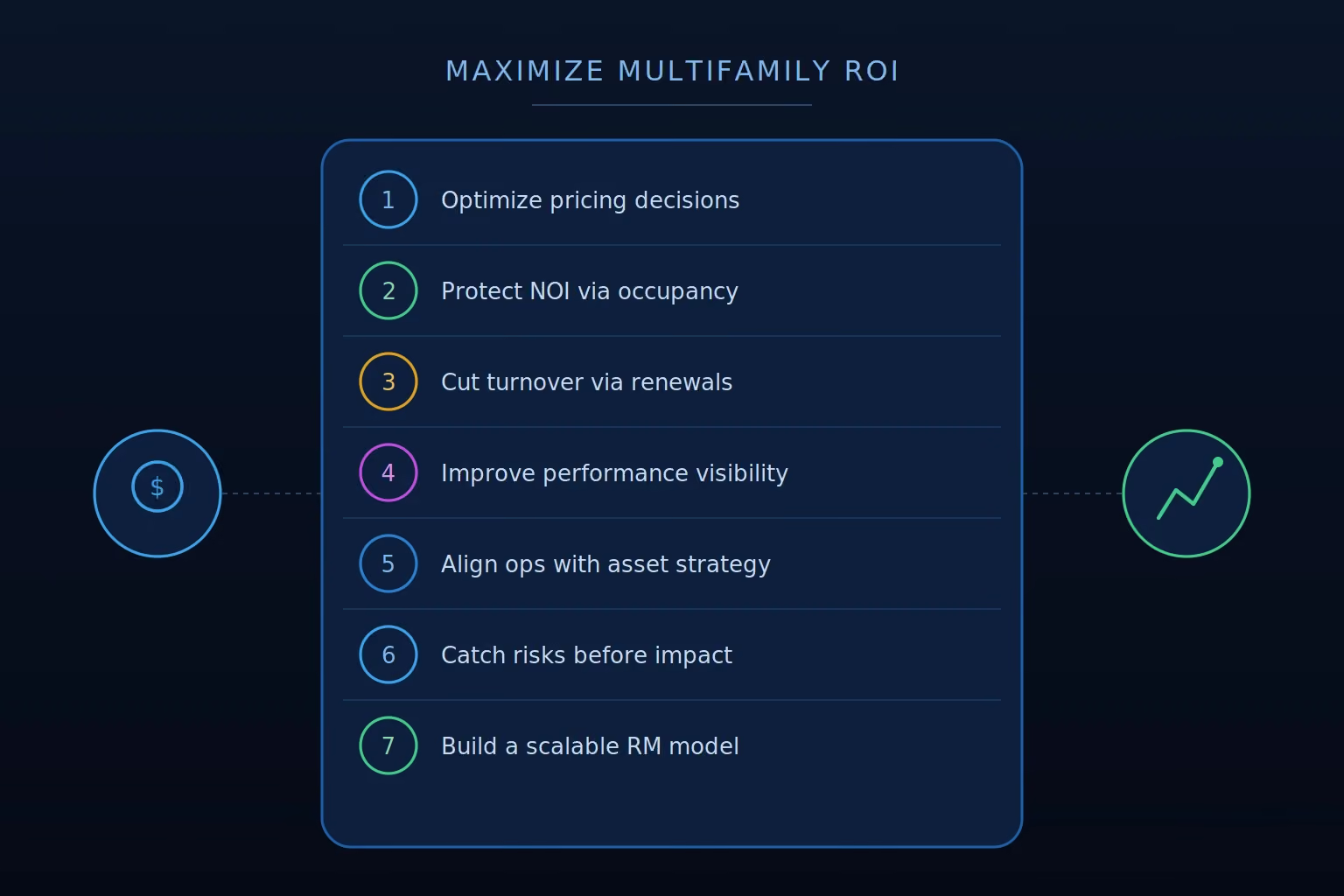
- Optimize Revenue Performance Through Better Pricing Decisions
- Protect NOI Through Occupancy Management
- Reduce Turnover Costs Through Stronger Renewal Performance
- Improve Decision-Making With Better Performance Visibility
- Align Operations With Asset Strategy
- Identify Performance Risks Before They Impact Financial Results
- Build a Scalable Revenue Management Operating Model
1. Optimize Revenue Performance Through Better Pricing Decisions
Revenue growth is one of the most direct ways multifamily operators influence ROI. Even small improvements in achieved rents across a portfolio can create meaningful NOI impact over time.
However, maximizing revenue does not mean simply increasing rents whenever possible. Effective pricing decisions require understanding where demand exists, where performance is under pressure, and how each unit group is performing relative to asset objectives.
A property may appear healthy at the overall occupancy level while individual bedroom types or unit groups are performing very differently. One segment may support pricing increases due to strong demand, while another may require a different strategy to improve absorption.
The most effective pricing strategies evaluate:
- Current occupancy and future occupancy expectations
- Leasing velocity by bedroom type or custom unit group
- Demand signals and conversion trends
- Current pricing positioning
- Loss to lease opportunities
- Asset-specific pricing goals
By connecting pricing decisions to actual leasing behavior, operators can protect occupancy while capturing available revenue opportunities.
Rentana supports this process by providing pricing recommendations at the bedroom type or custom unit group level, helping teams evaluate not just what price is recommended, but the operational context behind the recommendation.
2. Protect NOI Through Occupancy Management
Occupancy directly influences revenue performance, but managing occupancy effectively requires more than reacting after occupancy declines.
By the time occupancy appears in historical financial reporting, the operational conditions that created the change may have been developing for weeks or months.
Strong occupancy management requires visibility into the leading indicators that influence future performance:
- Leasing velocity
- Forward availability
- Lease expiration exposure
- Renewal conversion
- Unit-level demand trends
The goal is not simply maintaining occupancy today. It is understanding where occupancy is expected to move and whether current leasing, pricing, and renewal strategies support the asset’s objectives.
A property with strong current occupancy may still have future risk if expirations are concentrated, demand is softening, or leasing velocity is slowing within a specific unit group.
Rentana’s predicted occupancy and exposure forecasting help teams connect current leasing activity, renewal trends, and future availability to understand what may happen under current conditions and where additional attention may be needed.
Read Also:
- Multifamily Property Performance: 5 Key Metrics to Track
- Multifamily Rental Market Trends so Far
3. Reduce Turnover Costs Through Stronger Renewal Performance
Retention directly impacts ROI because every avoidable move-out creates additional costs and operational work.
A resident turnover event can require:
- Vacancy loss
- Make-ready work
- Marketing spend
- Leasing effort
- Potential concessions
- Replacement leasing activity
Strong renewal performance does not mean retaining every resident at any cost. It means making informed decisions about when retaining the resident creates stronger economics than replacing the lease.
Renewal strategy should consider:
- Current market rent
- In-place rent position
- Replacement rent expectations
- Forward exposure
- Seasonal demand
- Turnover costs
- Concession environment
The strongest operators treat renewals as a revenue strategy rather than an administrative process.
Rentana supports renewal decision-making by providing visibility into renewal conversion trends, renewal recommendations, exposure, and future availability so teams can evaluate renewal outcomes within the broader asset strategy.
4. Improve Decision-Making With Better Performance Visibility
Multifamily operators have more data than ever, but ROI is not improved by collecting more information. It is improved by understanding which information matters and when action is needed.
Asset managers and operators need visibility into:
- Which properties are outperforming or underperforming
- Which unit groups are creating pressure
- Where leasing velocity is changing
- Whether renewal trends support occupancy goals
- Which operational factors may be influencing revenue performance
Without connected visibility, teams often spend valuable time assembling reports instead of evaluating decisions.
The most effective reporting environments combine consistent performance tracking with the ability to investigate specific questions when something changes.
Rentana supports this through portfolio dashboards, reporting tools, Metrics Browser analysis, and AI-generated Insights that help teams identify what is changing, why it may matter, and where additional investigation may be warranted.
5. Align Operations With Asset Strategy
Every multifamily asset has a different investment strategy.
A lease-up asset is focused on building occupancy and establishing its rent roll. A stabilized asset may prioritize maintaining occupancy while protecting revenue. A value-add asset may be balancing renovation execution with revenue growth.
The same operating targets do not apply equally across every property.
Maximizing ROI requires ensuring that operational decisions align with the strategy established for each asset.
That includes:
- Appropriate occupancy targets
- Pricing guardrails
- Leasing velocity expectations
- Renewal objectives
- Exposure management strategies
When teams manage every property using the same assumptions, they risk making decisions that work against the asset’s actual objectives.
Rentana supports asset-level configuration, allowing operators to evaluate performance based on the strategy and targets appropriate for each property rather than applying a one-size-fits-all approach.
Top Picks:
6. Identify Performance Risks Before They Impact Financial Results
Financial performance is often the result of operational decisions made weeks or months earlier.
A decline in NOI does not happen suddenly. It is usually preceded by smaller signals:
- Slowing leasing velocity
- Weakening renewal conversion
- Increased future exposure
- Growing availability pressure
- Changing demand patterns
The ability to identify these signals early gives operators more time and more options.
AI-generated Insights can help surface performance changes that may not be immediately obvious through standard reporting. Instead of requiring teams to manually search through data, insights can highlight:
- What is changing at the asset
- Why the change may matter
- Which operational factors may be contributing
- Where teams may want to investigate or evaluate a course correction
This shifts performance management from explaining what already happened to understanding what may need attention next.
7. Build a Scalable Revenue Management Operating Model
As portfolios grow, maximizing ROI becomes increasingly dependent on having repeatable processes and shared visibility across teams.
Leasing, revenue management, property management, and asset management teams all influence financial performance, but they often evaluate different pieces of the operating picture.
A scalable revenue management operating model connects these functions around shared performance information.
This requires:
- Connected data
- Consistent workflows
- Clear ownership
- Portfolio-level visibility
- The ability to move from broad trends into specific property or unit-level decisions
The goal is not simply having more technology. It is creating an operating environment where teams can identify opportunities faster, coordinate decisions more effectively, and spend more time improving performance.
Rentana helps multifamily operators create this operating model by connecting pricing, leasing, renewals, occupancy, exposure, and performance data into one revenue intelligence platform.
Don’t Miss:
- Multifamily Proptech: 7 Tools for the Right Stack
- The Multifamily Leasing Funnel Explained
Conclusion on Maximizing ROI on Multifamily Investments
Maximizing ROI on multifamily investments is not only about finding the right acquisition opportunity. It is about executing the investment strategy effectively throughout the life of the asset.
The operators who consistently protect and improve returns are the ones who understand how daily operational decisions influence long-term performance.
Better pricing decisions protect revenue. Strong renewal strategies reduce unnecessary turnover. Forward visibility helps teams identify risks before they impact NOI. Connected data helps operators spend less time assembling information and more time making decisions.
The highest-performing multifamily operations are the ones with the visibility, processes, and operational discipline to consistently focus attention where it can create the greatest impact.
ROI is created through execution. The right technology helps operators execute with better information, better timing, and greater confidence.