Artificial intelligence is rapidly becoming part of the multifamily technology landscape, but the challenge for operators is no longer simply deciding whether to adopt AI. The harder question is determining which AI capabilities actually solve the operational problems that matter most.
The phrase “AI-powered real estate platform” can describe very different solutions. Some platforms automate leasing conversations. Others improve resident communication, streamline maintenance workflows, analyze investment opportunities, or help teams interpret operational data. The value of each platform depends on the specific challenge it is designed to solve.
According to Multifamily Dive’s analysis of how leading multifamily operators are putting AI to work ), the next phase of AI adoption is moving beyond simple efficiency gains and toward improving measurable operational outcomes. The operators seeing the most value are not evaluating AI based on how many tasks it can automate. They are evaluating whether it improves performance, decision-making, and the ability for teams to focus on higher-value work.
For multifamily operators, the best AI platform is not necessarily the one with the most AI features. It is the one that aligns with the decisions the team needs to make, the workflows they need to improve, and the outcomes they are trying to influence.
This article breaks down the major categories of AI-powered real estate platforms, what operational problems each category solves, and what operators should consider when evaluating which AI solution best fits their portfolio.
Related:
7 Best AI-Powered Real Estate Platform Categories
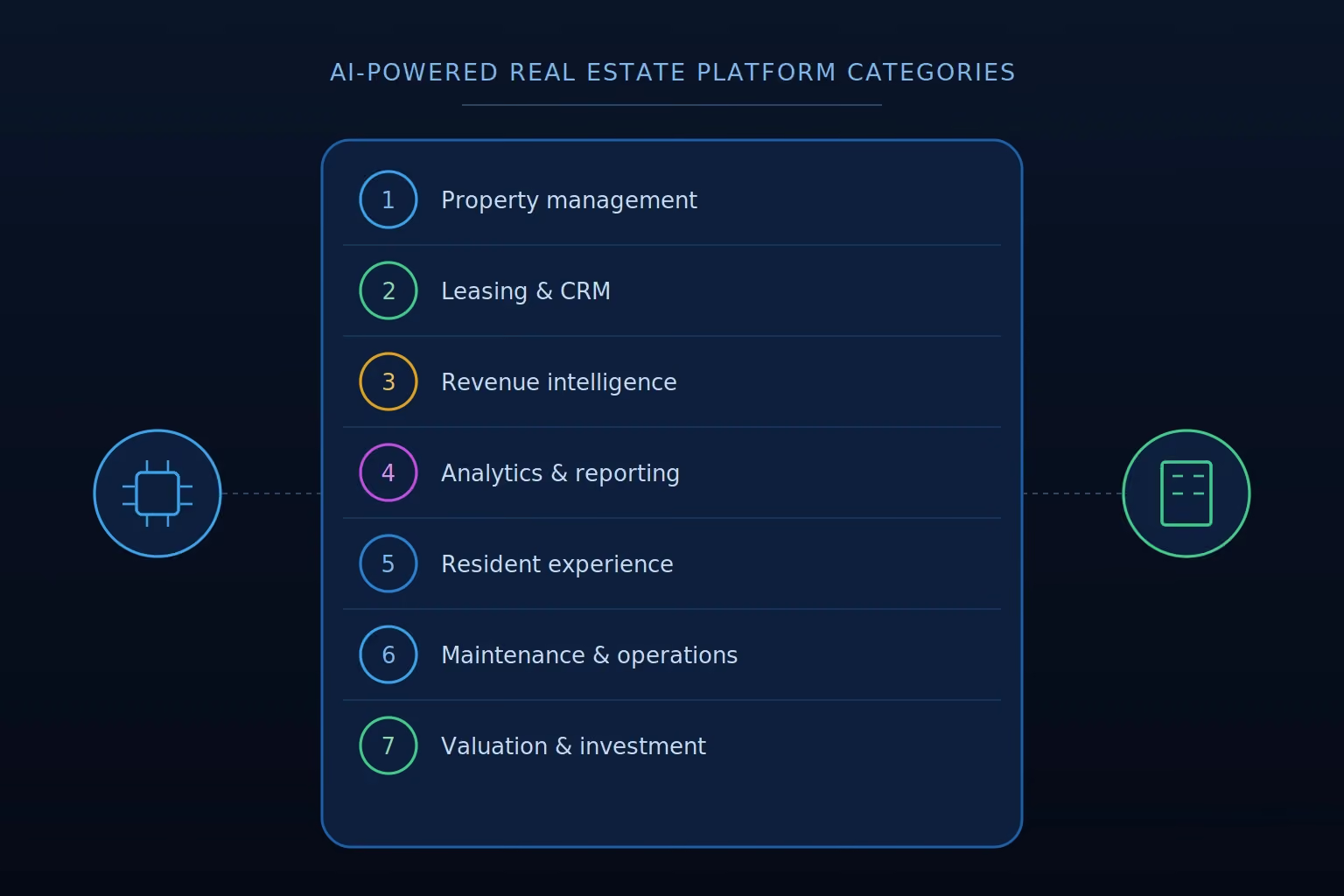
- AI Property Management Platforms
- AI Leasing and CRM Platforms
- AI Revenue Intelligence Platforms
- AI Analytics and Reporting Platforms
- AI Resident Experience Platforms
- AI Maintenance and Operations Platforms
- AI Valuation and Investment Analysis Platforms
1. AI Property Management Platforms
AI property management platforms are designed to improve the broad operational workflows required to manage multifamily communities, including resident communication, administrative tasks, maintenance coordination, and day-to-day property operations.
These platforms typically focus on reducing repetitive work, improving response times, and helping teams manage higher volumes of activity without adding equivalent administrative burden. The strongest solutions do not replace the operational judgment of property teams. Instead, they help automate routine workflows so employees can focus on the decisions and interactions that require human involvement.
As multifamily operators evaluate AI property management platforms, the most important consideration is not simply how many tasks the technology can automate. It is whether the platform improves measurable operational outcomes, such as response consistency, service quality, team capacity, and resident experience.
According to Multifamily Dive’s analysis of how leading multifamily operators are putting AI to work, the next phase of AI adoption is moving beyond basic efficiency improvements toward using AI to improve business outcomes. The operators seeing the most value are evaluating whether AI helps teams make better decisions, improve performance, and focus their time on higher-value work.
2. AI Leasing and CRM Platforms
AI leasing and CRM platforms focus on improving the prospect journey, from the initial inquiry through tour scheduling, follow-up, and conversion.
For multifamily operators, leasing AI often addresses some of the highest-volume points of friction in the funnel:
- responding to prospect inquiries quickly
- answering common availability and pricing questions
- scheduling tours
- maintaining consistent follow-up
- reducing prospect drop-off when teams are unavailable
The goal is not to remove the human role in leasing. The strongest implementations use AI to handle repetitive, high-volume interactions while allowing leasing teams to focus on conversations that require relationship-building, judgment, and closing skills.
According to Multi-Housing News’ coverage of agentic AI in multifamily marketing, AI leasing assistants are increasingly being used to support prospect communication, answer questions, and guide prospects through early leasing steps before transitioning more complex conversations to human team members.
When evaluating AI leasing platforms, operators should consider more than response automation. Important questions include:
- Does the platform improve lead conversion, not just response speed?
- Does it integrate with existing leasing workflows?
- Does the team maintain visibility into prospect interactions?
- Does the AI know when to escalate to a person?
3. AI Revenue Intelligence Platforms
AI revenue intelligence platforms represent a different category of AI solution. Rather than primarily automating a task, these platforms help operators interpret performance signals and make better revenue decisions.
Revenue intelligence connects the operational factors that influence occupancy and NOI, including:
- leasing velocity
- renewal conversion
- forward availability
- exposure risk
- pricing performance
- occupancy trends
- asset strategy
The value is not simply having more data. Most operators already have extensive reporting and operational data. The challenge is identifying what is changing, why it matters, and where teams should focus attention before performance issues become visible in historical reporting.
For multifamily operators, AI revenue intelligence helps bridge the gap between data collection and operational decision-making. Instead of requiring teams to manually assemble reports and search for patterns, AI can surface meaningful changes, provide context around contributing factors, and highlight opportunities for investigation or course correction.
This category is particularly valuable for asset managers and revenue teams because it connects daily operational signals to broader portfolio performance.
A strong AI revenue intelligence platform should help answer questions like:
- Which assets or unit groups are showing emerging performance pressure?
- Is a change in occupancy driven by pricing, leasing velocity, renewals, or availability?
- Where should the team focus attention first?
- Are current strategies producing the expected outcomes?
For Rentana, this is the core differentiation: using AI not just to automate tasks, but to help multifamily teams understand what is changing, why it matters, and what operational actions may need to be evaluated.
Top Picks:
- How to Use AI for Real Estate Analysis
- Top 9 AI Applications in Real Estate
4. AI Analytics and Reporting Platforms
AI analytics and reporting platforms help operators make sense of the large volume of operational data generated across a real estate portfolio.
Traditional reporting tells teams what happened. AI-powered analytics can help identify patterns, summarize performance changes, and surface areas that may require additional investigation.
For multifamily operators, the value of AI analytics is not simply producing more dashboards or reports. The challenge has never been a lack of available data. The challenge is determining which signals matter, understanding why performance is changing, and focusing attention on the areas where action may have the greatest impact.
The strongest AI analytics platforms help teams move from reviewing historical performance to understanding emerging trends. This can include identifying changes in leasing activity, occupancy patterns, resident behavior, operational performance, or portfolio-level trends.
When evaluating AI analytics platforms, operators should consider:
- Does the platform reduce manual reporting work?
- Does it help teams identify meaningful trends faster?
- Does it provide context around why performance may be changing?
- Can teams move from portfolio-level insights into property-level detail?
For asset managers and operators, the difference between reporting and intelligence is the ability to move from “What happened?” to “What is changing, why does it matter, and where should we focus?”
5. AI Resident Experience Platforms
AI resident experience platforms focus on improving communication, engagement, and service delivery throughout the resident lifecycle.
These platforms often support workflows such as:
- answering resident questions
- managing communication requests
- providing updates
- supporting service interactions
- improving consistency across resident touchpoints
The value of AI in resident experience is not simply faster responses. It is creating more consistent, reliable interactions while allowing property teams to focus on situations that require human judgment.
As multifamily operators evaluate resident experience AI, the key question is whether the technology improves the resident experience without removing the human relationships that remain important in property management.
The strongest implementations use AI to handle routine interactions while helping onsite teams deliver better service, clearer communication, and faster resolution when residents need support.
6. AI Maintenance and Operations Platforms
AI maintenance and operations platforms focus on improving the workflows behind property service delivery.
Maintenance operations often involve high volumes of requests, prioritization decisions, scheduling coordination, vendor communication, and resident updates. AI can help reduce administrative burden by organizing information, identifying patterns, and supporting faster responses.
For operators, the opportunity is not replacing maintenance teams. It is giving teams better tools to prioritize work, improve consistency, and spend more time on the service issues that require expertise and judgment.
When evaluating AI maintenance platforms, operators should consider:
- Does the platform improve response and communication workflows?
- Does it integrate with existing operational systems?
- Does it help teams prioritize issues more effectively?
- Does it improve visibility into recurring operational patterns?
AI is most valuable when it strengthens existing teams and helps them operate more efficiently.
7. AI Valuation and Investment Analysis Platforms
AI valuation and investment analysis platforms apply artificial intelligence to acquisition, underwriting, portfolio analysis, and investment decision-making.
These platforms can help investors analyze public market conditions, evaluate opportunities, process large amounts of information, and identify trends that may influence investment decisions.
For owners, operators, and investment teams, the value comes from improving the speed and depth of analysis required to evaluate opportunities and risks.
When evaluating AI investment platforms, teams should consider:
- What data sources does the platform use?
- How transparent are the assumptions behind the analysis?
- Does the platform support human review and decision-making?
- Does it improve investment decisions or simply accelerate existing workflows?
AI can help investment teams process information faster, but the strongest platforms support better judgment rather than attempting to replace it.
Related:
- Will AI Replace Real Estate Agents? Or Transform Them?
- AI Adoption Challenges in Real Estate & How to Solve Them
How to Choose the Right AI Platform Category for Your Operation
The best AI-powered real estate platform is not necessarily the one with the most features or the most advanced technology. It is the one that solves the operational challenge creating the greatest impact for your team and portfolio.
Before evaluating vendors, operators should start by identifying the decision or workflow they are trying to improve.
Are teams spending too much time responding to repetitive inquiries? An AI leasing platform may be the right fit.
Are property teams struggling with resident communication volume? An AI resident experience platform may provide the greatest value.
Are asset managers spending hours assembling reports and trying to understand why performance is changing? An AI analytics or revenue intelligence platform may be the better solution.
The right AI category depends on the problem being solved.
The technology landscape is becoming increasingly crowded, which makes platform selection more complex. According to Multifamily Dive’s PropTech predictions for 2026, operators are increasingly focused on integrated platforms that connect workflows and reduce the operational friction created by disconnected technology solutions.
Evaluate the Operational Outcome, Not Just the AI Capability
AI should not be evaluated based only on what the technology can do. The more important question is whether it improves a measurable business outcome.
Consider:
- Does the platform reduce manual work without creating additional complexity?
- Does it improve decision-making, not just automate tasks?
- Does it provide context around why something is changing?
- Does it integrate with existing systems and workflows?
- Does it maintain appropriate human oversight where judgment is required?
The strongest AI implementations are not designed to replace operational teams. They help teams spend less time on repetitive tasks and more time on decisions, relationships, and actions that influence performance. Multifamily operators are increasingly focused on AI solutions that improve outcomes rather than simply adding automation.
Consider How the Platform Fits Into Your Existing Technology Stack
AI works best when it is connected to the systems and workflows operators already rely on.
Adding another disconnected platform can create another source of information that teams have to reconcile. The goal should be technology that improves visibility and coordination rather than creating additional data silos.
When evaluating AI platforms, consider:
- Does it integrate with existing systems of record?
- Does it use the data already available across your operations?
- Can teams access the information they need without rebuilding manual workflows?
- Does it support portfolio-level visibility as well as property-level detail?
Integrated platforms allow AI to work with the context needed to provide more meaningful outputs. A leasing AI platform needs leasing data. A resident communication platform needs resident information. A revenue intelligence platform needs operational performance data.
The quality of AI output depends heavily on the quality and accessibility of the data behind it.
Prioritize Platforms That Support Human Decision-Making
The strongest AI platforms do not remove the need for operational expertise. They make that expertise more effective.
AI should help teams:
- identify where attention is needed
- understand what factors may be contributing to a change
- evaluate possible actions
- make decisions with better context
For multifamily operators, the goal is not an autonomous operation where decisions happen without oversight. The goal is an operation where teams have better visibility, better timing, and better information to make the right decisions.
Match the Platform Category to the Problem You Need to Solve
The right AI investment depends on where your biggest operational gap exists:
- Need faster prospect response and better lead conversion? Evaluate AI leasing and CRM platforms.
- Need better resident communication and service consistency? Evaluate AI resident experience platforms.
- Need to reduce reporting burden and understand performance trends?
Evaluate AI analytics platforms. - Need better visibility into pricing, leasing, renewals, occupancy, and revenue performance?
Evaluate AI revenue intelligence platforms.
The best AI platform is not the one that does everything. It is the one that helps your team solve the problems that matter most.
Don’t Miss:
- The State of AI in Real Estate: 15 Interesting Facts
- Key Benefits of AI in Real Estate
Conclusion on AI-powered Real Estate Platform
The best AI-powered real estate platform is not the one with the most AI features. It is the one that solves the operational problems that matter most for the organization using it.
For multifamily operators, AI can improve many areas of the business from leasing communication and resident experience to maintenance workflows, analytics, and revenue decisions. But these categories solve different problems, and adding technology without a clear operational purpose can create more complexity rather than less.
The operators gaining the most value from AI are the ones that start with the outcome they want to improve. They identify where teams are spending too much time, where decisions lack sufficient context, and where disconnected workflows are creating avoidable friction.
The next generation of multifamily technology will not be defined by automation alone. It will be defined by how effectively platforms help teams understand changing conditions, prioritize attention, and make better decisions.
For operators evaluating AI platforms, the question is not simply, “What can this AI tool do?”
The better question is:
“What operational decision or workflow will this platform help us improve?”
The right AI platform is the one that connects technology to measurable performance outcomes — helping teams operate more efficiently, respond more effectively, and manage portfolios with greater visibility and confidence.