Choosing an AI platform for multifamily operations starts with a practical question: which operational problem needs to be solved first? AI now covers leasing conversations, maintenance workflows, resident service, pricing, analytics, and portfolio oversight, and each category addresses a different part of the operation.
According to Multifamily Executive, AI adoption among property management firms rose from 17% in 2024 to 28% in 2025, a 65% year-over-year increase. As adoption grows, the capability behind the label matters more than the label itself.
This guide covers the main categories of AI platforms, how to match them to your challenges, what separates basic automation from actionable intelligence, and how to evaluate platforms. It ranks no vendors, because the best fit depends on your portfolio, your existing technology, and your asset objectives.
Related:
Which AI Platform Is Best for Multifamily Operations?
The best AI platform depends on the operational challenges your organization needs to solve. A platform designed to automate leasing communication serves a different purpose than one built to forecast occupancy, optimize pricing, or analyze portfolio performance.
Most multifamily AI platforms focus primarily on one of two functions:
- Operational automation: Streamlines repetitive activities such as responding to leasing inquiries, scheduling tours, coordinating maintenance requests, and managing resident communications.
- Performance intelligence: Analyzes property and portfolio data to identify trends, forecast potential outcomes, and support pricing, revenue management, and asset management decisions.
Some platforms combine both functions, but understanding their primary purpose helps operators identify which capabilities will deliver the most value.
For example, a property struggling with unanswered leasing inquiries may benefit most from leasing automation. An asset manager who lacks visibility into which properties are falling behind their objectives may need portfolio analytics. A property facing concentrated lease expirations and future occupancy risk may benefit from revenue management software with forecasting and exposure management capabilities.
Multi-Housing News emphasizes the importance of treating AI as integrated operational infrastructure rather than an isolated tool. Before selecting a platform, operators should understand what problem it solves, how it connects to existing systems, and which measurable outcomes will demonstrate its value.
6 Types of AI Platforms for Multifamily Housing Operations
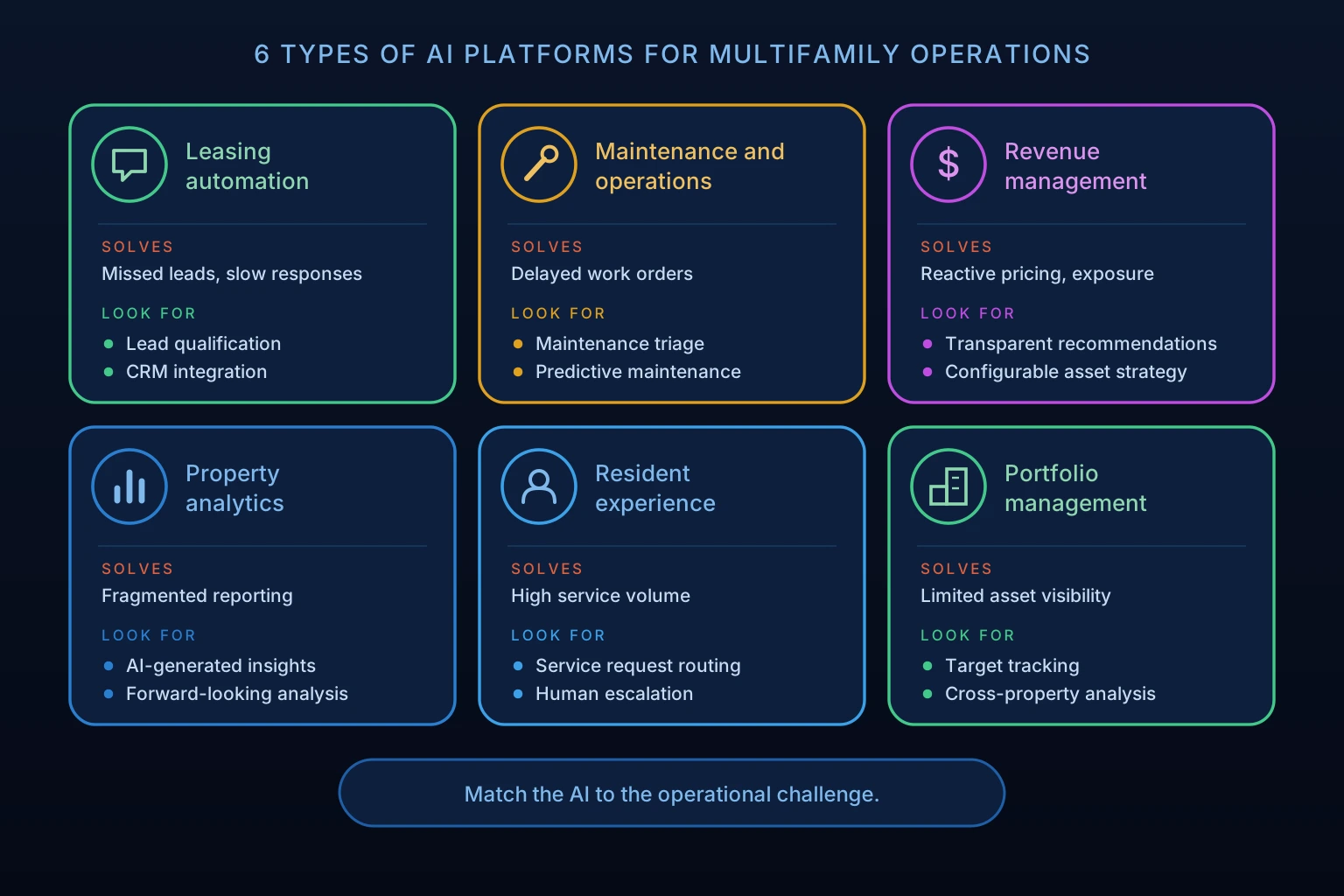
Six categories cover most of what operators evaluate today:
What Each AI Platform for Multifamily Housing Operation Does
1. Leasing automation
It handles prospect communication from the first inquiry through the tour. It responds to leads at any hour, answers common questions, qualifies prospects, schedules tours, and sends follow-up messages on a consistent cadence. The operational value shows up in response time and follow-up consistency, two factors that shape how many inquiries become tours.
Look for CRM and PMS integration so availability and lead status stay current, and for clear handoff rules that bring in a leasing agent when a prospect needs a person. Teams should also review automated messaging for accuracy and fair housing compliance before it runs at scale.
2. Maintenance and operations
These tools cover work order triage, maintenance coordination, and turnover efficiency. They can sort incoming requests by urgency, route them to the right technician or vendor, and help teams sequence make-ready work so units are ready by their move-in dates. Predictive maintenance applies equipment data and historical patterns to flag failure risk early.
According to Multi-Housing News, multifamily operators are using equipment performance data and predictive technology to detect potential maintenance problems before they become costly failures. At The Bainbridge Companies, monitoring equipment conditions has helped teams identify issues such as deteriorating pump components and HVAC problems before they caused larger disruptions.
For operators, the value extends beyond reducing emergency repairs. Earlier detection can support more efficient maintenance scheduling, minimize resident disruptions, and help teams better manage operational expenses.
Read Also:
3. Resident Experience
These platforms manage resident communication and service requests across the length of the lease. They send routine notices, confirm maintenance updates, answer common questions, and route requests to the right team member. The goal is consistent communication quality when volume rises, such as during move-in months or renewal windows.
Strong platforms include clear escalation to staff for sensitive or complex situations, multi-channel delivery, and PMS integration so contact details and lease status stay accurate. Teams should review outbound communication for tone and accuracy.
4. Revenue Management
AI-supported revenue management helps operators evaluate the relationship between pricing, occupancy, leasing demand, and future availability. Depending on the platform, capabilities may include transparent pricing recommendations, occupancy forecasting, renewal analysis, and lease expiration management.
When evaluating revenue management software, operators should look for the ability to configure property-specific objectives that reflect their asset strategy. A lease-up property working toward monthly absorption goals requires a different pricing approach than a stabilized property balancing occupancy and rent growth.
Effective platforms use the property's own operating performance, including leasing velocity, current and predicted availability, and renewal trends, to inform pricing recommendations. Publicly available market information can provide additional competitive context without replacing property-specific analysis.
Transparency and control are essential. Operators should be able to understand the reasoning behind pricing recommendations, evaluate their alignment with asset objectives, and maintain appropriate human review and authorization over pricing decisions.
5. Property Analytics
It gathers performance data into AI-generated insights that explain what changed, why it may matter, and where to investigate. It monitors leasing velocity, conversion, renewals, exposure, and pricing together, so teams see combinations of signals that individual reports would not show.
Conversational analytics allow users to ask performance questions in plain language and receive supporting charts and tables. The strongest platforms connect to the PMS so data stays current, work at the layout level where differences between configurations become visible, and flag emerging risks early enough to act on them.
6. Portfolio Management
They give asset managers visibility across multiple properties in one view. Portfolio dashboards show which assets are on track and which are drifting from plan, performance comparison helps prioritize attention, and target tracking measures results against occupancy, pricing, and renewal objectives.
This category suits operators who review properties one at a time and lose time assembling the picture before any comparison can happen. Look for flexible views, drilldown from portfolio signals to property and layout detail, and scheduled reporting that delivers the same information to asset management, revenue management, and ownership on a consistent cadence.
Top Picks:
Identify Which AI Capabilities Your Portfolio Actually Needs
Before evaluating vendors, identify the operational challenges creating the greatest inefficiencies or performance risks across your portfolio. The goal is to prioritize technology that addresses a measurable problem rather than adding capabilities simply because they're available.
Use the following framework to connect common multifamily challenges with the AI capabilities most likely to help:
Start with the challenges that have the greatest financial or operational impact. A property struggling with leasing follow-up may gain more immediate value from automation than advanced portfolio analytics. Conversely, an operator managing dozens of properties may already have efficient onsite workflows but lack the visibility needed to evaluate performance consistently.
By defining the problem and the measures of success before selecting software, operators can make more informed purchasing decisions and establish a baseline for evaluating results after implementation.
What Separates Basic AI Functionality From Actionable Intelligence?
AI capabilities fall along a progression:
- Automating workflows: Completing repetitive tasks consistently
- Displaying historical metrics: Showing what happened
- Forecasting performance: Showing where a metric appears to be heading
- Identifying actionable opportunities: Connecting related signals, explaining the findings, and pointing to where management should look next
Consider a dashboard that shows declining occupancy. That view is useful. An analytics layer that connects upcoming expirations, renewal conversion, leasing velocity, and target occupancy gives the team context for evaluating a response, such as adjusting renewal timing or reviewing pricing on the affected layouts.
When evaluating a platform, ask whether it can connect related data, explain its findings, identify emerging risks, and support management decisions. Platforms that stop at display or automation have a role, and they leave the interpretation work with your team.
Key Considerations When Selecting AI Platforms
Regardless of which operational challenge you're addressing, the right AI platform should fit your existing workflows, be practical for your team to use, and deliver measurable value.
Before selecting a solution, evaluate these considerations:
- Operational fit: Does the platform solve a clearly defined problem, or does it duplicate capabilities already available in your existing systems?
- Integration: Can it connect with the relevant property management, leasing, maintenance, or financial systems without creating additional manual work?
- Reliability and accuracy: How does the platform handle incomplete information, errors, and situations that require human intervention?
- Ease of adoption: How much training and workflow adjustment will teams need, and what ongoing support does the vendor provide?
- Measurable value: Which operational or financial metrics should improve, and how will you evaluate results after implementation?
- Data security and oversight: How is customer and resident information protected, and what controls allow operators to review AI-generated outputs and decisions?
The National Multifamily Housing Council emphasizes the importance of ongoing internal review and oversight of AI systems. Operators should consider not only what a platform can do during a demonstration, but how reliably it performs in everyday operations and how effectively their teams can manage it.
Ultimately, the strongest AI technology investments are those that integrate into existing operations, address a meaningful challenge, and deliver improvements that teams can measure over time.
How These AI Platforms Can Work Together Across Multifamily Operations
Complementary AI capabilities can support different teams without duplicating existing systems. Leasing automation improves prospect follow-up and response time. Revenue management analytics then evaluate whether leasing velocity and conversion are sufficient to meet occupancy goals. Each tool answers a different question, and the answers build on each other.
Three practices help keep a multi-platform technology stack effective:
- Connected systems: Ensure each platform integrates with the systems relevant to its purpose, whether that's the PMS, CRM, maintenance management software, or other operational data sources.
- Consistent information: Establish shared definitions for important performance metrics, including occupancy, leasing conversion, availability, and renewals, so teams can interpret results consistently across platforms.
- Clear workflow ownership: Define which systems support each process and which teams are responsible for acting on the information they provide.
Some overlap between platforms is inevitable and may be beneficial. The goal is to avoid redundant workflows, conflicting information, and unnecessary complexity. Operators should evaluate how each new platform fits into the existing technology ecosystem rather than treating every purchase as a standalone solution.
How Rentana Supports AI-Powered Revenue Management and Property Analytics
Rentana is a specialized solution for revenue management and asset performance intelligence. It works alongside the PMS and the leasing, maintenance, and resident platforms in a stack, and it does not replace them. Operators define property-specific goals, and Rentana helps teams evaluate performance against them. Each property runs in a private environment, and Rentana is SOC 2 Type II certified.
- Lease Up Mode builds data-backed monthly leasing targets around each property's pre-leasing and stabilization timeline, with pricing recommendations, forecasting, and AI Insights aligned to the property's absorption goals rather than stabilized occupancy targets.
- Configurable asset strategy settings translate each property's occupancy objectives, pricing parameters, renewal targets, and expiration management preferences into settings that help guide pricing recommendations alongside current operating performance.
- Transparent pricing recommendations at the bedroom or custom unit group level show their reasoning, so teams can review them before acting
- Predicted Occupancy connects current leasing activity, renewal trends, and future availability into a forward view of where occupancy is heading
- AI-generated Property Insights proactively identify trends, risks, and opportunities across leasing, occupancy, pricing, renewals, and exposure
- Ask Rentana lets users investigate property and portfolio performance through natural-language questions, with supporting analysis, charts, and tables
- Target Tracking monitors actual performance against occupancy, pricing, and renewal objectives
- Portfolio dashboards show which properties are on track and which need attention
Don’t Miss:
- 7 AI Adoption Challenges in Real Estate & How to Solve Them
- Top Uses of AI in Multifamily
Conclusion on Best AI Platforms for Multifamily Operations
Choosing the right AI platforms for multifamily operations goes beyond adopting the most technology. It's about identifying where automation, predictive analytics, and performance intelligence can make the greatest difference to your properties and teams.
A successful technology strategy starts with clearly defined operational challenges, measurable objectives, and tools that integrate effectively with existing workflows. Whether the priority is improving leasing efficiency, reducing maintenance disruptions, or making more informed revenue and asset management decisions, each platform should serve a defined purpose and contribute to better operational outcomes.
For multifamily operators looking to strengthen revenue management and asset performance visibility, Rentana combines configurable asset strategies, forward-looking analytics, and AI-powered insights to support more informed decisions across individual properties and portfolios.