Rent recommendation tools can help multifamily teams review pricing more efficiently, but the value of the tool depends on more than whether it produces a suggested rent.
A useful recommendation should be supported by clear operating context. Public market data may help teams understand the competitive environment, but pricing decisions also need to be evaluated alongside the property’s own leasing velocity, achieved rents, renewal trends, forward availability, exposure concentration, and asset strategy.
That distinction matters. A recommendation based primarily on external market context may show how advertised rents compare across nearby properties, but it may not fully explain whether a specific bedroom type or custom unit group is absorbing at the pace required by the asset’s occupancy goal, whether future availability is building, or whether renewal conversion is changing in a way that affects replacement risk.
The strongest rent recommendation tools help operators evaluate pricing in the context of the asset they are actually managing. They connect pricing to internal performance signals, make the reasoning behind recommendations transparent, and preserve operator control over final pricing decisions.
This article explains what rent recommendation tools do, how they differ, and what multifamily operators should evaluate before relying on a recommendation in practice.
Related:
- Apartment Rent Pricing Strategy: 7 Factors to Evaluate
- How Rentana Improves Revenue Management in Multifamily
What Is a Rent Recommendation Tool?
A rent recommendation tool is software that analyzes pricing, market, and property performance data to suggest rents for available units or unit groups.
In multifamily, these tools are commonly used to help operators review pricing more consistently and efficiently. Instead of manually pulling public market data, reviewing occupancy reports, checking leasing velocity, and comparing upcoming availability, a rent recommendation tool brings relevant signals into a pricing recommendation the team can evaluate.
The output is a recommendation, not a final decision. Operators should be able to review the reasoning, apply asset-specific judgment, and approve, modify, or decline the recommendation based on the property’s strategy.
What differentiates rent recommendation tools is what goes into the recommendation. A tool that relies primarily on public market context is solving a different problem than one that also connects pricing to internal leasing velocity, achieved rents, renewal trends, forward availability, exposure concentration, and asset-level goals.
Both may support pricing review, but the operational value depends on whether the recommendation reflects the conditions affecting the specific asset, bedroom type, or custom unit group being evaluated.
What Rent Recommendation Tools Should Analyze
Rent recommendation tools vary significantly in what they analyze and how they generate their outputs. Understanding those differences is more useful than comparing platforms by whether they all produce a suggested rent.
At a basic level, many tools can help teams review public market context, current asking rents, and recent pricing changes. That information can be useful, but it is only one part of the pricing picture.
A stronger rent recommendation process should also consider internal property performance, including:
- Leasing velocity by bedroom type or custom unit group
- Current and anticipated availability
- Exposure concentration
- Achieved rents and lease trade-outs
- Renewal conversion trends
- Concession usage
- Asset-level occupancy goals and target timeframe
This matters because pricing is not only a market-positioning question. A unit group with limited availability and strong leasing velocity may require a different evaluation than one with increasing exposure and slower absorption, even if both sit in the same broader competitive environment.
Forward availability is especially important. A recommendation based only on today’s occupancy may miss the pressure created by expirations, notices, or anticipated availability that is building over the next 30 to 90+ days.
Transparency also matters. A recommendation should show the signals influencing the suggestion so operators can understand the reasoning before deciding whether to act. Without that visibility, teams are being asked to trust an output they cannot evaluate.
The most useful tools do not replace pricing judgment. They organize the relevant context, explain the recommendation, and help operators make more consistent decisions within the asset’s independently established strategy.
Read Also:
- Multifamily Rent Growth: Public Market Trends
- Best Rental Property Software for Landlords
What to Look for When Evaluating Rent Recommendation Tools
The best way to evaluate a rent recommendation tool is to look at the quality, transparency, and usefulness of the recommendation it produces.
1. Does It Explain Its Reasoning?
A recommendation without reasoning asks the team to trust an output they cannot fully evaluate. The tools that tend to be adopted and used consistently are the ones that show which signals influenced each suggestion.
Transparency allows operators to validate the logic, apply property-specific judgment, and decide whether to approve, modify, or decline the recommendation.
2. Does It Support Custom Pricing Group Configuration?
Property-level pricing recommendations can obscure the differences that matter most. Even standard bedroom-type groupings may not be specific enough when units with the same bedroom count perform differently because of layout, renovation level, floor, view, amenity package, building, phase, or leasing velocity.
A useful rent recommendation tool should allow operators to configure pricing groups around the way inventory actually behaves. That may mean evaluating renovated and classic units separately, separating layouts within the same bedroom type, or creating custom unit groups that reflect meaningful differences in demand and performance.
This level of configuration gives operators a more accurate base for evaluating recommendations while still keeping the pricing structure understandable and manageable.
3. Does It Connect to Forward Availability?
A recommendation based only on current occupancy may miss what is coming next.
Scheduled expirations, notices to vacate, month-to-month behavior, and anticipated availability can all change the pricing context. A strong tool should help teams evaluate current pricing alongside forward availability so the recommendation reflects not only where the asset stands today, but what is anticipated under current conditions.
Top Picks:
4. Does It Reflect Asset Strategy Goals?
Different assets require different pricing frameworks. A lease-up, stabilized asset, and value-add property may have different occupancy targets, target timeframes, pricing guardrails, and effective-rent objectives.
A useful rent recommendation tool should allow recommendations to be evaluated within the property’s independently established strategy rather than applying one generic framework across every asset.
5. Does It Integrate With the PMS?
PMS integration gives a rent recommendation tool access to internal leasing, occupancy, availability, and performance data without relying on manual uploads or disconnected reporting.
That connection helps recommendations reflect the property’s own operating conditions rather than relying only on external market context or manually assembled data.
6. Does It Give Teams Shared Visibility?
Pricing decisions affect leasing teams, revenue managers, operators, and asset managers. A tool that creates visibility across those teams can support better coordination and reduce confusion around why a pricing recommendation is being reviewed.
The recommendation should not live in a black box or in one person’s workflow. Teams need shared context so pricing decisions can be evaluated consistently and explained clearly.
Read Also:
- Best Rent Analysis Tool for Multifamily Pricing Strategy
- Multifamily Rent Pricing Strategy: Complete Guide for Investors
How Rentana Approaches Rent Recommendations
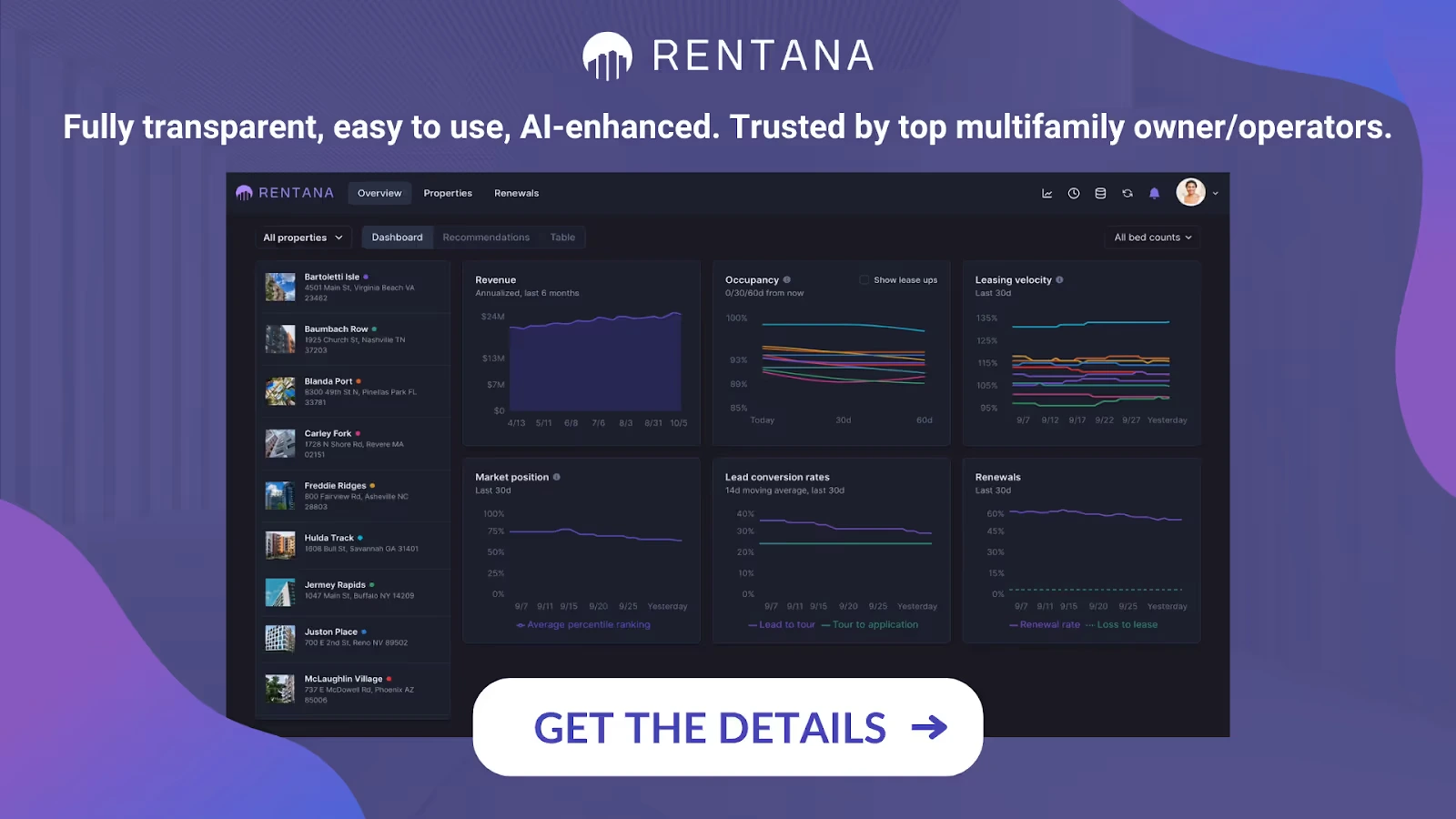
Rentana approaches rent recommendations as part of a broader revenue intelligence workflow, not as a standalone pricing output.
The goal is not only to suggest a rent. It is to help operators evaluate pricing in the context of leasing velocity, forward availability, renewal trends, exposure concentration, public market context, and asset-level strategy. That context helps teams understand why a recommendation is being surfaced before deciding whether to approve, modify, or decline it.
1. Configurable Pricing Groups
Rentana generates pricing recommendations at the bedroom-type or custom unit-group level, allowing operators to configure pricing groups around the way inventory actually performs.
That configuration can reflect meaningful differences in layout, renovation level, floor, view, amenity package, or other property-specific attributes. A renovated one-bedroom tier can be evaluated separately from an unrenovated one-bedroom. A top-floor two-bedroom with stronger demand characteristics can be separated from a lower-floor layout that performs differently.
This gives operators a more precise structure for evaluating recommendations without relying only on broad property-level averages.
2. Reasoning Attached to Every Recommendation
Rentana shows the reasoning behind each pricing recommendation before a decision is made.
The recommendation is presented with supporting context, including the signals being evaluated, leasing velocity, forward availability, public market context, and asset-level goals. That visibility helps teams understand what may be contributing to the recommendation and evaluate whether it aligns with the property’s strategy.
Operators are not asked to trust an output they cannot review. They retain control over the final decision and can approve, modify, or decline the recommendation.
3. Connected to Forward Availability and Asset Strategy
Rentana’s predicted occupancy shows what is anticipated under current conditions by connecting current leasing activity, renewal trends, and future availability.
That forward-looking context helps teams evaluate whether current pricing still aligns with upcoming exposure and occupancy goals. If future availability is concentrated in a specific unit group, or if demand is not pacing with anticipated supply, that context can be considered during pricing review.
Rentana also allows property-level configuration, including occupancy targets, pricing guardrails, and leasing velocity expectations. That means recommendations can be evaluated within the asset’s independently established strategy rather than applying one generic framework across every property.
4. PMS Integration and Shared Team Visibility
Rentana integrates with existing PMS systems to pull leasing, occupancy, pricing, and performance data into a connected operating view.
That integration reduces the need for manual exports and gives teams a more current view of internal performance data. When pricing updates are approved, Rentana can write approved changes back to the PMS, helping reduce the manual step between decision and execution.
Rentana also gives leasing managers, revenue managers, operators, and asset managers shared visibility into pricing context. Instead of pricing recommendations living in one person’s workflow, teams can review the same context and understand how pricing decisions connect to leasing activity, availability, renewal trends, and asset performance.
Conclusion on Rent Recommendation
Rent recommendation tools vary widely in how they support pricing review.
Some tools primarily help teams understand public market context. Others connect pricing recommendations to the property’s own leasing velocity, forward availability, renewal trends, exposure, achieved rents, and asset-level goals. The distinction matters because pricing decisions are not made in isolation. They are shaped by current demand, future availability, asset strategy, and the operator’s judgment.
The most useful rent recommendation tools make the pricing review process more transparent, consistent, and operationally connected. They explain the reasoning behind recommendations, support configurable pricing groups, integrate with internal performance data, and give teams shared visibility into the context behind each recommendation.
A recommendation should not replace the operator’s decision-making process. It should make that process easier to understand, easier to review, and easier to explain.