The early conversations about AI in real estate were dominated by speculation. Would it replace agents? Would it automate underwriting? Would it fundamentally reshape how properties were bought, sold, and managed? Most of that speculation missed what was actually happening, which was quieter, more practical, and in many ways more valuable than the headline predictions suggested.
What AI has actually delivered in real estate is not a wholesale transformation of the industry. It is a set of specific operational improvements that change how professionals work, what they can see, and how consistently they can evaluate information across assets, markets, and workflows. The benefit is not the technology itself. It is what technology makes possible for the people using it.
According to JLL's 2025 Global Real Estate Technology Survey, 88% of investors, owners, and landlords are already piloting AI, with most companies pursuing five pilot projects simultaneously across the real estate value chain. JLL also notes that investor priorities are shifting from basic efficiency toward growth, revenue generation, and competitive positioning.
That shift helps explain why AI is becoming more relevant across real estate. The value is not simply in automating tasks faster. It is in helping teams evaluate larger amounts of information, connect data across workflows, and identify the use cases where better visibility or faster analysis can improve business outcomes.
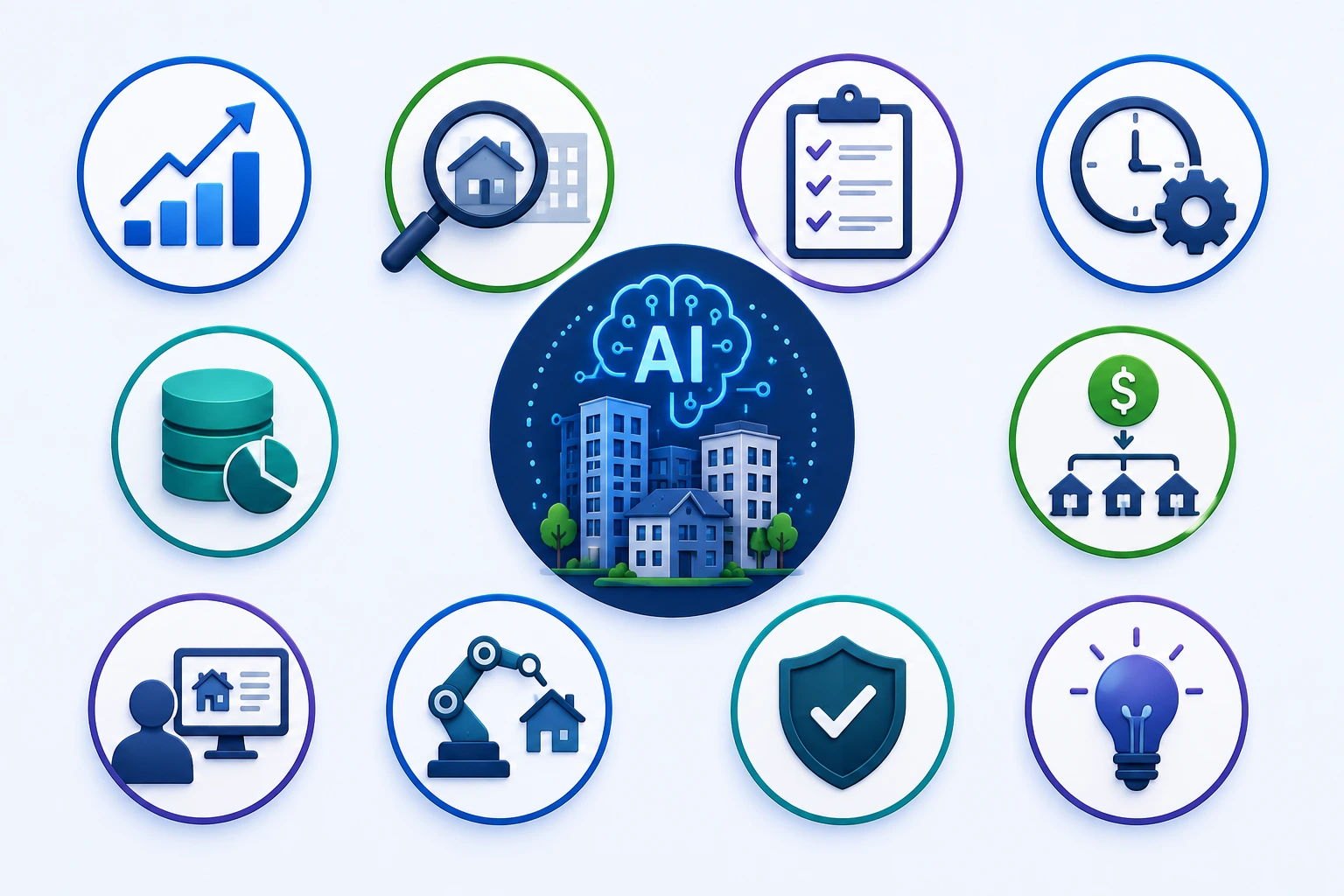
This article covers nine specific benefits of AI in real estate, each tied to a real operational problem rather than a broad technology claim. Whether you are managing a multifamily portfolio, evaluating commercial assets, or running a residential brokerage, the benefits that matter are the ones that change something specific about how you work.
Related:
9 Key Benefits of AI in Real Estate
- Faster Pattern Recognition Across Large Datasets
- More Efficient Communication Workflows
- Earlier Identification of Performance Changes
- Clearer Portfolio Prioritization
- Forward-Looking Performance Visibility
- More Connected Decision Support
- Better Team Alignment Across Functions
- Improved Asset Valuation Visibility
- More Credible Investor Conversations
Benefits of AI in Real Estate That Improve Daily Workflows
1. Faster Pattern Recognition Across Large Datasets
One of the clearest benefits of AI in real estate is its ability to review large amounts of information faster than manual analysis alone. Real estate teams often work across property management systems, leasing activity, financial reports, public market data, resident communication, and operational records. Individually, each source may tell part of the story. Together, they can reveal patterns that are difficult to identify when teams are reviewing reports one at a time.
AI tools can help organize and analyze these data points more efficiently, making it easier to identify recurring trends, unusual changes, and relationships between different parts of the business. For example, a multifamily operator may be able to compare leasing activity, occupancy, renewal behavior, and pricing performance across multiple assets more quickly than a manual review would allow.
The value is not that AI replaces the expertise of the real estate professional. It is that AI can reduce the time spent searching for patterns, allowing teams to spend more time evaluating what those patterns mean and whether they require a response.
2. More Efficient Communication Workflows
Real estate is a communication-heavy industry. Teams write emails to residents, prospects, owners, vendors, brokers, lenders, investors, and internal stakeholders every day. They also prepare meeting notes, follow-up summaries, ownership updates, variance explanations, listing descriptions, resident notices, and operational documentation.
AI tools can reduce the time required to create first drafts, summarize conversations, organize notes, and turn rough information into clearer communication. For property managers and leasing teams, this may mean faster resident updates, more consistent prospect follow-up, or cleaner vendor communication. For asset managers and ownership groups, it may mean faster summaries of performance changes, meeting outcomes, or reporting narratives.
The benefit is not that AI eliminates the need for human review. Real estate communication still requires accuracy, judgment, tone, and context. The value is that AI can reduce the friction of getting from a blank page to a usable draft, allowing teams to spend more time refining the message and less time starting from scratch.
Read Also:
- Generative AI in Real Estate: Top Use Cases & Early Adopters
- Conversational AI in Real Estate: A Complete Guide
Benefits of AI in Real Estate That Improve Visibility & Prioritization
3. Earlier Identification of Performance Shifts
Many real estate decisions are made using reports that confirm what has already happened. Occupancy declined. Expenses increased. Renewal conversion softened. Leasing velocity slowed. By the time those changes are fully visible in historical reporting, the options available to respond may already be more limited.
AI can help teams evaluate performance signals earlier by organizing current activity, identifying changes in patterns, and connecting information that may otherwise be reviewed separately.
In multifamily, that may include leasing activity, renewal behavior, future availability, occupancy trends, pricing movement, and operational performance. In other real estate sectors, it may include tenant activity, market demand, space utilization, energy performance, or asset-level financial trends.
The benefit is not certainty about the future. It is earlier visibility into the conditions that may influence future performance. When teams can see those changes sooner, they have more time to evaluate options, coordinate across functions, and make decisions before performance pressure becomes fully reflected in financial results.
4. Clearer Portfolio Prioritization
As portfolios grow, one of the biggest challenges is knowing where to focus attention first. A single property may have a leasing issue, renewal exposure, expense pressure, service concerns, or pricing questions. Across a full portfolio, those signals multiply quickly, making it difficult for teams to distinguish between normal variation and conditions that may require closer review.
AI can help teams prioritize by organizing performance information across assets and highlighting where conditions appear to be changing. Instead of reviewing every property in the same sequence or relying only on periodic reporting cycles, teams can more quickly identify which assets, unit types, or operational areas may deserve additional attention.
The benefit is not that AI decides what matters on its own. The benefit is that teams can spend less time searching across disconnected information and more time evaluating the issues most likely to affect performance. For asset managers, regional operators, and ownership groups, this creates a more focused way to manage portfolio oversight without adding unnecessary complexity.
5. Forward-Looking Performance Projections
Traditional real estate reporting is often strongest at explaining past performance. It shows where occupancy, revenue, expenses, leasing activity, or asset performance have already changed. That information is important, but it is not always enough for operators and investors who need to understand how current conditions may influence future outcomes.
AI can help real estate teams evaluate forward-looking performance signals by connecting current activity with future exposure, demand trends, renewal behavior, pricing conditions, and operational context. In multifamily, this may include understanding how leasing velocity, upcoming availability, renewal conversion, and pricing movement could affect future occupancy and revenue performance. In other real estate sectors, it may include space utilization, tenant demand, operating costs, energy usage, or market movement.
The benefit is not a guaranteed forecast. It is a clearer view of the conditions shaping future performance. When teams can evaluate those signals earlier, they can make more informed decisions about pricing, retention, marketing, capital planning, and asset strategy before the impact is fully visible in historical results.
6. More Connected Decision Support
Real estate decisions rarely depend on one metric. A pricing decision may be influenced by leasing activity, public market conditions, future availability, occupancy goals, and asset strategy. A renewal strategy may depend on resident retention, exposure risk, rent roll position, and upcoming demand conditions. An investment decision may depend on financial performance, operating trends, and future risk.
McKinsey highlights a key point for real estate teams: data and AI are most useful when they are organized around the business questions companies are trying to answer. That is the core benefit of connected decision support. The goal is not simply to add more information, but to bring the right context into the decisions teams actually need to make.
AI can improve decision support by helping teams connect information that is often reviewed separately. Instead of evaluating leasing, pricing, renewals, operations, and financial performance in isolation, teams can use AI-enabled tools to bring more context into the decision-making process. This helps reduce the risk of making decisions based on an incomplete or outdated view of the asset.
The benefit is not that AI tells teams what to do. It is that AI can help organize relevant signals, explain contributing factors, and provide clearer context for human judgment. For operators, asset managers, and investors, better decision support means more consistent evaluation, better-informed discussions, and decisions that are more closely aligned with the asset’s strategy and objectives.
Related:
- How to Use AI for Real Estate Analysis
- Top AI Applications in Real Estate
7. Better Team Alignment Across Functions
Real estate performance is rarely managed by one team alone. Leasing teams may be focused on traffic and conversion. Property managers may be focused on service delivery and occupancy. Revenue managers may be focused on pricing strategy. Asset managers and ownership groups may be focused on NOI, valuation, risk, and investment performance. When each team is working from different reports, systems, or interpretations of performance, alignment becomes harder.
AI-enabled platforms can help create a more consistent understanding of what is happening across an asset or portfolio. By organizing information across functions, these tools make it easier for teams to discuss the same performance signals, evaluate the same context, and coordinate decisions around shared objectives.
The benefit is not simply better reporting. It is better coordination. When teams have a common view of changing conditions, conversations can move more quickly from reconciling information to evaluating what those changes mean and how they relate to the asset’s broader strategy.
Benefits of AI in Real Estate That Improve Asset and Investment Outcomes
8. Improved Asset Valuation Visibility
Asset value is influenced by more than a single financial metric. NOI, rent growth, occupancy, retention, operating expenses, capital needs, and perceived risk all affect how an asset is evaluated. Traditional valuation work remains essential, but it often depends on assumptions that can change as operating conditions shift.
AI can help real estate teams evaluate the signals that influence valuation more consistently. In multifamily, that may include leasing velocity, renewal conversion, exposure, pricing trends, expense pressure, and changes in market demand. When those signals are easier to review together, asset managers and ownership groups can better understand where performance is strengthening, where risk may be emerging, and how current operating conditions may affect future value.
The benefit is not that AI replaces valuation models, investment judgment, or market expertise. It is that AI can provide better visibility into the operating conditions that support those decisions. For owners and asset managers, that can lead to more informed discussions around asset strategy, hold/sell decisions, capital planning, and performance expectations.
9. More Credible Investor Conversations
Investor conversations depend on more than reporting results. Owners, operators, and asset managers need to explain what happened, why it happened, what conditions are changing, and how those conditions may affect future performance. When teams rely only on static reports or disconnected updates, it can be difficult to tell a clear, consistent story about asset performance.
AI can help real estate teams prepare for investor conversations by organizing performance information, summarizing key changes, and connecting operating signals that may otherwise be reviewed separately. In multifamily, this may include leasing activity, renewal performance, occupancy trends, pricing movement, expense pressure, and future availability. In other sectors, it may include tenant activity, utilization trends, market movement, capital needs, or operating performance.
The benefit is not that AI replaces investor judgment or relationship management. It is that teams can enter investor conversations with clearer context, better-prepared explanations, and a more consistent understanding of the factors influencing performance. That can make discussions around strategy, risk, capital planning, and future expectations more credible and productive.
Read Also:
- AI Adoption Challenges in Real Estate & How to Solve Them
- Will AI Replace Real Estate Agents? Or Transform Them?
How Rentana Supports AI-Enabled Asset Performance Management
For multifamily operators, many of the benefits of AI come together around asset performance management. Teams need to understand what is changing across the portfolio, which assets or unit groups require closer review, and how leasing, renewals, pricing, occupancy, and future availability connect to broader revenue and asset objectives.
Rentana is designed to support that work by giving multifamily teams shared visibility into changing conditions across the portfolio. AI-generated property insights help teams understand what is happening at an asset and why it matters operationally. Pricing recommendations are generated in the contest of the asset strategy configured by the operator, including occupancy goals and timeframes. Predicted Occupancy shows what is anticipated to happen under current conditions, helping teams evaluate whether changes may be needed to support the asset’s occupancy and revenue goals.
The value is not simply faster reporting or more data in one place. It is helping asset managers, revenue managers, operators, and ownership groups evaluate performance with clearer context, prioritize attention more effectively, and coordinate decisions around the same information.
Conclusion on Benefits of AI in Real Estate
The benefits of AI in real estate are strongest when the technology is tied to a specific business problem. Faster communication, stronger pattern recognition, clearer portfolio visibility, better decision support, and more informed investor conversations all matter because they improve how teams work, what they can see, and how consistently they can evaluate performance.
The goal is not to replace real estate expertise. It is to give teams better tools for organizing information, identifying relevant signals, and understanding changing conditions across assets and portfolios. AI is most valuable when it helps people make more informed decisions, coordinate more effectively, and focus attention where it matters most.
For real estate organizations, the next step is not simply adopting more AI tools. It is choosing the use cases that align with business objectives, data quality, workflows, and the decisions teams need to make. When AI is applied with that level of focus, it becomes less about experimentation and more about improving the way real estate teams manage performance, strategy, and value.