AI has become a practical part of how multifamily operators analyze performance, surface patterns, and support revenue decisions. The value is not in replacing the judgment that revenue management requires. It is in processing more operational data, more consistently, and surfacing what matters before it becomes visible in standard reports.
This article covers what AI can realistically do in multifamily performance analysis, where it adds the most operational value, and how Ask Rentana specifically helps users analyze property performance and navigate operational data within the platform.
Related:
- Real Estate Asset Performance Analytics: Turning Data Into Operating Context
- Multifamily Data Analysis: What It Is and Why It Matters
What AI Can Analyze in Multifamily Operations
AI in multifamily operations analysis works best when it is applied to internal operational data: the leasing activity, pricing performance, renewal behavior, availability conditions, and portfolio signals that come directly from the PMS and the platform connected to it.
According to the National Multifamily Housing Council's AI Fact Sheet, housing operators are using AI platforms to overcome labor market challenges, improve accuracy in resident screening, and combat fraud in the application and leasing process, while housing owners and financiers are leveraging AI to improve efficiencies, underwrite lending, and identify investment opportunities.
The analytical value of AI in multifamily extends across the full operational lifecycle, from leasing and screening through performance monitoring and portfolio management.
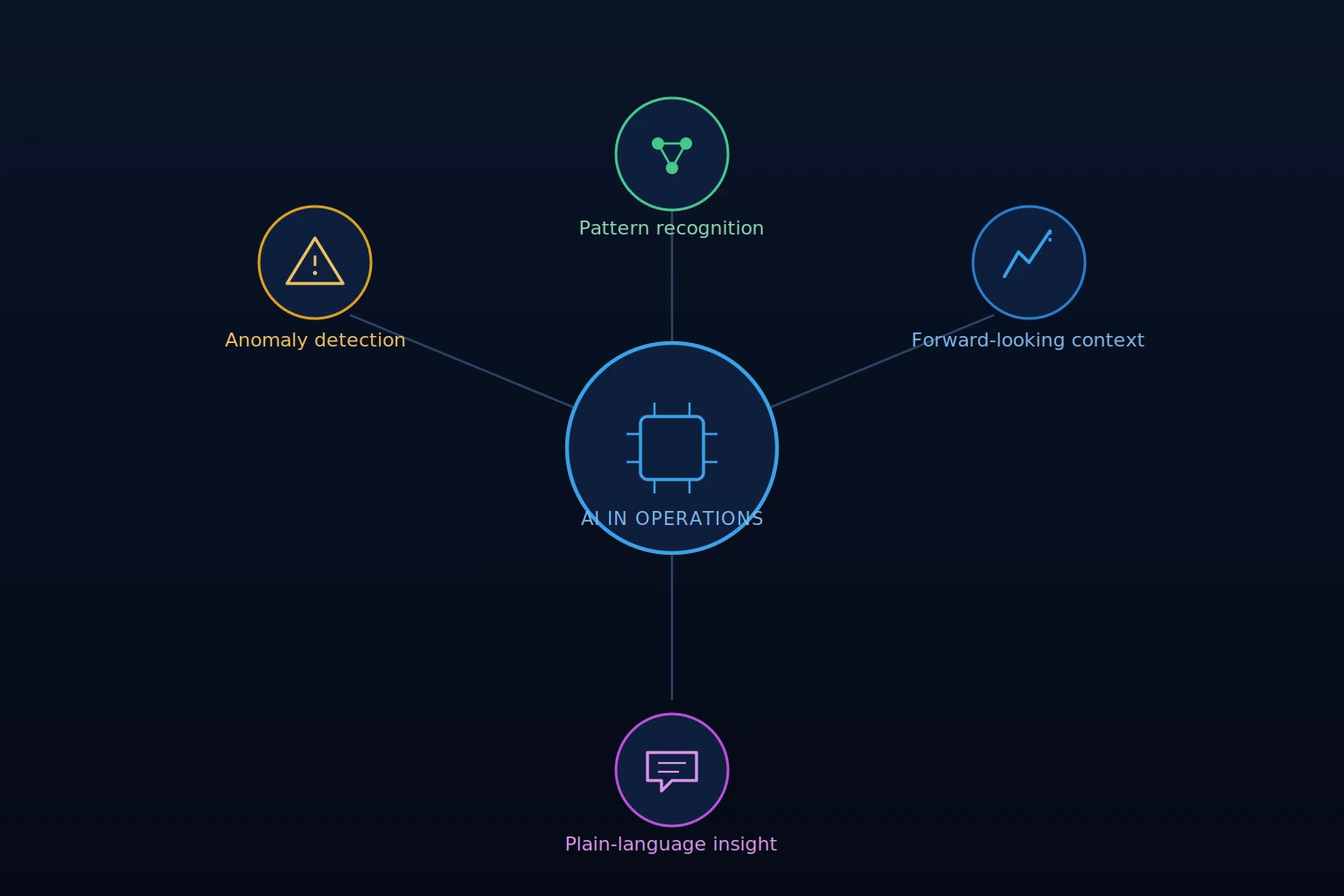
The areas where AI adds the most analytical value in multifamily are:
- Pattern recognition across multiple signals simultaneously. Identifying when leasing velocity, renewal conversion, and forward exposure are all shifting together at the same asset, rather than surfacing each metric independently
- Anomaly detection at scale. Flagging where a specific layout or property is diverging from its own historical performance or from comparable assets in the portfolio
- Forward-looking context. Helping teams interpret current leasing activity, renewal trends, exposure, and upcoming availability alongside forward-looking performance metrics
- Summarizing complex operational conditions. Translating combinations of signals into plain-language insights that explain what is changing and why it may matter, rather than presenting data that still requires significant interpretation before a decision can follow
What AI in operational analysis does not do is replace the human judgment required to evaluate those signals against asset strategy, decide what response is appropriate, and take responsibility for the outcome.
How AI Helps Surface Performance Changes Faster
The operational cost of discovering a performance shift late is almost always higher than the cost of catching it early. A leasing velocity decline identified at three weeks has more available responses than the same decline discovered at eight, after it has already started affecting occupancy.
AI-generated Insights can help surface performance changes earlier by analyzing operational signals across the portfolio rather than waiting for a scheduled review to surface them. Patterns that would require significant manual analytical time to find, a specific two-bedroom layout absorbing 20 days slower than the rest of the property, or renewal conversion softening over six consecutive weeks in a specific expiration window, can be identified and surfaced automatically.
Top Picks:
- How To Do A Rental Market Analysis Like a Pro (With AI Tools)
- AI for Public Rental Market Analysis by Zip Code
1. AI for Pricing and Revenue Analysis
Technology supports pricing analysis by connecting pricing recommendations with the operational context needed to evaluate them. Rentana uses purpose-built pricing algorithms to generate recommendations, while AI-generated Insights can help teams understand related changes in leasing and property performance.
The most useful AI-supported pricing analysis:
- Evaluates pricing at the layout or custom unit group level rather than the property level, where averages obscure the differences that matter most
- Connects pricing performance to leasing velocity in the same unit segment, so a slowdown in absorption is visible alongside the pricing conditions that may be contributing to it
- Incorporates forward availability into the pricing evaluation, so recommendations reflect where conditions are heading and not only where they currently stand
- Shows the reasoning and supporting property-level factors behind each pricing recommendation, so the revenue manager can evaluate the inputs and apply their own judgment before acting
Pricing recommendations remain decision support, not automated pricing. Operators retain control over whether and how to act on them.
2. AI for Leasing and Funnel Analysis
Leasing analysis benefits from AI primarily through pattern recognition at the unit type and funnel stage level, where the signals that explain a leasing challenge are often invisible in property-level aggregates.
AI-supported leasing analysis can:
- Identify where leasing velocity is running below pace relative to forward availability and occupancy targets, at the layout level rather than only at the property level
- Surface funnel conversion drops at specific stages, distinguishing between a volume problem at the top of the pipeline and a conversion problem further down
- Flag lead sources where inquiry volume and downstream conversion are moving in different directions, indicating a marketing efficiency problem that aggregate leasing numbers would not surface
- Identify patterns across multiple properties simultaneously, such as a tour conversion decline appearing across several assets in the same week, that would be missed in sequential property-level reviews
3. AI for Renewals, Occupancy, and Exposure
Renewal and exposure analysis is where AI in multifamily operations adds some of its most direct forward-looking value, because both involve connecting current behavior to future availability conditions that will determine occupancy weeks before they show up in financial reporting.
AI-supported renewal and exposure analysis can:
- Track renewal conversion trends by unit type over rolling periods, surfacing softening before it reaches occupancy numbers
- Connect renewal conversion signals to forward exposure concentration, so the combination of softening retention and upcoming availability pressure is visible as a single forward risk rather than two separate data points
- Bring scheduled expirations and known upcoming availability into the forward view, with additional anticipated availability such as month-to-month behavior and early terminations incorporated based on historical performance, producing a more complete view of what is actually coming to market than a standard expiration schedule provides
- Provide additional context alongside forward occupancy visibility based on current leasing activity, renewal trends, and upcoming availability, renewal trends, and upcoming availability into a signal that shows where occupancy appears to be heading under current conditions
Why AI Should Support, Not Replace, Revenue Management Judgment
AI in multifamily revenue analysis is a decision-support layer. It surfaces patterns, connects signals, and helps teams interpret performance changes. The strategy, the response, and the accountability for outcomes belong to the revenue management team.
This distinction matters operationally. A pricing recommendation is an input that should be evaluated against asset strategy, current conditions the system may not fully capture, and the revenue manager's knowledge of the specific property and market. A renewal insight that flags softening conversion is a prompt to investigate, not an instruction to act.
According to Multi-Housing News' reporting on AI in multifamily, AI technology offers the potential to analyze vast amounts of data more quickly and efficiently than manual processes allow, with portfolio management among the clearest practical applications. The analytical value comes from pattern recognition across connected signals, not from any single metric reviewed in isolation, and the decisions that follow from those signals remain the responsibility of the team evaluating them.
Read Also:
- How to do a Comparative Market Analysis in Real Estate
- How to Run a SWOT Analysis in Real Estate: Complete Guide
How Ask Rentana Helps Multifamily Teams Analyze Property Performance and Navigate Rentana Data
Ask Rentana is a conversational AI feature within the Rentana platform that helps users analyze their own property and portfolio performance data and navigate the platform more effectively.
Users can ask Ask Rentana questions about their operational data directly, such as how leasing velocity is trending for a specific layout, where renewal conversion stands relative to prior periods, what the forward exposure picture looks like for a specific property, or how to find a specific metric or report within the platform.
Ask Rentana draws on the operational data connected to the user's Rentana account through their PMS integration. It does not access non-public competitor data, proprietary market information, or data outside of what the operator's own portfolio has generated. The analysis it supports is focused on the operator’s own operational data, including many of the same pricing, leasing, renewal, occupancy, and exposure signals available elsewhere throughout the platform.
Ask Rentana is most useful for:
- Getting quick answers about current performance conditions without navigating to a specific report
- Understanding what a metric means, how it is calculated, or where to find it within the platform
- Exploring performance across multiple dimensions in a single conversational flow rather than opening multiple views
- Surfacing context around a specific signal, such as what else is changing at an asset alongside a leasing velocity flag, before deciding whether and how to act
Like all AI in the platform, Ask Rentana supports decision-making. The judgment and strategy behind every response remains with the user.
Don’t Miss:
- Best Rent Analysis Tool for Landlords
- How to Conduct a Tenant Retention Analysis for Multifamily Properties
Conclusion on AI for Multifamily Market Analysis
AI supports multifamily performance analysis by surfacing patterns faster, connecting signals that belong together, and generating forward visibility into where occupancy and revenue are heading. What it does not do is replace the revenue management judgment required to evaluate those signals, decide what response is appropriate, and take responsibility for the outcome.
The most effective multifamily teams use AI to handle the analytical work that would otherwise consume time without adding strategic value, and apply their own expertise to the decisions that follow from what the analysis surfaces.