


For most landlords, an eviction in an applicant's rental history is one of the factors that receives close attention during the screening process. It indicates that a previous tenancy ended through a legal process rather than a standard move-out, which raises questions a landlord will typically want to understand before making a leasing decision.
Checking for eviction history is not as straightforward as it might seem. Eviction records are not centralized in a single national database. They exist across thousands of county court systems, tenant screening bureaus, and credit reporting agencies, each with different levels of completeness, accuracy, and accessibility. Knowing which methods actually surface relevant eviction history, and which ones miss it, is an important part of building a screening process that is both effective and legally defensible.
This guide covers how landlords check for eviction history, what each method reveals, and what both landlords and applicants need to understand about how that information is used in the screening process.
Read Also:
What Is Eviction History?
Eviction history refers to the record of any legal eviction proceedings that have been initiated against a tenant in the past. It is not a single document or database entry but a collection of records that may exist across multiple sources depending on how far a proceeding progressed and in which jurisdiction it occurred.
It is important to distinguish between an eviction filing and an eviction judgment. An eviction filing, sometimes called an unlawful detainer action, is a court case initiated by a landlord seeking to remove a tenant. A filing does not mean the landlord prevailed or that the tenant was actually removed from the property.
Many eviction filings are resolved before a judgment is entered, sometimes because the tenant paid overdue rent, sometimes because the landlord withdrew the case, and sometimes because the court ruled in the tenant's favor.
An eviction judgment is a court ruling in the landlord's favor that legally authorizes the removal of the tenant. A judgment is a more definitive legal outcome than a filing, though the circumstances that led to it can vary significantly from case to case.
This distinction matters because many tenant screening tools report eviction filings alongside judgments without clearly differentiating between the two. An applicant with a filing on their record may have a very different history than one with a judgment, and a screening process that treats both identically without understanding the underlying circumstances may screen out applicants based on incomplete information.
Top 7 Methods Landlords Use to Check for Eviction History
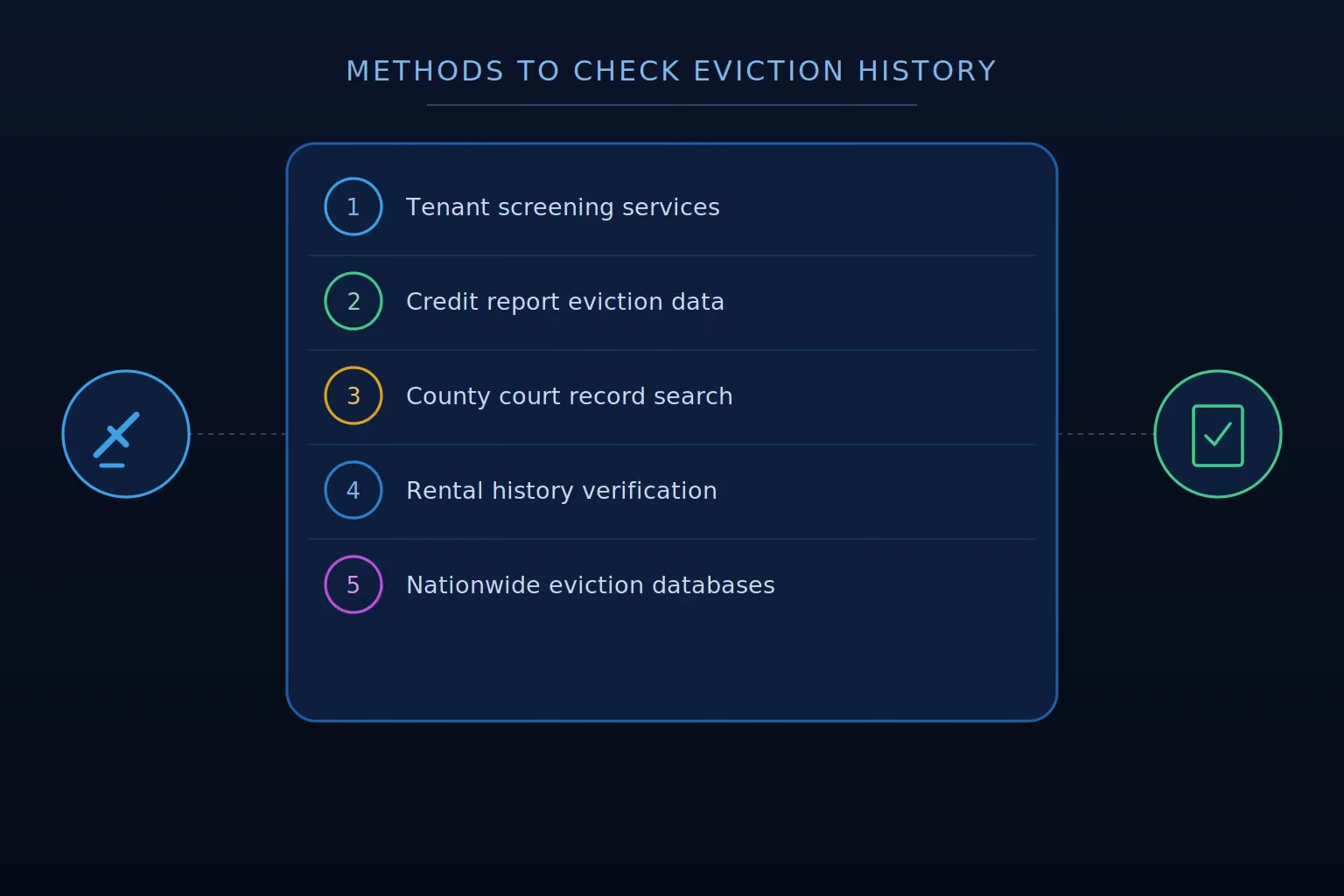
1. Tenant Screening Services
Tenant screening services are the most commonly used method for checking eviction history in residential real estate. These platforms compile data from court records, credit bureaus, and other public sources into a single report that landlords can order as part of the application process. Most screening services search eviction records across multiple counties and states simultaneously, which gives landlords broader coverage than a manual court search would produce.
The quality and completeness of eviction data varies significantly between screening services.
Some platforms have deeper court record coverage than others, and the frequency with which records are updated affects how current the information is. Landlords evaluating screening services should ask specifically about the geographic coverage of their eviction database, how frequently records are updated, and whether the report distinguishes between filings and judgments.
2. Credit Report Eviction Data
Eviction judgments that resulted in a monetary award can appear on a tenant's credit report as a civil judgment or collection account. Major credit bureaus may include this information in a credit report, giving landlords another data point that may surface eviction-related financial history even when a standalone eviction search misses it.
It is worth noting that credit reports do not capture eviction filings that did not result in a monetary judgment, which means relying solely on credit report data will miss a significant portion of eviction history. Credit report eviction data is most useful as a supplementary check alongside a dedicated eviction record search rather than as a standalone method.
3. County Court Record Searches
Eviction proceedings are filed at the county court level, which means county court records are the original source of eviction data that tenant screening services aggregate. Landlords who want the most current and complete eviction history for a specific jurisdiction can search county court records directly, either through the court's online portal where one exists or by requesting records in person at the courthouse.
The limitation of manual county court searches is geographic coverage. A landlord who searches only the county where their property is located will miss eviction history from other counties or states where the applicant previously lived.
For applicants who have moved frequently across multiple jurisdictions, a comprehensive eviction search requires searching multiple court systems, which is time-consuming to do manually and is one of the primary reasons landlords use screening services to aggregate that data.
Read Also:
4. Rental History Verification
Contacting previous landlords directly is one of the most informative methods available for understanding an applicant's rental history, including any tenancy that ended through a legal process.
A previous landlord who is willing to speak candidly can provide context that no database search can offer, including the circumstances surrounding an eviction filing, whether the matter was resolved, and how the tenant behaved throughout the tenancy.
The limitation of rental history verification is its dependence on cooperation. Some previous landlords will only confirm dates of tenancy and rent amounts due to liability concerns. Others may not be reachable. And some applicants may omit previous landlords from their application history to avoid a reference that might reflect negatively on them. Cross-referencing the landlord references provided on an application against the addresses listed on the credit report is one way to identify gaps in the rental history an applicant has disclosed.
5. Nationwide Eviction Databases
Several private companies maintain nationwide eviction databases compiled from court records across the country. These databases offer broader geographic coverage than a single-county search and are frequently integrated into tenant screening platforms as a supplementary data source alongside credit and background check information.
The accuracy and completeness of nationwide eviction databases varies and is not guaranteed.
Records may be missing from jurisdictions where court data is not digitized or publicly accessible, and the lag between when a court record is created and when it appears in a private database can mean that recent eviction filings are not yet reflected.
Landlords using nationwide eviction databases should understand these limitations and treat the results as one input among several rather than as a definitive and complete eviction history.
6. Background Check Services
General background check services that search public records for criminal history, civil judgments, and court filings often include eviction data as part of their standard report. These services are useful for landlords who want a consolidated view of an applicant's public record history rather than ordering separate reports for each category of information.
The eviction coverage in general background check services is typically less specialized than that of dedicated tenant screening platforms, which focus specifically on rental history data and often have deeper relationships with court record providers.
For landlords whose primary concern is eviction history rather than criminal background, a dedicated tenant screening service will generally provide more complete and more current eviction data than a general background check platform.
Top Picks:
7. Self-Reported Application History
Many rental applications ask applicants directly whether they have been subject to eviction proceedings in the past. While self-reported information is not independently verifiable without a third-party search, the application question serves two purposes.
First, it gives applicants the opportunity to disclose and contextualize any eviction history before the landlord discovers it through a screening report, which can work in the applicant's favor if the circumstances were straightforward and the applicant addresses them honestly.
Second, a material discrepancy between what an applicant discloses on their application and what a screening report reveals is itself meaningful information about the applicant's candor during the application process.
Landlords who ask about eviction history on their application should apply the question consistently to all applicants and document how disclosures are handled, both to ensure fair and consistent treatment and to maintain a clear record if a screening decision is ever questioned.
Fair Housing and Legal Considerations When Using Eviction History in Screening
Using eviction history as a screening criterion is legally permissible in most jurisdictions, but how it is applied matters significantly.
A growing body of federal guidance, state law, and local ordinance governs how landlords can and cannot use eviction records in tenant screening, and staying current on those requirements is an essential part of operating a legally defensible screening process.
Federal Fair Housing Considerations
- The Fair Housing Act prohibits discrimination based on race, color, national origin, religion, sex, familial status, and disability
- Screening criteria that appear neutral on their face, including eviction history policies, can create fair housing liability if they produce a disparate impact on protected classes
- HUD guidance has made clear that blanket policies excluding all applicants with any eviction record may constitute unlawful discrimination if they disproportionately affect protected groups without being justified by a legitimate business necessity
- Landlords should be able to demonstrate that their eviction screening criteria are narrowly tailored to address genuine tenancy risk rather than functioning as a broad exclusionary screen
Jurisdictions That Limit Eviction Record Use
- A growing number of states and cities have enacted laws that restrict how eviction records can be used in tenant screening
- Some jurisdictions prohibit landlords from considering eviction filings that did not result in a judgment in the tenant's favor or that were dismissed
- Others impose time limits on how far back a landlord can look, typically limiting consideration to evictions within the past three to seven years
- Seattle, San Francisco, Portland, and several other cities have enacted specific eviction screening ordinances that go beyond state law requirements
- Landlords operating in multiple jurisdictions should verify the specific rules applicable in each location rather than applying a single national policy
Read Also:
- 1031 Exchange in Real Estate, Explained
- 1033 Exchange in Real Estate, Fully Explained
Source of Income Protections
- An increasing number of states and cities prohibit landlords from rejecting applicants based on their source of income, including housing vouchers
- In jurisdictions with source of income protections, eviction screening criteria cannot be applied in a way that effectively excludes voucher holders if doing so would violate those protections
- Landlords should understand the source of income laws in their market before applying eviction screening criteria that may interact with those protections
Best Practices for Legal Compliance
- Apply eviction screening criteria consistently to every applicant for the same unit without exception
- Document the specific criteria used and how they were applied to each application
- Distinguish between eviction filings and judgments in your screening policy and consider the circumstances of each rather than applying a blanket rule
- Give applicants the opportunity to provide context about any eviction history before a final decision is made
- Review your screening criteria with a qualified attorney familiar with landlord-tenant law in your specific jurisdiction, particularly if you operate in a market with active tenant protection legislation


