The multifamily technology landscape has never been more crowded or more consequential. Operators are managing leaner teams, tighter margins, and more complex portfolios, and the tools they rely on increasingly determine how quickly they can identify and respond to what is changing in their properties.
According to Multi-Housing News’ RETCON Special Report, multifamily owners and operators are zeroed in on NOI growth and eager to incorporate innovations that infuse efficiencies into their operations, with CEOs of major operators citing the challenge of choosing the right platforms from an ever-expanding vendor landscape. The question has shifted from whether to invest in technology to which solutions actually solve the problems that matter most.
This article covers the eight multifamily solution categories leading operators are using in 2026, how to evaluate them, and where Rentana fits into the stack.
Related:
- What is a Good Cap Rate for Multifamily Properties?
- How To Calculate the Value of a Multifamily Property Easily
What Are Multifamily Solutions?
Multifamily solutions are the software, systems, and operational tools apartment operators use to manage leasing, pricing, renewals, maintenance, resident experience, reporting, and portfolio performance. They range from the PMS that serves as the operational system of record to AI-powered analytics platforms that surface what is changing across a portfolio before it reaches financial reporting.
The most effective multifamily solution stacks are built around a clear understanding of which operational problem each tool is solving and how the tools connect to each other through shared data rather than operating as isolated systems requiring manual reconciliation.
Why Multifamily Operators Are Rebuilding Their Tech Stacks
The strongest operators in the current market will be those that use data, technology, and disciplined capital strategies to navigate volatility, with technology becoming a practical operating advantage especially for larger and more experienced platforms. Better data and systems help operators manage leasing, renewals, maintenance, staffing, and resident experience more consistently across markets.
The pressure driving tech stack rebuilds in 2026 is not technology enthusiasm. It is an operational necessity. Rent growth has moderated. Expenses are elevated. Investors are pressing for clearer performance visibility. Teams are leaner. The operators responding most effectively are the ones whose tools reduce manual work, improve decision timing, and give every function shared visibility into the same current operational picture.
8 Multifamily Solutions Leading Operators Are Using in 2026
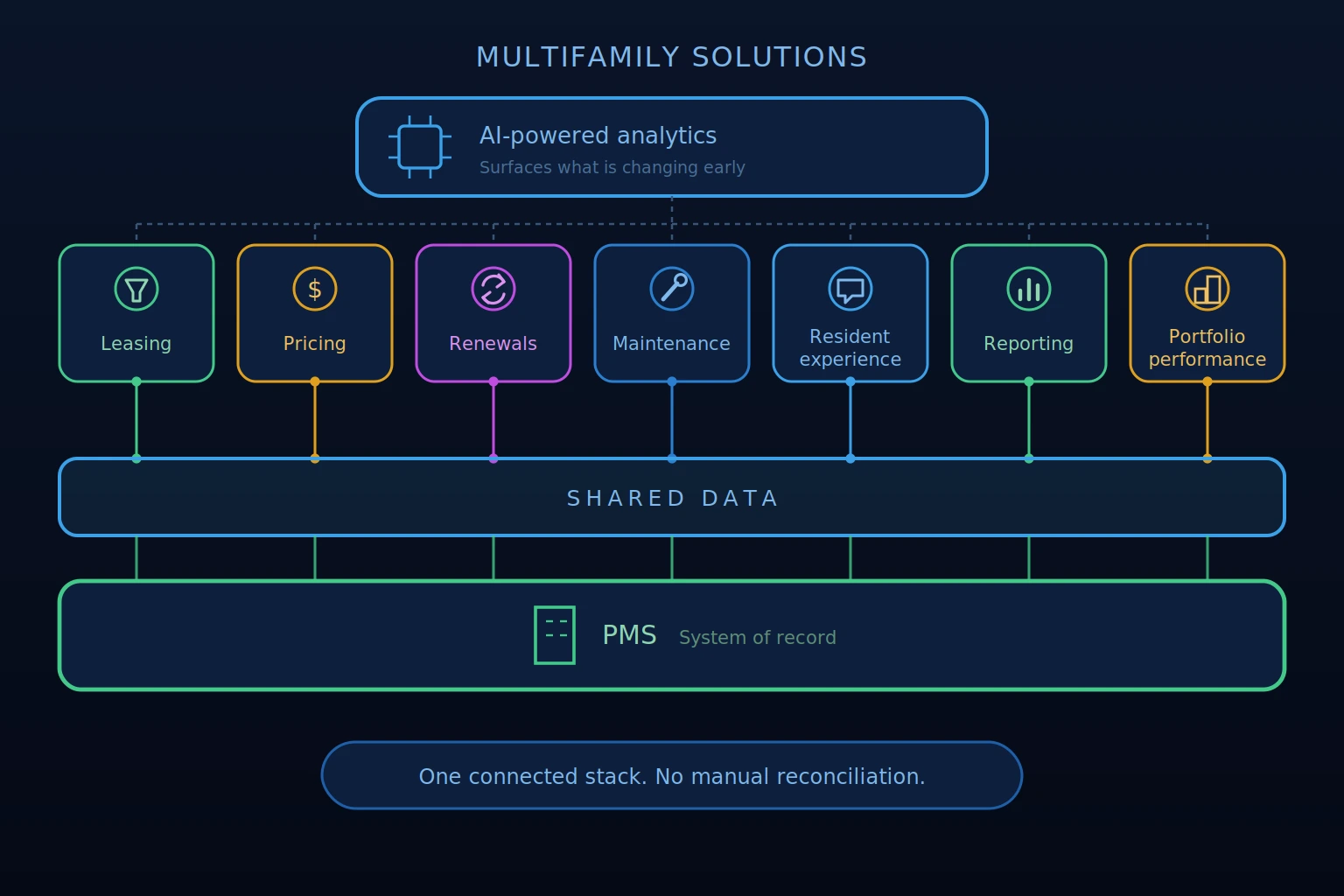
- Property Management Systems
- Leasing and CRM Solutions
- Revenue Management and Pricing Solutions
- Renewal Management Solutions
- Maintenance and Work Order Platforms
- Resident Communication Tools
- Reporting and Analytics Solutions
- AI-Powered Multifamily Solutions
1. Property Management Systems
Property management systems remain the operational system of record for every multifamily portfolio. It stores leases, processes rent, tracks maintenance, manages accounting, and holds the resident data that every other platform in the stack depends on.
The most important PMS evaluation criterion is not feature depth. It is an integration quality. A PMS that does not connect cleanly to pricing, analytics, leasing, and reporting tools creates data silos that require manual reconciliation before any cross-functional analysis can begin. The PMS should be the data foundation, not a bottleneck.
2. Leasing and CRM Solutions
Leasing and CRM platforms manage the prospect journey from first inquiry through signed lease, tracking every interaction and keeping the pipeline visible across the leasing team at all times. AI-powered leasing tools handle after-hours inquiry response and follow-up sequences automatically, ensuring every prospect receives a timely first response regardless of when they reach out.
The National Apartment Association’s State of Rental Housing 2026 report notes that rental housing professionals are using technology across leasing, resident communication, reminders, data entry, reporting, and back-office processes.
Leasing and CRM tools are part of that broader shift toward connected workflows that reduce manual follow-up and keep the prospect journey visible. Leasing tools that connect inquiry volume to funnel conversion by stage give teams the visibility to distinguish between a top-of-funnel problem and a mid-funnel conversion problem.
3. Revenue Management and Pricing Solutions
Revenue management and pricing solutions help operators evaluate availability, leasing velocity, demand conditions, forward exposure, renewal trends, publicly available market context, and asset strategy before making pricing decisions at the layout level. The most useful pricing tools generate recommendations with reasoning visible so revenue managers can evaluate the logic before acting.
Rentana supports this category for multifamily operators by generating pricing recommendations at the bedroom or custom unit group level with the reasoning attached, connected to leasing performance, forward availability, predicted occupancy, and asset strategy alignment. Approved pricing updates can be connected back to the PMS, reducing the manual steps between the decision and execution.
Read Also:
- What is Multifamily Syndication in Real Estate?
- 25 Interesting Multifamily Housing Statistics You Didn't Know
4. Renewal Management Solutions
Renewal management solutions support outreach timing, offer pricing, and conversion tracking across expiring leases. When renewal strategy is managed as an administrative calendar function rather than a forward-looking operational discipline, preventable turnover costs accumulate across every lease cycle.
The most effective renewal tools connect renewal offer pricing to current leasing conditions, forward exposure concentration, and occupancy targets so outreach reflects actual conditions rather than a fixed escalation applied uniformly across all expiring leases. Renewal conversion tracked by layout and expiration window over rolling periods gives teams earlier visibility into where retention is softening before it affects forward availability.
5. Maintenance and Work Order Platforms
Maintenance platforms manage work order submission, routing, vendor coordination, and completion tracking. Some maintenance tools are adding predictive and AI-assisted capabilities that help teams identify recurring issues, prioritize work, or flag potential equipment risk earlier. For portfolios with aging assets or high maintenance volume, better maintenance visibility can support expense control and resident experience.
Maintenance platform integration with the PMS ensures work order data and costs flow automatically into the same system as financial data, supporting accurate expense reporting and identifying recurring issues before they compound into capital planning problems.
6. Resident Communication Tools
Resident communication platforms automate routine notifications, maintenance updates, policy communications, and community announcements. The operational benefit is consistent communication quality regardless of team capacity or inquiry volume, with staff time redirected toward the conversations that require human judgment rather than routine follow-up.
The most useful resident communication tools integrate with the PMS so contact information and lease status are always current, and support multi-channel delivery that reaches residents through their preferred communication method rather than defaulting to a single channel for all residents regardless of response behavior.
7. Reporting and Analytics Solutions
Reporting and analytics platforms aggregate operational data from PMS and other connected systems into views that support decision-making at the property, revenue management, asset management, and ownership levels. The most useful analytics platforms surface what is changing and where performance is heading rather than only describing what already happened.
Portfolio-level dashboards that surface where assets need attention without sequential manual review, combined with property and layout-level drilldowns that explain what is driving portfolio signals, give asset managers both the prioritization view and the operational detail they need without maintaining separate reports for each function.
8. AI-Powered Multifamily Solutions
AI in multifamily operations adds value primarily through pattern recognition across connected signals, plain-language summaries of what is changing and why it may matter, and the surfacing of conditions that would take significantly longer to identify through manual review. AI should support human decision-making rather than replace the judgment, strategy, and accountability that operations require.
Rentana’s AI-generated Insights surface what is changing at specific assets, explain why it may matter given current operational conditions, and help teams understand where to focus.
Ask Rentana allows users to ask conversational questions about their own property and portfolio performance data without navigating to a specific report, with outputs grounded in the operator’s own PMS-connected data rather than general market assumptions.
Related:
- Multifamily vs Single Family: Which is a Better Investment?
- How to Analyze Multifamily Investment Opportunities
How to Evaluate Multifamily Solutions
According to Multi-Housing News’ RETCON coverage, leading operators recommend separating symptoms from root problems before evaluating any solution, not letting vendors drive the selection process, and sweating the configuration detail because how a tool is set up determines whether it actually solves the problem it was purchased for.
The evaluation criteria that matter most across all categories:
- PMS integration: Does it connect to the PMS automatically or require manual data management?
- Clear workflow fit: Does it solve a specific operational problem the team currently has?
- Portfolio visibility: Can it surface cross-portfolio performance without sequential manual review?
- Property-level drilldowns: Can it move from a portfolio signal to property and layout detail within the same platform?
- Reporting and scheduled reports: Does it support recurring automated delivery to the right audiences?
- AI-generated context: Does it explain what changed and why it may matter, not just present data?
- Pricing and renewal support: Does it connect pricing and renewal decisions to current operational conditions?
- Ease of adoption: Will the team actually use it consistently, or does it require significant process changes to get value?
- Role-based access: Does it give each function the view it needs without overwhelming team members with irrelevant data?
- Clear implementation process: Is there a structured onboarding process that connects the tool to actual workflows rather than a license handoff?
How Rentana Fits Into the Multifamily Solutions Stack
Rentana is a revenue intelligence platform that supports pricing, occupancy, renewals, exposure, reporting, and AI-driven analytics for multifamily operators. It connects PMS-sourced operational data into a forward-looking performance view organized around what is changing, why it may matter, and where teams may need to focus.
Pricing recommendations by layout connect leasing velocity, forward availability, publicly available market context, and asset strategy alignment into a supported pricing evaluation with reasoning attached.
Predicted Occupancy connects current leasing activity, renewal trends, and future availability into a forward view of where occupancy is heading at each asset.
Lease Up Mode supports lease-up properties with data-backed planning, forecasting, AI insights, and pricing recommendations aligned to the property’s path to stabilization, while helping teams keep future occupancy risk in view as leases are signed.
Targeted lead rate helps evaluate whether current demand volume is sufficient to meet occupancy goals based on recent conversion performance.
AI-generated Insights surface what is changing at specific assets, explain why it may matter, and help teams understand where to focus.
Target Tracking evaluates performance against configured occupancy and revenue targets by property.
Exposure management surfaces where lease expiration concentration is building by layout and time window, helping teams evaluate forward availability before it creates occupancy pressure.
Renewal visibility helps teams evaluate retention trends, renewal pricing in the context of current leasing conditions, and where renewal strategy may need adjustment.
Portfolio dashboards give asset managers a shared, color-coded view of performance across every property simultaneously, helping them identify where closer review may be needed.
Scheduled reporting delivers recurring reports automatically to the right audiences on the right cadence without manual assembly.
Read Also:
- Best Multifamily Newsletters for Operators
- 7 Best Asset Management Reporting Software for Multifamily
Conclusion on Top Multifamily Solutions
The multifamily solutions that deliver the most operational value in 2026 are the ones that reduce manual work, surface what is changing before it reaches financial reporting, and give every function shared visibility into the same current operational picture.
The right solution stack is not the one with the most tools. It is the one where each tool solves a specific problem, connects cleanly to the others, and is actually used consistently by the team it was built for.
Use Rentana to connect pricing, occupancy, renewals, exposure, reporting, and AI Insights into a multifamily solution built for modern operators.