
If there is one number that drives nearly every major decision in multifamily real estate, it is NOI.
Investors use it to evaluate acquisitions. Lenders use it to determine how much debt a property can support. Owners and operators use it to measure financial performance. And when it comes to valuing a multifamily asset, NOI is the starting point for nearly every method that matters.
Despite how central it is, NOI is frequently misunderstood. It is not the same as profit. It is not the same as cash flow. And it does not include every expense associated with owning a property. Understanding what goes into NOI, what does not, and why it matters is one of the most practical concepts in multifamily real estate.
According to the National Apartment Association's Income/Expense IQ report, many apartment operators have faced increasing pressure from rising operating expenses and moderating rent growth in recent years.
In that environment, financial performance depends not only on revenue growth but also on operational efficiency, expense management, pricing strategy, and resident retention. Understanding what drives NOI is therefore essential for investors, asset managers, and property operators alike.
This article explains what NOI is, how it is calculated, what affects it, why it matters, and how operators evaluate the factors that influence where it is heading.
Related:
- 9 Tenant Retention Strategies that Improve Multifamily NOI
- How to Improve NOI for Multifamily
What Is NOI in Multifamily?
Net Operating Income, or NOI, is the income a multifamily property generates after operating expenses have been subtracted from gross income. It measures how much money the property produces from its operations alone, before accounting for debt service, taxes, or capital expenditures.
NOI is the primary operating performance metric in multifamily real estate because it reflects the true earning power of an asset independent of how it is financed. Two identical properties with different financing structures will have different cash flows but the same NOI.
That consistency is what makes NOI the standard basis for comparing assets, evaluating performance, and estimating value across the industry.
NOI is not the same as profit. Profit accounts for debt service, depreciation, and taxes. NOI does not. A property can have strong NOI and still show a net loss on paper after mortgage payments and depreciation are factored in.
NOI is not the same as cash flow. Cash flow is what remains after debt service is paid. NOI is what the property produces before that payment is made. An asset with $1,000,000 in NOI and $700,000 in annual debt service has $300,000 in cash flow. Both numbers matter, but they answer different questions. NOI answers how well the property is operating. Cash flow answers how much money ends up in the owner's pocket.
A simple way to think about it: If you owned a multifamily property free and clear with no mortgage, the income left after paying all operating costs would be your NOI. It is the cleanest measure of what the asset itself is producing, regardless of how it was acquired or financed.
How to Calculate NOI in Multifamily: Formula and Examples
The NOI formula is straightforward: NOI = Gross Income − Operating Expenses
The inputs behind that formula are where the detail matters. Here is what goes into each side of the equation.
What Is Included in Gross Income
Gross income in multifamily is not just base rent. It includes every recurring revenue source the property generates:
- Base rent from occupied units
- Parking income
- Pet fees
- Utility reimbursements from residents
- Storage fees
- Laundry and vending income
- Any other recurring property income
The starting point for gross income is gross potential rent, what the property would collect if every unit were occupied at current asking rents. From there, vacancy loss and concession loss are subtracted to arrive at effective gross income, which is the actual revenue the property is collecting.
What Is Included in Operating Expenses
Operating expenses cover the costs of running the property day to day:
- Property management fees
- Payroll and staffing costs
- Repairs and maintenance
- Insurance
- Property taxes
- Utilities paid by the owner
- Marketing and advertising
- Administrative expenses
Top Picks:
- How to Calculate NOI in Real Estate: Complete Guide
- How to Use AI for Real Estate Analysis
What Is NOT Included in NOI
This is where NOI is most commonly misunderstood. The following are excluded from the NOI calculation:
- Mortgage payments and debt service
- Capital expenditures such as roof replacements or major renovations
- Depreciation
- Income taxes
These are real costs, but they are financing and ownership costs rather than operating costs. NOI is specifically designed to measure operating performance independent of how the asset is financed or structured.
Worked Examples of NOI in Multifamily
A 200-unit multifamily property with an average monthly rent of $1,500 per unit starts with a gross potential rent of $3,600,000 annually (200 units × $1,500 × 12 months). From there, a 5% vacancy loss reduces revenue by $180,000, and concession loss reduces it by a further $45,000. Adding $75,000 in other income from parking, storage, and ancillary sources brings effective gross income to $3,450,000.
On the expense side, property management fees at 5% of effective gross income total $172,500. Payroll runs $180,000 annually, repairs and maintenance $90,000, insurance $60,000, property taxes $120,000, utilities $45,000, marketing $30,000, and administrative expenses $22,500. Total operating expenses come to $720,000.
Subtracting total operating expenses from effective gross income produces an NOI of $2,730,000. That is what the property generates from operations before debt service, capital expenditures, or taxes. It is the number investors and lenders will use to evaluate the asset, and it is the number that drives valuation through the cap rate formula covered in the next section.
Why NOI Matters and How It Connects to Multifamily Asset Value

NOI is not just an accounting output. It is the number that drives almost every major decision in multifamily real estate, from how much debt a property can support to what it is worth on the open market.
Why investors, Lenders, and Asset Managers Care About NOI
For investors, NOI is the clearest measure of how well an asset is performing relative to its potential. It strips away financing structure and ownership costs to show what the property itself is producing. Two assets in the same submarket with similar unit counts but different NOI figures are performing differently at the operational level, and that difference is worth understanding before making any investment or disposition decision.
For lenders, NOI determines how much debt an asset can support. Debt service coverage ratio, one of the primary metrics lenders use to evaluate loan risk, is calculated by dividing NOI by annual debt service.
A property with $1,000,000 in NOI and $700,000 in annual debt service has a DSCR of 1.43, meaning it generates $1.43 for every $1.00 of debt obligation. Most lenders require a minimum DSCR of 1.20 to 1.25, which means NOI directly determines borrowing capacity.
For multifamily asset managers, NOI is the scorecard that connects operational performance to investment outcomes. Occupancy, pricing, renewals, concessions, and expense management all flow into NOI, which means every one of those decisions is also a NOI decision whether it gets framed that way or not.
How NOI Connects to Multifamily Asset Value
Multifamily properties are valued primarily using the income approach, which divides NOI by the market cap rate to estimate asset value: Value = NOI ÷ Cap Rate
This is where the operational leverage of NOI becomes most visible. According to CBRE's Q4 2025 Multifamily Underwriting Survey, the average core multifamily going-in cap rate was 4.75% in Q4 2025, with exit cap rates holding steady at 4.95%, reflecting broad stabilization in multifamily asset pricing. At a 5.0% cap rate, every $100,000 improvement in NOI adds $2,000,000 in asset value. That multiplier is what makes operational decisions so consequential from a valuation perspective.
Simple valuation example:
NOI: $1,000,000 Cap Rate: 5.0% Estimated Value: $20,000,000
Now watch what happens when NOI improves by 10%:
NOI: $1,100,000 Cap Rate: 5.0% Estimated Value: $22,000,000
A $100,000 improvement in annual NOI created $2,000,000 in additional asset value. That is the valuation consequence of operational decisions that most multifamily teams make every week without explicitly connecting them to value.
What Improves NOI
- Higher occupancy that reduces vacancy loss
- Stronger effective rents reflecting current demand conditions
- Additional ancillary income from parking, storage, and other sources
- Expense control across payroll, maintenance, and administrative costs
- Resident retention that reduces turnover costs and vacancy cycles
What Reduces NOI
- Vacancy loss from units sitting empty longer than necessary
- Concessions that suppress effective rent below asking rent
- Turnover costs including make-ready, marketing, and vacancy loss per turn
- Rising operating expenses that outpace revenue growth
- Poor collection performance that reduces effective gross income
Related:
How Rentana Helps Multifamily Operators Improve NOI
NOI is one of the most important metrics in multifamily real estate, but it is also a lagging indicator. By the time vacancy loss, concessions, turnover costs, or rising expenses appear in an NOI report, the operational decisions that created those outcomes have often been developing for weeks or months.
This is why operators monitor more than NOI itself. Leasing activity, renewal trends, future availability, exposure concentration, and occupancy conditions often begin shifting well before those changes become visible in financial reporting. Understanding those signals provides the opportunity to respond earlier, before performance has materially changed.
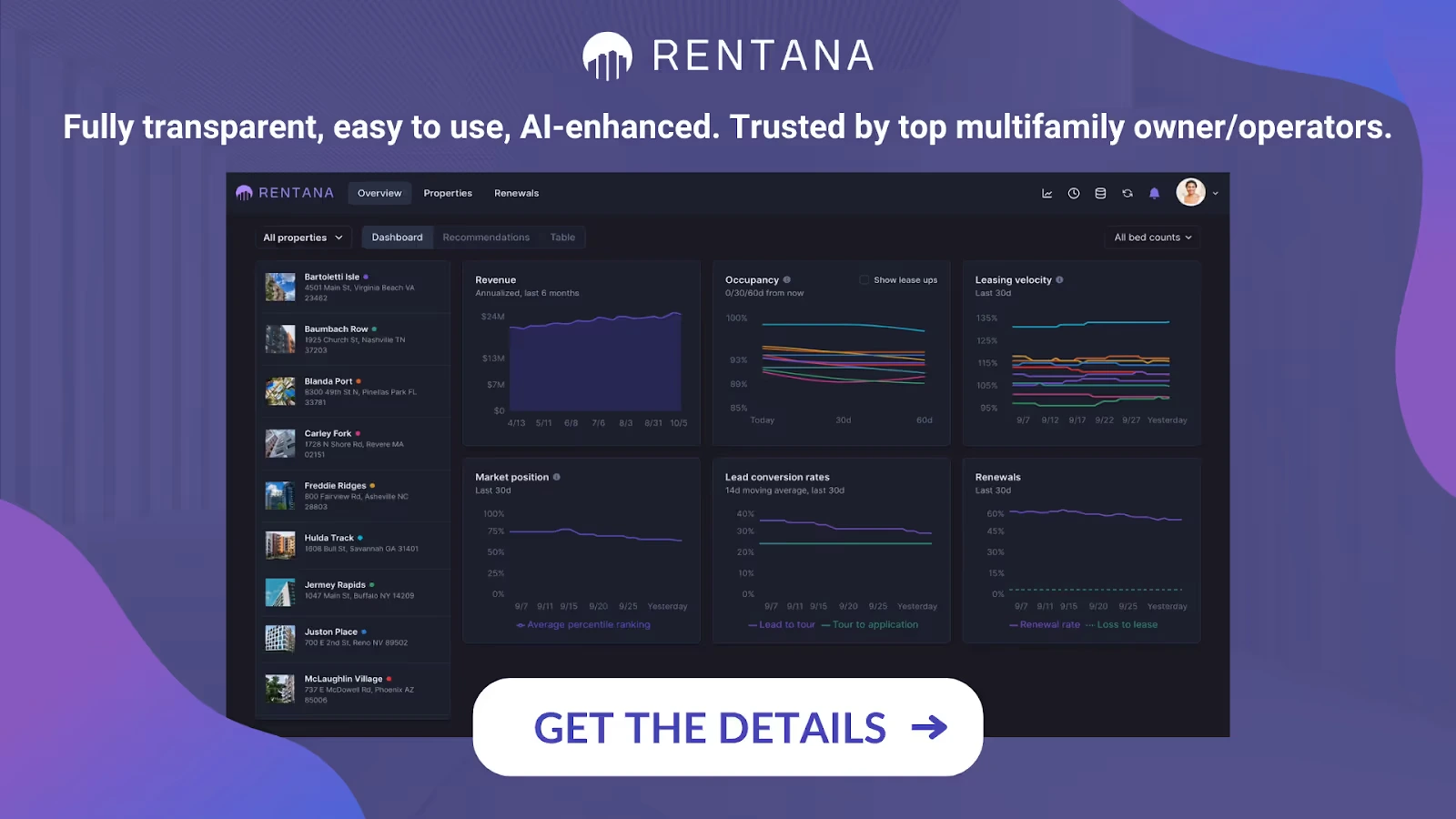
Rentana is built around this concept. Rather than measuring NOI directly, Rentana helps teams monitor the operating conditions that influence it.
- Predicted occupancy connects current leasing activity, renewal trends, and future availability to provide forward visibility into where occupancy is heading.
- Pricing recommendations are generated at the bedroom type or custom unit-group level based on the asset strategy configured by the customer, including occupancy goals and target timeframes. Supporting context accompanies every recommendation, helping teams evaluate pricing decisions within the broader context of asset performance.
- Renewal conversion visibility helps teams monitor retention performance alongside future availability conditions, providing additional context around future occupancy and revenue outcomes.
- Exposure forecasting surfaces lease expiration concentration alongside notices to vacate, month-to-month behavior, and early terminations, helping teams understand future availability conditions before they create operational pressure.
- AI-generated property insights help surface changing conditions by summarizing what is happening at an asset, why it matters operationally, and the factors contributing to the shift. Rather than requiring teams to review dozens of reports and metrics individually, insights help focus attention on the performance changes most likely to influence occupancy, revenue, and asset performance.
- Portfolio dashboards and reporting visibility help teams identify which assets are performing as expected, which may require additional review, and where attention should be prioritized.
Together, these capabilities help operators evaluate the conditions that influence NOI before those conditions become visible in financial results.
NOI is the foundation of multifamily performance measurement. The operators who protect and grow it most consistently are not necessarily the ones reviewing NOI reports most frequently. They are the ones monitoring the conditions that produce NOI before those conditions have already changed the outcome.
Read Also:
Conclusion
NOI sits at the intersection of operations, valuation, and investment performance. It is one of the most important metrics in multifamily real estate because it reflects how effectively an asset converts revenue into operating income.
Understanding NOI is about more than knowing a formula. It requires understanding the operational decisions that influence it. Occupancy, pricing, concessions, retention, expenses, and future availability all contribute to where NOI ultimately lands.
The most important thing to remember is that NOI tells you what has already happened. The conditions that determine where it is heading often become visible much earlier. The operators who consistently protect and improve NOI are the ones monitoring those conditions before they show up in the monthly report.
Frequently Asked Questions About NOI in Multifamily
What is a Good NOI for a Rental Property?
There is no universal benchmark for a "good" NOI because NOI depends on factors such as asset size, location, age, operating model, and market conditions. A property generating $500,000 in NOI may be exceptional in one market and underperforming in another.
For that reason, investors and operators typically evaluate NOI relative to the property's historical performance, budget, comparable assets, and investment objectives. Trends in NOI growth are often more meaningful than the raw NOI figure itself.
Is Higher NOI Always Better?
Generally yes, but context matters. A higher NOI achieved through aggressive concession reduction or deferred maintenance may look strong short term while creating occupancy or capital problems downstream. The most reliable NOI growth comes from stable occupancy, strong effective rents, controlled expenses, and resident retention, all working together rather than any single lever being pushed at the expense of the others.
How Do I Figure out My NOI?
Start with your effective gross income, total rent collected plus ancillary income like parking, pets, and storage. Then subtract all operating expenses including property management, payroll, maintenance, insurance, property taxes, utilities, and marketing. The result is your NOI. Do not include mortgage payments, capital expenditures, depreciation, or income taxes in the calculation.
What is the NOI Formula?
The NOI formula is: NOI = Gross Income − Operating Expenses. Gross income includes all revenue the property generates. Operating expenses cover the costs of running the property day to day. Debt service, capital expenditures, and depreciation are excluded from both sides of the equation.
How to Calculate NOI for Real Estate?
To calculate NOI for a real estate property, add up all gross income sources including base rent, parking, pet fees, and utility reimbursements. Then subtract total operating expenses including management fees, payroll, maintenance, insurance, taxes, and utilities. A 200-unit property collecting $3,450,000 in gross income with $720,000 in operating expenses has an NOI of $2,730,000.