
Most multifamily investors think about asset valuation at acquisition and disposition. Everything in between often gets managed as an operational problem rather than a valuation one.
That framing is costing operators more than they realize. Multifamily asset valuation is not a snapshot taken at acquisition and disposition. It is a continuous reflection of operating performance that changes every time an occupancy decision is made, a pricing recommendation is accepted or ignored, a renewal is retained or lost, or a concession is offered to fill a unit that has been sitting too long.
Understanding multifamily asset valuation is not just a finance skill. It is an operational one. The asset managers who connect day-to-day decisions to long-term investment outcomes are the ones who understand that every leasing, pricing, and renewal call is also a valuation call, whether it gets framed that way or not.
The five approaches below help multifamily asset managers understand current value, future value potential, and the operational decisions that influence both.
Related:
- What Is Asset Performance Management?
- Data Audits for Multifamily Properties: Complete Guide
Multifamily Valuation: 5 Methods of Evaluation Used By Asset Managers
- The Income Approach (Cap Rate Valuation)
- In-Place NOI Valuation
- Stabilized NOI Valuation
- Connecting Operations to Value
- Evaluating Future Value Risk
1. The Income Approach (Cap Rate Valuation)
The income approach is the dominant multifamily asset valuation method used by investors, lenders, and brokers. Unlike residential real estate, where comparable sales often play a larger role, multifamily assets are valued primarily as income-producing businesses. While capital market conditions and investor expectations influence pricing, NOI remains the primary driver of value.
The formula is straightforward: Value = NOI ÷ Cap Rate
NOI is net operating income, the income remaining after operating expenses are deducted from property revenue, but before debt service, depreciation, and capital expenditures. The cap rate represents the return investors require for an asset of similar risk, quality, and location.
Example: An asset generating $2,000,000 in NOI in a market where comparable assets trade at a 5.0% cap rate would be valued at approximately $40,000,000.
$2,000,000 (NOI) ÷ 0.05 (CapRate) = $40,000,000(Value)
Now consider what happens if NOI improves by just 5%:
$2,100,000 ÷ 0.05 = $42,000,000
Assuming the market cap rate remains unchanged, a $100,000 improvement in NOI creates approximately $2,000,000 in additional asset value. This multiplier effect is what makes operational performance so consequential in multifamily investing.
According to CBRE's Q4 2025 Multifamily Underwriting Survey, the average core multifamily going-in cap rate increased by just 2 basis points to 4.75% in Q4 2025, while exit cap rates held steady at 4.95%, reflecting broad stabilization in multifamily asset pricing as investor sentiment continued to improve. In a market where cap rates are moving in basis points rather than full percentage points, NOI growth is where the real valuation leverage lives.
2. In-Place NOI Valuation
In-place NOI valuation reflects what an asset is producing today based on its current operating performance. Investors typically evaluate this using recent historical results, often through trailing twelve-month (T12) financials, current rent roll performance, and other indicators of ongoing income and expense trends. It is generally considered the most conservative view of value because it is grounded in demonstrated performance rather than future expectations.
Lenders, investors, and buyers often begin with in-place NOI because it provides a view of the asset's current income-producing capability based on actual operating results. Unlike projected performance metrics, in-place NOI reflects what the asset has already proven it can achieve under current conditions.
However, in-place NOI does not always reflect an asset's long-term potential. Lease-up properties, recently acquired assets, communities undergoing renovations, and assets operating with elevated concessions may have an in-place NOI that understates what the property could ultimately achieve once operations stabilize.
For asset managers, the value of in-place NOI is not simply understanding where the asset stands today. It is understanding the gap between current performance and stabilized performance. That gap often represents both the opportunity and the risk embedded in the investment thesis.
Read Also:
- 9 Tenant Retention Strategies that Improve Multifamily NOI
- How to Improve NOI for Multifamily
- What is a Good Cap Rate for Multifamily Properties?
3. Stabilized NOI Valuation
Stabilized NOI valuation estimates what an asset should produce once it reaches a normalized operating state. Occupancy has stabilized, concessions have normalized, renovation programs are complete, and operations are performing at expected levels. Rather than focusing on what the asset is producing today, stabilized NOI reflects what investors believe the asset is capable of producing once the business plan has been successfully executed.
This is often the valuation framework used to support acquisition pricing, value-add investment strategies, and development underwriting. Investors are not simply buying current performance. They are investing in the future performance they believe can be achieved through operational execution.
The difference between in-place NOI and stabilized NOI is where most multifamily value creation occurs. For a lease-up asset, that gap may be driven by occupancy gains. For a value-add investment, it may be driven by renovation premiums, improved retention, or reduced concessions. In every case, the investment thesis depends on the team's ability to close the gap between current performance and projected performance.
According to the National Apartment Association's Income/Expense IQ report, repairs and maintenance costs have risen nearly 28% since 2021 while NOI has increased just 10% over the same period, highlighting how expense pressure can compress the stabilized NOI investors are underwriting to. In that environment, achieving stabilized performance requires tighter operational execution than it did in previous cycles.
For asset managers, the objective is not simply reaching stabilized performance. It is reaching it efficiently, sustainably, and in a way that supports the value creation assumptions behind the investment.
4. Connecting Operations to Value
The previous valuation approaches focus on measuring value. This approach focuses on creating it.
For multifamily asset managers, value is not built through valuation models. It is built through hundreds of operational decisions made throughout the hold period. Occupancy management, pricing strategy, renewal performance, concession usage, exposure management, marketing effectiveness, and turn execution all influence NOI, which ultimately influences asset value.
Consider a stabilized asset beginning to show signs of softening demand. Leasing velocity slows, future availability begins to build, and renewal conversion starts to decline in a key unit type. None of those signals independently determine the asset's value. Together, however, they create the operating conditions that will ultimately influence occupancy, revenue, expenses, and NOI.
The asset manager's role is not simply to measure those outcomes after they occur. It is to identify the operational drivers influencing performance and coordinate the response before those conditions become financial results. That may involve adjusting pricing strategy, reallocating marketing spend, modifying renewal strategy, addressing exposure concentration, or focusing operational attention on a specific area of the business.
This is why multifamily asset valuation is ultimately an operational discipline. The decisions that influence value are rarely made during an acquisition or disposition process. They are made throughout the hold period, one operating decision at a time.
According to Multi-Housing News, multifamily is expected to outperform commercial real estate sectors over the next decade. In a sector where long-term fundamentals remain strong, the operators who consistently protect and grow NOI through disciplined execution are the ones most likely to maximize value creation across the hold period.
5. Evaluating Future Value Risk
The previous approaches evaluate value based on current or projected stabilized performance. Understanding value also requires assessing how likely an asset is to achieve those expectations in the future.
Evaluating future value risk means looking beyond historical results and focusing on the leading indicators that influence future performance. Occupancy, revenue, and NOI describe what has already happened. Leasing velocity, renewal conversion, future availability, demand trends, and concentration risk provide insight into what may happen next.
Consider a stabilized asset that is meeting its occupancy and revenue targets. Traditional reporting suggests performance is healthy. However, leasing activity has slowed, renewal rates have declined, and a large number of leases are set to expire during a weaker demand period.
None of these conditions have materially affected occupancy or revenue yet. Viewed historically, the asset appears to be performing as expected. A forward-looking perspective reveals a different picture: the conditions driving future performance are beginning to shift.
The goal is not to predict outcomes with certainty, but to identify emerging risks and opportunities before they appear in financial results. Leading indicators provide early warning signals that allow stakeholders to respond while meaningful options still exist.
This highlights the difference between lagging and leading indicators. Lagging indicators confirm what has already occurred, while leading indicators help assess future outcomes. Both matter, but relying only on historical performance can delay recognition of changing conditions.
As markets become more dynamic, the ability to monitor future value risk becomes increasingly important. Organizations that make better decisions are often those that combine strong historical reporting with a clear understanding of the signals shaping future performance.
Read Also:
- Best Leasing Solutions for Managing Multiple Multifamily Assets
- 7 Key Multifamily Revenue Optimization Strategies
How Operational Decisions Affect Multifamily Asset Value

This is where multifamily asset valuation stops being a finance exercise and starts being an operational one. Every decision made at the property level either strengthens or weakens NOI, and every change in NOI moves asset value in direct proportion. The five levers below are where that connection is most consequential.
1. Occupancy Performance
Occupancy is one of the clearest examples of how operational performance influences asset value because changes in occupancy flow directly into NOI. Every vacant day represents revenue that cannot be recovered. But the valuation impact of occupancy is not just about the rent that goes uncollected. It is about the signal that vacancy sends to lenders and investors evaluating the asset.
Getting it right: A 300-unit asset moves from 93% to 95% occupancy by catching a leasing slowdown early and adjusting pricing and leasing focus before the gap widens. That improvement fills 6 additional units at $1,800 per month.
6 × $1,800 × 12 = $129,600 in additional annual NOI At a 5.0% cap rate: $2,592,000 in added asset value
Getting it wrong: The same slowdown goes unnoticed for eight weeks. By the time it shows up in the monthly report, 12 units are vacant and concessions are needed to re-lease them quickly. The NOI impact is now $259,200 annually in lost revenue plus concession costs, erasing over $5 million in value at a 5.0% cap rate.
2. Pricing and Revenue Management
Pricing influences asset value because it affects far more than the rent shown on a lease. Pricing decisions influence occupancy, leasing velocity, renewal performance, concession usage, marketing efficiency, and ultimately the amount of NOI an asset produces.
Getting it right: A multifamily asset manager notices two-bedroom availability beginning to build. Rather than reacting only after occupancy declines, the team evaluates leasing velocity, future exposure, renewal performance, and current demand conditions to determine whether pricing, marketing, leasing strategy, or some combination of factors requires adjustment. Availability remains manageable, effective rents are protected, and the asset stays aligned with its performance objectives.
Getting it wrong: Availability begins to build in a key unit type, but the underlying cause is not identified early. Some units sit vacant longer than expected, marketing spend increases to compensate, concessions become more common, and additional turns create avoidable vacancy and make-ready costs. Occupancy may ultimately recover, but the NOI lost during the process is rarely recovered. What appears initially as a pricing issue often becomes a broader operational performance issue with direct valuation consequences.
The highest-performing operators do not evaluate pricing in isolation. They evaluate how pricing decisions influence leasing performance, occupancy, retention, exposure, and revenue across the asset as a whole.
3. Renewal Strategy
Retention is one of the highest-leverage drivers of multifamily asset performance because every resident who renews avoids the vacancy loss, turn costs, marketing spend, and leasing effort associated with replacing them. The financial impact of a move-out is often far greater than the temporary vacancy period alone.
Getting it right: A multifamily asset manager identifies that retention is beginning to soften in a key unit type and evaluates the potential impact on future availability, occupancy, and operating expenses. The team adjusts its renewal strategy to better align with asset objectives and retention goals. More residents choose to stay, reducing turnover costs and preserving revenue continuity.
Getting it wrong: Renewal strategy is managed in isolation without considering future availability conditions or retention trends. As more residents choose to leave, turnover costs rise, vacancy increases, and additional marketing and leasing effort is required to replace lost occupancy. The impact accumulates gradually across the year and often becomes visible only after it has already affected NOI.
The value of retention is not simply keeping occupancy high. It is reducing the operational friction and expense required to maintain it.
4. Concession Strategy
Rent Concessions are sometimes necessary to sustain occupancy in a competitive leasing environment. The question is whether they are being deployed strategically or reflexively, and whether their impact on effective rent and NOI is being measured rather than assumed.
Getting it right: A leasing team identifies that one specific floor plan is absorbing slowly and offers a targeted two-week concession to move the unit. Occupancy holds, effective rent on the rest of the portfolio is unaffected, and the concession cost is isolated and measured.
Getting it wrong: A blanket one-month-free promotion is offered across all unit types to hit an occupancy target. The promotion moves units, but it also suppresses effective rent across a much larger portion of the asset than necessary.
Example: 20 units receiving one month free at an average rent of $1,800 represents $36,000 in concession loss. At a 5.0% cap rate, that reduction in NOI equates to approximately $720,000 in asset value.
The challenge with broad concession programs is that the benefit is often immediate while the cost persists much longer. Occupancy may recover quickly, but rebuilding effective rents after a concession period can take significantly more time.
Exposure Management
Lease expiration concentration creates predictable vacancy pressure that compounds into NOI erosion when it is not managed proactively. Exposure concentration is often predictable well before it affects occupancy and revenue performance. The operators who act on it early enough produce meaningfully different valuation outcomes than those who react after it has already created pressure.
Getting it right: A multifamily asset manager identifies that 22% of two-bedroom leases expire within a 45-day window in Q1, historically the softest leasing period. The team adjusts renewal strategy, staggers lease terms where possible, and coordinates leasing activity in advance. Availability builds gradually rather than all at once. NOI stays stable through the exposure window.
Getting it wrong: The concentration goes unnoticed until three weeks before the window. The team scrambles to fill units in a slow leasing period, concessions spike, and effective rent on re-leased units comes in below the expiring lease rates. The combined impact of vacancy loss and concession spend during an unmanaged exposure window can easily represent 2% to 3% of annual NOI on a stabilized asset, which at a 5.0% cap rate is a meaningful valuation impact on any portfolio.
The common thread across all five levers is that multifamily asset value is created or eroded through operational performance. Occupancy, pricing, retention, concessions, and exposure management all influence NOI, and NOI ultimately drives value. While valuation is often discussed as a finance exercise, the factors that drive it are operational. The decisions made throughout the hold period are the same decisions that determine whether value grows, stagnates, or declines over time.
Read Also
- Top Uses of AI in Multifamily
- Multifamily Market Trends Every Investor Should Know
How Rentana Helps Multifamily Asset Managers Monitor the Drivers of Value
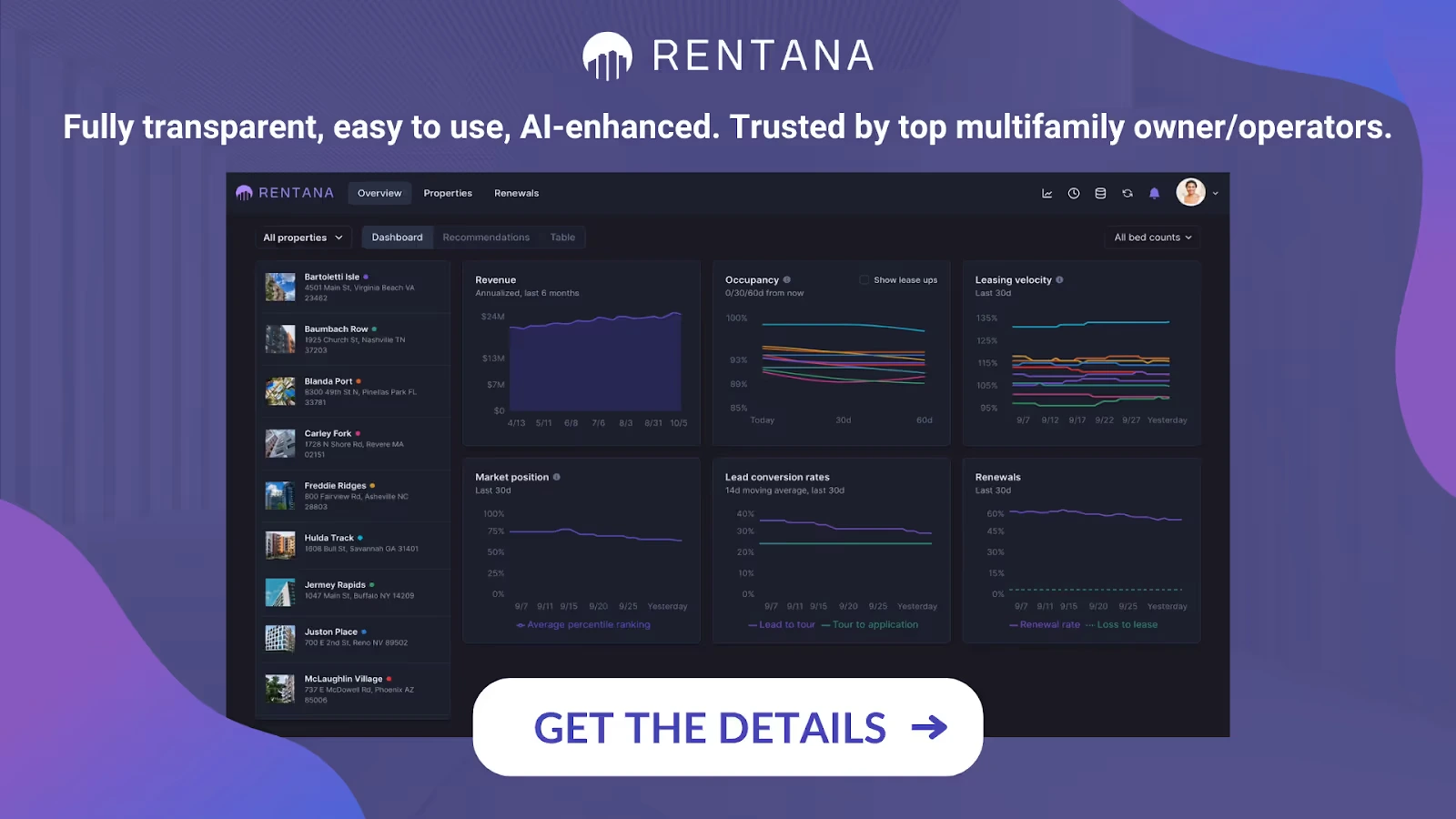
Rentana does not calculate multifamily asset valuations. It helps asset managers monitor the operating conditions that influence where NOI is heading, giving teams earlier visibility into the factors that ultimately drive asset value.
- Predicted occupancy connects current leasing activity, renewal trends, and future availability to provide forward visibility into where occupancy is heading. This helps teams identify potential performance gaps before they appear in occupancy reporting or financial results.
- Pricing recommendations are generated at the bedroom type or custom unit-group level based on the asset strategy configured by the customer, including occupancy goals and target timeframes. Supporting context accompanies every recommendation, helping teams evaluate pricing decisions within the broader context of asset performance and strategy.
- Renewal conversion visibility helps teams monitor retention performance alongside future availability conditions. Rather than evaluating renewals in isolation, teams can understand how resident retention may influence future occupancy, exposure, and revenue outcomes.
- Exposure forecasting surfaces lease expiration concentration alongside notices to vacate, month-to-month behavior, and early terminations, providing a clearer view of future availability conditions before they create operational pressure.
- AI-generated property insights help surface changing conditions by summarizing what is happening at an asset, why it matters operationally, and the factors contributing to the shift. Rather than requiring teams to review dozens of reports and metrics individually, insights help focus attention on the performance changes most likely to influence occupancy, revenue, and asset performance.
- Portfolio dashboards and reporting visibility across the portfolio, helping asset managers identify which assets are performing as expected, which may require additional review, and where attention should be prioritized.
Together, these capabilities help asset managers move beyond periodic valuation reviews and maintain continuous visibility into the operational drivers that influence long-term asset value.
Conclusion on Multifamily Asset Valuation
Multifamily asset valuation is often discussed as a finance exercise, but during the hold period it is largely an operational one. Occupancy, pricing, renewals, concessions, and exposure management all influence NOI, and NOI ultimately drives value.
The five approaches covered in this article provide different ways to evaluate that relationship, from understanding current performance to assessing future risk. Together they reinforce a simple reality: asset value is not determined only at acquisition and disposition. It is shaped continuously by the operational decisions made between those events.
The asset managers who consistently protect and grow value are the ones who understand that connection. They do not wait for valuation changes to appear in reports. They monitor the operating conditions that create them.