AI implementation has crossed from optional to expected across most industries. According to McKinsey's State of AI 2025, 88% of global organizations now use AI in at least one business function, yet only 23% have scaled it meaningfully across the enterprise. That gap reflects the difference between experimenting with AI and integrating it into the workflows, data infrastructure, and team habits that determine how work actually gets done.
Deploying an AI tool is relatively straightforward. Implementing AI in a way that improves operations is harder. The organizations that skip the operational work often end up with dashboards nobody uses, recommendations nobody trusts, and tools that create more process instead of better outcomes.
In real estate and property management, the implementation challenge is especially important because operations span leasing, pricing, maintenance, resident communication, renewals, and portfolio performance. The question is not simply which AI tool to buy. It is how to embed AI into the workflows that matter most in a way that improves decisions, protects data, supports adoption, and keeps human accountability in place.
This article explains how to implement AI into your operations thoughtfully, from identifying the right use cases and evaluating data quality to managing privacy, compliance, team adoption, and success measurement.
Related:
- The Best AI Tools for Real Estate Investors
- AI Solutions for Multifamily Rental Operational Efficiency
What Thoughtful AI Implementation Looks Like
Most AI implementation failures are not technology failures. They are workflow failures.
A tool deployed without a clear understanding of which operational gap it is supposed to close, which team members will use it, and what better looks like after deployment can create more complexity instead of better outcomes.
Thoughtful AI implementation starts with the problem, not the product. The operational gap should be specific enough to point toward a measurable improvement.
For example:
- Response time dropping from 24 hours to under 5 minutes
- Pricing reviews that used to take 90 minutes taking 15
- Lease expiration concentration that was previously caught at 20 days being surfaced at 90
- Manual report assembly being reduced or eliminated
- Renewal follow-up becoming more consistent across properties
Vague goals like “better efficiency” or “more data-driven decisions” are not specific enough to evaluate whether implementation has worked.
The Most Common Implementation Mistakes:
- Deploying a tool before auditing whether the underlying data is clean and consistent enough to produce reliable outputs
- Selecting tools based on feature lists rather than whether the output leads directly to a decision the team is actually making
- Skipping change management and assuming the team will adopt the tool because it was purchased
- Measuring success by whether the tool was deployed rather than whether it changed operational outcomes
- Adding AI tools that duplicate capabilities already in the stack, creating version control problems and team confusion
- Treating AI outputs as decisions rather than inputs to decisions, removing the human judgment and accountability that operational decisions require
Read Also:
- Will AI Replace Real Estate Agents? Or Transform Them?
- AI for Commercial Real Estate: Top 9 Tools
How to Implement AI Into Your Operations: Top 7 Ways
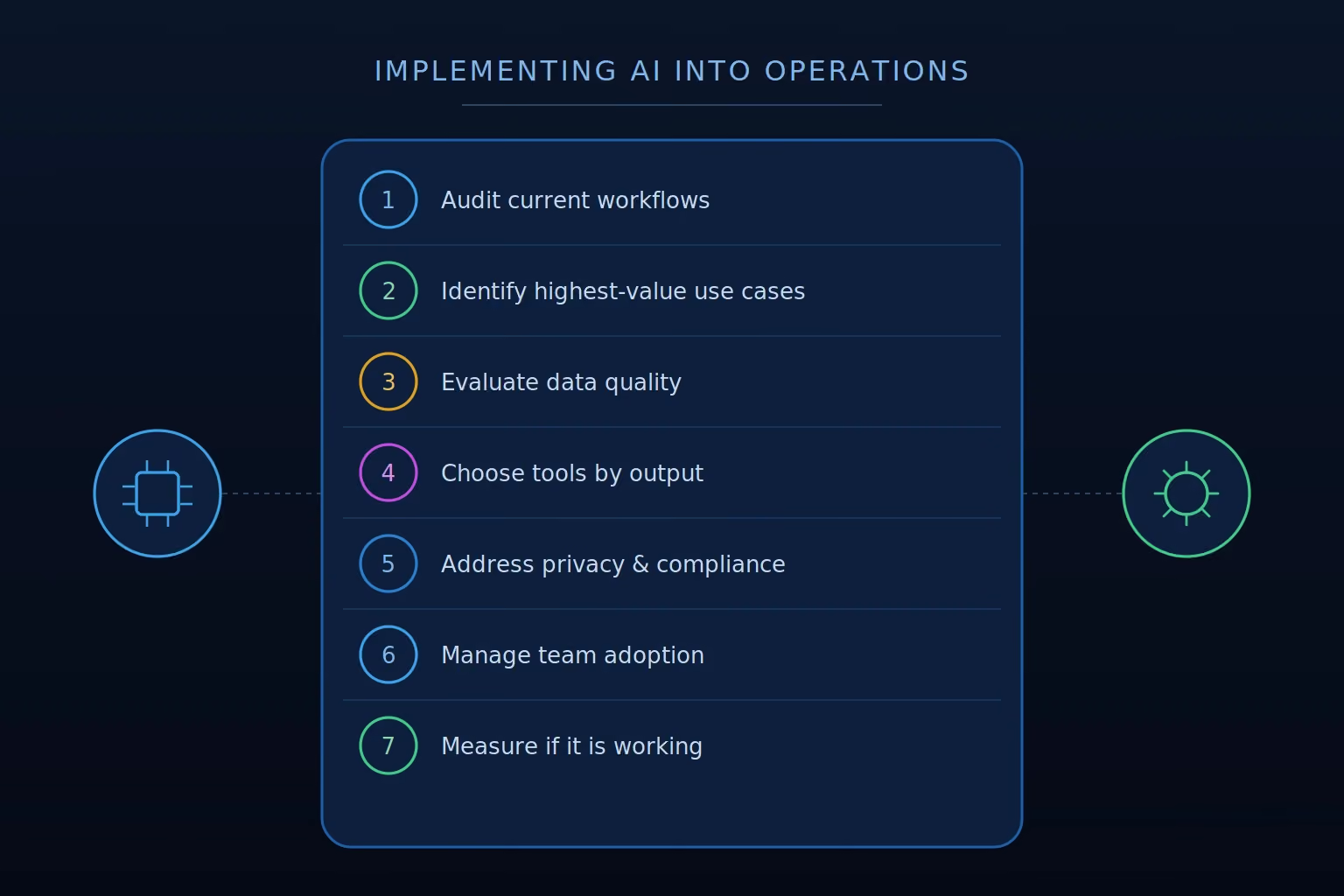
- Audit Your Current Workflows
- Identify the Highest-Value Use Cases
- Evaluate Data Quality Before Selecting Tools
- Choose Tools Based on Output, Not Features
- Address Privacy and Compliance Requirements
- Manage Team Adoption Deliberately
- Measure Whether It Is Working
1. Audit Your Current Workflows
Before evaluating any AI tool, start by identifying where the current operation is breaking down.
Where is time being consumed by repetitive, high-volume work that does not require much judgment? Where are teams making decisions based on incomplete or outdated information? Where are important tasks dependent on manual follow-up, individual memory, or disconnected reports?
The workflow audit does not need to cover every part of the operation. It should identify the two or three operational gaps that are creating the most friction, whether that friction shows up as lost time, inconsistent execution, delayed decisions, or limited visibility.
Those gaps become the starting point for AI implementation. The goal is not to apply AI everywhere. It is to identify where AI can help improve a specific workflow that already matters.
2. Identify the Highest-Value Use Cases
Not every workflow is equally suited to AI.
The strongest use cases usually share a few characteristics: they are high-volume, consistency-dependent, data-rich, and connected to decisions that have measurable operational consequences.
In real estate and property management, common high-value AI use cases include leasing response and follow-up, pricing analysis, maintenance routing, renewal outreach timing, resident communication, and portfolio performance monitoring.
Start with one use case before trying to implement several at once. A single AI application that is implemented well, adopted consistently, and tied to a clear operational outcome will create more value than multiple tools launched at the same time without clear ownership or measurement.
3. Evaluate Data Quality Before Selecting Tools
AI tools are only as reliable as the data feeding them.
Before selecting a platform, review the quality and consistency of the data the tool will depend on. In property management, this may include unit data, availability status, lease records, pricing history, renewal information, maintenance records, resident communication history, and PMS integration quality.
Common data issues include inconsistent unit tagging, stale availability, incomplete lease records, duplicate records, manual spreadsheet workarounds, and systems that do not share data cleanly.
Data quality problems do not need to be fully resolved before implementation begins, but the most significant gaps should be identified early. If the data feeding the AI tool is incomplete or inconsistent, the outputs may reflect those data issues rather than actual operating conditions.
Evaluating data quality before selecting tools helps teams understand whether they are ready for implementation, what needs to be cleaned up first, and which tools are most likely to produce reliable outputs.
Top Picks:
- Generative AI in Real Estate: Top 11 Use Cases
- How AI is Changing Real Estate in the USA
4. Choose Tools Based on Output, Not Features
The most important evaluation criterion for any AI tool is not how many features it has. It is what the tool produces and whether that output helps the team make a better decision or complete a workflow more effectively.
A strong AI tool should produce outputs that are specific, explainable, and connected to the workflows the team already uses. If the tool surfaces information but still requires significant manual interpretation before anyone can act, it may be adding another reporting layer rather than improving the operation.
In property management, a pricing tool that generates a recommendation with the reasoning attached is more useful than one that provides a number the team has to validate separately. A portfolio dashboard that highlights which assets need attention is more useful than one that presents every metric for every property with equal weight.
The right tool is the one whose output connects clearly to a decision the team is already responsible for making. Choose AI based on the operational decision it supports, not the number of capabilities listed in the demo.
5. Address Privacy and Compliance Requirements
AI tools that handle resident data, lease information, financial records, or operational communication need to be reviewed for privacy and compliance before deployment.
Operators should understand what data the tool uses, how that data is stored, who has access to it, whether it is shared with third parties, and how long it is retained.
Fair housing compliance also deserves specific attention. AI tools used in leasing, pricing, renewals, or resident communication should be reviewed to ensure outputs are based on operational and property-level data rather than resident characteristics or any protected class information.
The goal is not to slow implementation down. It is to make sure the tool can be used responsibly before it becomes part of an operational workflow.
6. Manage Team Adoption Deliberately
Deployment is not adoption.
An AI tool only improves operations if the team understands what it is for, how it changes the workflow, and what they are still responsible for reviewing or deciding.
Training should focus less on the technology itself and more on the specific workflows and decisions the tool supports. A leasing agent does not need to understand every technical detail behind an AI leasing tool. They need to understand what the tool handles, when a human needs to step in, and how the handoff should work.
Adoption improves when AI makes the team’s job easier rather than adding another system to check. Clear ownership, practical training, and feedback loops help teams build trust in the tool and use it consistently.
7. Measure Whether It Is Working
Every AI implementation should have a defined success metric before deployment. That metric should connect directly to the operational gap the tool was selected to address.
If the goal is faster leasing response, measure response time before and after implementation. If the goal is more efficient pricing review, measure how long the review process takes and whether decisions are being made with better context. If the goal is stronger renewal performance, evaluate whether renewal conversion, outreach consistency, or exposure management improves after the tool is in place.
Teams should review performance at 30, 60, and 90 days after deployment. If the tool is not producing the expected outcome, the next step is to diagnose the issue specifically. The problem may be inconsistent data, limited team adoption, unclear workflow ownership, or outputs that do not connect clearly enough to the decision the tool was supposed to support.
Measuring AI implementation this way helps teams improve the process rather than treating AI as successful simply because the tool launched.
Related:
- The Best AI Property Insights Platforms
- How to Use AI to Generate Property Performance Reports, in Minutes
Important Considerations Around Data Privacy, Ethics, and Team Impact
AI implementation can improve how operations run, but it also introduces risks that should be evaluated before deployment. This is especially important in real estate and property management, where AI-informed workflows may involve resident data, lease information, pricing, leasing communication, and housing-related decisions.
Data Privacy
AI tools depend on data. In property management, that data may include resident information, lease records, payment history, maintenance requests, communication logs, pricing data, and operational performance information.
Before deploying any AI tool, operators should understand:
- What data the tool accesses and why
- How resident and property data is stored
- Whether data is shared with third parties
- Who can access AI-generated outputs
- How long data is retained
- Whether the tool complies with applicable privacy regulations in the markets where the portfolio operates
Data privacy should be reviewed before implementation, not after the tool is already embedded into the workflow.
Fair Housing Compliance
AI tools used in leasing, pricing, renewals, or resident communication should be evaluated for fair housing compliance before deployment.
Even when a tool is not designed to use protected class information, operators should confirm that its outputs do not create discriminatory patterns or influence housing-related decisions in a way that creates compliance risk.
Operators should:
- Ensure pricing recommendations are based on unit-level performance data, public market conditions, and asset strategy rather than resident or prospect characteristics
- Review AI outputs for patterns that could create discriminatory results
- Document the basis for AI-informed decisions in leasing, pricing, and renewal workflows
- Involve legal counsel when deploying AI in prospect-facing, pricing, or resident-impacting workflows
The goal is not to avoid AI. It is to make sure AI is implemented within the same compliance framework that already governs housing-related decisions.
Human Accountability
AI tools generate outputs. People remain responsible for the decisions those outputs inform.
This distinction matters. A pricing recommendation, leasing follow-up prompt, renewal strategy, or resident communication may be AI-supported, but the accountability for the final decision still belongs to the team.
Operators should establish clear policies around which AI outputs require human review, who is responsible for approving actions, and when AI-informed recommendations should be escalated for additional review.
AI should support decision-making, not remove human judgment from decisions that require accountability.
Team Impact
AI changes how work gets done. Tasks that were previously manual, repetitive, or high-volume may shift toward automation, while team members spend more time on review, judgment, communication, and higher-value operational work.
That transition needs to be managed deliberately.
Teams should understand which tasks AI will support, which responsibilities remain human-owned, and how workflows will change after implementation. Training should focus on practical usage, review standards, and when team members should question or escalate AI outputs.
Implementation works best when AI makes the team’s job clearer and more focused, not when it feels like another system added on top of existing responsibilities.
Don’t Miss:
- Conversational AI in Real Estate: A Complete Guide
- Agentic AI in Multifamily: Use cases & How it Works
Conclusion on How to Implement AI into Your Operations
AI implementation is not simply a technology decision. It is an operational decision.
The organizations that get the most value from AI are not necessarily the ones that adopt the most tools. They are the ones that identify the right operational problems, evaluate whether their data can support reliable outputs, choose tools that connect directly to decisions, and manage adoption deliberately.
In real estate and property management, this matters because AI-informed workflows may affect leasing, pricing, renewals, resident communication, maintenance, compliance, and portfolio performance. These are not isolated tasks. They are operational decisions that require visibility, accountability, and human judgment.
AI is here to stay, but successful implementation depends on more than deployment. It requires clear use cases, clean data, privacy and compliance review, team training, and ongoing measurement of whether the tool is improving the workflow it was selected to support.
Start with the operational gap. Choose the AI use case that can address it clearly. Build the process around responsible use, team adoption, and measurable outcomes.