Manual data entry is one of the most persistent hidden costs in property management. It shows up in the hours spent copying data between systems, the errors that appear when one platform is updated and another is not, and the version-control problems that emerge when leasing, occupancy, pricing, and reporting data all live in different places.
For multifamily teams, the issue is not only administrative time. Manual data transfer can affect the accuracy and currency of the operating picture teams use to make decisions. A unit status that is updated in the PMS but not reflected in a connected platform, a leasing event that is recorded in one system but not another, or a pricing update that is manually entered inconsistently can all create downstream problems.
Multi-Housing News notes that the difference between working slowly with manual processes and working quickly with automation can be the difference between success and failure in a competitive or changing marketplace, with integrated platforms helping teams reduce risk, improve accuracy, and spend less time on administrative reconciliation.
Integrations reduce that burden by allowing data to move between the property management system and connected platforms automatically on a configured sync cadence. When the connection is reliable, teams spend less time exporting, uploading, copying, and reconciling data and more time using the information to evaluate performance.
The value is not just efficiency. Better integrations can reduce lag, improve consistency, limit duplicate entry, and make operational reporting and analytics more dependable.
This article explains where manual data entry creates the most problems in property management, how PMS integrations work, what makes them reliable, and how connected data supports a more accurate and timely operating view.
Related:
Where Manual Data Entry Creates Problems in Property Management
Manual data entry does not create problems evenly across every workflow. It creates the most risk in places where data moves between systems often, where timing matters, and where small errors can affect downstream reporting, availability, pricing, or resident communication.
1. Syncing Leasing Activity Between PMS and CRM
Leasing activity often originates in the CRM, where prospect interactions, tours, applications, and lease progress are tracked. The PMS needs that same information to maintain an accurate occupancy picture, update unit status, and support correct expiration schedules.
When the transfer between systems is manual, there can be a lag between when leasing activity happens and when it is reflected in the PMS. There is also a version-control risk every time someone updates one system but not the other.
The downstream effect is an occupancy picture that may be incomplete, an expiration schedule that may not reflect the current rent roll, and analytics that inherit the same inconsistency.
2. Updating Availability Across Listing Platforms
When a unit is leased, comes back on the market, or changes status, that update needs to be reflected everywhere the unit is listed.
If the process is manual, prospects may inquire about units that are no longer available or miss units that should be visible. Both outcomes create friction for the leasing team and weaken the prospect experience.
For properties with frequent turnover or active lease-up activity, manual listing management can become one of the highest-volume and highest-error workflows in the operation.
3. Reconciling Financial Data Between Systems
Financial data that originates in the PMS may need to move into accounting systems, budget files, ownership reports, or investor packages.
When that transfer is manual, discrepancies can appear between systems and require additional time to investigate. A payment date, rent charge, concession amount, or adjustment entered differently in two places can create a variance that someone has to trace before reporting can be finalized.
Manual reconciliation also scales poorly. As portfolios grow, the amount of data to review increases, and the risk of missed or inconsistent entries grows with it.
Related:
- The Leasing Funnel, Fully Explained
- Best Leasing Solutions for Managing Multiple Multifamily Assets
4. Maintaining Pricing Across Multiple Platforms
When pricing changes, the update may need to appear in the PMS, listing platforms, leasing tools, and any pricing or analytics systems the team uses.
Manual pricing updates create lag and inconsistency. A prospect who sees one rent online and receives a different quote from the leasing team has encountered a version-control problem at a critical point in the leasing process.
That inconsistency can damage trust, create internal confusion, and make it harder for teams to evaluate whether pricing changes are producing the intended leasing response.
5. Transferring Performance Data Into Reporting Tools
Occupancy, leasing activity, financial performance, renewal trends, and availability data often need to be pulled into reporting templates before ownership calls, asset reviews, or internal performance meetings.
When that process depends on manual exports and formatting, teams spend time preparing the data before they can analyze it. The report may also reflect the last time the data was pulled rather than the most current operating picture.
According to Multifamily Dive's 2026 PropTech outlook, 78% of property managers say digital transformation improves operational efficiency. For multifamily teams managing data across multiple systems, reducing manual data transfer is one of the most direct ways to capture that efficiency, freeing time from reconciliation and data preparation for analysis and decision making instead.
For asset managers and operators, that lag matters. Decisions about pricing, concessions, renewals, or leasing focus are more useful when they are based on current information rather than a manually assembled snapshot that may already be outdated.
Recommended:
- Best Unit-Level Pricing Strategy in Multifamily
- The Best Multifamily Pricing Tool for Investors
How PMS Integrations Work and What Makes Them Effective
An integration is a configured connection between two software systems that allows data to move between them automatically instead of requiring a person to transfer it manually.
In property management, integrations commonly connect the PMS to leasing platforms, listing services, accounting systems, revenue management tools, analytics platforms, and reporting systems.
How Data Moves Between Systems
Most integrations work through an API, or application programming interface. An API allows two systems to exchange data in a structured format.
For example, when a leasing event is recorded in a CRM, an integration may send that information to the PMS. When a unit status changes in the PMS, that update may flow to connected listing platforms. When performance data is needed for analytics or reporting, the integration can pull from the PMS without requiring a manual export.
Some integrations update close to real time. Others run on a scheduled cadence, such as hourly, nightly, or at another configured interval. The right sync frequency depends on the workflow. Availability, pricing, and leasing activity usually need more frequent updates than historical reporting or financial summaries.
What Makes an Integration Reliable
Not all integrations deliver the same value. A reliable integration depends on three things: accurate data mapping, appropriate sync frequency, and clean source data.
Data mapping determines whether information moves into the correct fields. A lease start date in one system needs to map to the lease start date field in another. A unit status field needs to map to the corresponding availability field. If mapping is incomplete or incorrect, data may transfer successfully but still create downstream errors.
Sync frequency determines whether the data is current enough for the workflow it supports. A nightly sync may be sufficient for some reporting needs, but it may not be frequent enough for active availability, pricing, or leasing workflows during high-volume periods.
Source data quality determines whether the integration is distributing reliable information. If the PMS contains inconsistent unit statuses, incomplete amenity tags, incorrect lease dates, or uneven data-entry practices, the integration will move those issues into the systems connected to it.
An integration reduces manual work, but it does not replace the need for clean data, clear definitions, and consistent operating processes.
The Data Quality Prerequisite
The most important thing to understand about integrations is that they do not fix data quality problems. They automate the movement of whatever data exists in the source system.
If the PMS has inconsistent unit tagging, incorrect lease dates, incomplete amenity data, uneven occupancy calculations, or different data-entry habits across properties, those issues will flow into every connected system that depends on the PMS.
That can make data quality problems more visible and more consequential. A manual process may hide inconsistencies until someone reviews a report. An integration can distribute those inconsistencies automatically into analytics, pricing, availability, reporting, and portfolio views.
Auditing PMS data before connecting additional platforms is therefore not just a technical step. It is an operational prerequisite. The outputs of every connected system are only as reliable as the data flowing into them from the source.
A strong integration strategy starts with clean source data, consistent definitions, and clear ownership of data-entry practices.
Read Also:
- 7 Best Rental Property Software for Landlords
- Multifamily Property Data: 5 Metrics Operators Should Actually Track
How Rentana's PMS Integration Reduces Manual Data Entry
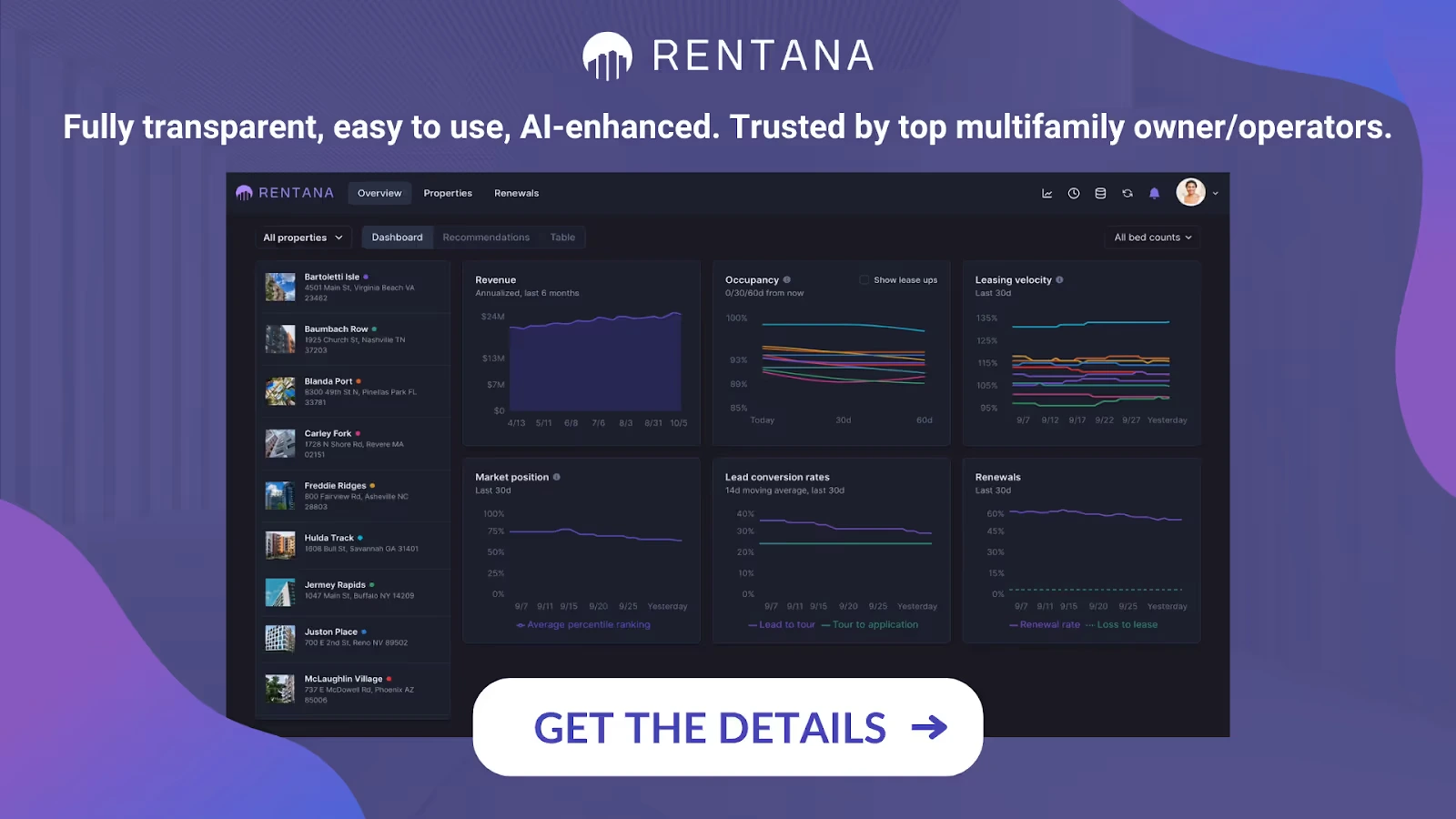
Rentana integrates with existing property management systems to pull leasing, occupancy, pricing, and performance data into a connected operating view without requiring manual exports, uploads, or spreadsheet reconciliation before analysis can begin.
The operational change is specific. Teams spend less time assembling data and more time evaluating what the data means. Leasing velocity, occupancy trends, expiration schedules, renewal activity, pricing performance, and forward availability can be reviewed from a shared source rather than rebuilt manually before each pricing review, asset meeting, or ownership conversation.
The integration also reduces version-control risk. When teams rely on manual data transfers, the same unit, lease, or pricing record may exist in multiple places with slightly different information. A connected data flow helps reduce those inconsistencies by allowing Rentana to work from PMS data directly instead of a manually prepared snapshot.
For a revenue manager supporting multiple assets, that changes the starting point of the workflow. Instead of beginning with data pulls, formatting, and reconciliation, the team can begin with the operating picture already assembled in Rentana. For an asset manager preparing for an ownership call, the conversation can start from a more current shared view rather than a report that only reflects the last manual export.
That matters most when conditions are moving quickly. During lease-up, high-expiration periods, active pricing cycles, or periods of softening demand, a stale report can lead teams to evaluate yesterday’s conditions instead of the current operating picture.
Rentana’s forward-looking signals, including Predicted Occupancy, exposure forecasting, pricing recommendations, and leasing velocity tracking, depend on the quality and consistency of the PMS data feeding them. When unit statuses, lease expiration dates, renewal activity, and availability records are accurate, the resulting views are more reliable.
That is why the integration is not just a time-saving feature. It is the foundation that allows teams to evaluate leasing, pricing, renewals, and availability from a more current and consistent operating picture.
Conclusion on PMS Integration
Manual data entry in property management is not just an efficiency problem. It is a data quality problem, a version-control problem, and an analytical reliability problem that can affect every system and report built from the data.
Integrations reduce that risk by allowing information to move between the PMS and connected platforms on a configured sync cadence instead of depending on manual exports, uploads, and re-entry. The result is less duplicate work, fewer inconsistencies, and a more current operating picture.
The prerequisite is clean source data. An integration that moves inconsistent or incomplete PMS data will distribute those issues into every connected platform that depends on it.
When the PMS data foundation is reliable and the integration is configured well, connected systems can give teams a clearer basis for evaluating leasing, occupancy, pricing, renewals, availability, and performance without rebuilding the data picture manually every time.