Pricing decisions in multifamily have always carried significant operational and financial impact. What has changed is the number of interconnected variables that now influence whether a pricing decision aligns with actual asset performance and forward portfolio conditions.
A decade ago, a weekly comp survey and a read on current occupancy were enough to make a reasonably informed pricing call for most operators.
Today, the same decision requires visibility into leasing velocity at the unit type level, forward availability and upcoming expiration concentration, renewal conversion trends, asset strategy goals including occupancy targets and timeframes, and how public market conditions are moving relative to the specific floor plans being priced. None of those variables operate independently.
A pricing adjustment that appears reasonable based on current occupancy alone may not align with upcoming exposure concentration or forward availability conditions.
A comp-based adjustment that looks right at the property level may be missing a significant demand difference between unit types within the same bedroom group.
This article covers what effective multifamily pricing tools actually do, where current approaches often fall short, what operators should evaluate when selecting a platform, and why connected revenue intelligence systems have become increasingly important for multifamily pricing operations in 2026.
For more on how market conditions and operational signals influence multifamily pricing strategy, see Rentana’s article on multifamily market trends.
Why Current Multifamily Pricing Approaches Fall Short
PMS-based Pricing Captures What Happened, not What is Coming
- PMS reporting describes past performance, not where occupancy is heading
- No forward view of upcoming availability, expiration concentration, or predicted occupancy
- Pricing decisions based solely on historical PMS reporting are often reacting to conditions that have already begun shifting operationally
Broad Pricing Strategies Miss how Different Unit Types Behave
- A property-level adjustment applied to all two-bedrooms ignores how differently individual unit types absorb under the same demand conditions
- Pricing spreads that do not reflect actual unit-level demand patterns can create missed revenue opportunities on highly preferred units while generating unnecessary leasing friction on less desirable layouts
- According to the National Apartment Association's Income/Expense IQ report, vacancy, and rent loss rose to $1,323 per unit in 2024, continuing a multi-year increase that reflects ongoing leasing pressure across many multifamily markets
Renewal Pricing Managed Separately from New Lease Pricing
- Renewal and new lease pricing are connected decisions that should be informed by the same signals
- Disconnected pricing workflows can create renewal offers that residents perceive as misaligned with current new lease conditions at the same property
- Over time, those disconnects can contribute to avoidable turnover and weaker retention performance
For more on how renewal strategy connects to exposure management and occupancy performance, see Rentana’s article on lease renewal strategy in multifamily operations.
Related Blogs:
6 Things a Useful Multifamily Pricing Tool Actually Does

The best multifamily pricing tools are not rent-setting engines. They are decision support platforms that surface the right information, with the right context, so the team can make a confident and well-informed pricing call. Here is what that looks like in practice.
1. Generates Recommendations at the Custom Unit Group Level
A multifamily pricing tool that only operates at the property level is not granular enough to reflect how individual unit types actually behave under changing demand conditions.
Recommendations should operate at the bedroom type or custom unit-group level, incorporating leasing velocity, availability conditions, and layout-level demand patterns specific to each group rather than averaging materially different performance behaviors into a single property-wide adjustment.
2. Provides full Reasoning Behind Every Recommendation
A recommendation without reasoning is asking the team to trust a black box. Effective pricing tools provide operational context around what factors contributed to each recommendation, including leasing velocity, forward availability, occupancy targets, exposure conditions, and public market context, so revenue managers can evaluate the logic, apply operational judgment where appropriate, and make decisions with greater clarity. Explainability is not just a convenience feature. It is what allows recommendations to be operationally interpretable and reviewable by the teams responsible for pricing decisions.
3. Connects Pricing to Predicted Occupancy and Forward Exposure
Current occupancy tells you where the asset stands today. Predicted occupancy provides a forward-looking operational view based on current leasing conditions, known availability changes, and projected portfolio movement.
A pricing decision made without visibility into forward availability and upcoming expiration concentration is a decision made on an incomplete picture. The most effective pricing platforms connect recommendations to forward availability and exposure conditions so teams can evaluate current pricing decisions within the broader context of expected future occupancy performance.
For more on forward visibility and exposure forecasting, see Rentana’s article on multifamily portfolio analytics.
4. Uses Public Market Data as Context, not as the Primary Driver
Public market comp data is a useful context. It can add context to pricing changes without being the sole or primary driver. A unit type that consistently leases faster than comparable alternatives may be reflecting internal demand conditions that public market data alone cannot fully explain.
The strongest pricing tools evaluate public market conditions alongside internal leasing performance, using market data as supporting context rather than as the driver of pricing directionality.
5. Supports Configurable Guardrails that Reflect Asset Strategy
A lease-up asset has different pricing parameters than a stabilized one. A value-add property mid-renovation has different occupancy targets than a fully stabilized asset in the same submarket.
Effective pricing tools allow operators to configure guardrails at the property level, including occupancy targets, daily recommendation limits, and leasing expectations, so pricing decisions align with actual asset strategy rather than a uniform framework applied across fundamentally different operating conditions.
6. Gives Teams a Shared View of Pricing Decisions
Pricing decisions do not exist in isolation. Leasing teams need to understand the context behind current pricing. Asset managers need visibility into how pricing strategy aligns with forward performance.
Ownership needs confidence that pricing decisions reflect current conditions and asset goals. A pricing tool that only the revenue manager logs into creates a new information bottleneck while solving an old one. Shared visibility across leasing, revenue management, asset management, and ownership teams helps pricing decisions remain coordinated operationally rather than fragmented across disconnected workflows.
Top Picks:
How Rentana Fits as a Multifamily Pricing Tool for Investors & Operators
For operators who have worked through the evaluation criteria in the previous section, Rentana is built to meet every one of them. Not as a general analytics platform adapted for pricing, but as a purpose-built multifamily revenue intelligence platform designed specifically around the decision support requirements that multifamily pricing actually demands.
1. Pricing Recommendations at Custom Unit Group Level with Full Explanation
Rentana generates daily pricing recommendations at the bedroom type or custom unit group level, configured around the specific layout groupings that match how each team actually prices.
Each recommendation includes supporting operational context, including leasing velocity within that unit type, current availability conditions, renewal trends, forward exposure, and public market context, so revenue managers can evaluate how the recommendation aligns with current portfolio conditions before determining whether adjustments are appropriate.
This level of explainability helps make recommendations operationally reviewable rather than functioning as an opaque black-box process.
Managers can validate recommendations, incorporate additional operational context where appropriate, or adjust recommendations based on asset-specific considerations not fully reflected within the system. When adjustments are approved, updates can be written back into the PMS workflow directly, reducing the operational friction between evaluation and execution.
2. Connected to Predicted Occupancy and Forward Exposure
Rentana's pricing recommendations do not exist in isolation from the forward picture. Predicted occupancy incorporates leasing velocity, renewal behavior, known availability changes, and expiration schedules to provide a forward operational view of where each asset may be trending over upcoming leasing periods.
Exposure forecasting surfaces where lease expiration concentration is building before it creates vacancy pressure. Both sit alongside pricing recommendations so the team can see not just what the system is suggesting today but how current pricing decisions are likely to affect forward performance.
Connecting pricing recommendations to forward occupancy and exposure conditions helps teams evaluate pricing decisions within a broader operational timeframe rather than relying exclusively on current occupancy conditions.
A pricing adjustment that appears appropriate based on current conditions alone may not align with upcoming exposure concentration or forward availability trends. Rentana brings those operational views together within the same workflow so pricing decisions can be evaluated within a more complete forward-looking context.
3. Configurable Settings that Reflect each Asset's Strategy
Rentana's property-level configuration allows operators to set occupancy targets, daily recommendation limits, and leasing velocity expectations at the asset level rather than applying a uniform framework across properties with fundamentally different strategies and objectives.
A lease-up asset gets configured around the parameters appropriate for a property still building its initial rent roll. A stabilized asset gets settings that reflect its occupancy range and exposure management goals. A value-add asset mid-renovation gets a configuration that accounts for temporarily reduced availability and a pricing trajectory designed to move with improving unit quality.
This configurability helps ensure Rentana’s pricing recommendations remain operationally aligned with the actual objectives and lifecycle stage of each asset.
Different asset types, leasing strategies, and occupancy objectives require different operational parameters. Rentana’s property-level settings allow pricing workflows to operate within the framework appropriate for each asset’s actual operating strategy.
Related Blogs:
4. Renewal Pricing Connected to the Same Signals
Rentana's renewal conversion tracking sits alongside pricing recommendations and forward availability data so renewal and new lease pricing decisions are informed by the same signals rather than managed as separate functions with separate data sources.
Teams can see where retention risk is building in the context of forward availability, which unit types are showing softening renewal conversion, and how renewal offers compare to current new lease pricing conditions, all in the same view.
This shared operational visibility helps teams reduce disconnects between renewal pricing and current new lease conditions. When renewal strategy, new lease pricing, forward availability, and exposure conditions are visible within the same workflow, teams can evaluate retention strategy with a more complete operational picture.
5. Shared Visibility Across Leasing, Revenue Management, and Asset Management
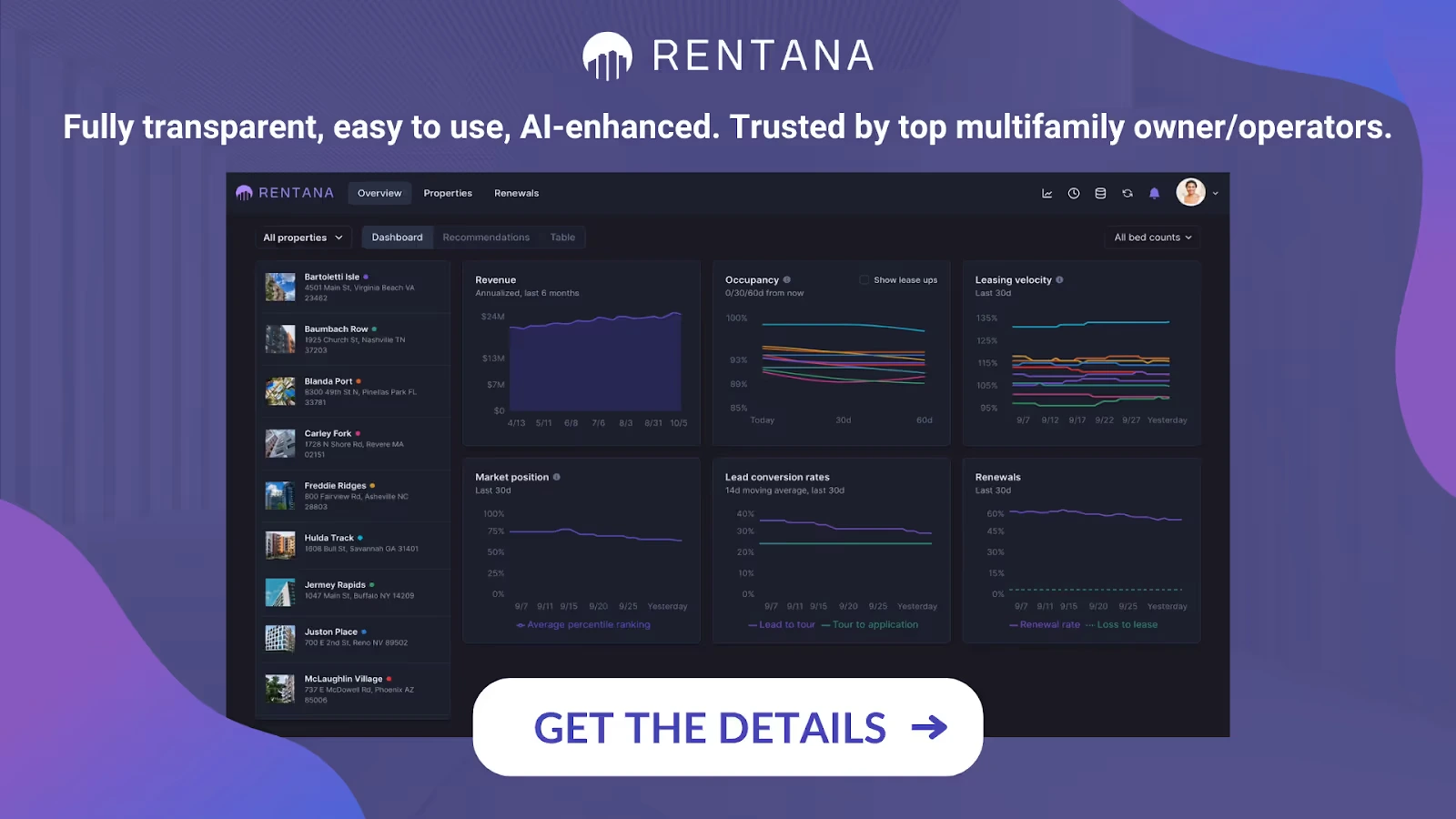
Rentana's portfolio dashboard gives every stakeholder a shared, current view of pricing performance and forward signals across the full portfolio. Leasing teams see the context behind current pricing.
Asset managers see how pricing strategy aligns with predicted occupancy and forward exposure. Ownership sees portfolio-level performance indicators without requiring a separate reporting process.
When pricing visibility is shared across teams, coordination between leasing activity, pricing strategy, marketing response, and asset management becomes more aligned operationally rather than functioning through disconnected sequential workflows. That shared visibility helps reduce delays between changing conditions and coordinated operational response across teams.
For multifamily operators evaluating multifamily pricing tools, the bar is clear. The right tool should make the next pricing decision faster, more specific, better connected to the forward picture, and easier to explain to everyone who needs to understand it. Rentana is built to meet that bar across every asset type, every strategy, and every team level involved in making pricing decisions well.
Related:
- AI Adoption in Multifamily: Top Trends for Operators
- How to Manage a Multifamily Portfolio Smarter
Conclusion on Multifamily Pricing Tool
Multifamily pricing has become too operationally complex for static comp reviews and broad property-level adjustments to consistently support effective decision-making on their own. Unit-level demand conditions, forward availability, expiration concentration, renewal behavior, and asset strategy objectives all need to be evaluated together within a connected operational framework rather than through isolated reporting workflows.
The most effective multifamily pricing tools are not the ones attempting to automate pricing decisions entirely. They are the ones that help teams evaluate operational conditions more clearly, understand how current decisions connect to forward portfolio performance, and coordinate pricing strategy across leasing, revenue management, and asset management workflows more effectively.
That is the operational standard worth evaluating before implementing any multifamily pricing platform across a portfolio where pricing decisions continuously compound over time.