
Every multifamily report says the same thing in different ways.
Supply is rising. Demand is shifting. Rent growth is slowing or stabilizing depending on where you look.
Most people read that and move on.
But those trends don’t live in reports. They show up in very specific ways across properties and portfolios. A layout that used to lease in a week now takes two. Renewals that felt predictable start to get inconsistent. A few months on the calendar start to carry more lease expirations and move-outs than expected.
Nothing dramatic at first. Just small changes. That’s how most market shifts start.
The gap is not awareness at the market level. Most operators already know what is happening in broad terms. The gap is connecting those shifts to what needs to change across properties and at the portfolio level. at the property level.
Should pricing move? Is demand actually slowing or just shifting? Is this a leasing issue or a timing issue?
Those are the decisions that sit underneath market trends.
And they are not answered by reports alone.
The teams that stay ahead are not just watching the market. They are watching how market conditions are translating into leasing activity, renewals, adn availability across their portfolio, and adjusting as those patterns start to form.
That is why multifamily market trends are useful.
Related:
- The Best AI Solution for Multifamily Operators
- AI Adoption in Multifamily: Why it's Accelerating So Fast
Why Multifamily Market Trends Matter for Portfolio Performance
Most investors and operators already follow market trends.
They read reports, track headlines, and stay updated on supply, demand, and rent patterns. That part is not the challenge.
The challenge is what happens next.
Because trends are only useful when they influence decisions.
A shift in supply is not just something to note. It affects how layouts compete for demand. A change in renter behavior is not just interesting. It shows up in how quickly units lease and which floorplans perform. Rent growth patterns are not just market commentary. They influence how pricing needs to be approached in real time and across leasing cycles.
These trends feed directly into operations.
Leasing velocity starts to change. Some layouts move faster than others. Renewal decisions become less predictable. Availability builds in certain months without much warning. These are the ways market trends show up inside a portfolio.
Timing is what determines the outcome.
If a trend is recognized early, there is room to adjust. Pricing can be reviewed. Leasing strategy can shift. Marketing efforts can be redirected toward layouts that need demand. Renewal and resident retention strategies can be refined to manage future availability. Exposure can be managed before it becomes a problem.
If it is recognized late, the options become more limited. Decisions become reactive, often after performance has already started to move.
This is why market trends matter at the portfolio level.
Not because they provide context, but because they directly shape pricing, leasing, and exposure decisions that drive performance.
The Multifamily Market Trends Shaping Performance Today
1. Supply and New Deliveries
New supply has been one of the biggest forces shaping multifamily performance.
Recent data shows that vacancy rates rose to 4.9% as new deliveries outpaced demand in multiple markets.
That number matters because it tells you something very specific.
More supply does not just increase vacancy. It changes how leasing behaves.
When more units hit the market at the same time:
- Prospects have more options
- Leasing timelines stretch
- Layouts that would normally move quickly may start to sit
So if you’re seeing leasing slow down, it is not always a property issue. It can be a supply timing issue. That distinction changes how you respond.
2. Demand Shifts and Renter Behavior
Demand is still there, but it is behaving differently.
CBRE notes that multifamily demand remains strong and continues to support occupancy across many markets.
The key is how that demand is showing up.
It is no longer evenly distributed across layouts and price points.
You may see:
- One-bedroom layouts leasing quickly while two-bedrooms lag
- Strong lead volume but inconsistent conversion
- More sensitivity to pricing at certain levels
That tells you demand has not disappeared. It has become more selective.
For operators, this becomes a targeting and alignment problem, not a demand problem.
3. Rent Growth Patterns
Rent growth has started to level out in many markets, but performance is increasingly driven by how revenue is distributed across layouts and unit features.
According to CBRE, rent growth has slowed as new supply continues to be absorbed.
This does not reduce the importance of pricing.
It means pricing becomes more precise.
In a high-growth environment, broad pricing strategies can still work. In a slower growth environment:
- Some layouts will still lease at current levels
- Others may require adjustment to maintain pace
You start to see more variation within the same property.
That is where pricing decisions need to be more closely tied to how layouts and specific unit features are performing.
In many cases, this extends beyond base rents. Differences in finishes views, or amenities can influence leasing velocity, and small adjustments to how those premiums are positions can impact overall performance.
4. Leasing Activity and Seasonality
Leasing activity remains seasonal, but the timing and intensity of those patterns are becoming less predictable.
Industry research from sources like CBRE and NAA shows that leasing activity typically peaks in spring and early summer, with slower periods towards the end of the year. What matters is how you interpret that as conditions evolve.
A slowdown in leasing toward the end of the year is expected. But if it happens earlier than usual, or more sharply, that could signal something else.
On the flip side, strong leasing in what is typically a slower period might indicate demand shifting forward.
Without context, seasonality can lead to incorrect assumptions.
With context, it becomes a useful signal for:
- planning availability exposure
- pacing leasing activity
- aligning pricing with changing demand windows
These patterns are not just calendar-based expectations.
They show up in how layouts move, how pricing performs, and how availability builds. When viewed in context, they help teams recognize when demand is shifting earlier or later than expected and adjust strategy before those changes impact performance.
5. Conversion and Leasing Efficiency
Leasing conversion is becoming a more important performance signal across multifamily portfolios.
In many markets, demand remains present, but it does not translate into leases as consistently as it has in the past.
You may see:
- High lead volume with lower-than-expected application rates
- Strong tour activity with fewer completed leases
- Longer decision timelines from prospects
This does not always indicate a lack of demand. It often reflects friction in the leasing process or a misalignment between pricing, expectations, and availability.
For example, a property may generate consistent traffic, but if conversion from tour to application declines, leasing velocity will still slow.
That makes conversion a key operational layer of market trends, not just an internal performance metric.
These multifamily market trends are not just market observations. They show up in how layouts move, how prospects make decisions, and how availability builds. The more clearly you understand where conversion is breaking down, the easier it becomes to decide whether adjustments are needed in pricing, leasing execution, or how demand is being directed across layouts.
6. Renewal Behavior and Retention Pressure
Renewal patterns are becoming less predictable as market conditions shift.
In stable conditions, renewal conversion tends to follow consistent patterns. As supply increases and pricing sensitivity changes, that consistency starts to break down.
You may see:
- More variability in renewal acceptance across properties
- Greater sensitivity to pricing at renewal
- Different behavior across layouts and price points
This is not just a retention issue. It is a forward-looking supply signal.
When renewal conversion declines, more layouts return to the market at the same time. That increases future availability and changes how leasing and pricing need to be managed.
Renewals are one of the earliest indicators of how market conditions are affecting resident decisions.
Read Also:
- Multifamily Asset Management: A Complete Guide for Asset Managers
- Multifamily Portfolio Analytics: Complete Guide for Investors
How Multifamily Market Trends Show Up in Day-to-Day Operations

Multifamily market trends do not show up all at once. They appear as small changes across leasing, renewals, pricing, and availability that build over time.
At the portfolio level, these signals are not just observations. They help identify where conditions are shifting, what is driving those changes, and where to focus first.
1. Leasing Velocity Slowing or Accelerating
Leasing velocity is often the first signal that market conditions are starting to shift.
When demand is strong or supply is limited, units move quickly. Tours convert, and days on market stay low. When conditions shift, this is where you feel it first.
For example, a layout that used to lease within 7 to 10 days may start taking closer to 15 to 20 days. That change might seem small, but across a property or portfolio, it adds up quickly.
This shift is rarely isolated. It can reflect changes in supply, demand or how pricing is being received.
For example:
- A slower leasing pace across multiple properties in the same submarket may point to new supply entering at the same time.
- A slowdown concentrated in specific layouts may indicate demand shifting across unit types or price points.
- A drop in velocity without a change in traffic may signal that pricing is no longer aligned with current conditions.
The key is recognizing that these changes are not random. They are early indicators of how market conditions are impacting leasing performance.
2. Conversion Breakdown Across the Leasing Funnel
Conversion becomes most useful when you can see where it is breaking down.
At the property level, it is easy to look at overall conversion and assume performance is strong or weak. At the portfolio level, that is not enough. What matters is how demand is moving through each stage of the leasing funnel.
For example:
A property may show stable leasing velocity overall, but underlying conversion patterns can vary significantly across layouts or time periods.
Where those changes occur is what provides insight.
- A drop in lead-to-tour conversion may indicate that initial pricing or availability is not aligning with what prospects expect.
- A drop in tour-to-application conversion may point to issues with how layouts are being presented or how value is being communicated.
- A drop in application-to-lease conversion often reflects increased pricing sensitivity or hesitation at the final decision stage.
These patterns do not show up in aggregate metrics alone. They require looking at how demand progresses step by step.
At the portfolio level, this helps explain why two properties with similar traffic can produce very different leasing outcomes. It also highlights where adjustments are needed, whether in pricing, leasing execution, or how demand is being directed across layouts..
3. Renewal Behavior as a Forward Signal
Renewals are one of the earliest indicators of how market conditions are shifting beneath current occupancy.
When conditions are stable, renewal decisions tend to follow predictable patterns. When renters have more options or become more price-sensitive, those patterns start to shift.
You might notice:
- Changes in renewal acceptance rates across properties or unit types
- More variability in decision timing
Differences in behavior across layouts or price points For example, if renewal acceptance drops even slightly across a few properties, that can translate into a larger number of units returning to the market over the next few months.
That is not just a retention issue. It directly increases future availability and changes how leasing and pricing need to be managed.
The timing of these shifts is what makes them important. A decline in renewal conversion today does not immediately impact occupancy, but it increases the volume of layouts that will need to be leased in upcoming months.
At the portfolio level, this creates forward pressure that may not yet be visible in headline metrics, but will affect leasing pace, pricing decisions, and exposure if not addressed early.
4. Availability and Exposure Timing
Availability rarely builds evenly across time.
Multifamily market trends often show up as timing imbalances. Certain months start to carry more exposure than others, sometimes without being obvious at first.
For example:
- a cluster of move-outs may begin to concentrate in specific months
- Renewal patterns may shift, increasing the number of units returning to market at the same time
- new supply may be delivered during the same leasing window
Individually, these do not stand out. Together, they create pressure.
This is how a portfolio can move from stable to exposed within a short window. Leasing teams suddenly need to fill more units at once, often in a more competitive environment.What matters is not just how much availability exists, but when it is concentrated.
A portfolio with steady overall occupancy can still experience pressure if a large share of expirations, move-outs, or deliveries align within the same period.
At the portfolio level, this creates defined windows where leasing performance, pricing strategy, and demand generation need to work together more precisely.
5. Pricing Performance Across Layouts
Pricing rarely shifts evenly across layouts within a property.
Market trends tend to affect unit types differently. One floorplan may continue leasing steadily, while another slows down under the same pricing approach.
For example:
- smaller units may continue to lease steadily while larger layouts begin to slowly stay in demand while larger ones lag
- certain price points may see more resistance than others
- similar layouts may perform differently depending on timing, availability, and specific unit features
This variation is where pricing performance becomes a signal.
If layouts are not leasing at the expected pace, it often reflects how pricing is being received under current market conditions.
In many cases, this extends beyond base rent. Differences in finishes, views, or amenity access can influence leasing velocity, and how those premiums are positioned can impact performance across similar layouts.
At the portfolio level, these differences help identify where pricing is aligned with demand and where adjustments may be needed to maintain leasing pace without applying broad changes across all layouts.
These operational signals are where multifamily market trends become tangible.
They show up in how quickly layouts move, how consistently demand converts, how renewal decisions evolve, and how availability builds across time.
Watching these signals together allows teams to identify changes early, understand what is driving them, and respond while conditions are still manageable.
Read Also:
- Multifamily Marketing Strategies that Actually Drive Leasing
- Rental Pricing Software for Multifamily Real Estate
Why Portfolio-Level Interpretation Matters
Multifamily market trends rarely impact every property in the same way.
Two assets in the same city can behave very differently at the same time. One may be leasing steadily, while another slows down. One may see strong renewal activity, while another starts to experience more move-outs. High-level market trends alone do not capture that variation.
That is where portfolio-level interpretation becomes important.
Instead of asking “what is happening in the market,” the more relevant question becomes “where and how is this showing up across my portfolio?”
For example, a broader supply increase might affect newer properties more than stabilized ones. Demand may remain strong overall but shift toward specific price points or layouts. Rent growth may slow at the market level while certain assets continue to perform well.
This is not uncommon. Vacancy rates can vary widely across markets and asset classes even within the same cycle, reflecting how local conditions and property characteristics influence performance.
This variation is what makes portfolio-level interpretation necessary.
It helps you:
- Identify which properties are being affected first
- Understand where trends are concentrated
- Avoid making broad pricing or leasing decisions based on average performance
Without that view, it becomes easier to overcorrect in some areas while missing where attention is actually needed.
Portfolio-level interpretation brings direction to multifamily market trends.
It connects what is happening externally with how it is showing up internally, across properties, layouts, and timelines. That is what makes trends actionable, guiding where to focus and how to respond across the portfolio.
How Operators Adjust Strategy Based on Multifamily Trends
1. Aligning Pricing With Asset Strategy and Current Conditions
Pricing decisions are one of the primary ways operators respond to changing market conditions.
How pricing is adjusted depends on the strategy defined for the asset, not just what is happening in the market. Asset goals, such as occupancy targets and leasing timelines, establish the direction for pricing decisions.
From there, performance, forecasted availability, and publicly available market conditions provide context for how pricing should respond.
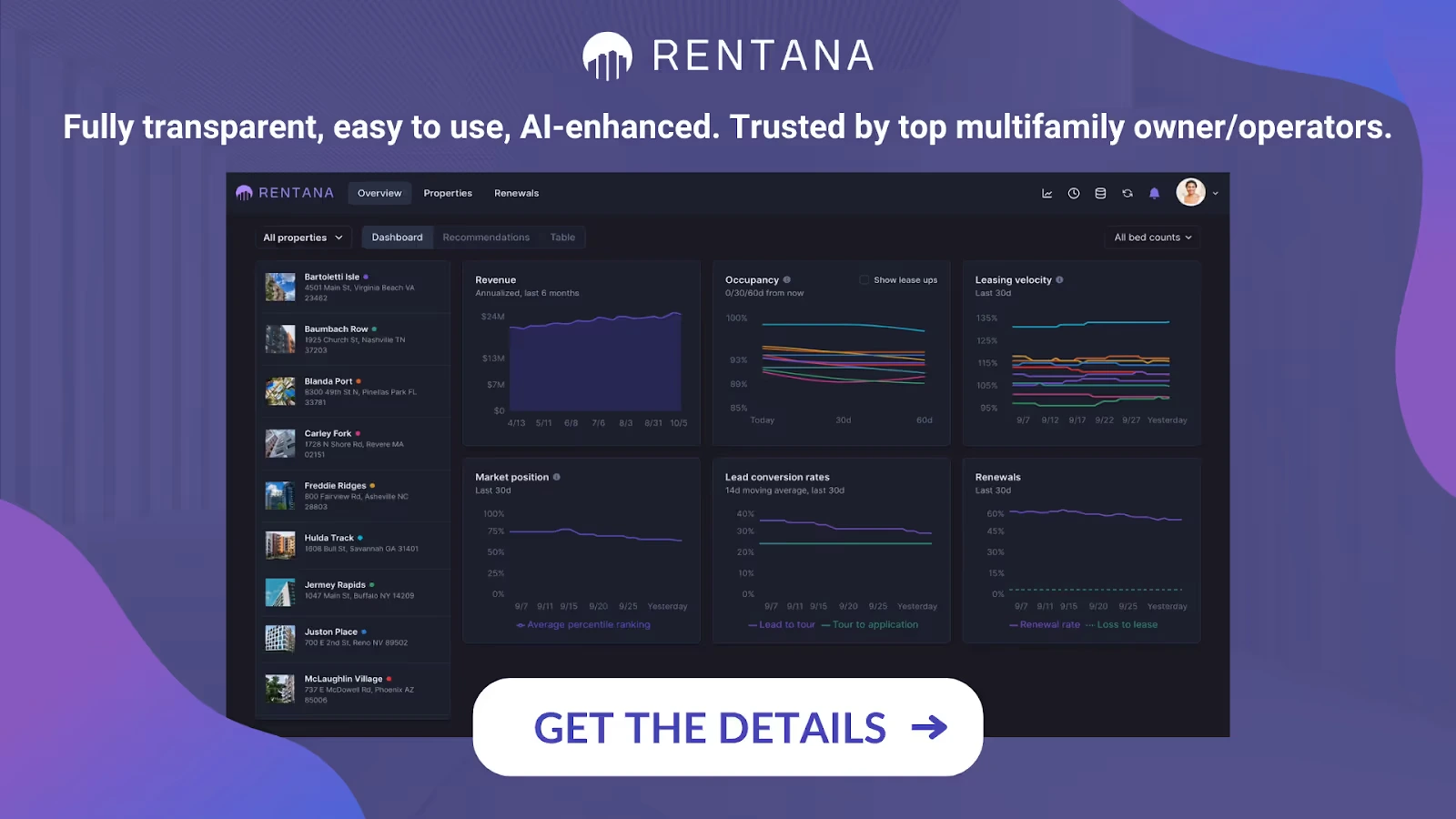
Rentana brings these inputs together by combining asset goals, current leasing performance, predicted availability, and publicly available market data. This allows pricing recommendations to reflect how conditions are changing, adjusting the magnitude of changes while remaining aligned with the strategy defined by the asset.
Instead of applying broad adjustments, pricing can be updated in a way that stays consistent with asset strategy while responding to real-time conditions.
2. Layout-Level Pricing and Feature Sensitivity
Pricing decisions are not applied evenly across layouts within a property.
Demand does not move uniformly. It shifts across layouts, price points, and unit features, often within the same property.
For example, one floorplan may continue leasing steadily at current pricing, while another begins to slow under the same conditions. That difference is what drives the need for more precise pricing at the layout level.
With Rentana, pricing is typically applied at the floorplan level, with the ability to group unit-types based on asset strategy. Performance signals, such as leasing velocity and demand response, help identify where pricing is aligned and where adjustments may be needed.
This also extends beyond base rent. Differences in finishes, views, or amenity access can influence how layouts perform, even when they are otherwise similar.
By incorporating these signals, pricing adjustments can reflect how demand is responding across layouts and features, rather than applying a single approach across the entire property.
3. Managing Exposure and Future Availability
Market conditions influence not just how layouts lease today, but when availability returns to the market.
Without active management, lease expirations can become concentrated within short timeframes, creating periods where a large number of layouts need to be leased at once. This increases pressure on pricing, leasing pace, and demand generation, especially in more competitive conditions.
Proactive exposure management focuses on shaping that timing in advance rather than reacting after availability builds.
With Rentana, this is supported through exposure forecasting and predicted availability. By combining current occupancy, known move-outs, renewal behavior, and leasing trends, operators can see how availability is expected to build across future months before it becomes visible in headline metrics.
This forward view allows teams to identify where exposure is concentrating and adjust lease structure and pricing accordingly. Term-based pricing can be used to influence when layouts return to market, helping distribute availability more evenly across time.
At the portfolio level, this approach helps reduce concentration risk, align leasing pace with expected demand, and support more stable pricing decisions as conditions evolve.
Related: The Best Real Estate Forecasting Software for Investors
4. Turning Property Performance Signals Into Action
Across a portfolio, performance is constantly shifting. Leasing pace changes, conversion strengthens or weakens, pricing response evolves, and future availability begins to take shape.
The challenge is not seeing these changes. It is understanding which ones matter and how they impact the asset strategy.
Rentana’s AI-generated insights are designed to surface those shifts as they happen. They highlight what is changing across leasing activity, conversion, pricing response, renewal behavior, and predicted availability, and connect those changes back to performance against targets.
Instead of reviewing metrics in isolation, teams are presented with a clear view of where a property is outperforming, where risk is building, and where conditions are moving out of alignment.
These insights also provide guidance on how to respond. Whether that is maintaining pricing discipline, adjusting lease structure, or focusing leasing efforts on specific layouts, the goal is to bring attention to the actions that will keep performance aligned with the asset strategy.
At the portfolio level, this creates a consistent way to interpret performance across properties, so decisions are based on the same signals and can be made more quickly as conditions evolve.
Related:
- How to Use AI to Generate Property Performance Reports, in Minutes
- How to Accurately Conduct a Property Performance Review
5. Aligning Teams Around Shared Signals
Adjusting strategy requires coordination across teams. Pricing, leasing, and marketing decisions are all influenced by the same underlying signals, but they are often interpreted differently across functions.
Leasing teams focus on tours and conversion. Marketing focuses on lead volume and campaign performance. Asset managers focus on occupancy, pricing, and portfolio outcomes. Each view is valid, but without alignment, decisions can move in different directions.
For example, marketing may continue driving traffic toward layouts that are already leasing well, while others begin to slow. Leasing teams may prioritize volume over conversion. Pricing adjustments may not reflect how demand is actually performing across layouts.
Shared visibility helps bring these perspectives together.
With Rentana, portfolio dashboards and performance signals provide a consistent view across teams. Leasing velocity, conversion, pricing response, and predicted availability are visible in one place, so decisions are based on the same understanding of what is happening.
This allows teams to align around where demand is strongest, where it is weakening, and where availability needs support. Marketing can shift focus toward layouts that need demand. Leasing teams can adjust how they prioritize tours and follow-up. Pricing can stay aligned with how conditions are evolving.
At the portfolio level, this alignment helps ensure that decisions across pricing, leasing, and marketing support the same objective, keeping performance consistent as market conditions change.
Conclusion
Multifamily market trends are only useful if they lead to better decisions.
Across a multifamily portfolio, leasing activity, conversion, pricing response, renewals, and availability are all shifting at the same time. The challenge is not tracking these changes. It is understanding how they connect and deciding where to act first.
The signals are there early. Leasing slows in specific layouts. Conversion patterns shift. Renewal behavior changes. Availability begins to concentrate in certain months. These are the indicators that performance is moving, often before it shows up in occupancy or financial results.
Operators who stay close to these signals are able to respond with more precision. Pricing stays aligned with demand. Leasing efforts are directed where they are needed. Exposure is managed before it creates pressure.
Rentana supports this by bringing performance signals together across the portfolio. Leasing velocity, conversion, pricing response, predicted availability, and exposure are visible in one place, helping teams interpret what is changing and take action with a shared understanding.
Over time, that clarity makes a difference. It allows teams to focus on what matters, adjust as conditions evolve, and keep portfolio performance aligned with the market.