

If you manage an apartment property, unit turnover is one of those costs that's easy to underestimate until you actually sit down and do the math. Every time a tenant moves out, you're looking at cleaning, repairs, marketing, leasing commissions, and weeks of lost rent while the unit sits vacant. It adds up fast, and for most properties, reducing turnover is one of the quickest ways to improve the bottom line.
But before you can improve your turnover rate, you need to know what it actually is. A lot of landlords and property managers have a general sense that turnover is "high" or "low" without ever putting a precise number to it. That's a problem, because without a clear metric you have no baseline to measure against, no way to track improvement, and no data to bring to an owner or investor conversation.
Calculating your unit turnover rate is simpler than most people expect. Once you know the formula and understand what the number is telling you, it becomes one of the most useful tools you have for managing a property efficiently.
This guide walks through exactly how to do it, with real examples, industry benchmarks, and practical steps for bringing your turnover rate down.
Related:
- House Hacking in Real Estate: A Complete Guide
- Rent Roll in Real Estate: A Complete Guide
What Is Unit Turnover Rate and Why Does It Matter?
Unit turnover rate is a metric that measures how frequently rental units change hands over a given period of time. It tells you what percentage of your units were vacated and re-rented within a specific timeframe, usually a year. The higher the rate, the more often tenants are leaving and the more time and money you're spending to replace them.
It sounds like a simple number, and mathematically it is. But what it represents is far from simple. A high turnover rate is rarely just an inconvenience. It's a signal that something isn't working, whether that's the quality of the units, the rent pricing, the management experience, or the tenant screening process. A low turnover rate, on the other hand, is one of the clearest signs of a well-run property with tenants who want to stay.
Why Turnover Is More Expensive Than Most Landlords Realize
The direct costs of turnover are obvious: cleaning, paint, repairs, and the cost of advertising the vacant unit. But the indirect costs are just as significant and much easier to overlook.
Lost rent during the vacancy period is usually the biggest single cost. If a unit sits vacant for 30 days at $1,500 per month, that's $1,500 gone before you've spent a dollar on repairs or marketing. Add in leasing fees, which can run anywhere from half a month to a full month's rent depending on your market, and the total cost of a single turnover can easily reach $3,000 to $5,000 or more on a mid-range unit.
Multiply that across multiple units in a year and the financial impact becomes very clear very quickly. For a 50-unit property with a 40% annual turnover rate, you could be looking at 20 turnovers per year. At an average cost of $3,500 per turnover, that's $70,000 a year in turnover-related expenses, money that could otherwise flow straight to the bottom line.
What Turnover Rate Tells Investors and Owners
Beyond the day-to-day operational impact, unit turnover rate is a metric that investors and asset managers pay close attention to when evaluating a property's performance. A property with consistently high turnover raises questions about tenant quality, management effectiveness, and the sustainability of the income stream.
When you're presenting a property's financials to an owner or preparing for a refinance or sale, being able to show a declining turnover rate over time is a strong indicator of improving operational performance. It tells the story of a property that's getting better, not just one that's generating revenue.
How Turnover Rate Fits Into the Bigger Picture
Unit turnover rate doesn't exist in isolation. It connects directly to other key metrics like occupancy rate, net operating income, and tenant retention rate. A rising turnover rate will almost always show up as downward pressure on occupancy and income, while a falling turnover rate tends to correlate with stronger cash flow and more predictable operations.
Tracking turnover rate alongside these other metrics gives you a much clearer picture of how a property is actually performing, and where the biggest opportunities for improvement are.
Read Also:
- 9 Tenant Retention Strategies that Improve Multifamily NOI
- What is OCR in Real Estate?
How to Calculate Unit Turnover Rate Step by Step
The formula for calculating unit turnover rate is straightforward. Here's a clear walkthrough of the formula with examples at different property sizes.
The Formula
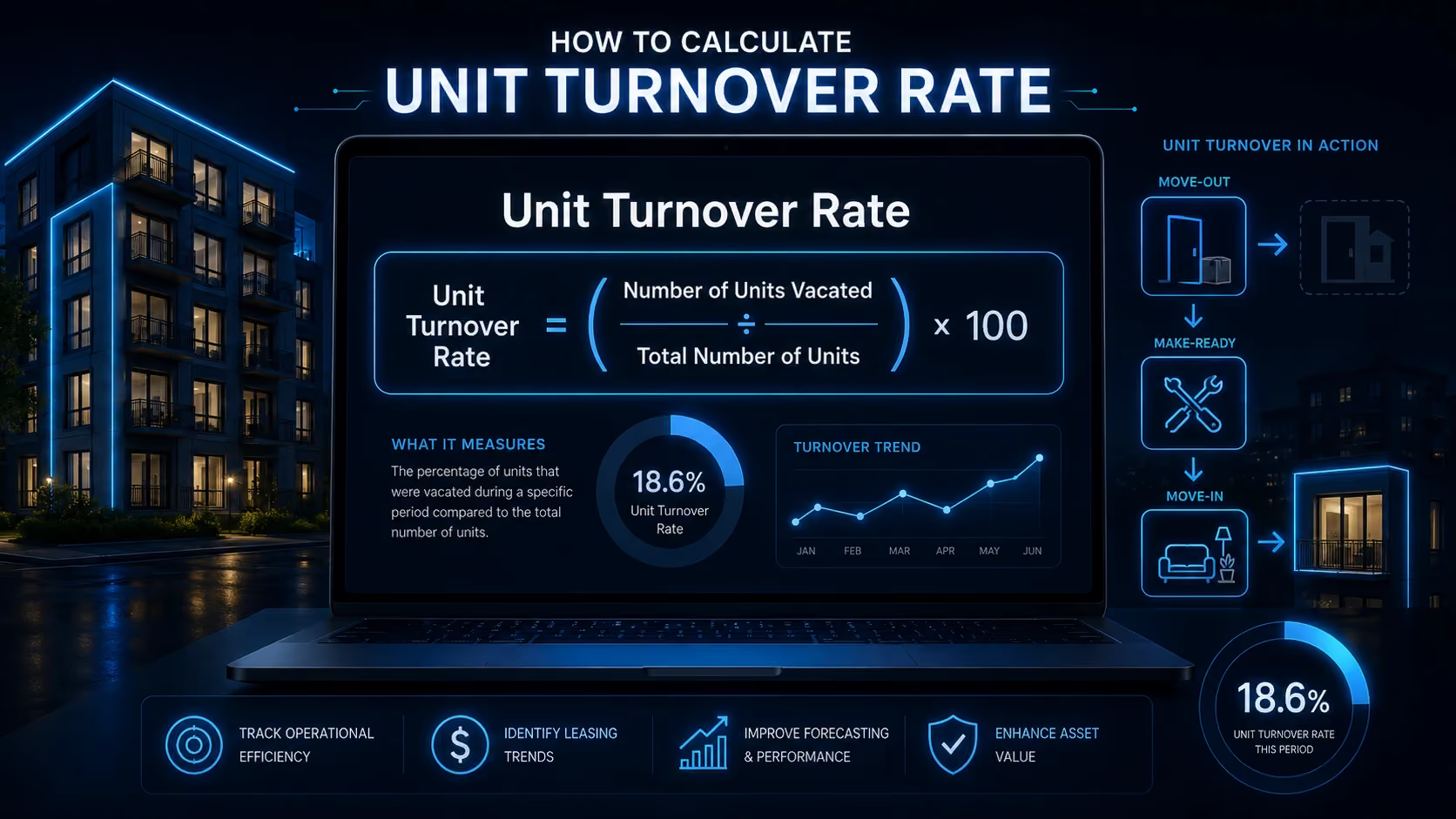
The basic unit turnover rate formula is:
Unit Turnover Rate = (Number of Units Vacated ÷ Total Number of Units) x 100
The result gives you a percentage that represents how many of your units turned over during a specific period, usually a calendar year or a fiscal year.
Tracking Turnover Rate Over Time
A single turnover rate calculation is useful, but the real value comes from tracking it consistently over time. Set up a simple spreadsheet that logs your monthly or quarterly vacancies alongside your total unit count, and calculate the rolling annual turnover rate at the end of each quarter.
Over time, that data will show you whether turnover is improving, worsening, or staying flat, and it will help you connect any operational changes you make to actual movement in the metric. If you implemented a lease renewal incentive program in Q2 and your turnover rate dropped in Q3 and Q4, that's a data point worth knowing and worth sharing with ownership.
Related:
- 1031 Exchange in Real Estate, Explained
- 1033 Exchange in Real Estate, Fully Explained
What Is a Good Unit Turnover Rate and How Does Yours Compare?
Knowing your turnover rate is one thing. Knowing whether it's good, bad, or somewhere in between is another. Context matters a lot here. A 30% turnover rate might be completely normal for one property type and a serious red flag for another. Here's how to benchmark your number against industry standards and interpret what it's actually telling you.
The national average annual apartment turnover rate in the United States hovers around 47% to 50%, according to data from the National Apartment Association. That means roughly half of all apartment tenants move out every year across the industry as a whole.
That said, the national average is a blunt instrument. Your more useful benchmark is the typical turnover rate for your specific property type and market.
These are general ranges, and actual rates vary by market, management quality, and local economic conditions. A Class B property in a high-demand urban market might see lower turnover than one in a slower secondary market simply because tenants have fewer affordable alternatives nearby.
What a High Turnover Rate Is Telling You
A turnover rate that sits consistently above the benchmark for your property type is worth taking seriously. It rarely has a single cause. More often it's a combination of factors that together make tenants less likely to renew.
Common drivers of high turnover include rent prices that are out of step with the market, slow or unresponsive maintenance, poor communication from management, unit quality that doesn't match tenant expectations, and weak tenant screening that results in short-term or unreliable tenants cycling through the property.
High turnover in a specific unit or floor plan can also point to a localized issue, a noisy neighbor, a persistent maintenance problem, or a layout that's harder to rent than others. Tracking turnover at the unit level rather than just the property level gives you a much sharper view of where the real problems are.
What a Low Turnover Rate Is Telling You
A turnover rate well below the benchmark for your property type is generally a strong sign. It suggests tenants are satisfied enough with their living experience to keep renewing, which is the most direct measure of how well a property is being managed.
Low turnover also has a compounding financial benefit. Every lease renewal is a turnover that didn't happen, which means no vacancy loss, no make-ready costs, no leasing fees, and no time spent finding a replacement tenant. Over time, a property with consistently low turnover builds a more stable and predictable income stream than one where half the units are cycling every year.
That said, an unusually low turnover rate can occasionally be a warning sign of a different kind. If rents are significantly below market and tenants are staying because they know they have a deal, the property may be leaving substantial income on the table. Low turnover combined with below-market rents is a common finding in value-add acquisitions, and it's one of the first things an experienced investor will look for.
How to Use Your Turnover Rate as a Management Tool
The real power of tracking turnover rate comes from using it as an ongoing management signal rather than an annual report card. When turnover starts creeping up, it's an early warning that something is changing on the property, whether that's a shift in the local rental market, a management issue, or a physical condition problem that's starting to affect tenant satisfaction.
Setting a target turnover rate for your property and reviewing it quarterly gives you a clear performance benchmark to manage against. If you're running a Class B property and your turnover rate is sitting at 60% when the benchmark is 40% to 55%, you have a specific, quantifiable gap to close and a clear direction for where to focus your operational energy.
Related:
How to Reduce Unit Turnover Rate and Keep Good Tenants Longer
Calculating and benchmarking your turnover rate tells you where you stand. This section is about what to do about it. Most of the strategies that meaningfully reduce turnover come down to one thing: making tenants feel like staying is worth more than leaving. Here's how to do that systematically.
1. Start with Better Tenant Screening
The easiest turnover to prevent is the one that starts with the wrong tenant. A tenant who was never a good fit for the property, whether financially, behaviorally, or in terms of lifestyle, is far more likely to leave early, get evicted, or cause problems that push other good tenants out.
Tightening your screening criteria won't eliminate turnover, but it will reduce the share of short-term tenants cycling through your property. Look beyond credit scores and income verification. Check rental history carefully, talk to previous landlords, and pay attention to how applicants communicate during the application process. A tenant who is disorganized, slow to respond, or evasive during the application stage rarely improves once they move in.
2. Be Proactive About Maintenance
Nothing drives a good tenant out faster than feeling like their maintenance requests disappear into a black hole. A leaking faucet that takes three weeks to fix, an HVAC unit that gets patched instead of replaced, or a common area that's been in disrepair for months sends a clear message: management doesn't care. And tenants who feel that way don't renew.
Flipping that dynamic is one of the highest-return investments a property manager can make. Set clear response time standards for maintenance requests, communicate proactively when a repair is going to take longer than expected, and do periodic unit inspections to catch issues before tenants have to report them. Tenants who feel taken care of are tenants who stay.
3. Start the Renewal Conversation Early
Most property managers wait until 60 days before lease expiration to think about renewal. That's too late. By the time a tenant is 60 days out, many have already started looking at other options, toured competing properties, and mentally committed to leaving. Starting the renewal conversation at 90 to 120 days gives you a meaningful window to retain them before the decision is effectively made.
Reach out personally, not just with a form letter. Ask how things are going, address any outstanding concerns, and present the renewal offer in a way that feels like a conversation rather than a transaction. A tenant who feels valued is far more likely to sign another lease than one who gets a boilerplate renewal notice in the mail.
4. Use Renewal Incentives Strategically
Sometimes a tenant is on the fence about renewing, and a well-timed incentive can tip the decision in your favor. Renewal incentives don't have to be expensive to be effective. A free carpet cleaning, a small rent concession for signing early, a unit upgrade like new appliances or fresh paint, or even just a gift card as a thank-you for renewing can make a meaningful difference in how a tenant feels about staying.
The key is to offer incentives before the tenant has already decided to leave, not as a last-ditch attempt to change their mind after they've given notice. Build renewal incentives into your standard operating process rather than treating them as an emergency measure.
5. Price Rent Increases Carefully
Rent increases are one of the most common triggers for tenant turnover, and one of the most mismanaged. A large, unexpected rent increase at renewal time is a reliable way to lose good tenants who might otherwise have stayed for years.
That doesn't mean you shouldn't raise rents. It means you should do it thoughtfully. Keep increases modest and predictable, communicate them early, and make sure they're in line with what comparable units in the market are actually renting for. A tenant who understands that a 4% increase reflects market conditions is much easier to retain than one who feels blindsided by a 15% jump with no explanation.
If market conditions genuinely require a significant increase, give the tenant as much notice as possible and be transparent about the reasoning. Tenants who feel respected, even when they're not thrilled about a rent increase, are more likely to stay than ones who feel like they're just being squeezed.
6. Build a Community Worth Staying In
This one is harder to quantify but easier to feel. Properties where neighbors know each other, where management is visible and approachable, and where living there feels like more than just a transaction tend to have lower turnover than properties where tenants feel anonymous and disconnected.
Small things make a difference here. A welcome note when a new tenant moves in, a seasonal event that gives residents a chance to meet each other, a management team that remembers names and follows up on concerns. None of these are expensive, but together they create an environment where tenants feel a sense of belonging that's genuinely hard to replicate somewhere else.
7. Track Turnover by Unit and by Reason
Finally, make sure you're capturing data on why tenants are leaving, not just that they're leaving. Every move-out should come with a simple exit survey or a brief conversation that helps you understand the reason behind the decision.
Over time, that data will reveal patterns that aggregate turnover numbers can't show you. If a disproportionate number of tenants in a specific building or floor plan are citing noise as their reason for leaving, that's an actionable insight. If a large share of non-renewals happen right after rent increases, that tells you something specific about how your pricing strategy is landing with tenants.
Tracking turnover at the unit level and by reason turns a lagging metric into a leading one, giving you the information you need to get ahead of retention problems before they show up in your annual numbers.
Related:
- What is a Short Sale in Real Estate?
- Contingent vs Pending: What’s the Real Difference?
Conclusion on How to Calculate Unit Turn Over Rate
Unit turnover rate is one of those metrics that looks simple on the surface but carries a lot of weight underneath. A single percentage point improvement across a 100-unit property can translate into tens of thousands of dollars in saved turnover costs every year. That's not a rounding error. That's real money that flows directly to the bottom line.
The math is the easy part. The harder part is building the operational habits that actually move the number: screening tenants carefully, staying on top of maintenance, starting renewal conversations early, and pricing rent increases in a way that keeps good tenants from walking out the door.
Most properties that struggle with high turnover aren't dealing with one big problem. They're dealing with several small ones that add up over time. Tracking your turnover rate consistently, benchmarking it against comparable properties, and digging into the reasons behind each move-out gives you the visibility to find those problems before they compound.
If you've never formally calculated your unit turnover rate before, start there. Run the numbers for the past 12 months, compare them to the benchmarks for your property type, and let that gap, or the lack of one, tell you where to focus next.


